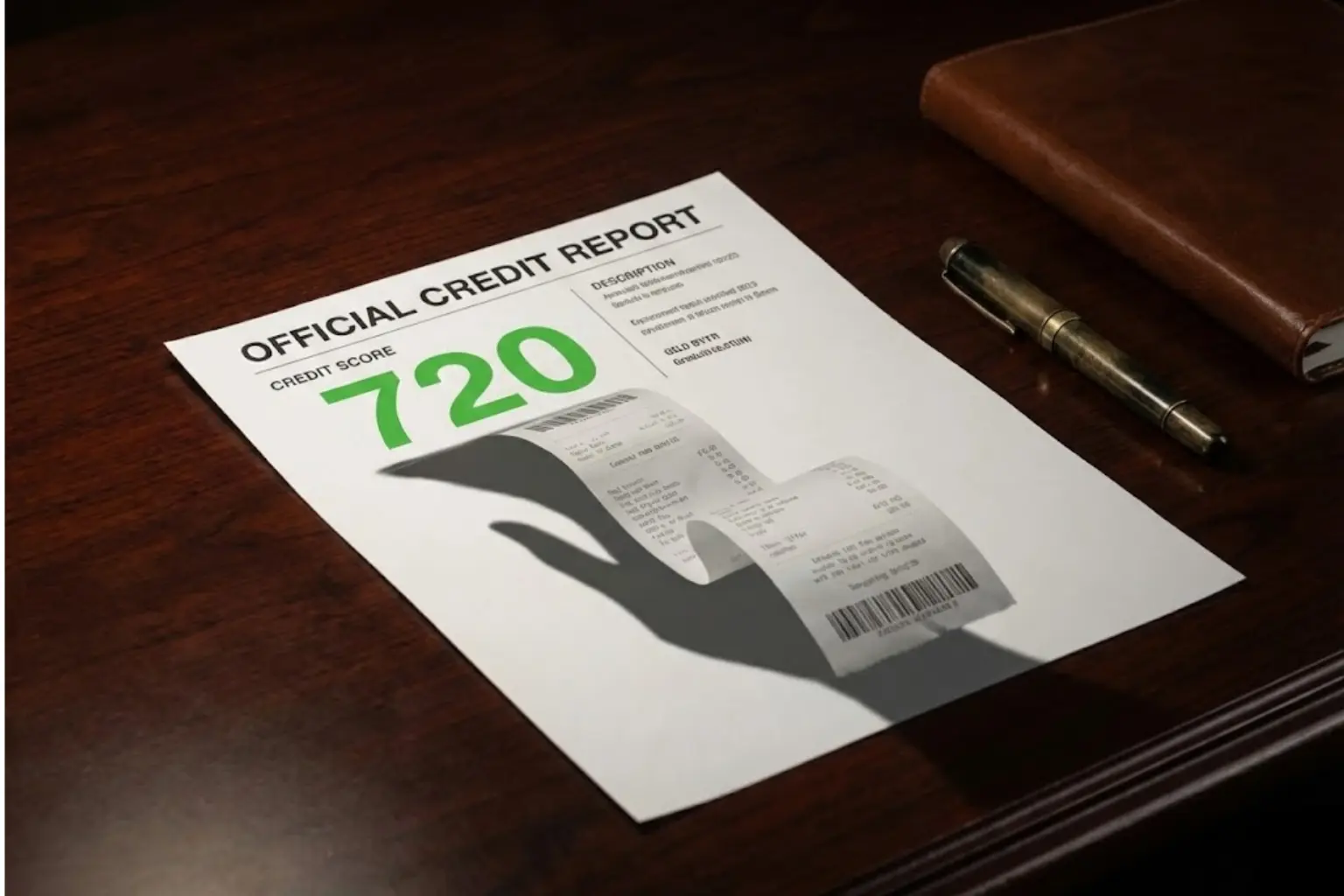
You wear your 800 credit score like a badge of honor, believing it proves financial success. But to a bank, that number doesn’t mean you are rich. It means you are a highly efficient host for their product.
Welcome to the 800-Point Paradox the dangerous confusion between being good at borrowing money and being good at owning it.
The truth is stark: a credit score is an interaction metric, not a wealth metric. It measures your obedience to the lending system, not your net worth.
By obsessing over this number, high earners often fall into the credit float, using high limits to mask a dangerous lack of true liquidity. You are optimizing your ability to be a customer rather than an owner.
- The Obedience Metric: Your credit score does not measure your net worth or your cash flow. It strictly measures your profitability to the banking system as a reliable borrower.
- The Utilization Trap: Obsessing over thirty percent utilization keeps you constantly using debt. True wealth is zero percent utilization, but the algorithm penalizes you for stepping away from the game entirely.
- The Points Distraction: Chasing credit card rewards often leads to silent inflation where you quietly spend twenty percent more to earn two percent back.
- The Post-Credit Goal: The highest form of financial independence is not an eight hundred fifty score. It is becoming credit invisible because you have enough assets to be your own bank.
The Gamification of Debt
The credit score is the ultimate gamification of personal finance. By turning debt management into a game with points, levels, and rewards, banks have convinced consumers to engage with products they might otherwise avoid.
When you check your score and see it drop by five points, you feel a visceral pang of failure. When it rises, you feel a dopamine hit of success. This emotional coupling keeps you hyper-focused on your debt profile rather than your asset profile.
Consider the behavior this encourages. You might keep a credit card debt january balance open just to show activity. You might open a new card you do not need just to increase your total available credit.
And you are making financial decisions based on an algorithm’s rules, not your own financial best interest. This behavior feeds the golden handcuffs phenomenon.
You are maintaining a pristine reputation as a borrower so that you can borrow more to fund a lifestyle that requires you to keep borrowing. It is a perfect, self-reinforcing loop of servitude.
Financial Metrics That actually Matter: The Borrower vs. The Owner
This comparison highlights the difference between the Credit Score mindset optimizing for debt and the Wealth mindset optimizing for ownership.
| Metric | The 800-Score Chaser | The Wealth Builder | The Result |
|---|---|---|---|
| Primary Goal | Maximize credit limit | Maximize net worth | Leverage vs equity |
| View on Debt | Its a tool for points | Its a risk to cash flow | Behavioral shift |
| Spending Driver | Hitting bonus tiers | Needs and value | Efficiency |
| Emergency Plan | Ill use my credit card | I have cash savings | Emergency fund |
| End Game | Infinite borrowing power | Zero need to borrow | Freedom |
Source: Investozora Wealth Strategy Analysis 2026, contrasting typical consumer credit behaviors with high-net-worth asset management strategies outlined by the Consumer Financial Protection Bureau.
What the Score Actually Measures
It is critical to deconstruct what goes into the FICO score calculation. The largest factors are payment history and amounts owed. Notice what is missing from this formula. Your income is not included. Your savings rate is not included.
And your investment portfolio is not included. You could have a million dollars in a brokerage account and a low credit score. You could have zero dollars in savings and a perfect credit score.
This misalignment creates a dangerous blind spot. By focusing on the score, you are focusing on the rearview mirror. The score looks at your past behavior with debt.
It tells you nothing about your future solvency. This is why the phantom debt bnpl crisis is so risky. Buy Now, Pay Later services often do not report to bureaus, meaning your score remains high even as your actual financial foundation crumbles.
You can be technically bankrupt but still look like a prime borrower on paper. This is the essence of the illiquidity trap. You look rich to the bank, but you are actually broke in reality.
The Opportunity Cost of Points
The most sophisticated trap within the credit score paradox is the rewards system. High scorers are targeted with premium cards offering travel points, cash back, and lounge access.
These perks are framed as free money for the financially savvy. However, credit card companies are not charities. The rewards are funded by merchant fees and, more importantly, by the behavioral shift in spending that plastic induces.
Studies show that consumers spend significantly more when using credit versus cash. The friction of parting with physical money is gone.
When you are chasing a sign-up bonus or trying to hit a spending tier, you justify purchases you would otherwise skip.
You might convince yourself that you are beating the system by getting 3% cash back, but if you spent 15% more to get it, you have lost. This creates a great downgrade in your wealth efficiency. You are trading dollars of principal for pennies of rewards.
The Transition to Post-Credit Wealth
The goal of a wealth builder should not be to optimize their credit score forever. The goal should be to render the score irrelevant. This is the transition to Post-Credit wealth.
In this stage, you are no longer asking a bank for permission to buy a car or a home. You are using your own capital. When you are your own bank, you do not care what Experian thinks of you.
This transition requires a mindset shift. It means stopping the endless cycle of opening best 0 apr balance transfer credit cards to shuffle debt around.
It means focusing intensely on increasing your emergency fund amount and your investment capability. The most liberated financial state is not having an 850 score with a $4,000 monthly mortgage payment.
It is having a 0 score with a paid-off house and a seven-figure portfolio. The bank cannot profit from you anymore, and that is the only score that truly matters.
The Bottom Line
A credit score is a useful tool, like a hammer. It allows you to build things, like buying a first home or qualifying for best personal loans U.S. in a pinch. But you should not worship the hammer. Do not confuse the tool with the house.
Use the score to get what you need, then focus on the real metrics of success: net worth, cash flow, and freedom. If you spend your life polishing your credit score, you will end up with a very shiny set of chains.
Methodology
This article analyzes the structural limitations of the FICO scoring model as a proxy for financial health. It contrasts Creditworthiness the ability to repay debt with Solvency the possession of assets to demonstrate how high-income earners can be trapped in a cycle of debt dependency despite having perfect credit scores.
Investozora uses only trusted, verified sources. We focus on white papers, government sites, original data, firsthand reporting, and interviews with respected industry experts. When relevant, we also use research from reputable publishers. Every fact is checked against a primary source so readers get clear, accurate, and up-to-date information, and we update our citations whenever official guidance changes.
- MyFICO (Credit Scoring Model) – Official FICO educational resource explaining how credit scores are calculated, weighted, and evaluated by lenders.
- Consumer Financial Protection Bureau (Credit Reports & Scores) – Federal consumer guidance on credit reports, credit scores, dispute rights, and how lenders use credit data.
Frequently Asked Questions
Author