


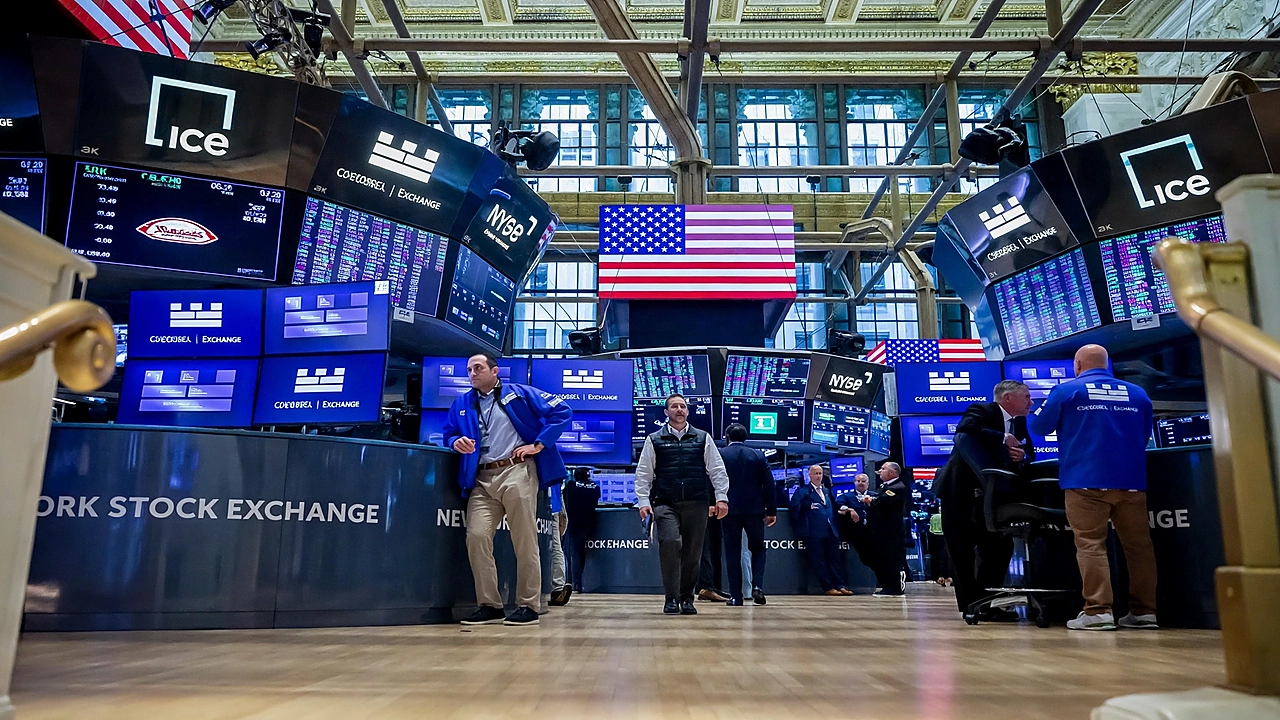
Wall Street was set for a quiet start Wednesday after the Nasdaq Composite closed at a second straight record high, with Nasdaq-100 futures showing little movement before the opening bell. At 5:25 a.m. ET, Nasdaq-100 E-minis were up 1.75 points, or 0.01%, while S&P 500 E-minis gained 0.09% and Dow futures rose 0.06%, according to Reuters’ September 23 futures report. The futures reading is a premarket snapshot, not a confirmed cash-market opening level.
Tuesday’s Nasdaq Composite close was 27,244.28, up 0.45%, while the index reached an intraday record of 27,288.79, according to Nasdaq’s index record. That extended the technology-led rebound covered in Investozora’s Monday Nasdaq report, when the index jumped 1.62% and AMD crossed a $1 trillion market value.
The key change Wednesday is the shift from a powerful rally to consolidation near the high. The Nasdaq gained 122.19 points Tuesday after advancing 599.55 points Monday. Reuters described Tuesday’s close as the second consecutive record, with chip stocks and broader enthusiasm around artificial intelligence helping sustain the move.
One measure that makes the setup notable is Treasury yields. The U.S. Treasury’s official daily par yield curve shows the 10-year Treasury rate at 4.96% on September 22, compared with 4.89% on September 21, a seven-basis-point increase in one session.
The Nasdaq’s record close therefore came even as long-term Treasury yields moved higher, an important cross-market tension for investors tracking technology valuations. Investozora previously examined that rate backdrop in its 10-year Treasury yield coverage.
The broader market was less uniform than the Nasdaq headline suggests. The S&P 500 finished essentially flat Tuesday, while the Dow fell 0.36% and the S&P 500 financial sector dropped 1.68%. JPMorgan Chase and Wells Fargo both lost more than 3%. The divergence means the record Nasdaq close did not represent an across-the-board advance.
Oil is another part of Wednesday’s market setup. Brent crude was at $98.47 a barrel and West Texas Intermediate at $89.31 as of 6:51 a.m. GMT, according to Reuters, with both benchmarks heading for a sixth consecutive session of declines.
The move reflects improving supply expectations and hopes for diplomatic progress in the Middle East, but it does not establish that the underlying supply risks have been resolved. Investozora has tracked this development in its earlier oil and Saudi export coverage.
Markets are also watching the U.S.-China diplomatic calendar. The White House says Chinese President Xi Jinping is due to arrive Wednesday, with a state visit to the White House scheduled for Thursday. Reuters said investors are watching the visit for developments involving the existing trade truce and technology policy.
The final major test comes from economic and Federal Reserve signals. The Fed raised its target range by a quarter point to 3.75%–4% on September 16. Governor Michael Barr is scheduled to speak at 10:05 a.m. ET Wednesday, according to the Fed’s official calendar, while a fresh September business-activity reading is due later in the morning.
For now, the clearest signal is restraint rather than another breakout: Nasdaq-100 futures were nearly unchanged after a record Nasdaq Composite close. The next move will depend on how investors absorb Treasury yields, oil prices, economic data and policy developments rather than on the futures indication alone.
