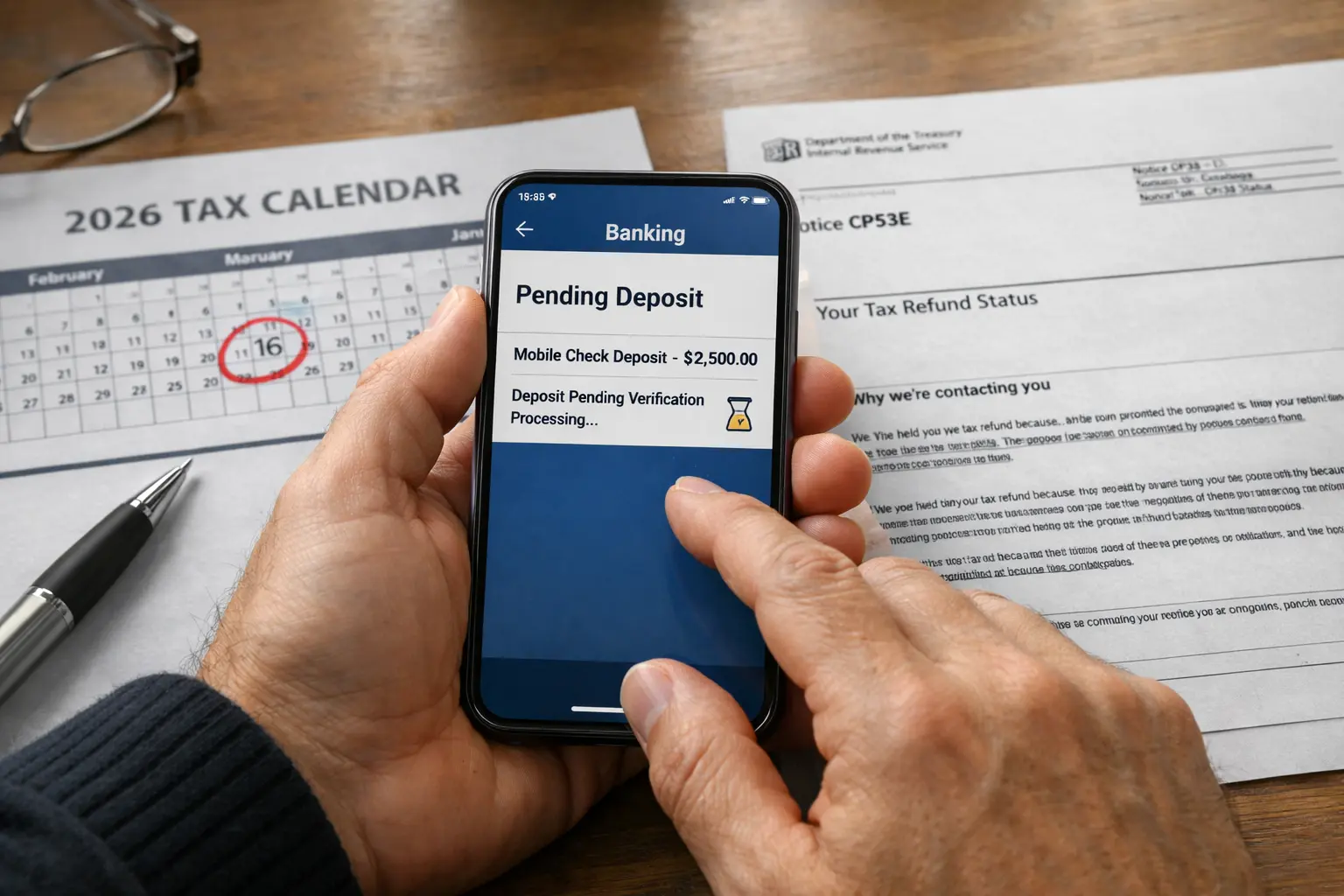
At 6:47 AM, the kitchen light hums on. Two phones sit beside two coffee mugs. One balance has already jumped. The other remains unchanged. Both payments were released yesterday evening. Both originated from the same federal source. Yet only one household can see the money.
This difference often gets explained as bank speed. In reality, it reflects each institution’s final posting window, a structural decision built around liquidity risk, settlement sequencing, and exposure controls rather than when money was sent. What feels like delay is usually deliberate system design.
Why posting speed is a risk policy, not a transmission issue
Once federal payments, payroll files, or refunds enter the clearing ecosystem, they move through standardized rails. The money does not travel separately for each customer. Banks receive settlement signals in coordinated batches. What changes is when institutions feel safe making balances visible.
Some banks release funds as soon as clearing before posting confirmation appears. Others wait for deeper settlement certainty. The distinction is not technical ability. It is exposure tolerance. Early visibility increases short-term liquidity risk. Later visibility reduces it. Posting strategy becomes a balance sheet decision.
Early-posting institutions and intraday liquidity buffering
Banks that post earlier rely on internal liquidity cushions. They maintain excess reserves specifically to absorb institutional exposure controls during unsettled periods. When ACH batches finish overnight, these banks front provisional credit. The ledger updates before full interbank settlement completes.
This approach assumes expected settlement completion, minimal return risk, and predictable federal payment reliability. Liquidity buffers temporarily cover any mismatch. These institutions treat early posting risk as a manageable factor supported by capital planning. The money is not fully settled yet. But the bank is willing to carry that short exposure.
Late-posting institutions and settlement certainty prioritization
Other banks operate on confirmation-first logic. They wait until clearing queues reconcile, reserve balances verify, and interbank settlement completes. Only then do they update customer ledgers. This reduces risk of reversals. It eliminates provisional exposure.
It protects overnight liquidity ratios. From a system view, this is conservative balance sheet management. Funds are already in motion. Visibility is intentionally delayed. Not because processing is slow. Because confirmation matters more than speed.
Clearing queues and transaction hierarchy
Inside clearing systems, not all transactions reconcile simultaneously. Files move through priority layers. Federal benefit batches often process before commercial payroll. High-volume institutional flows settle before smaller originations.
Queue hierarchy determines which transactions reconcile first, when banks receive usable settlement confirmation, and which ledgers can safely update. Two payments released together may clear at different sequence levels. Banks positioned to front credit ignore this nuance. Banks waiting for full reconciliation must respect it. This posting timing gaps shift can move visibility by hours.
The national 8:00–9:00 AM posting cluster
Across the U.S. banking system, most visibility occurs between 8:00 and 9:00 AM local time. This window aligns with multiple structural events including ACH overnight batch completion, core banking ledger synchronization, morning reserve account verification, and interbank settlement readiness.
By this point, most clearing queues have reconciled, liquidity buffers have refreshed, and exposure metrics reset for the day. Even when funds arrived at 2:00 AM, many banks wait for this institutional checkpoint. It is not a customer schedule. It is a balance sheet safety reset.
Fedwire reopening and reserve balancing influence
Each morning, the Fedwire Funds Service reopens after its overnight pause. Banks rebalance reserve positions shortly afterward. This fedwire coordination moment confirms incoming settlement credits, outgoing obligations, and net liquidity availability.
Many institutions delay morning balance updates until this verification completes. Once reserves align, risk drops sharply. Only then does ledger release occur. This micro-timing explains why posting clusters after early morning infrastructure resets.
Structural transparency inside the payment system
The Federal Reserve publicly outlines how ACH settlement cycles, interbank settlement timing, and reserve account coordination operate across the system. Readers can review the official documentation directly through the appropriate U.S. government source. These processes exist to maintain systemic liquidity stability. Posting policies simply align around them.
How different philosophies shape customer experience
Early-posting banks optimize for immediacy by assuming settlement completion, absorbing short exposure, and prioritizing visibility. Late-posting banks optimize for certainty by confirming reserves, waiting for reconciliation, and releasing after risk clears.
Neither approach is faster or slower. Each reflects institutional risk design. To understand how this fits within the broader infrastructure, Investozora’s money movement system framework maps how funds sequence through the system. Posting is simply the final visibility step.
Why funds can be “there” but not visible
Settlement and posting are not the same event. Settlement moves money between banks. Posting updates customer ledgers. Between them sit clearing verification, reserve confirmation, and internal exposure controls. Many institutions insert deliberate delay during the evening settlement phase.
This protects capital. It reduces operational risk. It ensures regulatory liquidity ratios remain stable. Customers interpret this as slowness. In reality, it is precision. For deeper timing structure behind these sequences, Investozora’s analysis on settlement timing windows breaks down how confirmation windows influence availability.
Treasury and Federal operational coordination
U.S. Treasury payment releases coordinate directly with Federal Reserve settlement cycles. Disbursements enter clearing streams designed around liquidity control. The treasury release flow explains how funds distribute through banks while maintaining systemic stability.
Readers can review the official documentation directly through the appropriate U.S. government source. These controls ensure payment reliability across thousands of institutions. Posting policies align downstream.
Why posting differences will always exist
There is no single national posting rule. Each bank designs around capital reserves, risk appetite, liquidity forecasting, and operational exposure. Uniform speed would increase systemic risk. Controlled variability preserves stability. Some banks monetize early visibility as a service feature.
Others monetize safety through conservative liquidity management. Both models function within the same clearing infrastructure. For readers studying internal sequencing mechanics, the clearing system’s queue logic explains how transaction priority shapes confirmation flow. Posting simply follows these hierarchies.
Returning to the morning comparison
At 6:47 AM, nothing was wrong. Both payments had already entered the settlement stream. One bank chose to front visibility using liquidity buffers. The other waited for full reserve confirmation. Neither delayed transmission. Neither moved slower.
They followed different institutional risk philosophies. Early and late posting are not advantage or failure. They are structural choices inside America’s payment infrastructure, each designed to balance speed, certainty, and systemic stability.
Author