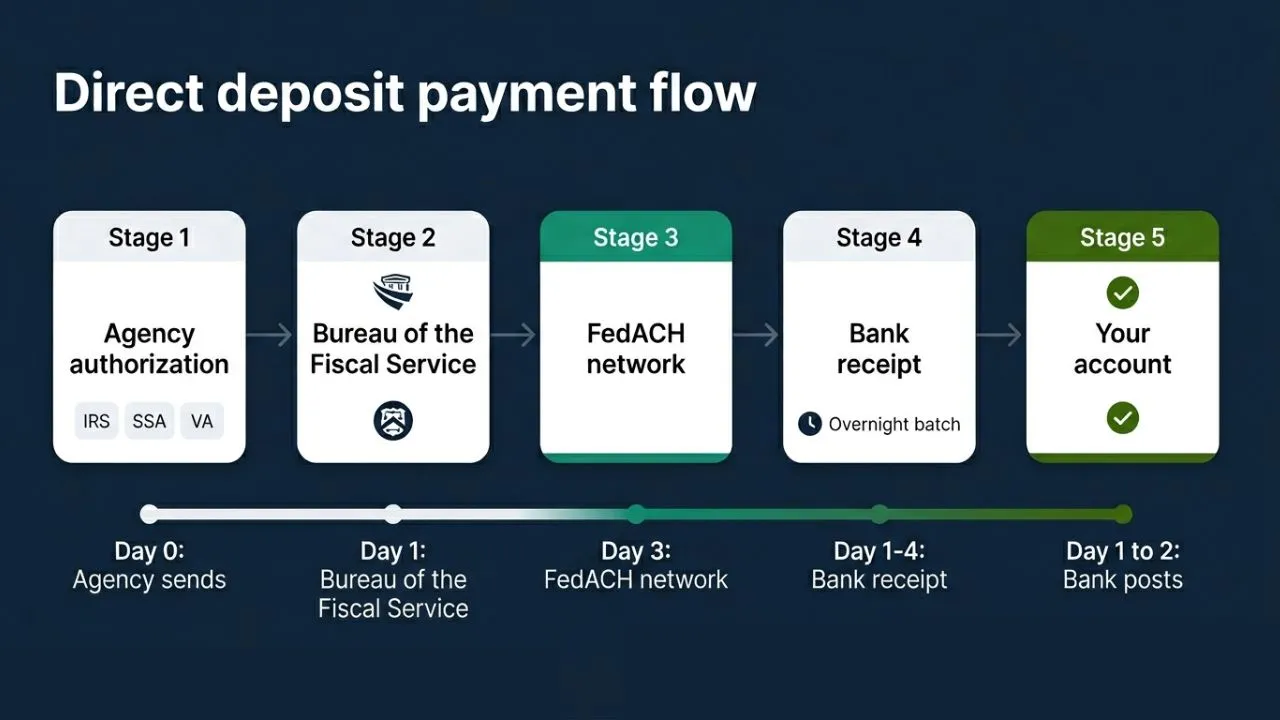
At 7:41 AM, a payroll deposit appears on a banking app. The amount shows in full. The available balance does not. For many households using early direct deposit, that short gap feels inconsistent.
It is not inconsistency. It is structured sequencing.
What looks like hesitation reflects a bank advancing funds before final reserve settlement. The visible deposit sits inside a narrow modeling window between file receipt and confirmed interbank transfer. Understanding that window requires moving past surface ACH explanations. The deeper layer sits in probability modeling, capital exposure, and liquidity forecasting performed before 9:00 AM.
File Receipt Is a Forecasting Event
When an ACH payroll file arrives overnight, it is not merely queued. It is scored. Each entry carries routing history, employer identification, settlement date, and trace numbers. Banks compare that file against historical behavior.
Payroll credits operate under ACH return rules defined by NACHA. Because return probabilities are low, banks can estimate expected loss with high confidence. Internal risk systems translate that data into institutional risk positioning limits.
The bank does not advance blindly. It advances within a capped aggregate exposure threshold. Readers can explore how these netting and settlement layers connect in the broader U.S. money movement framework. The provisional release decision rests directly on that structural base.
The 8:00–9:00 AM Conversion Window
The visible change between 8:00 and 9:00 AM Eastern Time marks more than a posting cycle. It marks reserve verification.
ACH credits and debits net across institutions overnight. Those net positions settle through the Federal Reserve’s National Settlement Service. Once NSS completes the scheduled cycle, reserve balances adjust across participating banks.
Before that confirmation, a provisional payroll credit remains an advance against expected reserve inflow. After confirmation, it becomes a true liquidity balance.
Fedwire liquidity timing intersects with this window. If projections show a shortfall in net position, treasury desks can move liquidity through the Fedwire Funds Service before final customer posting. The 8:17 AM balance update reflects the completion of multiple layers: ACH batch reconciliation, NSS reserve adjustments, and internal core synchronization.
Return Probability and Exposure Caps
Provisional credit introduces temporary credit risk. Banks model expected return exposure using historical payroll reliability and apply internal caps to the total amount advanced.
If exposure approaches a threshold, additional early credits may delay until settlement window timing completes. That policy explains why some institutions post at standard hours during heavy inflow days. This often results in funds showing as pending before clearing on the user’s screen.
Capital Buffers and Balance Sheet Impact
Advancing funds before settlement temporarily increases risk-weighted assets. Even if the exposure window lasts less than one hour, it exists.
Large banks with diversified capital bases absorb that exposure easily. Smaller banks may manage tighter buffers. Therefore, institutional size and capital ratio influence early posting behavior. If projected net outflows exceed high-quality liquid assets, treasury teams may adjust posting policies temporarily.
Predictive Payroll Recognition
Modern systems extend beyond static probability tables. Banks employ pattern recognition to forecast recurring payroll flows. If an employer transmits payroll every other Thursday, the bank anticipates that payroll file settlement before it arrives.
Federal payment streams operate under similar predictability. The Bureau of the Fiscal Service outlines transmission and disbursement coordination through Fiscal Service resources. When federal ACH files enter the stream, banks evaluate Treasury release timing to decide between immediate release or waiting for reserve confirmation.
Intraday Liquidity Positioning
Between 7:00 and 9:00 AM, treasury desks monitor reserve projections continuously. Incoming ACH credits increase expected balances, while outgoing activity reduces them. The institution must avoid daylight overdrafts at the Federal Reserve.
Early direct deposit therefore depends on synchronized forecasting. It requires confidence in return probability, capital capacity, and intraday liquidity access. This coordination provides the liquidity timing stability required for modern retail banking. This is also where same-day ACH timing can create additional narrow windows for liquidity management.
Back to the Morning Screen
At 8:26 AM, the balance refreshes. The funds become fully available. Nothing changed in the household’s financial reality during those minutes; the system simply completed its reconciliation sequence.
The earlier preview was not a promise without backing. It was a calculated advance grounded in statistical modeling and reserve forecasting. When early direct deposit appears before settlement, it reflects an institution willing to extend balance sheet liquidity within defined exposure caps. When it converts to collected funds, reserve confirmation closes the loop.
Author