April 2, 2026 • 3:30 AM ET
Most banks complete their overnight ACH posting cycle between midnight and 6 AM. If your balance still shows zero, check your bank app for a pending transaction and wait until 9 AM before taking any action.
It is early morning. You woke up expecting to see your paycheck, your IRS refund, or your Social Security payment in your account. Your balance shows zero. You check again. Still zero. Your first instinct is that something went wrong with the payment.
In the large majority of cases, nothing went wrong. The payment arrived at your bank hours ago. Your bank simply has not posted it to your account yet. Banks process incoming ACH deposits in scheduled batch cycles, and those cycles end at different times for different institutions.
The gap between when your bank receives the ACH file and when your balance reflects it can be anywhere from minutes to several hours, depending entirely on your bank’s internal posting schedule.
What You Need to Know Right Now
- A zero balance at 6 AM is almost always a bank posting schedule issue, not a payment problem. The ACH file may have already arrived at your bank. The bank simply has not posted it to your account yet.
- Banks post deposits on their own internal schedule, not the moment the ACH file arrives. Large national banks typically post between midnight and 6 AM. Regional banks and credit unions commonly post between 6 AM and 9 AM.
- A pending transaction in your bank app is a good sign, not a warning. Pending means the bank has received the ACH credit and will post it during the next scheduled posting window.
- Fintech apps like Chime and Varo sometimes post early. They recognize certain government and payroll originator codes and advance funds before the ACH settlement window technically closes.
- 9 AM on a business day is the action threshold. If no deposit and no pending transaction appears by 9 AM, it is time to call your bank, not the payment agency.
- Weekends and federal holidays shift every posting window forward. A deposit expected on a Friday that falls before a Monday holiday will not post until Tuesday morning at the earliest.
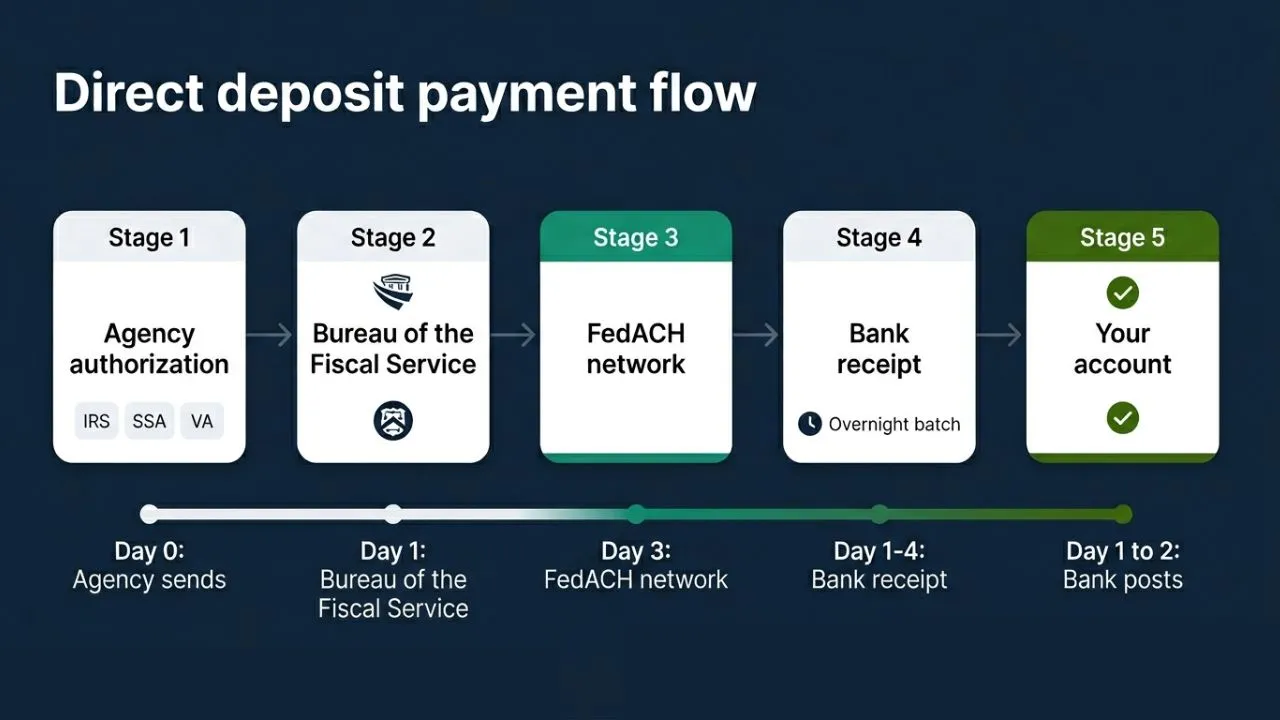
This guide explains exactly why early morning deposit delays happen, when each type of bank posts its ACH credits, what a pending transaction means for your deposit, and what to do if nothing has appeared by 9 AM. For a complete picture of how payments move from the federal government all the way to your bank account, see How the U.S. Money Movement System Works.
Why Your Deposit Has Not Appeared Yet This Morning
The ACH network delivers payment files to banks throughout the business day and evening. When your bank receives an ACH file containing your credit, it does not post that credit to your account immediately. It holds the file until its internal posting cycle runs.
The posting cycle is a scheduled batch operation, similar to how a payroll department cuts all checks on the same day rather than individually as each one is approved.
This means there are two separate events involved in every direct deposit: the moment the ACH file arrives at your bank, and the moment the bank posts the credit to your account.
The first event can happen at any time during the day or evening. The second event happens on a fixed schedule that your bank controls. The gap between those two events is the deposit delay you are experiencing this morning.
The payment is not lost. The payment is not frozen. The sending agency has done its part. The ACH network has done its part. Your bank has the file and will post it when its scheduled cycle runs. Understanding this distinction removes the anxiety from the early morning gap and tells you exactly when the money will appear.
The Federal Reserve’s FedACH service, which processes most federal government payments, runs multiple settlement windows throughout the business day. When those windows close, the files go to receiving banks for internal processing.
The full FedACH operating schedule is documented at federalreserve.gov. For a detailed explanation of how FedACH batch windows create gaps between sent status and posted status, see FedACH Settlement Delays Explained.
Bank Posting Schedules by Institution Type
No single posting schedule applies to all banks. The time at which your balance updates depends on the type of institution you bank with and how that institution has configured its internal ACH processing. The following windows reflect general industry patterns based on how ACH processing is structured across different institution types.
Large national banks including major institutions that serve tens of millions of customers typically run ACH posting cycles between midnight and 6 AM. These institutions process ACH files in multiple batches, meaning they may also post a second wave of credits between 8 AM and 9 AM for files received after their overnight cutoff.
If you bank with a large national institution, your deposit will most commonly appear when you check your phone in the early morning hours. A balance still showing zero at 5 AM may update before 6 AM as the overnight cycle completes its final runs.
| Institution Type | Typical ACH Posting Window | Early Posting Available? |
|---|---|---|
| Large National Banks | Midnight to 6 AM | Yes, some post by 3 AM |
| Regional and Community Banks | 6 AM to 9 AM | Rarely |
| Credit Unions | 6 AM to noon (varies widely) | Rarely |
| Fintech Apps (Chime, Varo, Current) | Up to 2 days early for recognized originators | Yes, for select payment types |
Regional and community banks typically run a single overnight posting cycle that completes later than large national banks, commonly between 6 AM and 9 AM. These institutions process smaller volumes and may not run the multiple intraday cycles that larger banks offer.
If you bank with a regional or community bank, a zero balance at 6 AM does not indicate a problem. Your posting window simply runs later than a national bank’s cycle. Check again after 9 AM before concluding the deposit is delayed.
Credit unions vary significantly in their posting schedules. Some credit unions process ACH credits in the same overnight window as large national banks. Others process once daily, with posting completing anywhere between 6 AM and noon depending on the institution’s size, systems, and ACH processor relationship.
If you bank with a credit union and experience early morning deposit delays regularly, call your credit union and ask specifically when they run their ACH posting cycle. Knowing the answer eliminates the guesswork for every future payment.
Fintech apps and neobanks including Chime, Varo, Current, and similar platforms operate differently from traditional banks. Many of these platforms monitor incoming ACH files for specific originator codes used by federal agencies and major payroll processors.
When they recognize these codes, they advance the funds to your available balance before the ACH settlement window technically closes. This is why many fintech account holders report seeing federal benefit deposits one to two days before the scheduled date.
However, this early posting behavior is not guaranteed for all payment types and does not apply to every originator. If your fintech app has not posted a payment by the expected date, it means the originator code was not recognized for early release and the standard ACH posting timeline applies.
The single most reliable way to know your bank’s exact posting schedule is to call the customer service number on the back of your debit card and ask directly: what time does the bank post incoming ACH direct deposits, and does the bank run a second posting window in the morning.
Recording that answer saves time on every future payment cycle. For a deeper breakdown of how the overnight batch system works and why different banks process at different times, see How Direct Deposits Process Overnight.
What Pending Means and Why It Is a Good Sign
If you open your bank app and see the word pending, processing, or available soon next to a transaction entry, that is confirmation that your deposit delay is already resolved at the system level.
Pending means your bank has received the ACH credit file, verified the entry, and accepted the funds. The credit is sitting in your bank’s internal queue and will move to your available balance when the next posting cycle runs.
A pending transaction is not a hold, a freeze, or a problem. It is a receipt confirmation. The money is at your bank. The bank has acknowledged it.
The only remaining step is the mechanical process of the posting cycle updating your balance. That process happens automatically on its scheduled timeline. You do not need to call anyone, visit a branch, or take any action.
The timing between a pending entry appearing and your balance updating depends on your bank’s posting schedule. If the pending entry appeared at 4 AM and your bank posts at 6 AM, your balance will update at 6 AM. If your bank does not run another posting cycle until 9 AM, the balance updates at 9 AM. In either case, the outcome is certain. The deposit is coming.
If your bank app shows a pending entry but also shows a $0 available balance, this reflects a standard distinction between your pending balance and your available balance.
Some banks display these as separate figures. Your available balance will match your total balance once the posting cycle posts the pending credit. This is normal display behavior, not a restriction on your account.
What You Should Do Now
A deposit delay before 9 AM on a business day almost never requires action. Work through these steps before making any calls.
Step 1: Check your bank app for a pending transaction right now. Look in every section of your banking app including pending, processing, and recent activity. If a pending entry exists for the expected amount, your deposit is confirmed at your bank and will post in the next cycle. Stop here. No action is needed.
Step 2: Identify your bank’s posting window. If you do not know when your bank posts ACH credits, check the bank’s help center or FAQ online. Search for the phrase “direct deposit posting time” combined with your bank’s name. Most major banks publish this information. If you cannot find it, call the number on the back of your card and ask.
Step 3: Wait until 9 AM on a business day before escalating. If no pending transaction is visible and it is before 9 AM, give the posting cycle time to complete. A zero balance at 7 AM at a regional bank or credit union is not a deposit delay in any meaningful sense. It is simply the gap before the posting window runs.
Step 4: If no pending transaction appears by 9 AM on the expected business day, call your bank. Ask the bank representative specifically whether an incoming ACH credit from the sending agency has been received for your account.
The bank can see incoming files even before they post. If the bank confirms an ACH credit is in the queue, no further action is needed. It will post in the next cycle.
Step 5: If your bank confirms no ACH file has been received by 9 AM, check the sending agency portal. For IRS refunds, go to irs.gov/refunds and check the current status and effective date.
For Social Security or SSI payments, log in to your account at ssa.gov/myaccount. If the portal shows a sent status with an effective date of today or yesterday and your bank has no record of the file, contact the agency and request a payment trace.
Step 6 (edge case): Check whether a weekend or federal holiday falls between the payment release date and today. The ACH network does not process on weekends or federal holidays. A payment released on Friday does not reach banks until Monday morning.
A Monday federal holiday pushes that to Tuesday. For a full explanation of how weekend timing affects every posting window, the Federal Payment Sent But Balance Zero guide covers every scenario in detail.
Conclusion
An early morning deposit delay is one of the most common and least serious payment situations a bank account holder encounters. The deposit delay you see at 6 AM is almost always a bank posting schedule event, not a payment problem. The ACH file arrived. Your bank has it. The posting cycle will update your balance when it runs.
Knowing your bank’s specific posting window transforms a stressful morning into a predictable wait. Large national banks post before 6 AM. Regional banks and credit unions typically post by 9 AM.
Fintech apps may post even earlier for recognized originators. In every case, the deposit delay resolves on its own as long as the payment was sent correctly and your bank account information on the payment is accurate.
What You Should Do Now
- Open your bank app and check the pending section right now before concluding anything is wrong. A pending entry ends the concern immediately.
- If no pending entry exists, identify your bank’s ACH posting window by checking their FAQ or calling customer service.
- Wait until 9 AM on the expected business day before making any calls to your bank or the sending agency.
- If 9 AM passes with no deposit and no pending entry, call your bank and ask specifically whether an ACH credit from the sending agency is in your account’s queue.
- If your bank confirms no file received, check the sending agency portal for the payment status and effective date, then contact the agency directly if the effective date has passed with no payment on record at your bank.
Editorial Note: Investozora is an independent news publication. This content is for informational purposes only. For official guidance, please visit the relevant .gov website.