April 1, 2026 • 1:15 AM ET
FedACH processes federal payment batches throughout the business day on weekdays only. If your deposit is pending and today is a business day, the next settlement window will clear it within hours without any action from you.
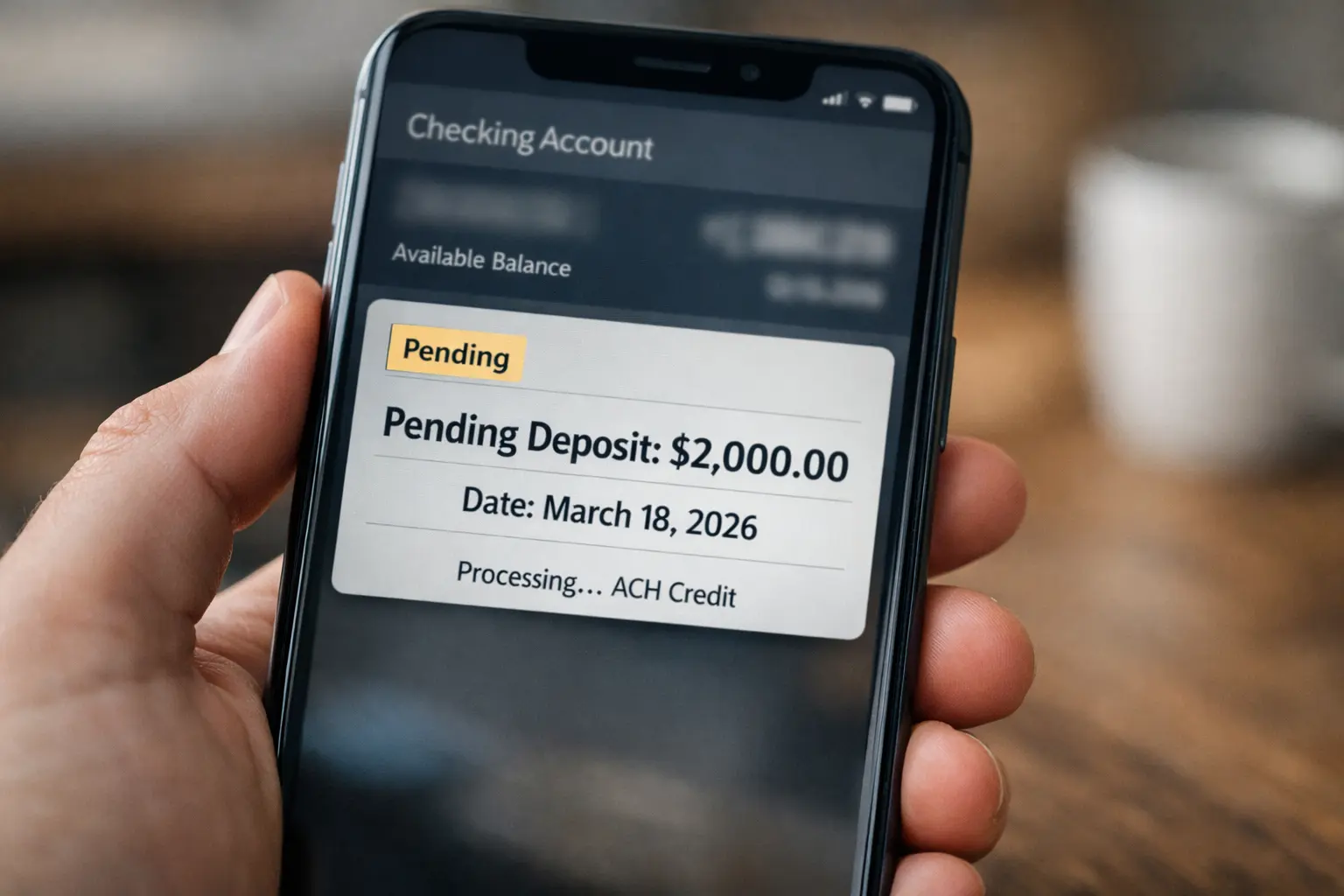
Your federal deposit shows sent in the agency portal. Your bank shows nothing, not even a pending transaction. You searched for answers and found references to FedACH. Now you want to know what FedACH actually is, whether it is responsible for your missing deposit, and what you can do about it.
FedACH processes more than 16 billion ACH payments per year on behalf of the Federal Reserve. It handles the large majority of all U.S. government benefit and tax payment disbursements.
When FedACH delays a batch, millions of recipients can feel it at the same time. When it operates normally, which is the overwhelming majority of the time, most federal deposits reach bank accounts within one business day of the Treasury release.
What You Need to Know Right Now
- FedACH is the Federal Reserve’s ACH service that processes the large majority of U.S. federal government payments, including IRS refunds, Social Security, VA disability, and SSI.
- FedACH processes in scheduled batch windows, not in real time. A payment submitted after one window closes waits for the next window, which creates a predictable gap between sent and posted.
- FedACH does not operate on weekends or federal holidays. A deposit released on Friday will not settle through FedACH until Monday morning at the earliest.
- System-wide FedACH delays are rare and self-resolving. When they occur, they affect all recipients equally and typically clear within 4 to 12 hours without any action required.
- A FedACH delay is not account-specific. Nothing you do with your bank or the sending agency will accelerate a batch processing delay at the ACH operator level.
- Two full business days with no pending entry is the threshold for action. Before that point, the delay is almost certainly within normal FedACH processing parameters.
This guide explains exactly what FedACH is, every reason it creates delays, how long each type of delay lasts, and what to do if your deposit has been stuck longer than expected. For a complete explanation of how all federal payments travel from agency to bank account, see How the U.S. Money Movement System Works.
What FedACH Is and How It Processes Federal Payments
FedACH is the Automated Clearing House service operated by the Federal Reserve Banks. It is one of two ACH operators in the United States. The other is the Electronic Payments Network, operated by The Clearing House, a private financial industry organization.
While both operators process ACH payments, FedACH handles the large majority of federal government disbursements, making it the critical infrastructure behind virtually every payment the U.S. government sends to individual recipients.



When the Bureau of the Fiscal Service at the U.S. Treasury releases a payment file, that file travels to FedACH. The file contains individual payment entries for every recipient in the batch, whether that is 200 Social Security recipients or 2 million IRS refund recipients.
FedACH does not process each entry the moment it arrives. It holds the file until the next scheduled batch settlement window, at which point it processes all entries in the queue, performs interbank settlement, and forwards each credit entry to the appropriate receiving bank.
This batch architecture is fundamental to understanding why a payment can show as sent in a government portal while your bank balance still shows zero. The payment has left the Treasury and entered the FedACH queue. It has not yet been processed through a settlement window.
The credit has not been forwarded to your bank. Your bank has not posted it to your account. Each of those steps takes time within FedACH’s operating schedule. Full technical details on FedACH operations and settlement windows are published by the Federal Reserve at federalreserve.gov.
The same batch window structure applies to every federal payment regardless of agency. IRS refunds, Social Security retirement benefits, SSI payments, VA disability compensation, and federal employee payroll all travel through FedACH on their way from the U.S. Treasury to individual bank accounts. Disbursement schedules for Treasury payments are published at fiscal.treasury.gov.
Why FedACH Causes Payment Delays
FedACH delays are almost always structural, meaning they result from the design of the batch processing system rather than from errors or account-specific problems. Understanding the specific causes helps you identify which type of delay you are experiencing.
Batch Window Timing
FedACH runs settlement windows at scheduled intervals throughout the business day. If the U.S. Treasury releases a payment file after the last window of the day has closed, that file waits in queue until the first window of the following business morning.
The payment is not lost or delayed in any unusual sense. It is simply in the queue for the next available processing opportunity. This is the most common cause of a one-day gap between a sent status and a bank deposit.
Federal Holiday Closures
FedACH observes all federal holidays and does not process ACH settlements on those days. If a payment file is released by Treasury on the day before a federal holiday, it cannot clear through FedACH until the next business day after the holiday. For a single-day holiday, this adds one business day to the timeline. For multi-day holiday periods, the gap extends accordingly.
Weekend Non-Processing
FedACH does not operate on Saturdays or Sundays. This is one of the most predictable and frequently misunderstood causes of deposit delays. A Treasury payment file released on Friday afternoon will not clear through FedACH until Monday morning. During that window, the payment shows as sent in every government portal, but your bank balance remains at zero because no ACH settlement has occurred. The deposit is not lost. It is waiting for Monday’s first settlement window.
System-Wide Processing Delays
On rare occasions, FedACH experiences technical issues or unusually high processing volumes that cause settlements to run later than the scheduled window. When this occurs, it affects all recipients whose payments are in the delayed batch simultaneously.
No individual recipient is singled out. These events are not announced in advance and are not visible through agency portals or bank apps. They typically resolve within 4 to 12 hours as FedACH catches up on the backlog.
High-Volume Tax Season Pressure
During peak IRS refund processing weeks in February, March, and April, FedACH handles a significantly larger volume of Treasury-originated payment files than in other periods.
This does not typically cause formal delays, but it can push the completion of certain settlement windows slightly later than usual, which in turn pushes some bank postings from the overnight window into the following morning’s second wave.
One critical point applies to every type of FedACH delay: individual action cannot speed up a batch processing delay at the ACH operator level. Calling your bank, calling the IRS, or calling the SSA will not accelerate a payment that is waiting in a FedACH queue.
The system processes on its own schedule. The only productive actions are to monitor your bank’s pending section and wait for the next settlement window to complete. For a detailed breakdown of how bank posting waves interact with FedACH settlement windows, see How Direct Deposits Process Overnight.
How Long FedACH Delays Typically Last
Most FedACH delays resolve far faster than recipients expect. The following timelines apply in virtually all cases.
Standard Batch Window Gap
If your payment missed a settlement window, it processes in the next window. FedACH runs multiple windows throughout the business day, so a missed afternoon window typically resolves by evening or the following morning’s first window. This type of delay lasts hours, not days.
Weekend Gap
A payment released on Friday clears on Monday morning. The delay lasts from Friday afternoon through Monday morning, which is two calendar days but zero additional processing time in terms of FedACH business operations. This is expected behavior, not a malfunction.
Federal Holiday Gap
A single-day federal holiday adds one business day. A holiday that extends a Friday weekend gap (for example, a Monday federal holiday) pushes the clearing date to Tuesday morning.
System-Wide FedACH Delay
When a technical event slows processing, resolution typically occurs within 4 to 12 hours. These events are self-resolving and do not require recipient action. By the following morning, the payment has almost always cleared and posted to receiving banks.
The two-business-day threshold is the practical decision point. If your payment shows as sent in the agency portal, and two full business days have passed with no deposit and no pending transaction visible in your bank app, the delay is likely no longer at the FedACH level.
At that point, the issue may be at the receiving bank, a Regulation CC hold, a direct deposit information mismatch, or a payment routing error. For a complete guide to why a sent payment has not reached your bank and what each cause means, see the Federal Payment Sent But Balance Zero guide.
What You Should Do Now
FedACH delays resolve on their own in the overwhelming majority of cases. Before taking any action, work through these steps in order.
Step 1: Check your bank app for a pending transaction. Look in the pending or processing section, not just your available balance. A pending entry means FedACH has settled the payment and your bank has received it. The credit is waiting for your bank’s next posting cycle. No further action is needed.
Step 2: Check the sending agency portal for the payment status and effective date. Log in to IRS Where’s My Refund at irs.gov/refunds for tax refunds. Log in to SSA my Social Security at ssa.gov for Social Security or SSI payments. Check VA.gov or eBenefits for VA disability.
If the portal shows sent, note the effective date. If that date is today or yesterday and no pending entry exists, the payment is likely in a FedACH batch window that has not yet cleared.
Step 3: Identify whether a weekend or federal holiday explains the gap. If the payment was released on a Friday or the day before a federal holiday, a one to three day gap is expected behavior. No action is needed. The deposit will clear on the next business morning.
Step 4: If it is a business day and more than 24 hours have passed since the sent status appeared, wait until the next morning. FedACH processes throughout the business day and overnight. A payment that has not posted by noon may clear in the evening batch or overnight cycle.
Step 5: If two full business days have passed with no deposit and no pending entry, contact your bank first. Ask whether an incoming ACH credit from the U.S. Treasury has been received and is being held. Get the name of the representative. Document the call with the date and time.
Step 6: If your bank has no record of any incoming credit, contact the sending agency. For Social Security: 1-800-772-1213. For IRS refunds: 1-800-829-1954. For VA payments: 1-800-827-1000.
For other federal payments: the Bureau of the Fiscal Service at 1-855-868-0151. If the agency confirms the payment was sent but your bank has no record, request a formal ACH payment trace to locate the funds.
Conclusion
A FedACH delay is one of the most common and least alarming reasons a federal deposit does not arrive on the expected day. The batch processing architecture means payments move on a schedule, and anything released after a window closes waits for the next one. Weekends and holidays extend that wait by design. System-wide events are rare and self-resolving within hours.
The key to navigating any FedACH situation is understanding that individual action does not accelerate batch settlement. Monitoring your pending section and applying the two-business-day rule as your action threshold keeps you informed without wasting time on calls that cannot change the outcome.
Your FedACH payment is moving through a tested, high-volume system. In nearly every case, it arrives without any intervention required.
What You Should Do Now
- Open your bank app and check the pending section right now. A pending entry means FedACH has already cleared your payment and your bank will post it in the next cycle.
- Log in to the relevant agency portal and confirm the sent date and effective date. If the effective date is today, wait until 9 AM before concluding the payment is delayed.
- Check whether a weekend or federal holiday falls between the sent date and today. If yes, the gap is expected and will resolve on the next business morning with no action needed.
- If two full business days have passed with no deposit and no pending entry, call your bank and ask specifically whether an ACH credit from the U.S. Treasury is being held on your account.
- If your bank confirms no incoming credit has been received after two business days, contact the sending agency using the helpline numbers above and request a formal FedACH payment trace.
Editorial Note: Investozora is an independent news publication. This content is for informational purposes only. For official guidance, please visit the relevant .gov website.