April 6, 2026 • 11:05 AM ET
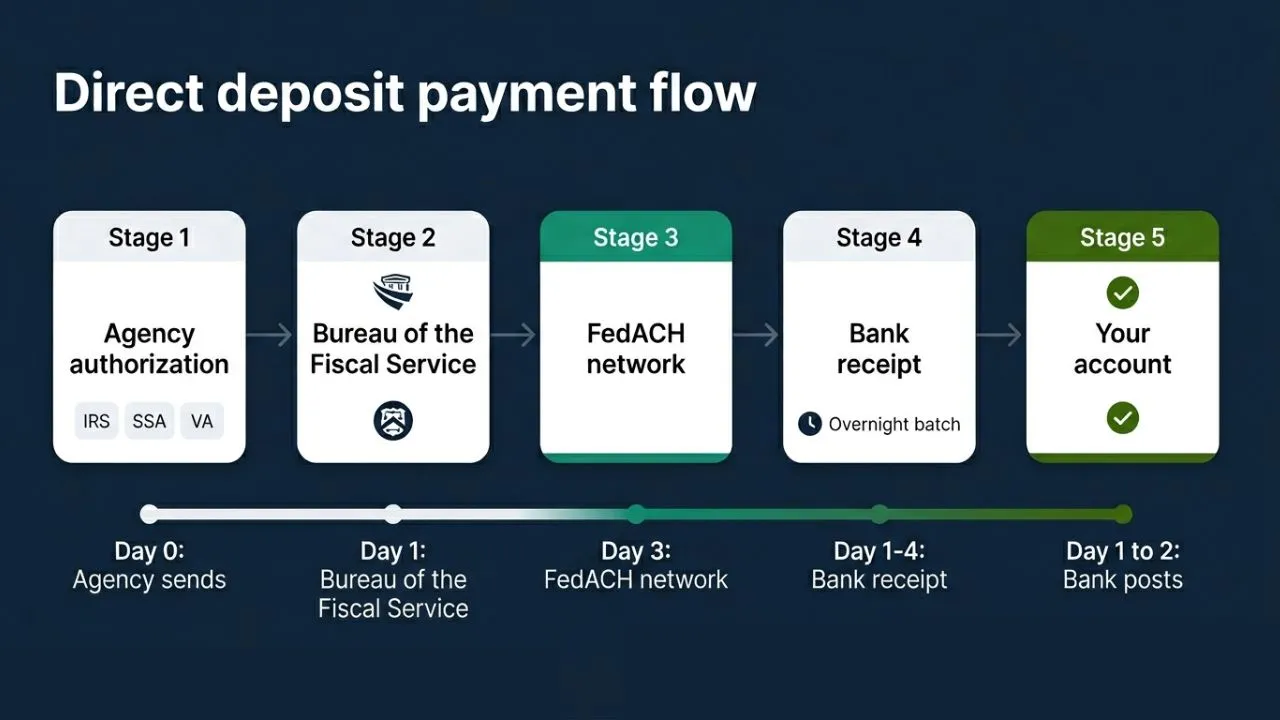
Federal payments move through a five-stage pipeline: agency authorization, Treasury disbursement, ACH network transmission, bank receipt, and bank posting. A payment marked “sent” by the government is not in your bank account yet. The gap between “sent” and “deposited” is typically one to two business days and is caused by ACH settlement windows, bank posting schedules, and Federal Reserve processing hours.
Every year, the U.S. federal government distributes more than $5 trillion in payments to American households, businesses, and institutions. This includes tax refunds, Social Security benefits, VA disability compensation, federal employee salaries, SSI, Medicare reimbursements, and dozens of other program disbursements.
These payments touch the financial lives of virtually every American family at least once a year. Yet the mechanics of how those payments actually travel from the government to a bank account remain almost entirely unknown to the people who depend on them.
That gap in understanding creates real problems. People call IRS hotlines to report missing refunds that are still in the ACH pipeline. Social Security recipients assume a payment failed when a weekend advance simply arrived one day early.
Federal employees check their accounts at midnight expecting payroll that will not post until 6 a.m. None of these situations involve system failures. All of them involve a system that works exactly as designed, operating on rules that are never explained to the people the system serves.
This guide closes that gap completely. By the end, you will understand the full five-stage pipeline that moves every federal payment from a government agency to your bank account, why a payment that shows “sent” may not appear in your balance for another 24 to 48 hours.
Federal Payments 2026
- Every federal payment, IRS refunds, Social Security, VA disability, SSI, and federal payroll, travels through the same ACH infrastructure operated by the Federal Reserve and the Electronic Payments Network.
- The Bureau of the Fiscal Service at the U.S. Treasury is the single disbursement authority for all federal payments. No agency sends money directly. All payments flow through Treasury first.
- Standard ACH settlement typically takes one business day. Same-day ACH settles within hours but applies only to certain payment types and amount limits.
- The Federal Reserve does not process ACH payments on weekends or federal holidays. Payments scheduled on those days are advanced to the prior business day or delayed to the next depending on the agency.
- A payment showing “sent” or “processed” in a government portal means the agency has transmitted the payment file to the Treasury. It does not mean the money has reached your bank account yet.
How ACH settlement and FedACH processing determine your exact deposit timing, why weekends and federal holidays cause payment shifts, how different federal payment programs submit their files on different schedules, and what specific steps to take when any federal payment appears to be missing.
How the U.S. Federal Payment System Works
The federal payment system is not a single wire transfer. It is a five-stage pipeline that spans multiple government agencies, a disbursement bureau, two competing private networks, your bank’s internal infrastructure, and the Federal Reserve’s settlement system. Understanding this pipeline at the operational level is the prerequisite for understanding everything else in this guide.
Stage 1: Agency authorization
Every federal payment begins with an agency decision. The IRS authorizes a refund after processing a tax return. The SSA authorizes a monthly benefit based on an eligibility determination. The VA authorizes disability compensation based on a rating decision. The authorizing agency does not send money. It generates a payment instruction that travels to the next stage.
Stage 2: Bureau of the Fiscal Service disbursement
The Bureau of the Fiscal Service, which is the payment operations division of the U.S. Department of the Treasury, receives payment files from every federal agency and processes them for disbursement. This centralization is deliberate. No federal agency operates its own payment system. All payments, regardless of which program authorized them, flow through the same Treasury disbursement infrastructure at Treasury fiscal service.

The Bureau of the Fiscal Service is responsible for the Pay.gov system, the financial agent relationships with banks, and the submission of payment files to the ACH network. It is the single chokepoint through which all federal money flows before reaching the banking system.
Stage 3: ACH network transmission
The Bureau of the Fiscal Service submits payment files to the Automated Clearing House (ACH) network. The ACH network is a batch-processing interbank payments system that handles direct deposits, bill payments, and money transfers across the U.S. banking system.
Two networks carry ACH traffic: FedACH, operated by the Federal Reserve, and EPN (Electronic Payments Network), operated by The Clearing House, a private entity owned by major commercial banks. Most federal payments travel through FedACH, which processes payment files in multiple daily settlement windows.
The ACH network does not process in real time. It processes in batches. Your payment file enters a batch, that batch settles at a specific window time, and your bank receives the credit in the next available cycle after settlement. This is why a payment authorized by the IRS on Monday may not reach your bank until Wednesday.
Stage 4: Bank receipt and pre-posting
When your bank receives the ACH credit file, the payment is technically in the bank’s possession. However, it is not yet in your account. The bank must process the file, match it to your account, and determine the posting time. Most banks hold incoming ACH credits in a pre-posting state until a scheduled internal processing run, which typically occurs in the early morning hours of the effective date.
Stage 5: Posting to your account
Your bank posts the credit to your available balance during its scheduled posting run. For most major banks, this occurs between 3 a.m. and 9 a.m. Eastern time on the payment’s effective date. For smaller institutions, credit unions, and some fintech accounts, posting may occur later in the business day or at a different time entirely.
This full pipeline is documented in comprehensive detail in the money movement system guide, which covers the complete federal disbursement architecture across all payment types.
Why Your Payment Says Sent But Your Balance Is $0
The most common confusion in the entire federal payments space has a precise technical explanation. When a government portal shows your payment as “sent,” “processed,” or “issued,” it means one specific thing: the agency has transmitted a payment file to the Bureau of the Fiscal Service. It does not mean Treasury has submitted that file to ACH. It does not mean your bank has received the credit. It absolutely does not mean the funds are in your account.
The ACH settlement gap
When Treasury submits a payment file to FedACH, the file enters a settlement queue. FedACH settles payments in multiple windows throughout the business day. A file submitted in the morning settles in an afternoon window. A file submitted in the afternoon settles in the next morning’s window. Your bank receives your specific payment credit only after the settlement window that contains your file closes.
This gap between agency transmission and bank receipt is typically four to twenty-four hours for standard ACH payments. For the specific mechanics of why a balance shows zero after a payment is marked sent, including the exact timeline for each major payment type, see the dedicated keeper article.
Effective dates and posting timing
Every ACH payment file includes an effective date, the date on which the paying party intends the funds to settle. For federal payments, the effective date is typically one business day after the agency submits the file to Treasury. Your bank is required to post the credit no later than the effective date.
It may post earlier, on the pre-notification file, which some banks process one business day before the effective date. The result is a range of possible posting times. A beneficiary at Bank A may see their Social Security payment at 6 a.m. on Wednesday.
A beneficiary at Bank B with the identical payment from the identical effective-date file may see it at 11 p.m. Wednesday. Both postings are correct. Both comply with ACH rules. The difference is entirely in the banks’ internal schedules.
Payment status portals and what they actually show
Government portals, the IRS Where’s My Refund tool, the SSA My Social Security account, the VA benefits portal, report the agency’s internal status, not the banking system’s status. A status of “refund sent” means the IRS has completed its side of the transaction.
It says nothing about where the money is in the ACH pipeline. Understanding what payment status codes actually mean versus what people assume they mean is one of the most practically valuable pieces of knowledge in this entire guide.
How Direct Deposits Process Through Banks
The path a federal payment takes through your bank’s internal infrastructure determines when you actually see the money. This process is more varied than most people realize, and the differences can mean hours to a full day of waiting time depending on which institution holds your account.
Overnight batch processing
Banks do not process ACH payments in real time. They process them in batches, typically at night. When your bank receives an ACH credit file from FedACH, it loads the file into its core processing system during an overnight batch run. The batch run typically occurs between 11 p.m. and 4 a.m. Eastern time. Payments received before the batch cutoff are processed that night. Payments received after the cutoff are held for the next night’s batch.
This is why the concept of deposit posting times matters. A federal payment that arrives at your bank at 9 p.m. Tuesday will be in the overnight batch and post Wednesday morning. A payment that arrives at 2 a.m. Wednesday may miss the batch cutoff and post Thursday morning. The ACH effective date governs when your bank must post the credit, but not when it actually processes the incoming file.
Large bank versus small bank versus fintech posting differences explained
Large national banks, including JPMorgan Chase, Bank of America, Wells Fargo, and Citibank, typically post ACH credits early in the morning on the effective date, often by 3 a.m. to 6 a.m. Eastern. These institutions process such high volumes of ACH transactions that they run multiple processing cycles overnight and are equipped to post credits well before business hours begin.
Regional banks and community banks typically post by 8 a.m. to 10 a.m. on the effective date, depending on their core banking system vendor and processing schedule. Credit unions often post in the morning but may post in a later window depending on their data processing arrangement, which is commonly outsourced to a credit union service organization.
Fintech accounts and digital banks, including Chime, Cash App, Current, and similar services, sometimes post federal payments one to two days early by crediting accounts as soon as pre-notification files arrive from FedACH.
Table: Large bank versus small bank versus fintech
| Institution type | Typical posting time | Pre-notification posting? | Notes |
|---|---|---|---|
| Large national banks Chase, BofA, Wells Fargo |
3 a.m. to 6 a.m. ET | Sometimes | Multiple overnight cycles; highest volume capacity |
| Regional and community banks | 8 a.m. to 11 a.m. ET | Rarely | Depends on core banking vendor schedule |
| Credit unions | 8 a.m. to 12 p.m. ET | Rarely | Often outsourced to CUSO; timing varies |
| Fintech accounts Chime, Cash App, Current |
1 to 2 days early | Yes, standard practice | Credits on pre-notification by choice; not ACH requirement |
This is not a violation of ACH rules; it is the fintech institution choosing to extend credit before the official effective date, which creates the perception that these accounts receive payments earlier. For the full explanation of why a morning deposit delay occurs at some institutions and not others, the dedicated keeper provides the technical detail.
Why two people with the same payment see it at different times
Two beneficiaries who receive an identical payment from the same agency on the same effective date may see that payment at completely different times because they bank at institutions with different posting schedules. This is not a system error. It is an inherent characteristic of the U.S. banking system, where ACH rules set the ceiling for posting (you must post by the effective date) but not the floor (you may post earlier if you choose).
ACH Settlement and FedACH Processing
The ACH system is the infrastructure backbone of every federal payment. Understanding how it operates at the technical level removes the mystery from why payments sometimes arrive earlier or later than expected.
What ACH is and how it works
The Automated Clearing House is a batch electronic funds transfer system governed by NACHA (the National Automated Clearing House Association), the standards-setting body for U.S. electronic payments.
NACHA establishes the rules that all participating financial institutions must follow when submitting or receiving ACH transactions. The Federal Reserve ACH system, known as FedACH, is the Federal Reserve’s own ACH operator and the primary network for federal government payments.
ACH payments are not wire transfers. Wire transfers are individual, real-time instructions that move specific amounts between specific accounts immediately. ACH is a batch system in which thousands or millions of individual payment instructions are grouped into files, submitted together, and settled as a unit.
This batch design makes ACH far less expensive than wire transfers and enables the volume of transactions the federal government processes, the Treasury processes hundreds of millions of ACH payments per year.
FedACH settlement windows
FedACH operates multiple settlement windows each business day. A settlement window is a specific time at which FedACH matches the payment files submitted by originating banks (in the case of federal payments, this means Treasury’s financial agents) against the accounts at receiving banks and credits the receiving banks’ Federal Reserve master accounts.
For standard ACH, FedACH settlement windows are at approximately 8:30 a.m., 1:00 p.m., and 5:00 p.m. Eastern time on business days. The Bureau of the Fiscal Service typically submits federal payment files in the evening, which means they settle in the morning windows of the following business day. Your bank receives the credit at morning settlement, processes it overnight, and posts it to your account by the start of business.
For the detailed mechanics of how FedACH settlement affects your specific payment timeline, including how to identify which settlement window your payment is in, see the FedACH keeper.
Same-day ACH versus standard ACH
Standard ACH operates on a next-business-day settlement model. A payment file submitted Monday settles Tuesday. A payment file submitted Friday settles Monday (because the weekend is not a business day for the Federal Reserve).
Same-day ACH was introduced by NACHA to enable faster settlement for eligible transactions. Under same-day ACH rules, payments submitted before 10:30 a.m. Eastern settle by 1:00 p.m. the same day. Payments submitted before 2:45 p.m. Eastern settle by 5:00 p.m. the same day. Same-day ACH enables funds availability the afternoon of submission rather than the following morning.
Not all federal payments qualify for same-day ACH. The current NACHA per-transaction limit for same-day ACH is $1,000,000, which encompasses most consumer federal payments. However, agencies must specifically submit files using same-day ACH file codes, and many agencies still use standard ACH files for most disbursements. For a complete comparison of timing, eligibility, and real-world use cases for same-day ACH versus standard settlement, see the dedicated guide.
The Bureau of the Fiscal Service has been expanding its use of same-day ACH for specific payment types, including certain emergency disbursements and payroll correction runs. As of April 4, 2026, however, most routine federal payments, including IRS refunds and Social Security benefits, continue to process as standard ACH with next-business-day settlement.
Weekend, Holiday, and Timing Delays in Federal Payments
Calendar effects are the single most frequent cause of federal payment confusion. Payments that appear to be missing or delayed are, in the vast majority of cases, payments that have been shifted by a weekend or holiday according to rules that most recipients have never been told.
Why the Federal Reserve does not process on weekends
The Federal Reserve’s ACH network, FedACH, operates on Federal Reserve business days only. Federal Reserve business days are Monday through Friday, excluding federal holidays. This is not a technology limitation. The Federal Reserve chooses not to process on weekends as a matter of operational policy that aligns with the broader settlement system.
When a scheduled federal payment date falls on Saturday or Sunday, the payment cannot settle through FedACH on that day. The Bureau of the Fiscal Service advances most recurring benefit payments to the prior Friday to prevent a two-day gap in receipt. For one-time payments such as tax refunds, the effective date is moved to the following Monday.
Federal holiday payment shifts explained
Federal holidays create the same no-processing problem as weekends. When a payment’s effective date falls on a federal holiday, Presidents Day, Memorial Day, the Fourth of July, Labor Day, Columbus Day, Veterans Day, Thanksgiving, Christmas, New Year’s Day, or MLK Day, the Bureau of the Fiscal Service adjusts the effective date. For recurring benefit payments, the adjustment is typically forward to the preceding business day. For tax refunds, the IRS adjusts the Code 846 date accordingly.
The practical result is that benefit recipients sometimes receive payments one to three days earlier than their standard schedule. Recipients who do not understand the holiday shift mechanism see an early deposit and assume a system error, a double payment, or a payment that will be clawed back. None of these concerns are valid. The shifted payment is the correct payment for that period, arriving on the adjusted date the system was designed to produce.
Table: Federal holiday payment shifts
| Payment type | Holiday falls on payment date | Result |
|---|---|---|
| Social Security and SSI | Advanced to prior Friday/business day | Arrives early |
| VA disability compensation | Advanced to prior business day | Arrives early |
| IRS tax refunds | Code 846 effective date moves to next business day | Delayed by 1 day |
| Federal employee payroll | Advanced to prior business day per agency calendar | Typically arrives early |
For the detailed breakdown of how weekend payment freeze periods affect transaction timelines, including the specific Monday morning volume surge that sometimes delays posting, see the weekend delays keeper.
Friday submission cutoffs and Monday morning volume
Fridays are the highest-volume ACH submission day of the week because all payments scheduled for the following weekend’s effective dates must be submitted before FedACH closes. This creates a surge in files entering the settlement queue on Friday afternoons.
Banks receiving large volumes of ACH credit files on Friday must process them over the weekend in preparation for Monday morning postings. Monday morning is the highest-volume ACH posting day of the week. Banks are posting Friday’s late filings, the full weekend’s pre-notification files, and the first regular weekday filings simultaneously.
At some institutions, this volume causes a posting delay of one to three hours compared to normal weekday mornings. A payment that would typically post at 4 a.m. on a Tuesday may post at 7 a.m. on a Monday because of the additional processing workload. This is not a delay in the traditional sense. It is a normal characteristic of Monday morning ACH volume.
The deposit eligibility threshold and payment holds
Banks are permitted to place holds on unusually large deposits, including federal payments, if the deposit exceeds the institution’s standard threshold for immediate availability. Under Regulation CC (the Expedited Funds Availability Act), banks must make the first $225 of any direct deposit immediately available on the day of posting.
The remainder of a deposit above $225 may be held for one business day. For new account holders, the hold period may be longer. For standard recurring federal payments within normal ranges, most banks do not impose Regulation CC holds because the payments are predictable and the institution has verified the source. For first-time federal payments or unusually large amounts, a hold is possible.
Understanding what determines deposit eligibility for large federal payments, including the $2,000 threshold that triggers enhanced bank scrutiny at some institutions, is covered in the dedicated keeper.
Federal Payment Types and Their Schedules
Different federal payment programs submit their payment files to the Bureau of the Fiscal Service on different schedules. This means the timing of your specific federal payment depends not only on ACH settlement rules but also on when your agency submits its file to Treasury each month.
IRS tax refunds
The IRS submits refund payment files to the Bureau of the Fiscal Service typically within one to two business days after posting Transaction Code 846 (Refund Issued) to a taxpayer’s account transcript. The Bureau of the Fiscal Service then submits the file to FedACH with a next-business-day effective date. The result is that most IRS refunds post to bank accounts one to three business days after Code 846 appears on the transcript.
IRS refund volumes are highest from late January through mid-April, creating elevated ACH transmission loads during this period. For the complete guide to IRS refund timing, transaction codes, and the full refund pipeline, see the IRS refund processing category pillar.
Social Security and SSI benefits
The Social Security Administration submits monthly benefit payment files to the Bureau of the Fiscal Service approximately one week before the scheduled payment dates. This advance submission is what enables the SSA to guarantee payments arrive on the correct Wednesday for each birth-date group. The large lead time means Social Security ACH files are among the most reliably timed in the federal payment system.
SSI payments, which are scheduled for the 1st of each month, are submitted earlier still and are governed by the same holiday advance rules as other recurring benefits. Both Social Security and SSI use ssa.gov/myaccount as the beneficiary portal for payment status and account management.
VA disability compensation
VA disability payments are issued monthly, typically between the 1st and the 3rd of each month for most recipients. The Department of Veterans Affairs submits payment files to the Bureau of the Fiscal Service in advance of the scheduled date. VA payments use the same FedACH infrastructure and are subject to the same weekend and holiday shift rules as other federal benefits.
Federal employee payroll
Federal employee payroll is administered by the National Finance Center (for most agencies) or the Defense Finance and Accounting Service (for Department of Defense employees).
Payroll files are submitted to the Bureau of the Fiscal Service in advance of bi-weekly pay dates. Federal employee paychecks are direct deposits that travel through the standard ACH pipeline and are subject to the same bank posting timing as any other ACH payment.
Other Treasury payments
The Bureau of the Fiscal Service also disburses vendor payments to government contractors, grant disbursements to states and municipalities, Medicare and Medicaid reimbursements to healthcare providers, and interest payments on Treasury securities.
These payments collectively account for a substantial share of the trillions of dollars the Bureau processes annually. All use the same ACH pipeline described in this guide, governed by the same FedACH settlement rules and subject to the same calendar effects.
What to Do When Your Federal Payment Is Missing
When a federal payment does not appear on the expected date, the protocol below applies in order. Most missing-payment situations resolve at Step 1 or Step 2. Steps 5 and beyond are necessary only in genuine exception cases.
Step 1: Verify your exact expected payment date
Before treating any payment as missing, confirm that you are checking on the correct date. Each federal payment type has a specific schedule. IRS refunds have a Code 846 effective date. Social Security payments have a birth-date Wednesday.
VA payments have a monthly schedule. SSI has the 1st. Federal payroll has a specific bi-weekly calendar. Checking your account before the correct effective date and concluding the payment is missing is the most common cause of unnecessary follow-up.
Step 2: Check for a weekend or holiday advance
If your scheduled payment date was a weekend or federal holiday, confirm whether the payment was advanced to the prior Friday or business day. An advance payment that arrived Thursday or Friday of the prior week is not a missing payment. It is the correct payment for that cycle, delivered on the adjusted date.
Step 3: Check your bank for a pending or processing transaction
After the effective date has arrived, check your bank account for a pending ACH credit. Most banks display incoming ACH payments as “pending” before they post to available balance. A pending transaction means the payment has been received by your bank and will post during the next scheduled processing run. If a pending transaction is visible, wait until your bank’s posting time before escalating.
Step 4: Check the relevant government portal
Log into the appropriate agency portal and verify the payment status. For IRS refunds, use IRS refund status or your IRS transcript. For Social Security, use SSA account portal. For VA, use the VA benefits portal at va.gov. If the portal shows the payment as issued or sent, the payment is in the ACH pipeline. If the portal shows no record of a payment for the current period, contact the agency.
Step 5: Wait until end of business day before escalating
If the effective date has passed and no deposit is visible in your account, wait until end of business day before contacting anyone. Many bank posting issues resolve during the business day. Payments visible as pending in the morning often post to available balance by afternoon. Contacting the paying agency before end of day typically generates a “payment is processing” response that adds no useful information.
Step 6: Contact your bank first
If end of business day has passed and no deposit has posted, call your bank before calling the paying agency. Your bank can confirm whether an ACH credit was received for your account on the effective date, whether it is in a processing queue, and whether a hold has been applied. If your bank confirms no ACH credit was received, you have confirmed the issue is upstream of the bank. Only then should you contact the agency.
Step 7: Contact the paying agency
Once you have confirmed from your bank that no ACH credit was received, contact the paying agency directly. For IRS: call 1-800-829-1954. For SSA: call 1-800-772-1213. For VA: call 1-800-827-1000. Have your account information, the expected payment date, your bank’s routing and account numbers, and any reference numbers from your bank ready before calling.
Frequently Asked Questions About Federal Payments
Why does my payment show as sent but I have no deposit?
“Sent” means the agency has transmitted a payment file to the Bureau of the Fiscal Service. The money is in the ACH pipeline between Treasury and your bank. The settlement and posting process takes one to two business days after that status appears. Wait until the end of the effective date before treating this as a problem.
What is the difference between FedACH and same-day ACH?
FedACH is the Federal Reserve’s ACH network and settles payments the next business day after submission. Same-day ACH is a service layer that allows payments submitted before specific morning or afternoon cutoffs to settle the same day they are submitted. Most federal benefit payments use standard FedACH settlement. Same-day ACH is used for specific scenarios including emergency disbursements and payroll corrections.
Why did I get my federal payment one day early?
Either your bank received the pre-notification ACH file early and chose to post in advance of the effective date, or the effective date was shifted forward because it fell on a weekend or holiday and the Bureau of the Fiscal Service advanced the payment to the prior business day. Both situations are normal. The payment is correct and will not be reversed.
Does the Federal Reserve process payments on weekends?
No. FedACH does not process ACH settlements on Saturdays, Sundays, or federal holidays. Payments scheduled for those days are adjusted by the paying agency to the nearest business day. For recurring benefits, this usually means the prior Friday. For IRS refunds, the effective date moves to the following Monday.
What bank account gets my federal payment posted fastest?
Large national banks typically post ACH credits earliest, between 3 a.m. and 6 a.m. Eastern on the effective date. Some fintech accounts and digital banks post one to two days before the effective date by crediting on pre-notification. Credit unions and community banks typically post mid-morning. Posting time depends on the institution’s core banking system, not the payment type.
What This Means For You
The federal payment system processes more than $5 trillion per year through a pipeline that most Americans experience as a mystery. The information in this guide translates into six concrete implications for how you should manage your expectations and actions around any federal payment.
A “sent” status in any government portal means the agency is finished. Your money is not in your account yet.
This single understanding eliminates the majority of unnecessary phone calls, anxiety, and confusion around federal payments. The pipeline between “sent” and “deposited” takes one to two business days under normal conditions.
Your bank determines when you see the money, not the government
The Bureau of the Fiscal Service transmits your federal payment to FedACH with an effective date. Your bank processes the incoming ACH credit on its own schedule. Two people with identical payments at different banks can see those payments at different times. If your payment seems late, call your bank before calling the agency.
Weekend and holiday payment shifts are not errors
When a federal payment arrives one to three days before its standard date, it is because the Bureau of the Fiscal Service advanced it to avoid a weekend or holiday non-processing gap. When it arrives on a Monday rather than the prior Friday, the same logic applies in reverse. These shifts are designed behaviors, not system failures.
Same-day ACH is the future of federal payment speed, but most routine payments do not use it yet
As of April 4, 2026, most IRS refunds and Social Security payments still use standard next-business-day ACH settlement. If you need faster access to federal payment funds, a fintech account that credits pre-notification files can effectively give you one to two days of earlier access without changing the payment itself.
Monday morning is the most complex federal payment day of the week
Weekend ACH accumulation, holiday-advance volumes, and the Monday startup surge combine to make early Monday deposits more variable than any other weekday. If your payment is scheduled for Monday and does not post by 9 a.m., wait until noon before escalating. The overwhelming majority of Monday morning delays self-resolve before end of business day.
The ACH system is designed for reliability, not speed
Federal payments are never at risk of being lost in the ACH system. If a payment file was submitted by Treasury to FedACH, it will settle. If a settled credit did not reach your bank, there is a traceable record at every step of the pipeline. A genuinely missing federal payment is extraordinarily rare and always has a resolution path through the paying agency.
Sources: All payment timing, settlement, and system information in this federal payments guide reflects current U.S. Treasury, Federal Reserve, and NACHA published guidance as of April 6, 2026. Treasury payment operations at fiscal.treasury.gov. Federal Reserve ACH at federalreserve.gov. IRS refund status at irs.gov/refunds. SSA account portal at ssa.gov/myaccount.
Editorial standard: Written and maintained to YMYL accuracy standards. All operational claims reference primary federal government sources. This guide describes how the federal payments system operates and does not constitute financial or legal advice for individual circumstances.