March 28, 2026 • 11:10 AM ET
The IRS is actively transmitting the latest batch of refunds this week. If you filed electronically and your return was accepted in early-to-mid March, check your IRS Account Transcript now — Code 846 may already be posted with your deposit date..
If you have been checking your IRS transcript and suddenly see IRS Code 846 listed with a dollar amount and a date, you have reached the finish line of tax refund season.
Code 846 is the single most important transaction code in the IRS system for anyone waiting on a refund. It means your return has been fully processed, your refund amount has been approved, and the IRS has officially scheduled your deposit.
For millions of Americans, the tax refund is not pocket money it is rent, car payments, medical bills, or emergency savings. Knowing exactly what Code 846 means, when the money actually arrives, and why the Where’s My Refund tool behaves strangely at this stage can save you days of anxiety and unnecessary calls to the IRS.
What You Need to Know Right Now
- IRS Code 846 is the official transaction code meaning your tax refund has been approved and a deposit date has been issued.
- The date next to Code 846 on your IRS transcript is the scheduled direct deposit date, not an estimate.
- Code 846 typically appears on your transcript one to five days before the money hits your bank account.
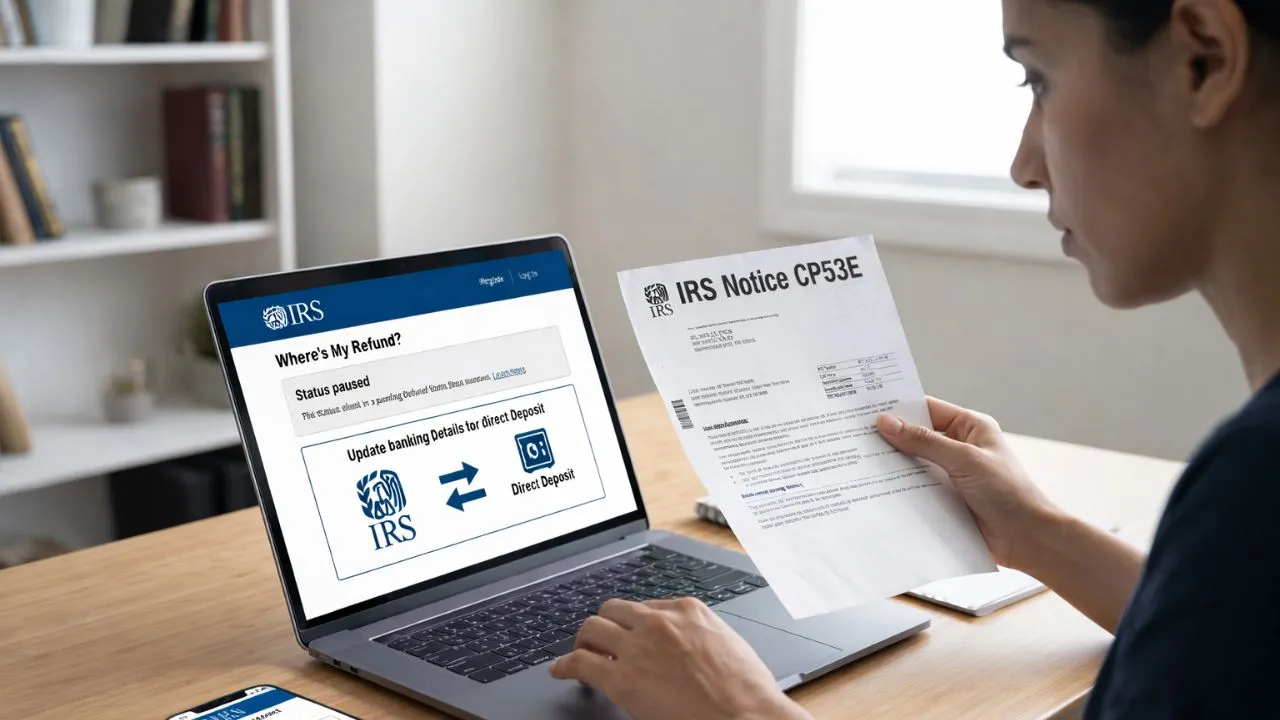
- When Code 846 appears, the Where’s My Refund status bar often disappears, this is normal and does not mean your refund is delayed.
- You can access your IRS transcript for free at IRS.gov/account to check for Code 846 before the WMR tool updates.
This article explains everything about IRS Code 846, what it is, how to find it, what the date next to it means, why the status bar sometimes vanishes when it appears, and what to do if your deposit does not arrive when expected. Every fact here is sourced directly from IRS guidance and official federal financial operations documentation.
What Is IRS Code 846 and Where Does It Come From?
The IRS uses a system of transaction codes three-digit numbers to record every action taken on your tax account. These codes appear on your official IRS Account Transcript. They are the internal language of the IRS processing system, and they update in real time as your return moves through review, verification, and approval.
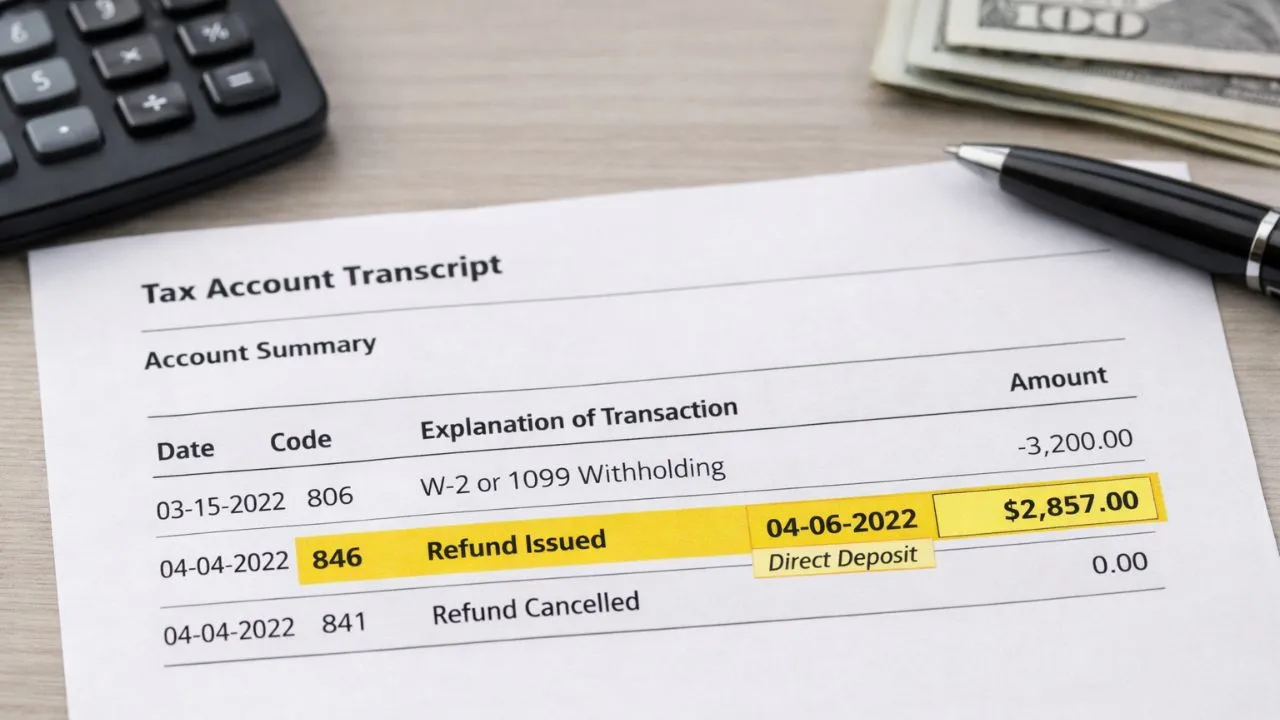
IRS Code 846 is labeled “Refund Issued” in the IRS Master File Transaction Codes document. It is generated automatically when the IRS completes processing of your return, confirms the refund amount, and schedules the payment to your bank or sends a paper check through the U.S. Treasury. No human agent manually enters this code, it is triggered by the system when your refund clears every verification checkpoint.
The code appears on your IRS Account Transcript, which is different from the Where’s My Refund (WMR) tool. WMR shows a simplified status bar with three stages: Return Received, Refund Approved, and Refund Sent.
Your transcript shows every transaction in your account, including Code 846, often before WMR catches up. This is why experienced taxpayers check their transcripts directly at IRS.gov/account.
There are other codes nearby that matter too. Code 150 means your return was filed. Code 806 reflects your withholding credits. Code 768 adds your Earned Income Tax Credit if applicable. When you see Code 846 appear below all of these, it means every prior transaction has resolved and the IRS is ready to pay you.
The Date Next to Code 846: What It Actually Means
The date printed directly to the right of IRS Code 846 on your transcript is your official refund deposit date. This is not an estimate. It is the date the IRS has scheduled your payment to leave the federal financial system and travel toward your bank account.

For direct deposit filers, this date is the day the IRS transmits your refund through the ACH (Automated Clearing House) network. Most banks receive direct deposits and make funds available on the scheduled date or the morning of that date. Some banks process incoming ACH transactions a day early meaning your money could appear one business day before the date listed.
For paper check filers, the date next to Code 846 is the check mail date not the arrival date. Paper checks sent through the Treasury typically take seven to fourteen business days to arrive by mail after that date.
Given that a federal executive order is phasing out paper refund checks in favor of direct deposit, taxpayers who still receive checks will face longer wait times going forward.
One important nuance: the Code 846 date is almost always a Friday or Saturday on the transcript. The IRS batches refund transmissions weekly, and most run at the end of the business week.
If you see a Saturday date on your transcript, your bank may post the funds Friday evening, Saturday morning, or by Monday at the latest depending on your bank’s ACH processing schedule.
If your Code 846 date has passed and your bank still shows nothing, do not panic immediately. Allow one to three additional business days before escalating. Banks occasionally hold ACH transfers for standard processing review. For context on what happens when an expected deposit simply does not appear, see our full breakdown on IRS deposit not showing.
Why the Where’s My Refund Status Bar Disappears
This is one of the most common and most alarming experiences taxpayers have during refund season. You have been watching the WMR tool update your progress, Return Received, then Refund Approved and then suddenly, the entire status bar disappears.
No message. No error. Just a blank screen or a generic message like “We cannot provide any information about your refund.” This happens at the exact moment many people see IRS Code 846 on their transcript. The two events are directly connected.
Here is why. When the IRS moves your refund from “approved” to “issued,” the account moves out of the active processing queue and into the payment transmission system.
At that transition point, the WMR tool loses its handle on the account status temporarily. The tool is not showing an error it is showing a gap between the processing system and the payment system. That gap usually lasts 24 to 72 hours.
During that gap, your transcript will show Code 846 with a deposit date. WMR will show nothing useful. The right move is to check your transcript, confirm the Code 846 date, and wait for your bank to post the deposit. Do not call the IRS during this period the representative will see the same Code 846 on your account and confirm your refund is on the way.
If you encounter login problems accessing your IRS account to check your transcript during this period, our guide on the IRS login error fix walks through the most common IRS.gov authentication issues and how to resolve them quickly.
How to Find IRS Code 846 on Your Transcript
You do not need a tax professional to read your IRS transcript. The process is straightforward, and it gives you earlier and more precise information than the WMR tool.
Step 1: Go to IRS.gov/account and sign in with your IRS Online Account. You will need ID.me or Login.gov credentials.
Step 2: Select “Tax Return Transcript” not the Account Transcript. Wait. Actually, for refund codes you want the “Account Transcript” for the tax year in question.
Step 3: Once inside, look for the section listing transaction codes. Scroll down through Codes 150, 806, 768, and others. When Code 846 appears, your refund has been issued.
Step 4: Read the date to the right of Code 846. That is your deposit date. Read the dollar amount to confirm it matches your expected refund.
If you see no Code 846 yet but see other codes in the 800s, your return is still processing. Common holding codes include Code 570 (additional account action pending) and Code 971 (notice issued). These do not necessarily mean a problem but they do mean Code 846 has not been generated yet.
The average 2026 tax refund is running approximately 22% higher than last year, which means more taxpayers are watching their transcripts more closely than ever this season. Understanding what each code means puts you ahead of the process.
How Long After Code 846 Until Money Is in Your Account
The timeline from Code 846 appearing on your transcript to money arriving in your bank account follows a fairly consistent pattern for direct deposit filers.
Day 0: Code 846 appears on your transcript. The IRS has scheduled your deposit.
Day 1–2: The IRS transmits your refund through the ACH network. This is the period when WMR may go blank.
Day 2–5: Your bank receives the ACH transmission and processes it. Most direct deposits post within two to three banking days of the Code 846 date.
Day 5+: If you have not received your deposit by this point, check with your bank first, confirm the routing and account numbers on file with the IRS match your active account. You can verify your direct deposit information through your IRS Online Account.
It is worth noting that the IRS deposits refunds on a specific weekly schedule based on the last two digits of your Social Security number and when your return was accepted.
Code 846 appears after your batch has been selected for that week’s transmission. This is why many taxpayers see Code 846 appear on Wednesday or Thursday with a Friday or Saturday deposit date.
What Happens If Your Code 846 Amount Is Different from What You Expected
This is the question that follows every Code 846 discovery for a significant share of filers. You expected a specific refund amount, but the number next to Code 846 is smaller. There are three common reasons for this.
Offset for federal debts. If you owe back taxes, student loans in default, child support, or other federal obligations, the Treasury Offset Program automatically deducts those amounts from your refund before issuing it.
You will typically receive a Bureau of the Fiscal Service notice explaining the offset. You can also call the TOP line at 800-304-3107 to verify any offsets on your account.
IRS math adjustments. If the IRS found a discrepancy in your return a calculation error, a credit you did not qualify for, or an income figure that did not match W-2 data they may have adjusted your refund amount downward.
A notice will follow in the mail explaining the change. If you filed with an incorrect W-2, our article on W-2 Box 1 errors covers how this affects high earners and what to do next.
Estimated tax or prior-year balance applied. If you had an underpayment from a prior year, the IRS may apply part of your current refund to that balance automatically.
In any of these cases, Code 846 is still good news, it means the remaining amount after any adjustments is being paid. If you believe the adjustment was made in error, you have the right to dispute it. You can learn more about IRS interest rules that apply to delayed or disputed refunds in our explainer on IRS unclaimed refund interest.
Special Situations: When Code 846 Is Delayed or Never Appears
Most straightforward tax returns generate Code 846 within 21 days of the IRS accepting the return. The IRS’s own published standard for direct deposit refunds is 21 days for electronically filed returns with no errors. But some returns take longer, and Code 846 will not appear until every upstream issue is resolved.
Identity verification holds
If the IRS flagged your return for identity verification, you will see codes like 971 and 570 on your transcript. You may have received an IRS letter such as a CP05 or CP53E, requesting documentation before processing can continue. Our breakdown of the CP53E refund freeze explains what that specific notice means and the 30-day timeline involved.
Path Act delays
Returns claiming the Earned Income Tax Credit or the Additional Child Tax Credit are legally held under the PATH Act until mid-February, regardless of when the return was filed. Code 846 will not appear for these filers until after the statutory release date.
Paper returns
Paper-filed returns take significantly longer often 6 to 8 weeks. Code 846 will appear eventually, but the timeline is not comparable to electronic filing.
Fraud screening
If your return was selected for additional fraud review, you will see holding codes on your transcript and eventually receive a letter. No Code 846 will appear until the review is complete.
For the 1.2 billion dollars in unclaimed refunds from prior years that the IRS has flagged, the IRS refund deadline article explains how that process works and what taxpayers can do to claim money that was never collected.
The Broader System Behind Code 846: How Refund Money Actually Moves
Code 846 is the IRS’s internal signal that your refund is ready. But after that signal is generated, the money moves through a chain of federal financial infrastructure before it reaches your bank account.
The IRS transmits payment instructions to the Bureau of the Fiscal Service, which is the Treasury Department agency responsible for all federal payments, from tax refunds to Social Security checks.
The Bureau processes the payment and sends it through the ACH network, operated by the Federal Reserve Banks. The Federal Reserve routes the transfer to your bank’s ACH processor. Your bank credits the funds to your account.
This same infrastructure handles Social Security payments, federal payroll, and government contractor payments. Understanding this pipeline helps explain why Code 846 does not mean the money is in your account instantly, it means the instruction has been issued, and the payment is now in transit through the federal financial system.
For a complete picture of how the U.S. government moves money, from IRS refunds to Social Security deposits, read our U.S. money movement system guide, which covers the entire federal payment infrastructure in one comprehensive reference.
The 2026 legislative landscape has also introduced some uncertainty into direct deposit timelines. Changes under consideration in federal spending legislation could affect IRS staffing and processing capacity. Our coverage of OBBBA direct deposit delays tracks how those policy changes may affect refund timing this season.
It is also worth noting that scams targeting taxpayers around refund season have increased significantly. If you receive any unexpected communication claiming to be from the IRS about a deposit you were not expecting, read our alert on federal deposit scams before taking any action.
Frequently Asked Questions About IRS Code 846
Does Code 846 guarantee my refund will arrive on that exact date?
For direct deposit, the Code 846 date is the scheduled transmission date — not a guarantee of same-day receipt. Most banks post the funds on or within one business day of that date. Occasional processing delays on the bank side can push it to the following business day.
My transcript shows Code 846 but Where’s My Refund says “information not available.” Is something wrong?
No. This is one of the most common transcript-vs-WMR gaps. When Code 846 is generated, WMR often goes blank for 24 to 72 hours before updating to “Refund Sent.” Trust the transcript. The Code 846 date is accurate.
Can Code 846 be reversed after it appears?
Technically yes, but this is extremely rare. If the IRS discovers a significant error after issuing Code 846 for example, a fraudulent return that was processed before the fraud was caught they can recall the payment through the ACH network if it has not yet been credited to a bank account. Once the funds are in your account, the IRS must pursue a separate collection process to recover them.
What if Code 846 shows a refund but my bank account information was wrong?
If your direct deposit fails because of incorrect routing or account numbers, the funds are returned to the IRS. The IRS will then issue a paper check to your address on file. This can add two to four weeks to your refund timeline. You can verify your refund status at IRS.gov/refunds.
I see Code 846 but the amount is less than I expected. Should I call the IRS?
Start by checking for a Treasury offset call 800-304-3107 to verify. Also look for a CP notice in your mail from the IRS explaining any adjustments. If you have not received a notice and the offset line shows nothing, then calling the IRS directly is the appropriate next step.
How early can I see Code 846 before the deposit hits?
Typically one to five days. Some taxpayers see Code 846 appear on Wednesday evening for a Friday deposit date. Others see it Thursday morning for that same Friday date. The transcript updates more frequently than WMR and will almost always show Code 846 before WMR shows “Refund Sent.”
Is there a Code 846 for amended return refunds?
Yes. If you filed an amended return (Form 1040-X) and it was approved, Code 846 will also appear on your transcript to indicate that refund is being issued. Amended return refunds typically take eight to twelve weeks to process, so the Code 846 date will appear much later than for original return filers. You can track your amended return at IRS.gov/refunds using the “Where’s My Amended Return” tool.
What This Means For You: IRS Code 846 in Plain Terms
IRS Code 846 is the finish line. When you see it on your transcript, your refund is no longer under review, no longer pending, and no longer uncertain. The IRS has decided your amount, scheduled your payment, and handed the money off to the federal payment system. Your job now is simply to wait for your bank.
The date next to Code 846 is your best information. Ignore friends’ timelines. Ignore online forums. The date on your official IRS Account Transcript, accessible at IRS.gov, is the scheduled transmission date for your specific return. That date is more reliable than any third-party tool or estimate.
The disappearing status bar is not bad news. If your WMR status bar vanishes the same week Code 846 appears, you are in the final gap between IRS processing and bank posting. This is normal. Check your transcript, confirm the date, and check your bank account on or after that date.
A reduced refund amount is not automatically an error. Government offsets, IRS math corrections, and prior-year balance applications all produce a legitimate Code 846 with a lower-than-expected amount. Investigate before assuming a mistake, check the offset line first, then look for IRS mail.
Transcript access is your best financial tool during tax season. The IRS Account Transcript at IRS.gov/account gives you real-time transaction data on your return.
Checking it weekly during filing season rather than repeatedly refreshing WMR puts you in control of the information. IRS Code 846 is the code you are looking for, and now you know exactly what it means when you find it.
For broader context on how the IRS refund system connects to Social Security payments, federal payroll, and the full infrastructure of U.S. government money movement, explore the IRS refund approved not deposited guide and our complete SSA payment system explainer both part of Investozora’s ongoing coverage of how federal dollars move from the government to your account.
Editorial Note: This article reflects IRS guidance and federal payment system operations as of 2026. Tax codes, refund timelines, and processing procedures may change. Always verify current information at IRS.gov before making financial decisions.