April 4, 2026 • 6:40 AM ET
Most IRS refunds arrive within 21 days for e-filed returns. IRS Transaction Code 846 on your transcript is the authoritative confirmation your refund has been approved. If you claimed the EITC or ACTC, your refund cannot legally be issued before February 15 regardless of when you filed.
If you are waiting for an IRS refund in 2026, you are not alone. More than 100 million Americans receive federal tax refunds every year, averaging over $3,100 per household in recent filing seasons, yet most people understand almost nothing about how the money actually moves from the IRS to their bank account.
They file, they wait, and then either money appears or it does not. When the deposit is late, they refresh a status page that provides no useful information. When the status bar disappears, they assume the worst. This guide changes that entirely.
What follows is a complete operational reference for the IRS refund system: the seven-stage processing pipeline, every status code that matters, the full taxonomy of delay reasons, how interest accruals work, the unclaimed refund deadline, and a precise action protocol for every scenario where something goes wrong.
IRS Refund 2026
- E-filed returns with direct deposit receive refunds within 21 calendar days in the vast majority of cases. Paper returns take 6 to 8 weeks under normal conditions.
- IRS Code 846 on your tax transcript is the single authoritative signal your refund has been authorized and is in transit. No other code confirms payment.
- PATH Act freeze legally prohibits the IRS from issuing EITC and ACTC refunds before February 15 each year, filing in January does not accelerate your refund.
- Refund delays beyond 45 days trigger mandatory IRS interest under IRC Section 6621, currently 6% annually (Q2 2026), paid automatically.
- Unclaimed refunds expire permanently three years after the original due date. The April 15, 2026 deadline for 2022 refunds is absolute, no appeals exist after it passes.
By the end of this article, you will understand exactly where your IRS refund is, why it may be delayed, and what you should do about it.
How the IRS Processes Your Tax Refund (Step-by-Step)
The IRS refund is not a single transaction. It is the output of a seven-stage pipeline that spans multiple federal agencies, a national payments network, and your bank’s internal posting schedule. Understanding each stage is the foundation for everything else in this guide.
Stage 1: Return Received (24–48 hours)
When you e-file, your return travels to the IRS via a federally approved transmission network. The IRS acknowledges receipt within 24 to 48 hours and issues a confirmation to your software. This acknowledgment means the IRS has your return. It does not mean your return has been reviewed or your refund authorized.
Paper returns follow a different path. They are physically received at IRS service centers, sorted, opened, and queued for manual data entry a process that alone takes 3 to 4 weeks at peak filing volume before any review begins.
Stage 2: Identity and Fraud Screening (Variable)
Before any refund calculation, every return passes through the IRS’s automated fraud detection filters. These systems compare returns against W-2 and 1099 data from employers, check for duplicate Social Security Numbers, and flag returns matching known fraud patterns. Returns that trigger a flag are routed to identity verification the primary source of major delays.
Stage 3: Return Processed and Refund Calculated (Days 1–18)
Once a return passes fraud screening, the IRS processes it. The system verifies the math, cross-references income figures against employer filings, and calculates the refund. If a math error is found, the IRS corrects it and issues a notice adding 2 to 6 weeks to the timeline and potentially changing the refund amount.
Stage 4: Code 846 Issued: The Key Milestone
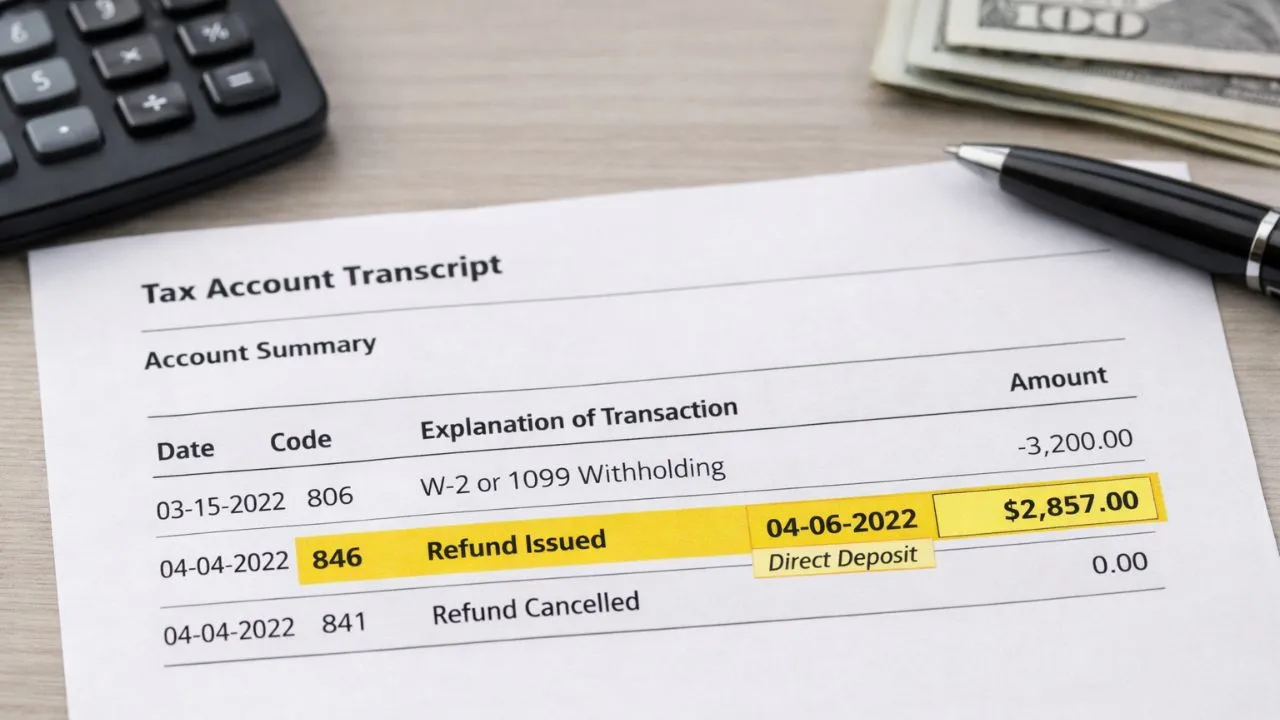
When your return is fully processed and your refund is approved for payment, the IRS posts Transaction Code 846 to your tax account transcript. This is the only code that confirms your refund has been authorized and scheduled for disbursement. The date next to Code 846 is the IRS’s scheduled payment date, not the date the money will appear in your account.
Stage 5: Treasury Disbursement (Same Day as 846)
The IRS does not send money directly to your bank. It sends payment instructions to the Bureau of the Fiscal Service, the disbursement arm of the U.S. Treasury Department. This agency manages the actual payment release into the national banking system.
Stage 6: ACH Network Transmission (1 Business Day)
Treasury transmits your payment through the Automated Clearing House (ACH) network, the same system that processes payroll direct deposits. ACH runs in batches once per business day, Monday through Friday, excluding federal holidays. A Code 846 date that falls on a weekend or holiday means your deposit processes on the following business day.
Stage 7: Bank Deposit Posted (1–2 Business Days)
Your bank receives the ACH credit file and posts to your account. Most major banks post same-day or by the following morning. Some credit unions hold until the ACH effective date. This final stage is entirely outside IRS control, which is why the IRS cannot tell you the exact minute the deposit will appear.
The standard IRS refund processing time for e-filed returns is 21 calendar days from IRS acceptance to bank deposit. Most refunds arrive in 10 to 14 days in practice. Paper returns: 6 to 8 weeks. Amended returns (Form 1040-X): 16 to 20 weeks. Track your IRS refund status at Where’s My Refund beginning 24 hours after e-file acceptance.
IRS Refund Status Codes and What Each One Means
The IRS provides two tracking interfaces: the Where’s My Refund (WMR) tool and your IRS tax account transcript. Most taxpayers use only WMR. Transcript readers get substantially more information — and far fewer surprises.
Where’s My Refund: the three statuses
| WMR Status | What it actually means | Should you act? |
|---|---|---|
| Return Received | IRS has your return in the processing queue. No review or approval has occurred. This status can persist the full 21-day window without indicating a problem. | No — wait the full 21 days. |
| Refund Approved | IRS has processed your return, confirmed your amount, and scheduled payment. A deposit date may appear. | No — deposit is in transit. Expect bank posting within 1–5 business days. |
| Refund Sent | IRS has transmitted payment instructions to Treasury. WMR sometimes skips from Approved to Sent without displaying a date — this is a display anomaly, not a problem. | No — wait 5 business days before escalating. |
Note on WMR status bar disappearance:
The WMR status bar sometimes disappears entirely during the Approved-to-Sent transition. This is a known display anomaly in the WMR application, not a refund cancellation. Check your IRS transcript directly if WMR shows no information after your expected deposit date.
IRS Transcript Transaction Codes
Your IRS tax account transcript is available at IRS.gov under “Get Transcript.” For a complete breakdown of every code and what each Direct Deposit Date means, see the Code 846 meaning guide.
| Code | Name | What it means |
|---|---|---|
| 846 | Refund issued | The authorization code. Payment scheduled. The only code that confirms release. |
| 150 | Return filed | Return received and in processing. No refund action yet. |
| 570 | Additional action pending | Hold placed before refund can be finalized. Often precedes Code 971. |
| 971 | Notice issued | IRS has generated and mailed a letter. The notice type determines your required action. |
| 768 | Earned income credit posted | EITC amount credited. A future date here signals PATH Act hold is active. |
| 776 | Interest credited | IRS has applied interest per IRC Section 6621 to your delayed refund. |
Why Your IRS Refund Is Delayed (Common Reasons Explained)
IRS refund delay is the most searched topic in the tax information space. Tens of millions of refunds are held, flagged, or re-routed every filing season. Each delay type has a distinct cause and a distinct resolution path.
| Delay Type | Typical Duration | Severity | Action Required? |
|---|---|---|---|
| PATH Act hold (EITC/ACTC) | Until mid-to-late February | Expected — not a problem | No action. Wait for February 15 release. |
| CP05 identity review | 45–60 days from notice | Moderate | No action unless notice requests documents. |
| 5071C / 5447C identity verification | 2–8 weeks after verification | Moderate — respond immediately | Verify identity at IDverify.irs.gov. |
| Math error correction | 2–6 weeks added | Minor | Review correction notice. Dispute within 60 days if incorrect. |
| Direct deposit failure / CP53E | 2–4 weeks for paper check | Moderate — preventable | Verify mailing address is current with IRS. |
| Treasury Offset Program | Permanent reduction | High — contact collecting agency | Contact the agency that collected the offset. |
| Amended return (1040-X) | 16–20 weeks | Expected for amended returns | No action before 16 weeks. |
| Paper return filed | 6–8 weeks baseline | Expected | No action before 8 weeks. |
The PATH Act Hold: the February freeze for EITC and ACTC returns
The Protecting Americans from Tax Hikes (PATH) Act, signed in 2015, legally prohibits the IRS from issuing any refund that includes the Earned Income Tax Credit or the Additional Child Tax Credit before February 15 of each filing year. This is a statutory requirement, not an administrative policy and it cannot be waived or expedited.
If you claim either credit and file in January, the IRS will accept your return but will not release your refund until the hold lifts. In 2026, the IRS began releasing PATH Act hold refunds in the third week of February. Most affected filers receive deposits in late February to early March.
For 2026 EITC income limits and maximum credit amounts, see EITC income limits at IRS.gov.
Identity Verification Delays
The IRS fraud system flags a subset of returns for enhanced review. The IRS issues a CP05 notice for standard reviews, no action required unless the notice specifically requests documentation, with a 45 to 60 day resolution window. More intensive cases receive a 5071C or 5447C letter requiring active verification through ID.me at IDverify.irs.gov.
Until verification completes, the refund remains frozen. Timeline from issuance to refund release ranges from 45 to 120 days depending on IRS staffing. Online verification through ID.me is consistently the fastest resolution path. Respond the day the letter arrives.
Direct Deposit Failure and the CP53E Notice
If your bank account number or routing number on your return is incorrect, the ACH payment fails. The bank returns the credit file to the Bureau of the Fiscal Service, which notifies the IRS.
The IRS converts your refund to a paper check and sends a CP53E paper check notice by mail. The paper check takes an additional 2 to 4 weeks from the original failed deposit date.
This is the most preventable delay in the system. Verifying your routing and account numbers before filing takes five seconds and eliminates a six-week delay entirely.
Treasury Offset Program Garnishments
If you owe back taxes, past-due child support, defaulted federal student loans, or certain state debts, the Treasury Offset Program (TOP) intercepts your refund before it reaches your bank.
The Bureau of the Fiscal Service applies offsets automatically by federal law, the IRS has no discretion in the process. Disputes must be filed directly with the collecting agency. Call the TOP hotline at 1-800-304-3107 to check whether an offset is pending before filing.
IRS Refund Approved But Your Bank Shows $0: Why This Happens
WMR shows “Refund Approved” possibly with a deposit date, but the date passes and your bank shows nothing. This is almost never a sign that something has gone permanently wrong.
The Gap Between IRS Approval and Bank Posting
IRS approval and bank deposit are separated by multiple systems on different schedules. When the IRS marks your refund approved, it has finished its internal processing.
The payment still needs to travel from IRS to Treasury, from Treasury through ACH to your bank, and through your bank’s internal posting queue. For the complete breakdown of every system involved in this transit, see the refund approved delays guide.
This gap typically ranges from one to five business days. During the first two weeks of February when tens of millions of PATH Act refunds release simultaneously, this gap frequently extends to the outer end of that range due to elevated ACH network volume.
ACH Effective Date vs. Settlement Date
The Bureau of the Fiscal Service transmits your refund with an effective date, the scheduled settlement date in your account. Your bank may receive the ACH file one business day early as pre-notification but must post the credit no later than the effective date itself.
If the effective date falls on a weekend or federal holiday, your bank cannot post until the following business day. A Code 846 date on Good Friday (April 18, 2026, a federal holiday) means a deposit on Tuesday, April 22 at the earliest for most banks.
When to escalate vs. when to wait:
If WMR shows “Refund Sent” and your bank shows nothing, wait five full business days (excluding weekends and holidays) before contacting the IRS. Most deposits that appear missing resolve within this window. Calling before five business days generates a “payment is in transit” response and adds no information.
IRS Interest on Delayed Refunds: Your Legal Right
Most taxpayers do not know the IRS is legally required to pay interest on their money when refunds are delayed beyond the statutory window. This is a right under federal law not a discretionary benefit and the IRS pays it automatically.
The Legal Basis: IRC Section 6621
Under Internal Revenue Code Section 6621, the IRS must pay interest on any refund not issued within 45 days of the return due date or filing date, whichever is later. For a return filed before the April 15 due date, the 45-day clock starts April 15. For a return filed after April 15, it starts on the actual filing date.
The full mechanics, how interest compounds, when it triggers, and how to estimate your entitlement are detailed in the IRS interest rate analysis.
| Quarter | IRS Interest Rate (Individual) | Legal Basis |
|---|---|---|
| Q1 2026 (Jan–Mar) | 7% per year, compounded daily | IRC § 6621; Fed funds rate + 3 percentage points |
| Q2 2026 (Apr–Jun) | 6% per year, compounded daily | Quarterly interest rates (IRS) |
Taxes on IRS Interest
IRS interest is taxable income. The IRS issues a Form 1099-INT for interest payments of $10 or more this income must be reported in the year received.
The IRS reports it to your account automatically. An omission can trigger a CP2000 underreported income notice. Check your transcript for Code 776 to confirm interest was applied to your account.
Unclaimed IRS Refunds: The Three-Year Deadline That Cannot Be Extended
Every year, billions of dollars in tax refunds go permanently unclaimed. The IRS holds these funds for three years from the original return due date, after which the money becomes the permanent property of the U.S. Treasury with no appeal process.
2022 refund deadline: April 15, 2026, already closed.
As of April 15, 2026, the window to claim 2022 tax year refunds has permanently closed. The IRS reported approximately $1.2 billion in unclaimed 2022 refunds as of the most recent IRS announcement. Review the unclaimed refund deadline guide for the next applicable year’s deadlines.
Who Is Most Affected
Non-filers in lower income brackets are disproportionately represented in unclaimed refund statistics. Many did not file because they believed their income was below the filing threshold — which may be accurate, but does not mean no refund exists. Withholding, refundable credits (EITC, ACTC), and other overpayments can generate a refund even for taxpayers who are not required to file.
How to Claim a Late Refund Before the Window Closes
File your late return immediately using original forms for the year in question (available at IRS.gov for all prior years). E-file through an authorized provider that accepts prior-year returns, or mail to the appropriate service center. Prior-year paper returns take 6 to 8 weeks. If you have outstanding balances from other tax years, the IRS may apply your late refund against those balances before issuing any remaining payment.
What to Do If Your IRS Refund Is Delayed: Complete Action Protocol
The single most common mistake is contacting the IRS before the standard processing window has passed. Follow these steps in sequence.
Step 1: Wait the full standard window
E-filed: 21 calendar days. Paper: 8 full weeks. Amended returns: 16 weeks minimum. The IRS cannot accelerate a return within its normal window. Calling early adds no information.
Step 2: Check Where’s My Refund and your transcript
Access WMR at irs.gov/refunds with your SSN, filing status, and exact refund amount. Note any error codes. Access your IRS Account Transcript and look for Code 846 (refund issued), 570 (hold active), or 971 (notice issued).
Step 3: Identify your delay type precisely
- PATH Act hold → wait for February 15
- CP05 notice → no action unless documents requested
- 5071C/5447C letter → verify identity at IDverify.irs.gov immediately
- CP53E notice → paper check in process, verify your mailing address
- Code 570 with no notice → wait for the physical letter before acting
- Refund sent, no deposit after 5 business days → contact your bank first
Step 4: Contact the IRS correctly when necessary
IRS refund hotline: 1-800-829-1954. Call at 7 a.m. local time for shortest wait. Have your SSN, filing status, exact refund amount, acceptance date, and transcript codes ready. For complex issues: 1-800-829-1040. For significant financial hardship: Taxpayer Advocate Service at 1-877-777-4778.
Step 5: Understand the broader federal payment context
Your IRS refund is one component of a federal payment infrastructure that processes trillions of dollars annually. Understanding where your refund sits within that larger system is documented in the federal payment system guide.
Frequently Asked Questions About IRS Refunds
How long does the IRS take to issue a refund in 2026?
The IRS issues most e-filed refunds with direct deposit within 21 calendar days of acceptance, most arrive in 10 to 14 days under normal conditions. Paper returns take 6 to 8 weeks. Amended returns take 16 to 20 weeks. Returns claiming EITC or ACTC cannot be issued before February 15 under the PATH Act.
What does IRS Code 846 mean on my transcript?
Code 846 means the IRS has authorized and scheduled payment of your refund. The date shown is the Direct Deposit Date, your bank typically posts within one to two business days of that date. No other code confirms that your refund has been released.
Why is my IRS refund approved but not in my bank account?
IRS approval and bank deposit are separated by the Treasury’s Bureau of the Fiscal Service and the ACH network. Transit time is typically one to five business days after the IRS approval date. Weekends and federal holidays add additional time. If five full business days have passed with no deposit, contact your bank first, then the IRS at 1-800-829-1954.
What if my refund never arrives in my bank account?
If five or more business days have passed with no deposit, three likely explanations exist: (1) incorrect bank information converted your refund to a paper check, check your mail for a CP53E notice; (2) a Treasury Offset Program garnishment intercepted your refund; or (3) a technical ACH rejection is being re-processed. Check for notices first, then call 1-800-829-1954.
When will I get my EITC refund in 2026?
EITC and ACTC refunds cannot be issued before February 15 by federal law. The IRS typically begins releasing these in the third week of February. Most deposits arrive late February to early March. Filing in January does not accelerate this, the PATH Act restriction is statutory.
Does the IRS pay interest on late refunds?
Yes. Under IRC Section 6621, the IRS pays interest on any refund delayed beyond 45 days of the return due date, currently at 6% annually for Q2 2026, compounded daily. Interest is paid automatically. It is taxable income report it in the year received. Check transcript Code 776 to confirm it was applied.
What is the IRS refund processing time for paper returns?
6 to 8 weeks under normal conditions, significantly longer during peak season. The IRS recommends e-filing for faster refunds in every filing season.
Can I check my IRS refund status without Where’s My Refund?
Yes. Access your IRS tax account transcript at IRS.gov under “Get Transcript.” The automated refund hotline at 1-800-829-1954 provides the same WMR information. Live representatives at 1-800-829-1040 follow the same 21-day waiting period guidance.
What This Means For You
The IRS refund is the largest financial transaction in most American households each year. Here is what the full content of this IRS refund guide means for your actual financial decisions.
1. E-file with direct deposit, every time: The difference between e-filing and paper filing is 5 to 7 weeks of additional wait time with zero benefit. Paper filing a refund return in 2026 is a choice to delay your own money.
2. Code 846 is your real answer, not WMR: When the WMR status bar disappears or freezes, your transcript tells the real story. If Code 846 has posted with a date, your IRS refund is authorized and in transit regardless of what WMR displays.
3. EITC and ACTC filers: plan around late February: If you claim either credit, February 15 is your earliest possible IRS refund date by law. Financial planning should reflect late February to early March as the realistic deposit window.
4. Bank account verification is worth five seconds: A failed direct deposit adds 4 to 6 weeks to your timeline. Verifying your routing number and account number before filing is the single highest-value error-prevention action available.
5. The IRS owes you interest if your refund is significantly delayed: If your IRS refund is not issued within 45 days of the return due date, interest accrues at 6% annually (Q2 2026) and is paid automatically. It is taxable income do not omit it from the following year’s return.
6. Unclaimed refunds disappear permanently after three years: The three-year window is absolute. No appeal, no hardship exception, no extension. Checking for prior-year refund eligibility could recover thousands of dollars before the deadline closes permanently.
Editorial Note: All refund timelines and interest rates referenced in this IRS refund guide reflect IRS published guidance current as of Q2 2026. Verify current rates at irs.gov/payments/quarterly-interest-rates. Refund status at irs.gov/refunds. This guide is written to YMYL accuracy standards, all claims reference primary .gov sources. Tax law and IRS procedures may change after publication.