April 2, 2026 • 5:20 AM ET
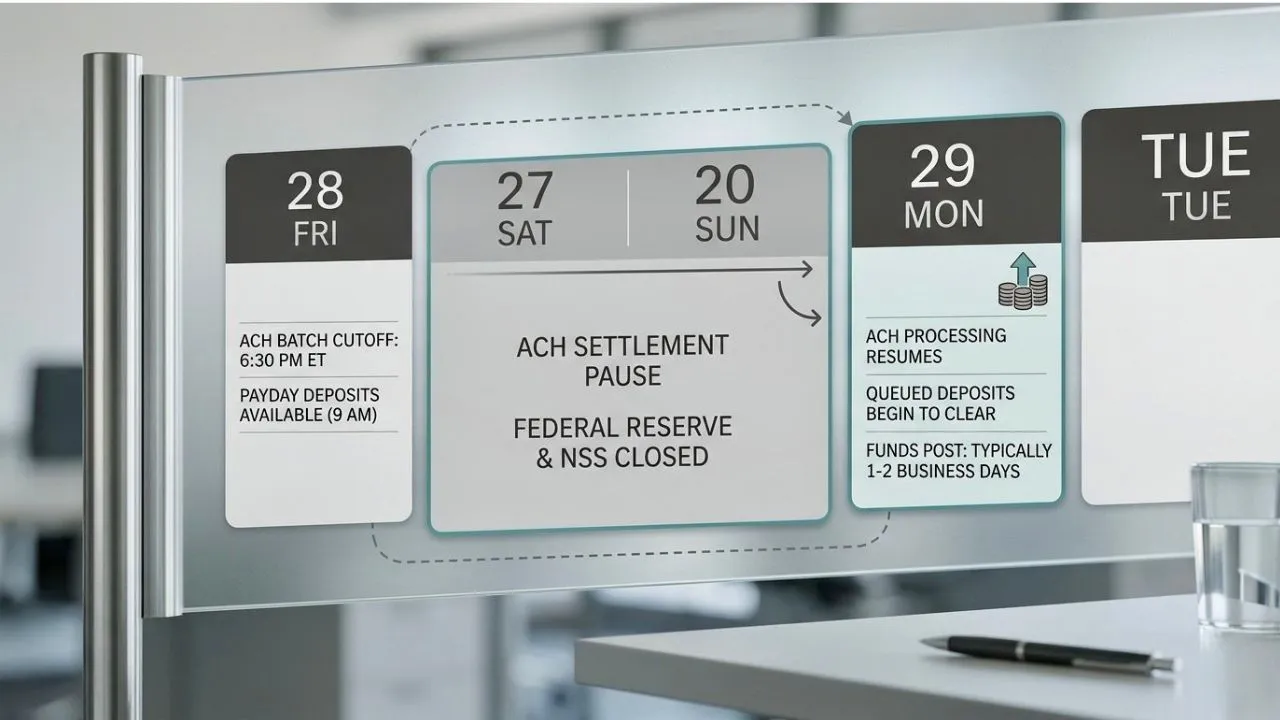
The ACH network does not settle payments on weekends or federal holidays. If your deposit was expected on Friday or over a holiday weekend, it will post Monday morning on the first available business day settlement window.
You checked your bank account on Saturday morning and saw zero. Your Social Security portal, IRS tracker, or agency payment page said the payment was sent on Friday. You are waiting and wondering whether something went wrong.
Nothing went wrong. The U.S. payment infrastructure runs on a schedule built around business days, and that schedule stops entirely on weekends and federal holidays.
The Federal Reserve, which operates the FedACH system that settles the large majority of U.S. government payments, does not process ACH settlements on Saturdays, Sundays, or any of the 11 federal holidays it observes each year.
When a payment is released on a Friday afternoon, it enters a queue that does not move until Monday morning’s first settlement window opens.
What You Need to Know Right Now
- The Federal Reserve does not process ACH settlements on weekends or federal holidays. Any payment file submitted after the last Friday window waits until Monday morning to clear.
- Friday is the highest-risk day for deposit delays. Payments released after the Friday afternoon cutoff do not reach banks until Monday, even though agency portals show them as sent.
- Federal holidays add exactly one business day to the standard ACH timeline. A holiday on Monday pushes the posting date to Tuesday morning.
- Monday mornings carry the largest deposit volume of any day. The entire weekend backlog clears overnight Sunday into Monday, which is why Monday postings can stagger between midnight and 9 AM.
- A Friday sent status with a zero Saturday balance is completely normal. The payment is queued and will clear Monday without any action from you.
- Back-to-back holiday weekends can create gaps of three or more days. If a federal holiday falls on the Friday before or the Monday after a weekend, plan for a Tuesday posting at minimum.
This guide explains every dimension of that weekend and holiday pause: why it exists, exactly how the Friday cutoff works, which federal holidays create deposit delays and by how many days, why Monday mornings see the heaviest deposit activity of the week.
And what to do if your deposit has not appeared by Monday at 9 AM. For a complete explanation of how every federal payment travels from agency to bank account, see How the U.S. Money Movement System Works.
Why Federal Payments Pause Over Weekends and Holidays
The ACH network is not a 24/7 real-time system. It is a batch processing infrastructure built on scheduled settlement windows that operate on business days.
The Federal Reserve’s FedACH service, which handles the large majority of federal government direct deposits, observes a specific operating calendar that excludes Saturdays, Sundays, and all 11 federally recognized holidays. The complete Federal Reserve holiday schedule is published at federalreserve.gov.


When the last FedACH settlement window of Friday closes, no further ACH settlement occurs until the first window of Monday morning. Any payment file that the U.S. Treasury releases after that Friday cutoff enters the FedACH queue and sits there for the entire weekend.
The payment shows as sent in every government portal because it has left the Treasury. It has not cleared FedACH because FedACH is not operating. Your bank has not received it because FedACH has not forwarded it yet.
This pause is not a malfunction, a freeze, or an account-specific problem. It is the designed operating schedule of the U.S. payment infrastructure. It applies equally to every recipient of every federal payment regardless of bank, location, or payment type. The pause resolves automatically at the opening of Monday’s first settlement window without any action from any recipient.
Understanding this distinction between a payment being sent and a payment being settled removes the anxiety from every Friday-into-Monday gap. The Federal Payment Sent But Balance Zero guide explains this sent versus settled distinction in full detail for every type of federal payment.
The Friday Afternoon Cutoff and What It Means for Your Money
The Friday cutoff is the most important single concept for understanding weekend deposit delays. FedACH runs its final ACH settlement window of the week on Friday afternoon.
Payments submitted to FedACH before that window closes settle on Friday, complete interbank fund transfer, and forward to receiving banks in time for Friday evening or overnight posting. Most recipients whose payments clear the Friday window see their deposits by Saturday morning.
Payments submitted after the Friday window closes do not settle until Monday. This is true even if the sending agency released the payment file on Friday morning.
If Treasury releases a large Social Security batch on Friday afternoon and the file arrives at FedACH after the final window has already processed, the entire batch waits in queue until Monday morning. The SSA portal shows all those payments as sent on Friday. Every recipient’s bank shows zero through the entire weekend. Monday morning, all of them post.
The practical implication is significant. Social Security retirement and disability payments for recipients whose payment date falls on a Monday are routinely pre-sent by the SSA on the prior Friday to ensure Monday posting.
If that Friday pre-send arrives at FedACH after the cutoff, the Monday posting can slip to Tuesday for some receiving banks. The official SSA benefit payment calendar, which shows scheduled payment dates by recipient birthday, is published at ssa.gov.
Some banks and fintech apps partially insulate recipients from the Friday cutoff by offering early direct deposit. These institutions advance funds from recognized originator files before FedACH settlement completes, which means some Chime, Varo, and similar account holders see Friday-released payments on Thursday or Friday morning.
This early access is a bank-level feature, not an ACH network feature. It is not available at all institutions and does not apply to all payment types.
Federal Holiday Deposit Delays
Every federal holiday that falls on a business day adds one business day to the standard ACH processing timeline. The Federal Reserve observes 11 holidays per year. Each one creates a predictable deposit delay for payments scheduled to clear on or immediately before that holiday.
The 11 Federal Reserve holidays are New Year’s Day, Martin Luther King Jr. Day, Presidents Day, Memorial Day, Juneteenth National Independence Day, Independence Day, Labor Day, Columbus Day, Veterans Day, Thanksgiving Day, and Christmas Day.
When any of these falls on a Saturday, the Federal Reserve observes the preceding Friday. When any falls on a Sunday, the Federal Reserve observes the following Monday.
The delay pattern for each holiday follows a simple rule. A payment scheduled to post on the holiday date instead posts on the next business morning.
A payment scheduled for Monday when Monday is a federal holiday posts Tuesday morning. A payment scheduled for Friday when Friday is the observed holiday posts Monday morning instead, and that Monday posting then competes with the standard weekend backlog.
Back-to-back scenarios create the longest gaps. When a federal holiday falls on the Friday before a three-day weekend, payments released Thursday afternoon can face a gap of three full days before posting.
A payment released Thursday after the Thursday window closes would miss Thursday settlement, miss Friday entirely because it is a holiday, miss Saturday and Sunday because those are non-operating days, and finally clear Monday morning.
The gap between sent and posted in that scenario spans from Thursday evening to Monday morning, covering four calendar days with no settlement activity. For a detailed explanation of how FedACH batch windows interact with holiday and weekend schedules at the operator level, see FedACH Settlement Delays Explained.
Monday and Tuesday Morning Deposit Patterns
Monday mornings carry the highest volume of direct deposit postings of any day of the week. Every payment file that accumulated in the FedACH queue from Friday afternoon through Sunday evening clears in Monday’s first settlement window. That single window contains the entire weekend backlog for millions of recipients across every federal benefit program, private payroll, and other recurring ACH payments.
Receiving banks handle this Monday volume surge in different ways. Large national banks with multiple daily posting cycles typically process the Monday morning FedACH wave and post credits to individual accounts between midnight and 6 AM, the same window they use every other day. Most recipients with large national bank accounts see their Monday deposits in the early morning hours, consistent with what they experience on other days.
Regional banks and credit unions that run a single daily posting cycle may stagger Monday postings differently. Because the volume of incoming ACH credits is higher on Monday than other days, some of these institutions process files in multiple passes rather than one overnight run.
The result is that some recipients see their Monday deposit at 6 AM and others see it at 8 or 9 AM, even though they bank at the same institution. This staggering is not an error and does not indicate any problem with the payment. For a full explanation of how bank posting cycles work on all days including Monday, see How Direct Deposits Process Overnight.
Tuesday patterns come into play when Monday is a federal holiday. In this scenario, Monday carries no settlement activity, and Tuesday morning absorbs both the standard Monday volume and any payments that would have settled on the holiday.
Tuesday after a Monday federal holiday is the heaviest single-day ACH volume event in a standard payment week. Recipients who bank with institutions that run once-daily posting cycles may see their Tuesday deposits posting later than usual, sometimes not until late morning, as the institution processes the elevated incoming file volume.
If your deposit has not appeared by 9 AM on the Tuesday following a Monday holiday, check your bank app for a pending entry before calling anyone. For more on what pending means and what to do if the balance has not updated by 9 AM, see Early Morning Deposit Delay Explained.
What You Should Do Now
Weekend and holiday deposit delays follow predictable, self-resolving patterns. The correct response in nearly every case is to wait for the next business morning and check again before taking any action.
Step 1: Identify what day the payment was released and whether a weekend or holiday falls between that date and today. If the agency portal shows a Friday sent date and today is Saturday or Sunday, your deposit will post Monday morning. No action is needed. If Monday is a federal holiday, your deposit will post Tuesday morning. Still no action needed.
Step 2: On the first business morning after the weekend or holiday, check your bank app before 9 AM. Look first in the pending section. A pending entry confirms the payment cleared FedACH overnight and is waiting for your bank’s posting cycle to complete. It will post without any action from you.
Step 3: If no deposit and no pending entry appears by 9 AM on the first business day, call your bank. Ask the bank representative specifically whether an incoming ACH credit from the U.S. Treasury or the sending agency has been received for your account. The bank can see incoming files before they post to your available balance.
Step 4: If your bank confirms no ACH file has been received, check the sending agency portal. For Social Security and SSI payments, log in to your account at ssa.gov.
The official SSA payment calendar at ssa.gov shows the scheduled payment date and any holiday adjustments. For IRS refunds, check irs.gov/refunds. For VA payments, check VA.gov or eBenefits.
Step 5 (edge case): If the agency portal shows the payment was sent more than two full business days ago and your bank has no record of any incoming credit, request a formal payment trace. For Social Security: 1-800-772-1213. For IRS refunds: 1-800-829-1954.
For VA payments: 1-800-827-1000. For other federal payments: the Bureau of the Fiscal Service at 1-855-868-0151. A payment trace initiates a formal ACH network search for the specific credit entry and locates it if it was misdirected or held.
Conclusion
Weekend and holiday deposit delays are the single most predictable pattern in the U.S. federal payment system. The ACH network pauses on weekends and federal holidays by design. Payments released after Friday’s final settlement window wait in queue until Monday morning.
Federal holidays push that timeline forward by exactly one business day. Back-to-back scenarios extend the gap further but always resolve on the first available business morning.
The deposit delays you experience every weekend are not errors, holds, or account problems. They are the scheduled behavior of a payment infrastructure that processes over 31 billion transactions per year on a business-day calendar. Knowing that calendar eliminates the anxiety from every Friday-into-Monday gap and every holiday weekend wait.
What You Should Do Now
- Check the agency portal right now and note the sent date. If the sent date was a Friday or the day before a federal holiday, your deposit posts on the next business morning without any action.
- On Monday morning or the first business day after the holiday, open your bank app and check the pending section before checking your available balance.
- Wait until 9 AM on that first business morning before calling your bank. Monday mornings carry peak ACH volume and some banks stagger postings across multiple windows into late morning.
- If no pending entry and no deposit appears by 9 AM on the first business day, call your bank and ask whether an ACH credit from the sending agency is queued for your account.
- If your bank confirms no file received and two full business days have passed since the sent date, contact the sending agency and request a formal payment trace using the helpline numbers above.
Editorial Note: Investozora is an independent news publication. This content is for informational purposes only. For official guidance, please visit the relevant .gov website.