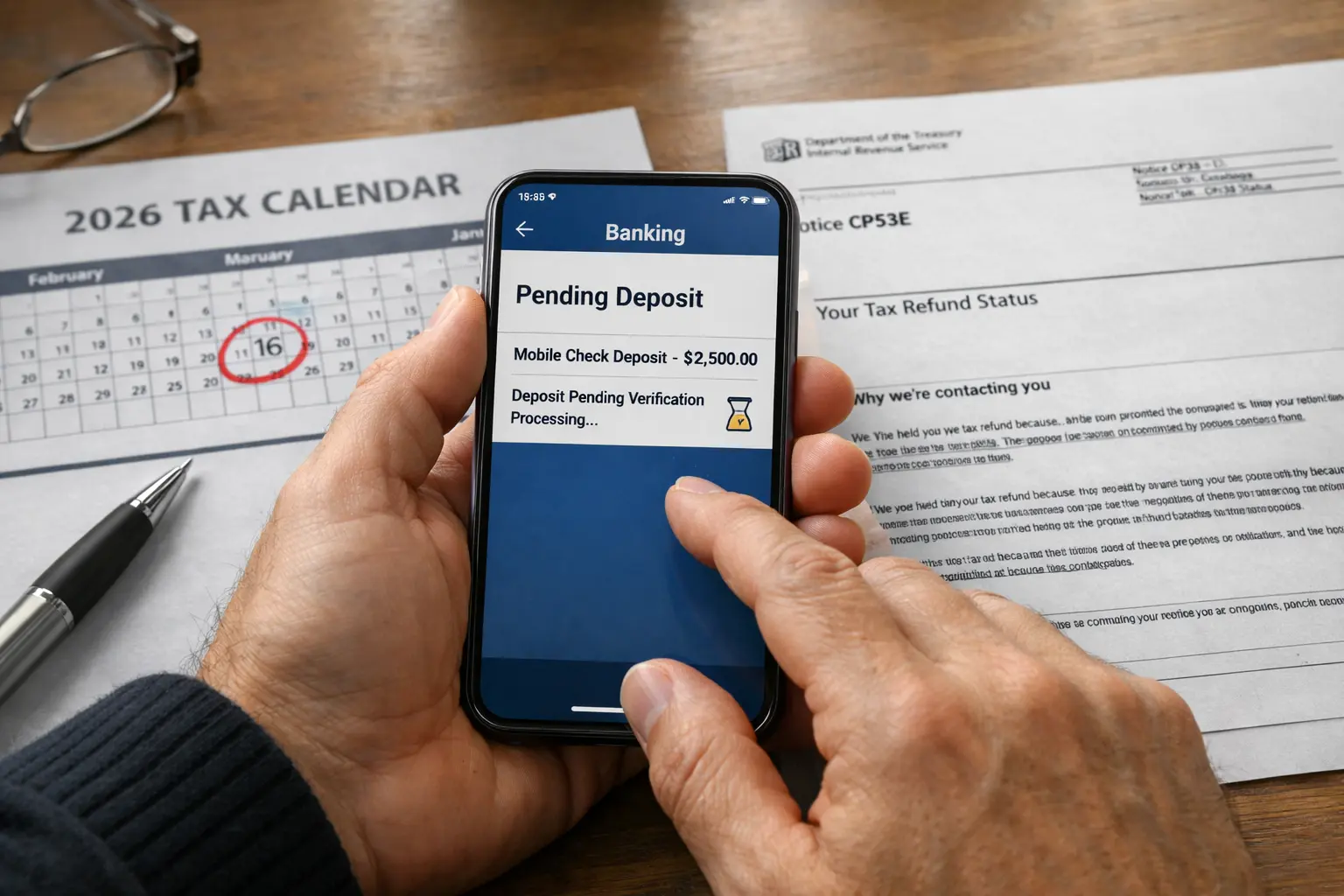
At 6:43 AM, two phones sit on the same kitchen counter. One screen already shows a federal deposit. The other still displays yesterday’s balance. Both payments were released overnight. Both traveled through the same national clearing systems.
Yet only one bank made the funds visible. This daily contrast reflects deposit posting timing, not when money was sent, but how institutions manage settlement exposure before releasing balances. Posting speed reflects engineered risk tolerance, not transmission speed.
Banks do not share a posting clock
Every U.S. bank connects to the same clearing infrastructure. ACH networks transmit deposits. Federal Reserve accounts settle balances. Treasury systems release federal payments.
What differs is how institutions choose to expose funds before every layer finishes reconciling. Some banks post early by design. Others wait by policy. The infrastructure is shared. The risk philosophy is not.
How early-posting banks engineer speed
Institutions that post deposits before full settlement operate with controlled exposure. Once payment files pass validation checks, these banks provisionally credit customer accounts. The ledger updates even while deeper clearing layers continue processing.
This approach relies on intraday liquidity buffers. Treasury desks maintain reserve capacity specifically to absorb early posting risk specifically between file receipt and final confirmation. If a batch later adjusts, internal offsets resolve the difference. Customers see funds early.
The bank carries temporary exposure. This is not casual acceleration. It is calculated liquidity engineering. Early-posting institutions model reversal rates, batch failure scenarios, and reconciliation variance daily. Posting speed becomes a managed operational cost.
Why late-posting banks delay visibility
Other institutions treat provisional credit as unnecessary risk. They hold deposits invisible until settlement layers confirm reserve alignment, queue resolution, and ledger integrity. No exposure window exists. No temporary imbalance occurs. Balances appear later, but with full certainty.
This design lowers liquidity strain. It reduces reconciliation complexity. It nearly eliminates adjustment scenarios. Late posting is not inefficiency. It is conservative control. These banks sacrifice early visibility in exchange for precision.
Clearing queues quietly shape morning differences
Inside national payment systems, transactions do not finalize simultaneously. Files move through priority bands. Large government payments often process earlier. Commercial deposits may settle later. Certain batches clear in early overnight processing cycles. Others close closer to dawn.
Banks that credit upon file receipt release funds as batches arrive. Banks that wait for queue completion release after cycle closure. Two deposits released together can reconcile hours apart. The clearing hierarchy itself creates posting differences among institutions.
Reserve verification decides when balances unlock
Before many institutions release funds, internal systems confirm Federal Reserve account positions. Incoming credits must align with reserve balances. Adjustments must settle. Liquidity thresholds must hold. If reserve positions remain unsettled, posting pauses.
Only once balances reconcile does the ledger permit visibility. These checks usually complete in early morning windows. Not because money arrived then. Because verification finished then.
Why 8:00–9:00 AM dominates national posting
Across the country, most late-posting banks cluster new balance updates between 8:00 and 9:00 AM local time. This window aligns multiple operational layers: Overnight ACH settlement cycles close. Federal Reserve systems reopen for real-time transfers. Reserve balances update.
Ledger rollover processes finalize. Once these systems synchronize, conservative institutions release funds. Early-posting banks already credited hours earlier.
The cluster reflects institutional rhythm, not payment release time. Readers who want deeper context on how funds move nationally can review Investozora’s overview of the money movement system.
ACH batch completion drives overnight gaps
Most payroll deposits, refunds, and federal benefits clear through ACH cycles that complete overnight in stages. Some batches settle shortly after midnight. Others close closer to early morning cutoff timing limits. Banks that post on receipt release when batches arrive. Banks that wait for full cycle closure release later.
The timing gap between these strategies often spans several hours. This explains why one account updates before sunrise while another waits until breakfast. For a deeper look at how these clearing phases affect visibility, Investozora explains the process in its breakdown of settlement timing.
Fedwire reopening anchors conservative posting
Although ACH handles most consumer deposits, Fedwire still anchors daily liquidity coordination and certainty. Each morning, Fedwire reopens real-time gross settlement between institutions. Reserve movements finalize bank-to-bank positions.
Many conservative banks prefer this real-time confirmation before releasing ACH-based credits. The Federal Reserve outlines payment operations and daily settlement schedules within its official documentation. This real-time layer restores balance integrity across the system. It quietly signals when posting becomes operationally safe.
Treasury sequencing adds another timing layer
Federal payments follow structured release schedules coordinated through clearing systems. Large benefit waves distribute in controlled bursts. Some reconcile in early overnight cycles. Others settle later toward morning. Banks interpret these waves through their own posting philosophies.
Same Treasury release. Different visibility outcomes. The U.S. Treasury publishes disbursement guidance on federal payment processing and settlement coordination. These controls ensure payment reliability across thousands of institutions.
Ledger rollover controls the final moment
Every bank closes and reopens its books daily. During rollover, systems lock balances while adjustments, interest calculations, and settlement postings finalize. Some institutions complete rollover shortly after midnight. Others extend into early morning hours. Posting cannot occur until rollover ends.
This alone explains why certain banks never display deposits before a specific hour regardless of clearing speed. The ledger governs visibility. Not the payment itself. For readers curious about provisional balances that appear before final confirmation, Investozora details the mechanics behind pending deposits.
One system, two philosophies
All banks connect to the same national infrastructure. ACH clearing Federal Reserve settlement Treasury payment releases What differs is exposure management. Early-posting banks deploy liquidity buffers and risk models. Late-posting banks wait for certainty layers to close. Neither approach reflects faster money. Neither reflects delay. They reflect different institutional priorities. One favors continuity. One favors precision.
The morning balance gap, reframed
When two households check balances at 6:43 AM, they are not seeing speed. They are seeing policy. One institution chose provisional visibility supported by liquidity reserves. The other chose confirmed settlement before release. By mid-morning, most balances align.
The difference was never about when funds arrived. It was about when banks felt secure enough to show them. Early and late posting are simply different designs for managing liquidity safety, both built on the same system of deposit posting timing.
Author