
April 5, 2026 • 1:02 AM ET
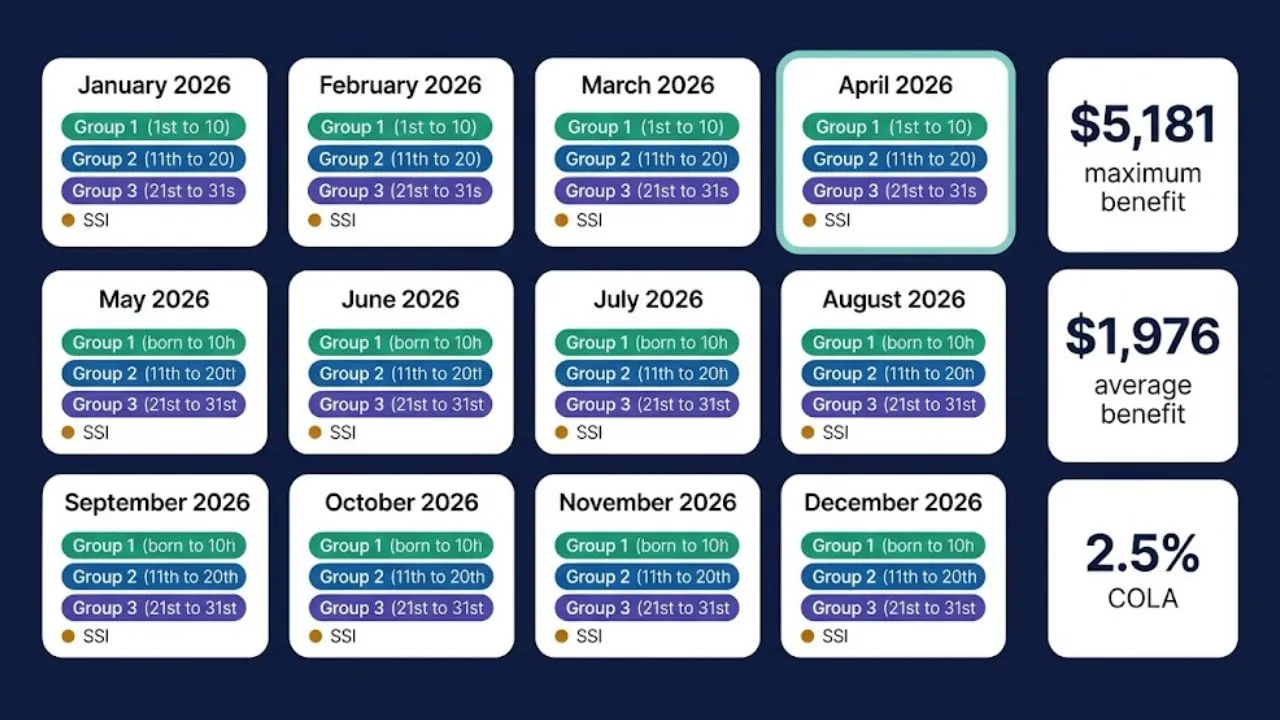
Social Security payments are issued on a Wednesday schedule based on your birth date: the second Wednesday (born 1st through 10th), third Wednesday (born 11th through 20th), or fourth Wednesday (born 21st through 31st) of each month. SSI is paid on the 1st. The maximum benefit at age 70 in 2026 is $5,181 per month. If your payment is late, wait until the end of your payment day before contacting the SSA.
If you receive Social Security payments, or expect to receive them soon, understanding exactly how the system works in 2026 is more important than in any recent year.
The SSA is navigating its largest workforce reduction in decades, implementing a landmark law that is adding billions of dollars in new payments to the system, and enforcing major new rules about how beneficiaries can manage their accounts.
For the more than 70 million Americans who depend on these payments, the margin for confusion is narrowing. This guide covers the complete picture. It explains how the payment system is structured, provides the full 2026 payment calendar for every birth-date group, details the current maximum and average benefit amounts.
Explains every reason a Social Security payment can be late or missing in 2026, covers every major policy change now in effect as of April 4, 2026, and gives you a precise action protocol for every scenario where a payment does not arrive as expected.
Social Security Payments 2026
- Social Security retirement and disability payments follow a three-group birth-date schedule. Your payment arrives on a specific Wednesday each month, not on the 1st.
- The maximum Social Security retirement benefit at full retirement age 70 in 2026 is $5,181 per month, reflecting the 2.5% COLA adjustment effective January 2026.
- The average Social Security retirement benefit as of early 2026 is approximately $1,976 per month after the COLA increase took effect.
- The SSA reduced its workforce from approximately 57,000 to 50,000 employees in early 2026. This reduction is causing measurable processing delays that are affecting first-time applicants and benefit changes most severely.
- The Social Security Fairness Act was signed into law and the SSA began issuing retroactive payments in early 2026, delivering an estimated $17 billion in back payments to approximately 3.2 million affected beneficiaries.
- As of April 14, 2026, the SSA no longer accepts direct deposit changes made by phone. All direct deposit updates must now be made through your My Social Security online account or in person at a field office.
Social Security payments represent the financial foundation of retirement and disability income for tens of millions of households. That foundation is sound in its long-term design, but the operational environment in 2026 is more complex than usual. The knowledge in this guide is the operating manual for navigating it with accuracy and without unnecessary alarm.
How Social Security Payments Work: The Complete System
The Social Security Administration does not send money directly from its offices to your bank account. The payment moves through a multi-agency pipeline that spans the SSA, the U.S. Treasury, the Automated Clearing House (ACH) network, and your financial institution. Understanding each stage removes the uncertainty that causes most beneficiaries to panic unnecessarily when a payment seems late.
Stage 1: SSA determines your eligibility and benefit amount
The SSA calculates your benefit based on your earnings record, your age at the time you filed, your filing date, and applicable deductions such as Medicare Part B premiums. Once your benefit is established, the SSA transmits a payment instruction to the U.S. Treasury on a pre-scheduled cycle.
Your benefit amount is recalculated at the start of each year to reflect the Cost of Living Adjustment (COLA). For 2026, the COLA was set at 2.5%, raising the average monthly payment from approximately $1,927 to approximately $1,976. Individual amounts vary based on your specific earnings history and filing age.
Stage 2: Treasury disburses through ACH
The Bureau of the Fiscal Service, which is the payment arm of the U.S. Treasury, receives the SSA’s payment file and transmits it through the ACH network. ACH processes in business-day batches. It does not process on weekends or federal holidays. When your scheduled payment date falls on a weekend or holiday, the Treasury advances the payment to the preceding business day.
Stage 3: Your bank posts the deposit
Your bank or credit union receives the ACH credit file and posts it to your account. Most institutions post Social Security deposits early in the morning on the payment date. Some smaller institutions post later in the day. The SSA cannot control or accelerate your bank’s internal posting schedule.
The three birth-date payment groups
Social Security retirement and disability (SSDI) payments are distributed across three groups to reduce the operational load on the Treasury and ACH systems. Your group is determined entirely by your birth date.
Your payment date has nothing to do with when you filed, how long you have been receiving benefits, or which state you live in. It is fixed by law based on the day of the month on which you were born.
Supplemental Security Income (SSI) operates on a completely separate schedule. SSI is paid on the 1st of each month for most recipients. When the 1st falls on a weekend or federal holiday, SSI is paid on the last business day before the 1st.
Beneficiaries who began receiving payments before May 1997 also receive their payments on the 3rd of each month, regardless of birth date. This legacy group is a separate category from the three standard groups.
The three groups and their 2026 payment dates are as follows.
Group 1: Born on the 1st through the 10th of any month Payments arrive on the second Wednesday of each month. Group 2: Born on the 11th through the 20th of any month Payments arrive on the third Wednesday of each month.
Group 3: Born on the 21st through the 31st of any month Payments arrive on the fourth Wednesday of each month. The complete 2026 schedule with exact dates for each group is below. Holiday shifts are noted where the standard date is moved.
2026 Social Security Payment Schedule: Complete Calendar
This is the authoritative 2026 payment schedule for all three birth-date groups plus SSI. All dates are sourced from the official SSA payment calendar. This section is the featured snippet target for “Social Security payment dates 2026” and every monthly variation of that search.
| Month | Group 1 (2nd Wed) | Group 2 (3rd Wed) | Group 3 (4th Wed) | SSI (1st or prior day) |
|---|---|---|---|---|
| January 2026 | January 14 | January 21 | January 28 | January 2 (Dec 31 paid early) |
| February 2026 | February 11 | February 18 | February 25 | February 3 (moved from Feb 1) |
| March 2026 | March 11 | March 18 | March 25 | March 3 (moved from Mar 1) |
| April 2026 | April 8 | April 15 | April 22 | April 1 |
| May 2026 | May 13 | May 20 | May 27 | May 1 |
| June 2026 | June 10 | June 17 | June 24 | June 1 |
| July 2026 | July 8 | July 15 | July 22 | July 1 |
| August 2026 | August 12 | August 19 | August 26 | August 3 (moved from Aug 1) |
| September 2026 | September 9 | September 16 | September 23 | September 1 |
| October 2026 | October 14 | October 21 | October 28 | October 1 |
| November 2026 | November 11 | November 18 | November 25 | November 3 (moved from Nov 1) |
| December 2026 | December 9 | December 16 | December 23 | December 1 |
When the standard Wednesday falls on a federal holiday, the SSA advances payment to the Tuesday before. The most notable 2026 shift occurs around federal holidays in November and January. For the most current schedule adjustments as they occur, verify dates at the SSA payment calendar.
For details on the March 2026 specific payment dates and any alerts affecting the March payment schedule, see the dedicated monthly guide.
Social Security Benefit Amounts in 2026
Understanding the benefit amount landscape gives every beneficiary context for whether their payment is reasonable, whether they are leaving money on the table, and how changes in 2026 affect their specific situation.
The 2026 COLA adjustment
The Social Security Administration applies a Cost of Living Adjustment each January based on the Consumer Price Index for Urban Wage Earners and Clerical Workers (CPI-W). For 2026, the COLA was set at 2.5%. This is lower than the 3.2% adjustment applied in 2025 but reflects a moderation in the inflation rate as measured over the comparison period.
For a beneficiary receiving $1,800 per month before the adjustment, a 2.5% COLA adds $45 per month, bringing the new payment to $1,845. The COLA applies automatically. No action is required from beneficiaries. The SSA sends a COLA notice in December of each year showing the new benefit amount.
Maximum and average benefit amounts
The maximum benefit amount in 2026 for a worker who files at the maximum delay age of 70 is $5,181 per month. This figure reflects the combination of maximum earnings history, delayed retirement credits accumulated from full retirement age to age 70, and the 2026 COLA adjustment.
It is not a target that most beneficiaries can reach. It represents the absolute ceiling for a worker who earned at or above the Social Security wage base for 35 or more years and deliberately delayed filing until age 70.
The maximum benefit for a worker filing at full retirement age (currently 67 for anyone born after 1960) is lower. The full retirement age maximum in 2026 is approximately $4,018 per month. Filing early at age 62 permanently reduces the benefit to a maximum of approximately $2,831 per month.
The average Social Security retirement benefit in early 2026 is approximately $1,976 per month. This figure includes all retirement beneficiaries, which means the average is pulled down by beneficiaries with shorter earnings histories, lower lifetime wages, and early filing decisions.
What determines your individual benefit
Five factors determine your monthly benefit amount. Your earnings history is the primary driver. The SSA uses your 35 highest-earning years to calculate your Average Indexed Monthly Earnings (AIME). If you worked fewer than 35 years, the SSA fills in zeros for the missing years, which reduces the average.
Your filing age is the second major factor. Filing at 62 permanently reduces your benefit by up to 30% compared to your full retirement age benefit. Filing at 70 increases your benefit by 8% per year for each year you delay past full retirement age, up to a maximum of approximately 24% to 32% above your full retirement age benefit depending on your birth year.
Medicare Part B premiums are deducted directly from your Social Security payment before it reaches your bank account. In 2026, the standard Part B premium is $185 per month.
Beneficiaries with higher incomes pay Income-Related Monthly Adjustment Amounts (IRMAA) that can substantially increase this deduction. The net deposit in your bank account will be lower than your gross benefit amount by at least $185 if you are enrolled in Medicare Part B.
Why Social Security Payments Get Delayed in 2026
Social Security payments run on a predictable schedule, but a meaningful subset of beneficiaries experience delays in any given month. The causes in 2026 include both longstanding system factors and new operational realities specific to this year.
| Delay cause | Typical duration | Affects ongoing beneficiaries? | Action required? |
|---|---|---|---|
| Weekend or holiday shift | 1 day early | Yes (calendar adjustment) | No. Check prior business day. |
| Bank posting schedule | Same day, later | Yes (minor) | No. Wait until end of business day. |
| SSA workforce reduction | Weeks to months added | New applicants and changes only | Yes if awaiting new award or change. |
| Incorrect direct deposit info | 2 to 4 weeks for paper check | Yes | Yes. Update at ssa.gov/myaccount immediately. |
| First payment processing | 30 to 90 days from award | New beneficiaries only | No (unless beyond 90 days). |
| SSA system interruptions | Hours to days | Yes (status visibility) | Check ssa.gov/news/press for alerts. |
| SSI calendar double-payment | Not a delay | SSI recipients | No action needed. |
Weekend and holiday schedule shifts
The most common reason a Social Security payment appears one to three days early or late is a calendar shift. The SSA advances payments when the standard payment date falls on a weekend or federal holiday because the ACH network does not process on those days. This is not a delay. It is an expected adjustment.
The confusion arises when beneficiaries check their accounts on the standard Wednesday and find nothing. For months where the payment was advanced to Tuesday, the deposit already arrived the day before.
For months where a holiday falls on a Wednesday payment day, the deposit arrives on Tuesday. For the complete explanation of how weekend payment delays interact with bank posting schedules, see the dedicated guide.
SSA workforce reduction and processing slowdowns
In early 2026, the SSA reduced its workforce from approximately 57,000 to approximately 50,000 employees, representing a reduction of roughly 12% of total staff.
This reduction is not affecting the automated payment disbursement system for existing beneficiaries in the short term. Payments to current beneficiaries continue to process on the standard schedule through the automated pipeline.
The workforce reduction is, however, causing measurable delays in three specific areas: new benefit applications, benefit recalculations including those triggered by the Social Security Fairness Act, and telephone customer service response times.
If you are a current beneficiary receiving your regular payment, the workforce reduction is unlikely to affect your April 2026 deposit. If you are awaiting a new award, a benefit recalculation, or a change request, the processing timeline may be extended by weeks to months depending on field office staffing levels.
The SSA’s national technology infrastructure also experienced multiple system interruptions in early 2026 that affected online account access and, in some cases, delayed payment status updates visible in My Social Security accounts. For the current status of system changes and their operational impact, see the SSA national system guide.
Bank posting schedule differences
Social Security deposits are transmitted by the Treasury as ACH credits with a specific effective date. Your bank is required to post the credit no later than the effective date.
Most major banks post early in the morning, and many beneficiaries see deposits before 9 a.m. on their payment date. Some credit unions and smaller community banks post later in the business day.
If your payment date is a Wednesday and your bank posts ACH credits at 11 p.m. rather than 9 a.m., your balance will not reflect the deposit until late in the day. This is not a delay from the SSA’s perspective. The payment was transmitted on time. Your bank’s internal schedule determines when you see it.
Incorrect direct deposit information
If your bank account number, routing number, or account type on file with the SSA is incorrect, your payment will fail at the ACH level. The Treasury returns the uncredited payment to the SSA, which then reissues it by paper check. This reissuance process adds two to four weeks to your payment timeline.
The SSA changed its direct deposit verification rules in early 2026. As of April 14, 2026, direct deposit changes by phone are no longer accepted. All changes must be made through your My Social Security account at ssa.gov/myaccount or in person at a field office.
If your bank account is changing or has already changed, update your SSA direct deposit information immediately and do not wait until a payment fails.
First-time benefit processing delays
When a beneficiary receives their first Social Security payment, the processing timeline is different from ongoing payments. New awards typically enter the payment system within 30 to 90 days of the SSA’s award decision, depending on staffing and workload. With the current workforce reduction, first payment processing for new awards is running at the longer end of this range or beyond.
New SSI recipients may also experience a gap between their eligibility determination and first payment. The SSA may issue back pay for the months between your determined eligibility date and your first actual payment, but this back payment is processed separately and may arrive weeks after the first ongoing monthly payment.
The SSI double-payment phenomenon and what it means
SSI recipients sometimes receive what appears to be two payments in a single month. This is not a system error. It occurs when a scheduled payment day falls in the next calendar month but the SSA advances the payment to the current month to avoid a delay.
The two payment groups dynamic occurs because the SSI schedule shifts forward when the 1st is a weekend or holiday, which can result in a calendar month where two payments appear and the following month appears to have none. Neither the extra payment in one month nor the absent payment in the next month requires any action from the recipient.
Major SSA Policy Changes in 2026 (Updated April 5, 2026)
The Social Security Administration has implemented more significant operational and policy changes in 2026 than in any year in recent memory. Each of the changes below is now in effect and directly affects beneficiaries.
The Social Security Fairness Act: $17 billion in new payments
The Social Security Fairness Act was signed into law in late 2024 and the SSA began implementing it in early 2026. The law eliminates two longstanding provisions that had reduced Social Security benefits for certain public sector workers: the Windfall Elimination Provision (WEP) and the Government Pension Offset (GPO).
The Fairness Act implementation is the largest single expansion of Social Security benefits in decades. Approximately 3.2 million affected beneficiaries are receiving increased monthly payments going forward.
They are also receiving retroactive payments covering the period from January 2024 through the date their recalculation was completed. The total retroactive obligation is estimated at $17 billion. The SSA began issuing these retroactive payments in March 2026 and expects to complete the full distribution by mid-2026.
If you are a retired teacher, firefighter, police officer, or other public employee who received a government pension alongside Social Security, and you have not yet seen an adjustment in your benefit, check your My Social Security account. Your case may be in the processing queue. Contact the SSA if your recalculation has not been applied by May 2026.
April 14, 2026: end of phone-based direct deposit changes
Effective April 14, 2026, the SSA no longer processes direct deposit changes submitted by telephone. This policy change affects every beneficiary who would normally call 1-800-772-1213 to update banking information. All direct deposit changes must now be completed through your My Social Security account at ssa.gov/myaccount or in person at an SSA field office.
The rationale for this change is fraud prevention. Phone-based account changes had become a vector for benefit theft, where fraudsters impersonated beneficiaries to reroute payments to accounts they controlled. The SSA’s online verification system provides a higher level of identity assurance than phone-based authentication.
If you do not have or cannot create a My Social Security online account, visit your nearest SSA field office with government-issued photo identification. Field office wait times have increased since the workforce reduction, so scheduling an appointment online before visiting is strongly recommended.
Workforce reduction from 57,000 to 50,000 employees
The SSA’s staffing decline from approximately 57,000 to 50,000 employees in early 2026 represents the agency’s lowest staffing level in decades as a percentage of workload. The SSA serves more beneficiaries today than at any point in its history, and the workforce reduction means each remaining employee is managing a larger caseload.
For existing beneficiaries receiving regular payments, the practical impact is primarily in customer service responsiveness. Average telephone hold times at 1-800-772-1213 have increased significantly since the reductions began. The SSA national system guide provides the current operational status and updated contact guidance for navigating SSA services efficiently during this period.
For new applicants and those awaiting benefit changes, processing delays have extended timelines materially. Plan accordingly and do not assume a standard timeline applies to your case in 2026.
How to Check Your Social Security Payment Status
Every beneficiary should have an active My Social Security account. It is your primary tool for verifying payment status, checking benefit amounts, updating contact information, and downloading official benefit documentation.
Creating your My Social Security account
Visit ssa.gov/myaccount and select “Create an Account.” You will need your Social Security number, a valid email address, a U.S. mailing address, and a smartphone or device capable of receiving verification codes. The SSA uses identity verification through Login.gov. If you already have a Login.gov account from another federal agency, you can use those credentials.
If you are unable to complete online identity verification, the SSA offers in-person account setup assistance at field offices. Call 1-800-772-1213 to locate your nearest office or to schedule an appointment.
Checking your payment date and amount
After logging in, navigate to “Benefits and Payments” to see your scheduled payment dates, your current monthly benefit amount after deductions, and your payment history. The history view shows every payment the SSA has issued to your account, which is useful for confirming whether a payment was transmitted even when your bank has not yet posted the deposit.
Updating your direct deposit information
Within your My Social Security account, navigate to “Direct Deposit” to update your bank routing number and account number. Changes take effect within one to two business cycles, typically meaning your next scheduled payment will process to the new account if the change is made at least one week before your payment date. Remember: as of April 14, 2026, this cannot be done by phone. It requires an online account or a field office visit.
Downloading your benefit verification letter
A benefit verification letter is an official SSA document showing your current monthly benefit amount. It is accepted by lenders, housing authorities, and government agencies as proof of income. Download it instantly from your My Social Security account under “Get a Benefit Verification Letter” at any time without calling or visiting the SSA.
For issues where the SSA’s online account portal is not functioning, check the SSA’s service status updates at ssa.gov/news/press for current system alerts.
What to Do When Your Social Security Payment Is Missing
When your payment date arrives and no deposit appears in your account, the correct response depends on how much time has passed and what information you have. The protocol below applies in order.
Step 1: Check your payment date precisely
Confirm your exact 2026 payment date using the calendar in this guide or at ssa.gov/pubs/calendar.htm. Many beneficiaries contact the SSA on the wrong day because they assume payment arrives on the 1st rather than their birth-date Wednesday. Verify which group you belong to before taking any further action.
Step 2: Check whether a holiday shift applied
If your payment date fell on or near a federal holiday, the payment may have been advanced to the prior Tuesday. Check your account for a deposit on the business day before your standard Wednesday.
Step 3: Check your bank for a pending transaction
Your bank may have received the ACH credit but not yet posted it to your visible balance. Most banks show pending transactions. If a deposit appears pending, wait until end of business day. The SSA considers a payment delivered once the ACH credit is transmitted, even if your bank posts it later in the day.
Step 4: Log into your My Social Security account
At ssa.gov/myaccount, check your payment history for the current month. If the SSA’s system shows a payment was issued, the problem is downstream at the ACH or bank level. If the system shows no payment was issued, contact the SSA.
Step 5: Wait until end of payment day before calling
The SSA advises beneficiaries not to call until the end of their payment day. A payment that does not appear in the morning may post by afternoon. Calling during business hours before end of day generates a “payment is in transit” response that adds no information.
Step 6: Call the SSA at 1-800-772-1213
Call early in the morning for shortest wait times. Have your Social Security number, date of birth, bank account information, and your My Social Security account payment history ready. The SSA can confirm whether a payment was transmitted, identify whether it was returned due to incorrect deposit information, and initiate a trace if necessary.
Step 7: Visit a field office if phone service is not accessible
With reduced staffing, phone hold times at the SSA in 2026 are significantly elevated. If you cannot reach a representative by phone after multiple attempts, visit a local SSA field office. You can find your nearest office and check appointment availability at ssa.gov. Bring photo identification, your Social Security card, and your banking information.
Understanding where Social Security fits in the full federal disbursement ecosystem gives additional context for why payments can encounter unexpected delays at the Treasury or ACH level. The complete architecture of that system is documented in the federal payment infrastructure guide.
Frequently Asked Questions About Social Security Payments
What day does Social Security get deposited?
Social Security retirement and SSDI payments are deposited on a Wednesday each month based on your birth date. Born 1st to 10th: second Wednesday. Born 11th to 20th: third Wednesday. Born 21st to 31st: fourth Wednesday. SSI is paid on the 1st of each month, or the preceding business day when the 1st falls on a weekend or federal holiday.
What is the maximum Social Security benefit in 2026?
The maximum Social Security retirement benefit for a worker who delays filing until age 70 is $5,181 per month in 2026. The maximum for a worker filing at full retirement age 67 is approximately $4,018 per month. Filing at age 62 reduces the maximum to approximately $2,831 per month.
What is the average Social Security check in 2026?
The average Social Security retirement benefit in 2026 is approximately $1,976 per month after the 2.5% Cost of Living Adjustment (COLA) effective January 2026. Individual amounts vary based on earnings history, years worked, and the age at which you filed.
Why did I get two Social Security payments this month?
If you receive SSI and see two deposits in one calendar month, this is the result of a scheduled calendar shift, not an error. The SSA advances payment when the 1st falls on a weekend or holiday. The following month will appear to have no payment. No repayment is required and no action is needed.
Can I still change my Social Security direct deposit by phone?
No. As of April 14, 2026, the SSA no longer accepts direct deposit changes by phone. All updates must be made through ssa.gov/myaccount or in person at a field office with government-issued photo ID. This policy is permanent and applies to all beneficiaries.
How long does it take to get my first Social Security payment?
For new applicants in 2026, allow 30 to 90 days from the SSA award decision to receive your first payment. Due to current staffing reductions, processing is running at the longer end of this range. Back pay for any months between your eligibility date and first payment is processed separately.
Will the Social Security Fairness Act affect my benefit?
If you are a retired public employee whose Social Security benefit was reduced by the Windfall Elimination Provision (WEP) or Government Pension Offset (GPO), yes. The SSA began recalculating affected benefits in early 2026 and is issuing increased payments plus retroactive back pay to approximately 3.2 million beneficiaries. Check ssa.gov/myaccount to see if your recalculation has been applied.
What happens if my Social Security payment goes missing?
If your payment was transmitted but not received, the SSA can initiate a payment trace. If the ACH payment was returned due to incorrect deposit information, the SSA reissues by paper check, which takes two to four additional weeks. Confirm your exact payment date and check your bank for pending transactions first, then call the SSA at 1-800-772-1213.
What This Means For You
The Social Security payment system is more stable than most public commentary suggests, but more operationally complex in 2026 than in most prior years. Here is what this guide’s full content means for your actual financial planning and benefit security.
Know your specific payment date and protect it. Your Social Security payment date is fixed by your birth date and is not the 1st of the month unless you are an SSI recipient or a pre-1997 beneficiary.
Writing down your exact 2026 payment dates from the calendar in this guide is the single action that prevents the most unnecessary anxiety when a deposit does not appear when expected.
Update your direct deposit now, not later. The April 14, 2026 deadline for phone-based changes has passed. If your bank account has changed or is about to change, the only path to updating your direct deposit is through your My Social Security account or a field office visit. A failed deposit means a two-to-four-week delay while the SSA reissues by paper check. Act immediately if your banking information is not current.
The workforce reduction affects new applicants and changes, not ongoing payments. If you are a current beneficiary receiving regular monthly Social Security payments, your payments continue to process through the automated pipeline and are not meaningfully affected by the staffing reduction.
If you are filing for benefits, awaiting a recalculation, or trying to reach SSA by phone, build in substantial additional time and use the online account as your primary tool.
The Fairness Act is adding real money to affected beneficiaries. If you are a former public employee whose Social Security benefit was reduced by the WEP or GPO, check your account. The SSA is processing retroactive payments worth thousands of dollars to eligible beneficiaries. If your recalculation has not been applied by May 2026, contact the SSA proactively.
A late Social Security payment is almost always a calendar issue, not a system failure. The overwhelming majority of payment concerns resolve when beneficiaries confirm their exact payment date, check for holiday shifts, and wait until end of business day before escalating. Knowing the system works as described here is more valuable than the phone number to call.
Create a My Social Security account before you need it. The beneficiaries who resolve payment issues fastest are those who already have active online accounts.
They can see their payment history, confirm transmissions, download verification letters, and update banking information without waiting on hold. Creating the account before any problem occurs is the highest-value preparatory step available to every beneficiary.
Sources: All payment dates, benefit amounts, and policy information in this Social Security payments guide reflect SSA published guidance current as of April 5, 2026. Payment schedule at ssa.gov/pubs/calendar.htm. Account management at ssa.gov/myaccount. System alerts and news at ssa.gov/news/press. Workforce and policy announcements via SSA workforce announcement.
Editorial standard: This article is written and maintained to YMYL accuracy standards. All factual claims reference primary SSA and federal government sources. This guide describes how the Social Security payments system operates and does not constitute financial or legal advice for individual circumstances.