

Updated: June 22, 2026 – Nacha’s updated Rule 9AM, which mandates direct deposit availability by 9:00 AM local time on the settlement date for all receiving depository institutions, is fully in effect across the ACH network as of its 2026 compliance deadline. Verified at nacha.org.
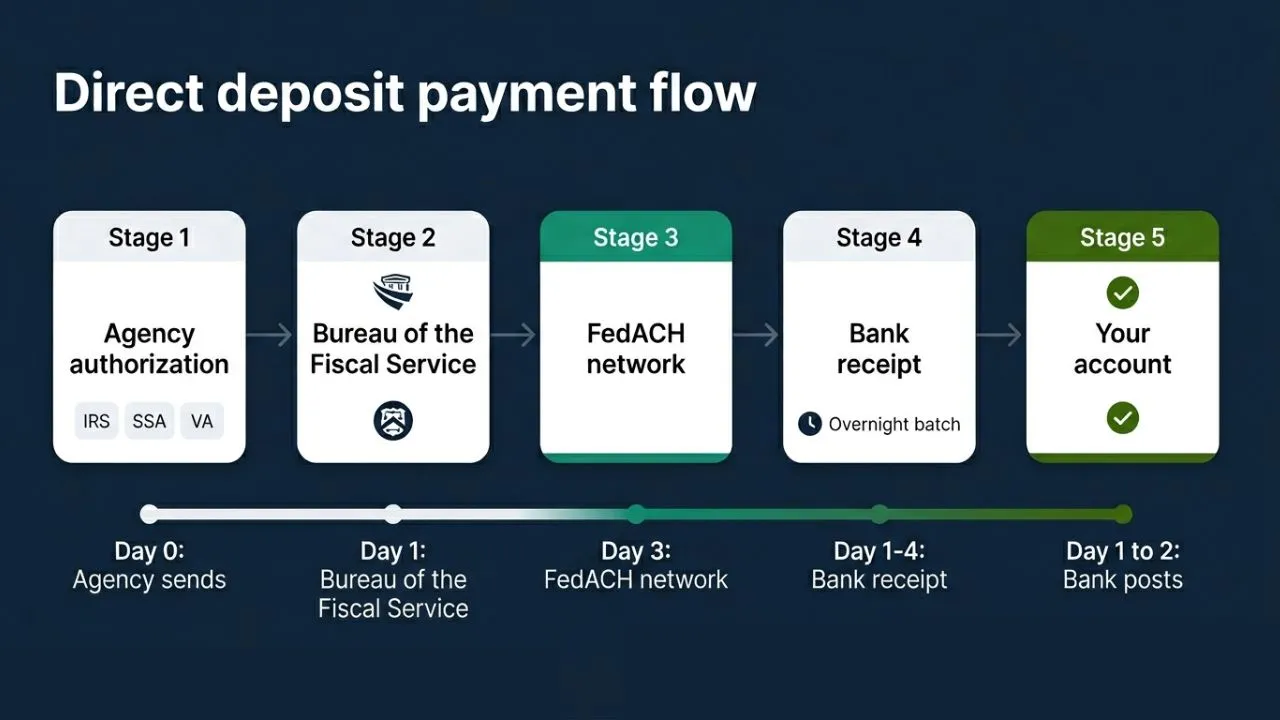
Direct deposit time depends on your bank, not on when the government or your employer sends the money. The federal agency or payroll system transmits the payment file one to two days before your scheduled deposit date.
Your bank receives that file and decides when to release the funds into your account. Nacha rules require your bank to make the money available no later than 9 AM local time on the settlement date.
The question millions of Americans type into a search engine the morning their deposit is due comes down to one practical concern: the money was sent, the portal says it is on its way, but the account balance has not moved.
Understanding direct deposit time requires understanding a three-layer system in which the federal agency, the Federal Reserve, and your individual bank each play a distinct role with their own processing clock. None of those clocks run in real time. All of them run on scheduled settlement windows that most bank customers have never been shown.
The pipeline begins when a federal agency, the Social Security Administration, the IRS, the Department of Veterans Affairs, or the U.S. Treasury for other government payments, creates an ACH credit instruction file.


That file does not carry actual money. It carries instructions that say, in precise federal payment terminology: on this specific settlement date, credit this account number at this routing number with this exact dollar amount.
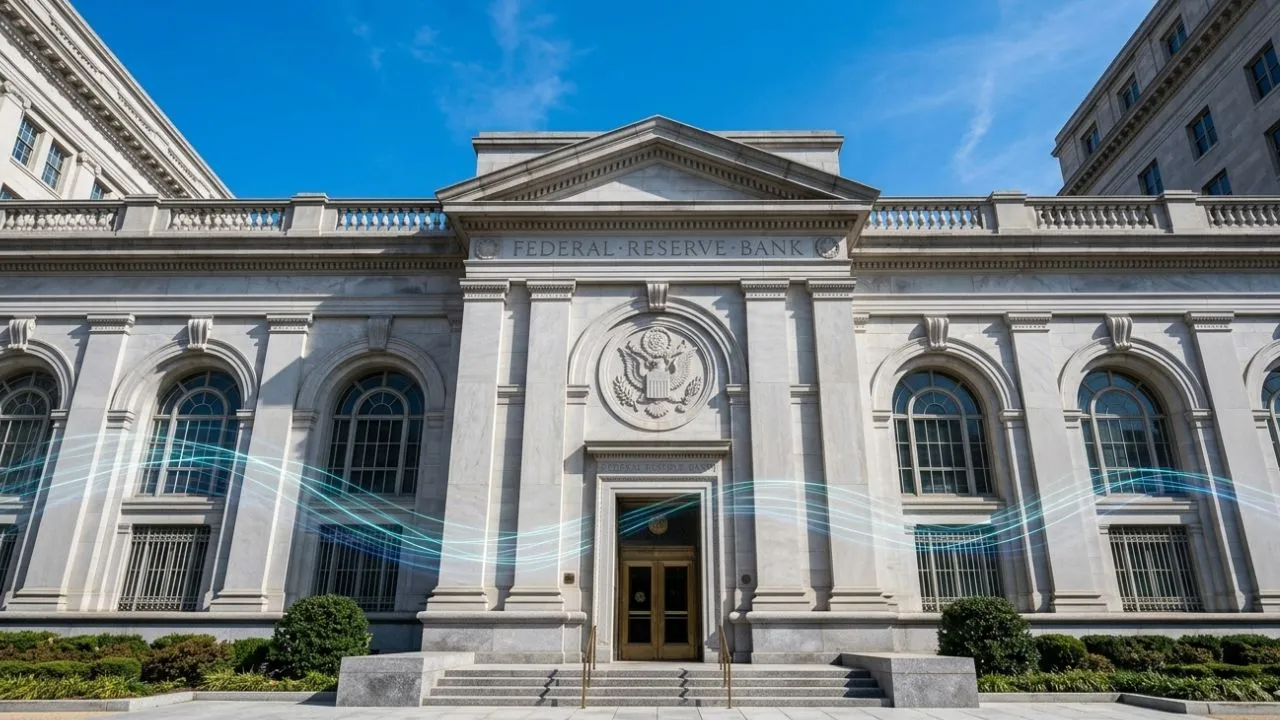
The file travels from the originating agency to the Federal Reserve Bank that serves as the ACH operator for that payment batch. The Federal Reserve holds that file until it processes the settlement. That settlement is not instantaneous.
It occurs at specific windows throughout the banking day. The complete architecture of how that file moves from the federal agency through the Treasury and Federal Reserve into your account is documented in the US money movement system reference guide.
The Nacha 9AM Rule Explained
Nacha, the organization that governs the ACH network in the United States, revised its operating rules to require all receiving depository institutions, meaning every bank and credit union that accepts ACH credits, to make incoming direct deposits available to customers no later than 9:00 AM local time on the settlement date.
This rule, commonly called the 9AM Rule, reached its full compliance enforcement stage in 2026. Before this rule, some smaller institutions held incoming ACH funds until their manual batch processing ran at 10 AM, noon, or even later in the business day.
The 9AM Rule establishes the maximum outer boundary. It does not establish when your bank must post the funds. A bank that posts deposits at 2:00 AM is fully compliant with a rule requiring posting by 9:00 AM.
The practical outcome is that most major banks and all major fintech institutions now process their overnight ACH file at the earliest available Federal Reserve settlement window, which runs from approximately midnight to 3:00 AM on the settlement date.
Readers who experienced the specific confusion of a payment arriving after 4 PM on a business day and wondering what the delay mechanism was should review the settlement window timing guide which documents every Federal Reserve processing window in detail.
The distinction between the settlement date and the posting time is where most consumer confusion originates. Your settlement date is the business day the Federal Reserve credits the receiving bank with the funds.
Your posting time is when your specific bank makes those funds visible and available in your account. These two events are legally required to fall on the same calendar day. They are not required to happen at the same time.
Bank Posting Times Reference
The direct deposit time at each major institution reflects that bank’s internal ACH processing protocol, its technology infrastructure, and its policy on when to release incoming credit files to customer accounts.
Chime and Capital One 360 process their overnight ACH file at approximately 12:00 AM to 3:00 AM local time on the settlement date. Both institutions actively offer early direct deposit as a product feature, meaning they release payroll and federal payment credits when the ACH memo file arrives, which is typically one to two business days before the official settlement date.
Readers tracking the specific mechanics of how early deposit works on Chime and Varo for IRS refund deposits will find that detailed breakdown there.
Chase and Bank of America process their standard overnight ACH batch between approximately 3:00 AM and 5:00 AM on the settlement date. Neither institution offers early direct deposit as a standard consumer feature.
Funds appear at opening of the standard morning posting window. Wells Fargo processes between approximately 2:00 AM and 4:00 AM and has rolled out early direct deposit capability for select account types, making funds available upon receipt of the ACH memo file one to two business days ahead of settlement for qualifying payroll and federal payment transactions.
Navy Federal Credit Union is among the fastest-posting institutions in the United States for federal payments, a structural advantage tied to its exclusive focus on military and federal employee payrolls. Navy Federal typically posts ACH credits between 12:00 AM and 2:00 AM on the settlement date.
For members receiving VA disability payments, military retirement, or federal civilian payroll, this often means the deposit is available at or near midnight the night before the official settlement date if the early file was received. The broader VA disability payment schedule is documented separately for recipients tracking those specific payment dates.
Why Holidays and Weekends Delay Your Deposit
The Federal Reserve’s National Settlement Service does not process ACH transactions on weekends or on the ten federal banking holidays recognized annually. This operational constraint is the single most common source of delayed direct deposit time that is not caused by an error.
When a payment settlement date falls on a Saturday, the Federal Reserve cannot process that settlement. The payment is advanced to the preceding Friday. When a settlement date falls on a Sunday, the payment is advanced to the preceding Friday as well. When a settlement date falls on a federal banking holiday, the payment is advanced to the last preceding business day.
This means a Social Security payment whose standard birth-date schedule would fall on a Monday that is also a federal holiday will post to accounts on the preceding Friday, giving recipients their money before the holiday rather than after. The federal holiday bank pause article documents every 2026 affected date.
Same-day ACH is a separate track from standard overnight ACH. Nacha introduced Same-Day ACH settlement windows that allow originators to submit files with a same-day settlement instruction by specified cutoff times: 10:30 AM ET for a noon settlement window, and 2:45 PM ET for a 5:00 PM settlement window.
Federal agencies do not typically use same-day ACH for their standard recurring payment programs. IRS refunds, Social Security deposits, and VA payments all travel on the standard overnight ACH track.
Employers using payroll processors may use same-day ACH for emergency off-cycle payroll runs. Readers who want the complete comparison of same-day ACH versus standard ACH timing mechanics will find that breakdown at that link. The FOMC rate decisions that set the federal funds rate do not directly alter ACH posting times.
They affect the interest income banks earn on the reserve balances they hold overnight at the Federal Reserve, which indirectly influences how aggressively banks compete for direct deposit customers through early deposit product features. The connection between Fed rate policy and bank deposit product behavior is indirect but real.
What You Should Do Now
- Look up your bank’s specific ACH posting policy today. Log into your bank’s help center and search “direct deposit time” or “ACH posting.” Know your institution’s exact window so you stop watching your account for funds before they are due.
- If you bank with a major institution that does not offer early direct deposit, consider whether a secondary fintech account at Chime or Capital One 360 is worth maintaining for federal payment deposits. The early access window on Social Security or IRS refunds can be 24 to 48 hours earlier than your primary bank.
- When your payment date falls on a Monday, verify that Monday is not a federal banking holiday. If it is, your deposit was advanced to the prior Friday. Check your account balance Friday afternoon before assuming a deposit is missing.
- Bookmark nacha.org as the definitive rule reference for ACH network operating standards. It is updated whenever Nacha revises its rules and provides the exact compliance language governing when your bank must post your funds.
- If you are expecting both an IRS refund and a Social Security July 2026 payment in the same week, read both the IRS refund schedule for 2026 and the July Social Security payment dates to understand the precise arrival sequence for each.