April 7, 2026 • 1:45 AM ET
The Federal Reserve sets the federal funds rate, operates FedACH and Fedwire (the payment networks that move all federal money), and publishes the holiday calendar that controls when your deposits can and cannot post. When the Federal Reserve raises or cuts rates, the cost of borrowing across the entire U.S. economy changes within days. When the Federal Reserve closes for a holiday, no ACH settlement occurs and your federal payment shifts by one business day.
Most Americans encounter the Federal Reserve in headlines about interest rate decisions. The FOMC meets, raises or cuts rates by a quarter point, and financial journalists explain what this means for mortgages. That coverage, while accurate, captures only one of the Federal Reserve’s two major functions.
The second function is almost never discussed in consumer media, yet it affects your bank account more directly and more frequently than any rate decision ever will. The Federal Reserve operates the payment infrastructure that moves money between every bank in the United States.
FedACH, the Federal Reserve’s Automated Clearing House network, processes the vast majority of direct deposits in America, including every IRS tax refund, every Social Security payment, every VA disability disbursement, and every federal employee paycheck.
Fedwire, the Federal Reserve’s large-value settlement system, handles the high-dollar interbank transfers that keep the entire financial system liquid every business day. When the Federal Reserve is closed, neither system processes. No federal payment settles. Your deposit shifts.
Federal Reserve 2026
- The Federal Reserve controls two things that directly affect your bank account every day: the federal funds rate (which sets the cost of money across the economy) and the payment infrastructure (FedACH and Fedwire) that moves every federal payment from the government to your bank.
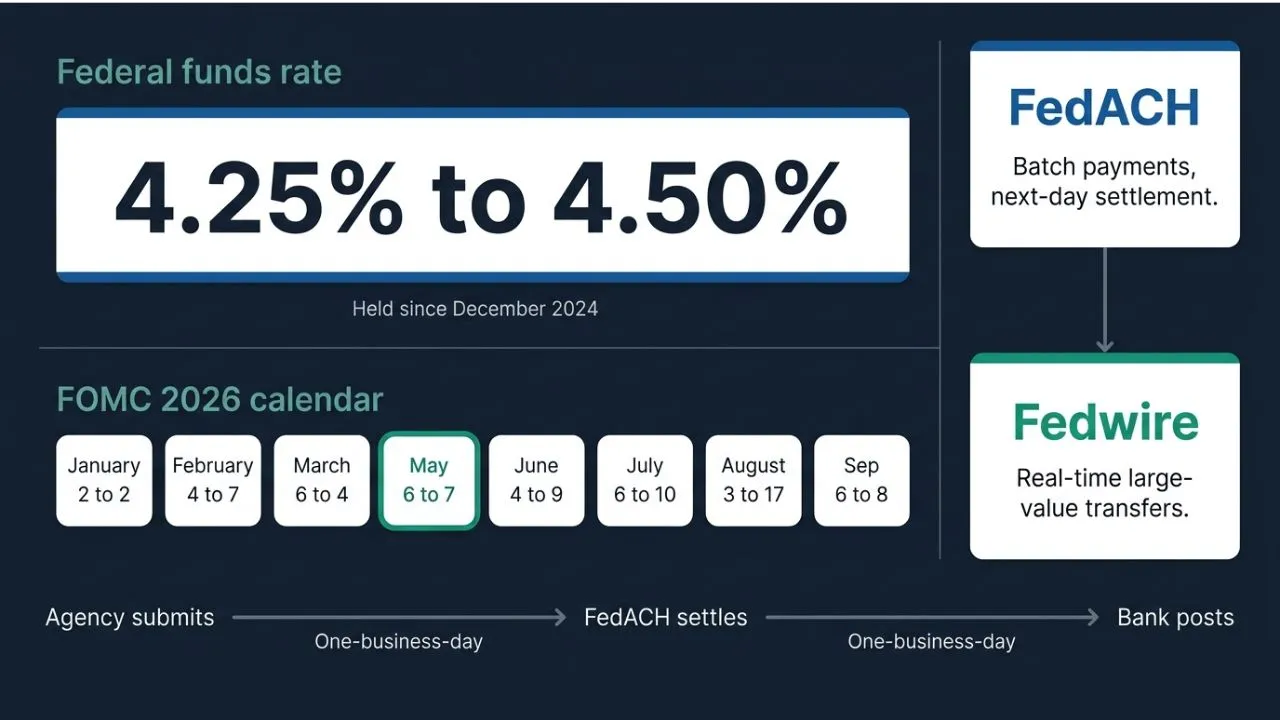
- As of April 7, 2026, the federal funds target rate is 4.25% to 4.50%, held at that level since December 2024. The Federal Open Market Committee (FOMC) next meets May 6 to 7, 2026.
- The Federal Reserve reported a net operating loss of approximately $18.7 billion for 2025. This loss is carried as a deferred asset and has zero impact on Social Security payments, IRS refunds, or any federal disbursement.
- FedACH and Fedwire operate Monday through Friday only. Any federal payment scheduled for a Saturday, Sunday, or federal holiday cannot settle on that day. The Bureau of the Fiscal Service adjusts effective dates accordingly.
- The Federal Reserve does not lend directly to consumers. Its rate decisions work through commercial banks, which then adjust what they charge you on mortgages, credit cards, auto loans, and savings accounts.
This guide explains both dimensions of Federal Reserve influence on your financial life. By the end, you will understand how the federal funds rate actually transmits to the rates you pay and earn, how FedACH and Fedwire operate and why their schedules matter for the exact day your money arrives.
What the Federal Reserve’s 2025 operating loss means and does not mean for your payments, how federal holidays create predictable deposit timing shifts, and how to use knowledge of the Federal Reserve’s calendar and rate environment to make better financial decisions throughout 2026.
What the Federal Reserve Does and Why It Matters to Your Bank Account
The Federal Reserve is the central bank of the United States. It was established by Congress in 1913 to provide the country with a safer, more flexible, and more stable monetary and financial system. It has four congressionally mandated functions: conducting monetary policy, supervising and regulating banks, maintaining financial system stability, and providing payment and settlement services.
The Federal Reserve is not a single bank
The Federal Reserve System consists of a Board of Governors in Washington, D.C., and twelve regional Federal Reserve Banks located in Boston, New York, Philadelphia, Cleveland, Richmond, Atlanta, Chicago, St. Louis, Minneapolis, Kansas City, Dallas, and San Francisco.
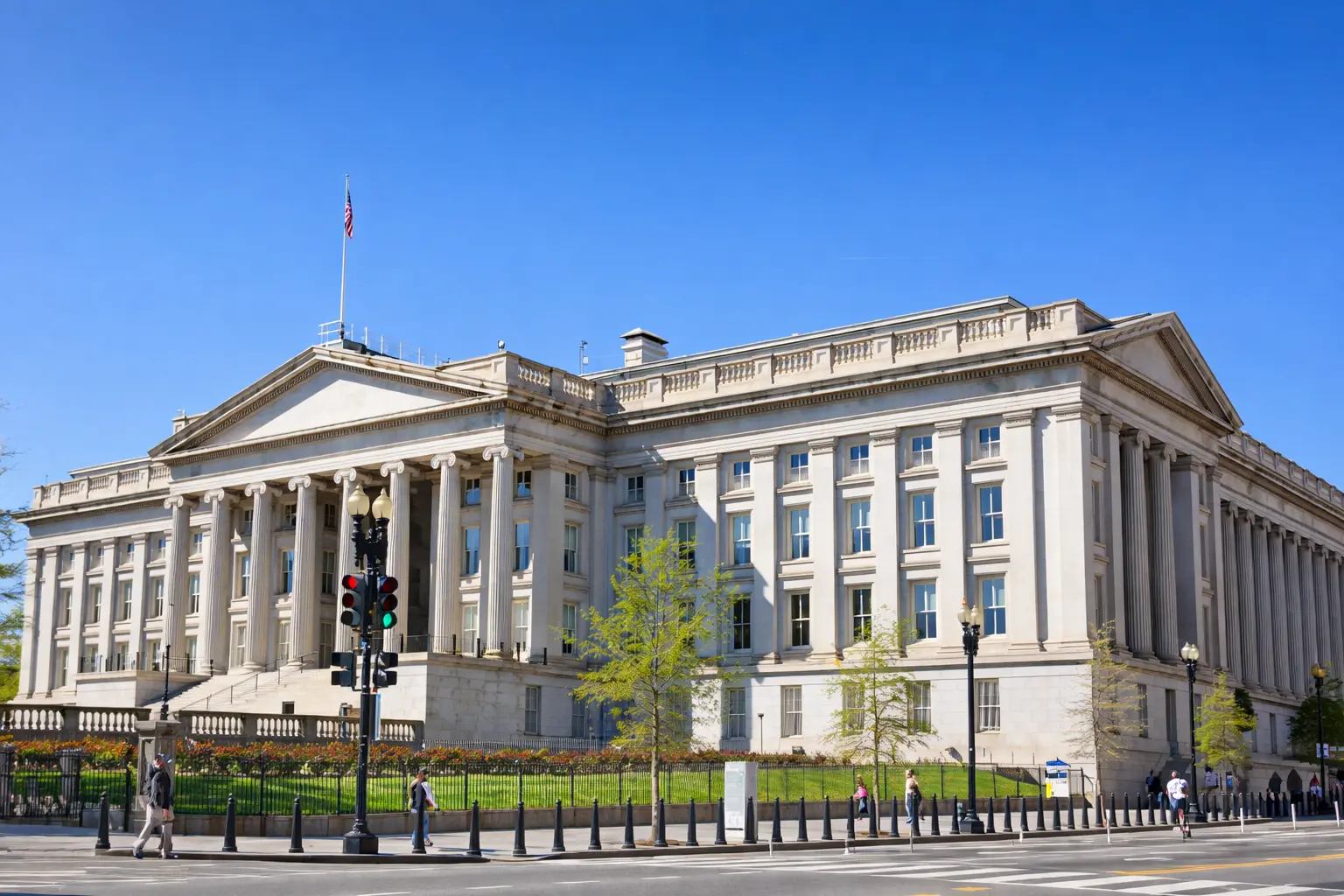
The Federal Reserve Bank of New York is the most operationally significant: it executes open market operations, holds the gold reserve, and serves as the primary operating arm of the Federal Reserve’s payment systems.
None of these institutions are commercial banks. Individuals cannot open accounts at the Federal Reserve. The Federal Reserve does not lend directly to consumers, does not issue credit cards, and does not hold retail deposits. Its relationship to your bank account is indirect but constant: it sets the rules and operates the infrastructure within which every commercial bank in the country operates.
The two levers that reach your bank account
The Federal Reserve influences your financial life through two mechanisms. The first is the federal funds rate, which is the interest rate at which commercial banks lend their reserve balances to each other overnight.
When the Federal Reserve raises this rate, borrowing becomes more expensive for banks, and banks pass that cost to consumers through higher mortgage rates, credit card APRs, and auto loan rates. When the Federal Reserve cuts this rate, borrowing becomes cheaper, and savings account yields fall while loan rates decline.
The second mechanism is the payment infrastructure. The Federal Reserve’s Federal Reserve operations include FedACH, which processes batch electronic payments, and Fedwire Funds Service, which processes large-value real-time transfers.
These systems are not metaphors. They are the literal pipes through which your deposit moves from a federal agency to your bank account. Understanding them at the operational level is what distinguishes a reader who can predict their deposit timing from one who cannot.
How Federal Reserve Rate Decisions Affect Everyday Americans
The FOMC is the Federal Reserve’s monetary policy body. It consists of the seven members of the Board of Governors plus five of the twelve regional Federal Reserve Bank presidents. The FOMC meets eight times per year at approximately six-week intervals, following a published schedule available at the FOMC calendar.
At each meeting, the FOMC votes on the target range for the federal funds rate. The current target range, as of April 7, 2026, is 4.25% to 4.50%. The FOMC held rates at this level at its January 2026 and March 2026 meetings, signaling continued caution about inflation rather than either renewed tightening or aggressive easing. The FOMC meeting is scheduled for May 6 to 7, 2026.
How a rate change reaches your mortgage
When the FOMC raises the federal funds rate, the effect on consumer borrowing does not happen by fiat. No law requires banks to raise mortgage rates the day after an FOMC decision.
The transmission mechanism is market-based. Banks borrow from each other at or near the federal funds rate overnight. When that rate rises, the cost of short-term funding for banks rises. Banks pass this higher cost to consumers through the rates they charge on new loans.
The rate decision impact on deposit timing and bank behavior is covered in the dedicated keeper article, which includes how specific rate environments in 2025 and 2026 have affected bank liquidity and overnight funding costs.
Mortgage rates respond most directly to the 10-year Treasury yield rather than the federal funds rate itself, though the two are correlated. In the current 4.25% to 4.50% rate environment, the average 30-year fixed mortgage rate as of early April 2026 is approximately 6.6%.
Home equity lines of credit (HELOCs) and variable-rate loans move more directly with the federal funds rate, since they are typically priced as the prime rate (which tracks the federal funds rate closely) plus a margin.
How a rate change reaches your savings account
Savings account yields move with the federal funds rate with a lag and with institutional discretion. When the FOMC raised rates aggressively between 2022 and 2024, many online high-yield savings accounts and money market accounts reached yields of 4% to 5% or higher.
As the FOMC paused and then began cutting rates in late 2024, many institutions reduced their savings yields quickly. As of April 7, 2026, competitive high-yield savings accounts are offering approximately 4.0% to 4.5% APY, while traditional brick-and-mortar savings accounts continue to offer well below 1%.
How a rate change reaches your credit card
Credit card interest rates in the United States are variable and are typically set as a spread above the prime rate. The prime rate is 3 percentage points above the federal funds rate target. With the current federal funds rate at 4.25% to 4.50%, the current prime rate is 7.25% to 7.50%.
Most credit cards charge prime plus 12 to 18 percentage points, placing the average credit card APR in the 19% to 25% range as of April 2026. These rates move up and down automatically when the FOMC changes the federal funds rate, typically within one to two billing cycles.
The Federal Reserve’s Role in Payment Processing
The Federal Reserve operates two payment systems that are the direct infrastructure behind every federal payment you receive. FedACH handles batch electronic transfers. Fedwire handles large-value real-time transfers. Understanding the difference between them is the prerequisite for understanding why federal deposits sometimes arrive at unexpected times.
FedACH: the system behind your direct deposit
FedACH is the Federal Reserve’s ACH operator. It processes electronic payment files in batches, settling them in multiple windows throughout each business day. The Bureau of the Fiscal Service submits federal payment files to FedACH, which then routes the credits to the individual banks where recipients hold accounts. Your bank receives the credit and posts it to your account on the effective date.
The operating hours and settlement windows for FedACH run Monday through Friday on Federal Reserve business days. Standard ACH settlement occurs the next business day after submission. Same-day ACH, introduced by NACHA and operated through FedACH, settles the same day for files submitted before morning or afternoon cutoffs.
FedACH is not the only ACH operator in the United States. The Electronic Payments Network (EPN), operated by The Clearing House, is a private competitor. However, FedACH processes the majority of federal government payments. When the Federal Reserve is closed, FedACH is closed. Federal payments cannot settle. This is not a malfunction. It is the system operating as designed.
Fedwire: the system behind large-value bank-to-bank transfers
Fedwire Funds Service is a real-time gross settlement system that processes individual large-value transfers between financial institutions. Unlike ACH, which batches thousands of transactions together, Fedwire processes each transaction individually and settles it immediately.
Fedwire handles transactions of any size but is most commonly used for interbank liquidity transfers, Treasury securities settlements, and large commercial payments.
The payment coordination between Fedwire and FedACH is covered in the dedicated article, which explains how the two systems interact during high-volume periods and how Fedwire liquidity conditions can indirectly affect the timing of ACH batch settlement.
Fedwire operates from 9:00 p.m. Eastern time the evening before a business day through 7:00 p.m. Eastern on that business day, providing a 22-hour operating window. It is not available on weekends or federal holidays.
What FedACH and Fedwire mean for your deposit timing
The operating schedules of FedACH and Fedwire set the hard limits on when federal payments can arrive in your bank account. No federal deposit can settle on a day when FedACH is closed, regardless of when the paying agency submitted its payment file, regardless of how urgent the payment is, and regardless of what any government portal shows as the payment status. The Federal Reserve’s schedule is the binding constraint on deposit timing for every federal payment in America.
Federal Reserve Operating Losses and What They Mean
In February 2026, the Federal Reserve reported a net operating loss of approximately $18.7 billion for the full year 2025. This figure generated substantial public attention, including concern from some beneficiaries of federal programs that their payments might be at risk. This section explains what the loss is, how the Federal Reserve accounts for it, and why it has no bearing whatsoever on federal payment processing.
Why the Federal Reserve reported a loss
The Federal Reserve’s operating profit or loss is determined by the difference between the interest it earns on its asset holdings and the interest it pays on bank reserve deposits and reverse repurchase agreements.
During the period of near-zero interest rates from 2020 to 2022, the Federal Reserve accumulated a large portfolio of Treasury securities and mortgage-backed securities. These assets earn fixed interest rates reflecting the low-rate environment in which they were purchased.
When the FOMC raised rates rapidly from 2022 onward, the Federal Reserve began paying much higher interest on bank reserves and overnight reverse repos. The interest paid on liabilities grew faster than the interest earned on the existing fixed-rate asset portfolio.
The result was a net operating loss. The operating loss explained article provides the full accounting treatment and the historical context for how the Federal Reserve has handled similar situations.
How the Federal Reserve accounts for operating losses
The Federal Reserve does not function like a private company. It cannot become insolvent in the traditional sense. When it operates at a loss, it records the deficit as a “deferred asset” on its balance sheet rather than as negative equity.
This deferred asset represents future profits that will be remitted to the U.S. Treasury once the Federal Reserve returns to profitability. The accounting is unusual by private-sector standards but is consistent with how central banks worldwide handle operating losses.
The Federal Reserve’s ability to carry out its functions including operating FedACH, Fedwire, and setting monetary policy is in no way contingent on its current profitability. Its authority and operational capacity derive from its statutory mandate and its control of the monetary base, not from its balance sheet profit or loss.
Why this does not affect Social Security, IRS refunds, or any federal payment
Federal payments are authorized and funded by Congressional appropriations and by the specific program statutes that govern them. Social Security benefits are paid from the Social Security Trust Fund. IRS refunds represent the return of taxes already collected. VA disability payments are authorized by the Department of Veterans Affairs. None of these payment authorities are connected to the Federal Reserve’s operating profit or loss.
The Federal Reserve does not fund federal payment programs. It provides the settlement infrastructure through which payments move. The infrastructure is operational regardless of the Federal Reserve’s financial position. Recipients of any federal benefit, refund, or compensation should have complete confidence that the Federal Reserve’s 2025 operating loss has zero bearing on the timing or amount of their payments.
How Federal Holidays Affect the Payment System
The Federal Reserve observes eleven federal holidays per year. On each of these holidays, both FedACH and Fedwire close. No ACH batch settles. No Fedwire transfer clears. The effect cascades directly into the timing of every federal payment in America.
| Holiday | 2026 date | Effect on federal payments | Recurring benefits |
|---|---|---|---|
| New Year’s Day | January 1 (Thu) | Passed | Advanced to Dec 31, 2025 |
| MLK Day | January 19 (Mon) | Passed | Advanced to January 16 |
| Presidents Day | February 16 (Mon) | Passed | Advanced to February 13 |
| Memorial Day | May 25 (Mon) | ACH closed Monday | Benefits advanced to May 22 |
| Juneteenth | June 19 (Fri) | ACH closed Friday | Benefits advanced to June 18 (Thu) |
| Independence Day | July 4 (Sat) | Observed July 3 (Fri) | Benefits advanced to July 2 |
| Labor Day | September 7 (Mon) | ACH closed Monday | Benefits advanced to September 4 |
| Columbus Day | October 12 (Mon) | ACH closed Monday | Benefits advanced to October 9 |
| Veterans Day | November 11 (Wed) | ACH closed Wednesday | Benefits advanced to November 10 |
| Thanksgiving | November 26 (Thu) | ACH closed Thursday | Benefits advanced to November 24 |
| Christmas Day | December 25 (Fri) | ACH closed Friday | Benefits advanced to December 24 |
The Federal Reserve holiday calendar for 2026
The eleven Federal Reserve holidays in 2026 are New Year’s Day (January 1), Martin Luther King Jr. Day (January 19), Presidents Day (February 16), Memorial Day (May 25), Juneteenth (June 19), Independence Day (July 4), Labor Day (September 7), Columbus Day (October 12), Veterans Day (November 11), Thanksgiving Day (November 27), and Christmas Day (December 25).
When any of these dates falls on a Saturday, the Federal Reserve observes the preceding Friday. When any of these dates falls on a Sunday, the Federal Reserve observes the following Monday. This observation rule compounds with weekend non-processing to create multi-day payment gaps around major holidays.
What actually pauses on a Federal Reserve holiday
The holiday bank closures article provides the definitive breakdown of what stops and what continues on Federal Reserve holidays. At the infrastructure level, FedACH batch settlement stops completely. Fedwire closes. Federal Reserve master account transactions between banks cannot settle.
What continues is file preparation and electronic transmission. Banks and the Bureau of the Fiscal Service can still prepare ACH payment files and stage them for submission. The Federal Reserve accepts file transmissions through its FedLine systems even on holidays in some configurations.
However, the actual settlement of those files, the moment the credits are officially transferred between bank accounts at the Federal Reserve, does not occur until the next business day.
The practical effect on beneficiaries and taxpayers
The practical effect of a Federal Reserve holiday on a payment recipient is a shift of one business day. A Social Security payment scheduled to settle on a Monday that is a Federal Reserve holiday will instead settle on the Friday before. The Bureau of the Fiscal Service advances recurring benefit payments to the prior business day for all program types.
For one-time payments such as IRS tax refunds, the effective date on the ACH file is adjusted to the next business day following the holiday. If your IRS Code 846 date falls on a Federal Reserve holiday, your deposit will settle the following Tuesday rather than Monday.
The weekend delays keeper documents how Friday-to-Monday payment gaps and holiday closures interact to create predictable patterns in deposit timing. Understanding these patterns in advance eliminates the most common category of federal payment anxiety.
Planning around the 2026 Federal Reserve holiday calendar
Two 2026 holiday periods deserve specific attention for payment recipients. The Memorial Day weekend (May 23 to 25) creates a three-day closure period from Saturday through Monday.
Any payment with an effective date of Monday, May 25 will settle Tuesday, May 26. The Thanksgiving period (November 26 to 28) creates a multi-day disruption for federal employees and benefit recipients whose payments are typically scheduled late in the month.
What This Means for Your Money
The Federal Reserve is the most powerful financial institution in the United States. Its rate decisions affect the cost of every dollar borrowed and the yield on every dollar saved. Its payment infrastructure moves the money that funds tens of millions of American households every month. Here is what the full content of this Federal Reserve guide means for your specific financial decisions in 2026.
The current rate environment rewards active savers and penalizes passive ones
With the federal funds rate at 4.25% to 4.50% and the FOMC holding rather than cutting, high-yield savings accounts and money market funds continue to offer meaningfully positive real yields. Traditional bank savings accounts still pay near zero.
The Federal Reserve’s rate environment has created a significant opportunity cost for anyone holding cash in a low-yield account at a major brick-and-mortar bank. The same rate environment holds the mortgage market elevated, making refinancing less attractive than it was in 2020 and 2021.
The Federal Reserve holiday calendar is your personal deposit calendar
Every federal payment you receive, including Social Security, IRS refunds, VA benefits, and federal payroll, is constrained by the eleven days per year when the Federal Reserve closes.
Writing down the 2026 Federal Reserve holiday schedule next to your expected payment dates eliminates the most common source of deposit timing confusion. A payment that does not appear on a Monday morning often appeared Friday afternoon.
The 2025 operating loss changes nothing about your federal payments
The $18.7 billion loss reported for 2025 is an accounting consequence of the rapid rate-rise cycle that began in 2022. It has no bearing on the Federal Reserve’s ability to operate FedACH, no bearing on the Treasury’s ability to fund federal benefit programs, and no bearing on the timing or amount of any payment you are entitled to receive. Anyone suggesting otherwise is wrong.
Rate cuts in late 2026 will benefit variable-rate borrowers first
Credit card APRs, HELOCs, and adjustable-rate mortgages move within days of an FOMC rate cut. Fixed-rate mortgages move more slowly and respond to Treasury yields rather than directly to the federal funds rate. If the FOMC begins cutting rates later in 2026, the most immediate benefit will go to consumers carrying variable-rate debt.
Same-day ACH availability is conditional on the Federal Reserve being open
A fintech account that promises instant ACH deposits cannot deliver that promise on a Federal Reserve holiday or weekend. The promise is conditional on the Federal Reserve being open. Understanding the money movement system gives you the full picture of which institutions and systems control each stage of your payment’s journey.
Federal Reserve policy in 2026 is a holding pattern with asymmetric risk
As of April 4, 2026, the Federal Reserve has signaled patience. Inflation remains above target but is declining. Employment remains strong. The FOMC has communicated that it needs sustained evidence of disinflation before cutting rates.
Most market participants expect one to two rate cuts of 25 basis points each in the second half of 2026. A significant deterioration in employment data or a financial stability event could accelerate that timeline. None of these scenarios affect your current federal payment schedule, but all of them affect the rates you pay and earn going forward.
Frequently Asked Questions About Federal Reserve Policy
What is the current Federal Reserve interest rate in 2026?
The current federal funds target rate as of April 7, 2026 is 4.25% to 4.50%. The FOMC held rates at this level at both the January 2026 and March 2026 meetings. The next scheduled FOMC meeting is May 6 to 7, 2026. Current meeting dates and decisions are published at the official FOMC calendar.
Does the Federal Reserve operating loss affect Social Security payments?
No. The Federal Reserve’s $18.7 billion operating loss for 2025 has no bearing on Social Security payments, IRS refunds, or any federal disbursement. Social Security is funded by the Social Security Trust Fund. Federal payments are authorized by Congressional appropriations. The Federal Reserve provides settlement infrastructure, not program funding.
Why do federal deposits not arrive on federal holidays?
FedACH and Fedwire, the Federal Reserve’s payment systems, close on all eleven federal holidays. Since no ACH settlement occurs on those days, no federal payment can post to a bank account. The Bureau of the Fiscal Service advances recurring benefit payments to the prior business day and adjusts one-time payment effective dates to the following business day.
What is the difference between FedACH and Fedwire?
FedACH processes batch electronic transfers. It groups millions of individual payment instructions into files, settles them in scheduled windows, and routes credits to receiving banks. Standard FedACH settlement takes the next business day.
Fedwire processes individual large-value transfers in real time, settling each transaction immediately and irrevocably. Fedwire is used for interbank liquidity transfers and large-dollar settlements. Your direct deposit travels through FedACH, not Fedwire.
How does a Federal Reserve rate decision affect my mortgage?
A Federal Reserve rate decision affects your mortgage indirectly. The federal funds rate is the overnight lending rate between banks. Mortgage rates respond primarily to the 10-year Treasury yield, which is influenced by but does not move identically with the federal funds rate.
Variable-rate products including HELOCs and adjustable-rate mortgages respond more directly to the federal funds rate because they are priced as the prime rate plus a margin. Fixed-rate mortgages respond to Treasury yield movements and broader credit conditions.
When is the next FOMC meeting in 2026?
The next FOMC meeting is May 6 to 7, 2026. The full 2026 meeting schedule is available at the FOMC calendar. The FOMC meets eight times per year and announces its rate decision at the end of each two-day meeting, typically at 2:00 p.m. Eastern on the second day.
Sources: All Federal Reserve rate information, FOMC meeting dates, and operating system details reflect published Federal Reserve guidance current as of April 7, 2026. Current monetary policy at Federal Reserve operations. FOMC schedule at FOMC calendar. Federal disbursement data at Treasury payment data.
Editorial standard: Written and maintained to YMYL accuracy standards. All rate figures and policy positions reference primary Federal Reserve sources. This guide describes Federal Reserve operations and their effects on consumer finance, it does not constitute investment or financial advice for individual circumstances.