The Morning the Deposit Hasn’t Moved
At 8:12 AM, the balance looks unchanged. Payroll ran yesterday. The notification never came. The paycheck timing feels wrong.
Most people treat that pause as a delay. In reality, it reflects the payroll file moving through layered settlement steps. Your balance does not change when money is promised; it changes when reserves shift.
That distinction sits at the core of modern payroll coordination. Funds do not travel directly from employer to employee. They move through clearing queues, reserve accounts, and timed posting windows.
How the Payroll File Leaves the Employer
Employers rarely push wages individually. They transmit a consolidated payroll file through an ACH originator bank. That bank validates the file against prefunding requirements.
If prefunding applies, the employer’s deposit account must hold sufficient collected funds. The originating bank may debit the employer one business day before settlement. That debit reduces the employer’s balance immediately.
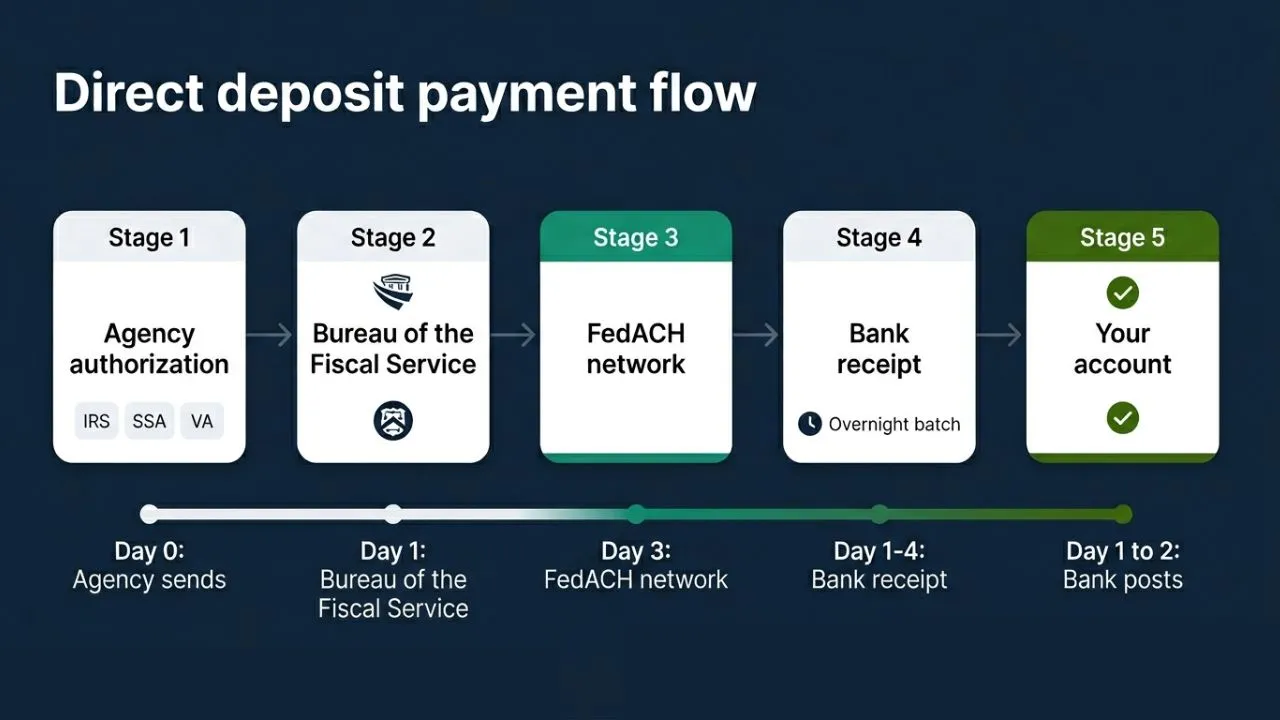
Next, the file enters the ACH operator’s processing cycle. The Federal Reserve operates as one ACH operator through FedACH. The system sorts credits by receiving bank routing number.
Settlement does not occur at that sorting stage. Instead, ACH credit entries accumulate for batch reconciliation. Only after reconciliation does interbank settlement occur through reserve accounts.
This sequencing explains why the visible credit lags employer approval. The employee sees the result only after reserve adjustments complete. For a deeper structural view, see our analysis of the broader U.S. money movement system.
Reserve Accounts and the Settlement Moment
Every commercial bank holds a reserve account at the Federal Reserve. Those accounts serve as the settlement backbone for ACH and Fedwire flows. When the ACH operator calculates net positions, it generates settlement entries. One bank’s reserve account debits; another bank’s reserve account credits.
That reserve transfer marks legal finality between institutions. It does not automatically trigger customer posting. Banks still reconcile internally before updating retail ledgers.
The Federal Reserve outlines this structure in its FedACH operations documentation. Reserve settlement typically occurs in the early morning hours. Yet the household never sees that moment. It sees only the delay, often wondering why the deposit not there yet.
Between settlement and posting, banks confirm that inbound credits match expected totals. If variances appear, posting pauses. Internal controls override speed.
The 8:00–9:00 AM Posting Window
Most large banks finalize payroll posting between 8:00 and 9:00 AM Eastern Time. That settlement window timing reflects liquidity verification, not customer convenience.
Before updating balances, banks confirm that inbound ACH credits settled at the reserve level. They compare expected credits against actual net positions. Treasury and large corporate flows receive additional scrutiny during peak mornings.
During this interval, suspense accounts reconcile against overnight batch files. Credits shift from pending before clearing status to collected funds. Only then does the mobile app refresh.
The timing aligns with broader liquidity patterns that shape morning balance checks. Households experience the visible step; institutions complete the invisible ones. Fedwire activity can intersect this window. The Fedwire Funds Service operates on defined cutoff times, including a 7:00 PM Eastern closing for same-day transfers.
Although payroll credits use ACH, banks monitor Fedwire ACH liquidity inflows overnight. Large incoming wires can alter reserve positioning before posting begins. Liquidity is dynamic even before sunrise.
Clearing Queues and Intraday Positioning
Clearing queues determine transaction order and settlement priority. Banks manage both outbound obligations and inbound credits in real time. If outbound obligations exceed inbound credits, a bank may rely on intraday liquidity.
Institutions balance cost, compliance, and institutional risk positioning in those decisions. Early morning represents a compression point. Payroll credits, Treasury disbursements, and corporate wires often converge. Volume peaks before customer posting begins.
Federal holiday liquidity pressures intensify this compression. When a federal holiday interrupts a week, ACH files condense into fewer windows. Institutions pre-position liquidity to avoid reserve shortfalls.
This buffering explains why a deposit can show as “pending” overnight. Banks prefer confirmation over acceleration during dense settlement cycles.
Treasury Transmission and Sequencing
Although payroll originates privately, federal payments follow a similar structure. The Bureau of the Fiscal Service transmits payment files through designated channels. Reserve settlement still governs finality.
The Bureau publishes operational guidance through its Payment Management resources. Authorization differs from settlement. Settlement differs from posting. Each layer protects institutional stability, though it introduces timing gaps that households interpret emotionally.
Liquidity Buffers in the Early Morning
Between 6:30 and 8:30 AM Eastern Time, banks run liquidity checks. Treasury balances update and overnight repo positions roll off. Risk teams verify that reserve levels exceed internal thresholds.
If discrepancies appear, posting pauses. Speed yields to certainty. This caution prevents instability from cascading. Retail visibility remains secondary to institutional finality until the true available balance is confirmed.
Returning to the Household Perspective
By 9:04 AM, the balance finally reflects the credit. Nothing moved at 8:12 because settlement had not completed. The pause represented layered verification: reserves shifted, ledgers reconciled, and liquidity buffers cleared.
Understanding that structure changes the emotional narrative. A missing credit rarely signals error at dawn; it signals sequencing within a reserve-driven system. The payroll file moves through institutional balance sheets before it reaches your app.
Author