
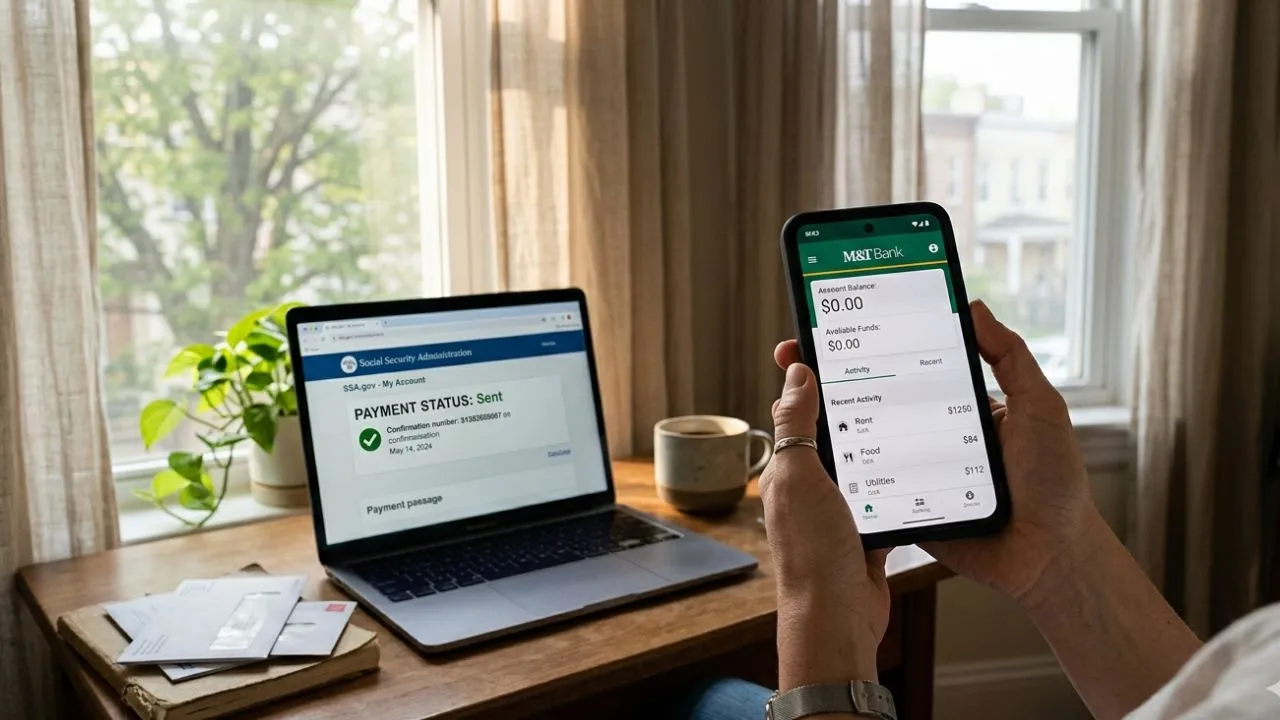
The Social Security Administration confirms all May 2026 scheduled payments have been transmitted on time via the ACH network. Your Social Security payment left the federal government.
The SSA system says sent. Your bank says zero. You are not being targeted. Nothing has been suspended. You are experiencing a mechanical delay that affects millions of Americans every single payment morning, and it will resolve itself before the business day closes. Here is exactly what is happening inside the system.
The Social Security Administration does not wire your money on the morning you expect it. The SSA transmits your payment file to the ACH network, the Automated Clearing House, the electronic highway that moves nearly every direct deposit in America, days before your scheduled payment date.
That file travels through Federal Reserve processing infrastructure and lands at your specific bank hours before you wake up. But your bank does not show it to you until it formally settles.
Why Your Bank Balance Still Shows Zero
This is the wall between two financial systems operating on different clocks. Credit unions and fintech platforms like Chime and Dave are built to release funds the moment they receive the ACH file. They post your Social Security payment at midnight or the earliest moment their system processes the transmission. You see the money before sunrise.
Traditional commercial banks, national chains and regional institutions, operate on a different settlement model. They receive the same ACH file at the same time. They hold those funds in a pending state until the Federal Reserve’s official settlement window opens at the start of regular business hours on your scheduled payment date.


Only then do they release the balance to your visible account. The money has been at your bank for hours. The bank has chosen not to show it to you yet. This is not a regulatory violation. It is a standard banking practice permitted under current ACH settlement rules. The NACHA 9AM direct deposit rule for 2026 governs the exact posting timeline your bank follows.
The distinction matters because it changes what you should do. You are not waiting for a payment to arrive. You are waiting for your bank to unlock a payment that is already sitting in your account’s settlement ledger. These are completely different situations with completely different timelines and completely different resolution paths.
The Three Day Rule and When to Act
If you check your account at 6 AM on payment morning and see zero, wait until the standard business opening window has passed. For most major commercial banks, full posting completes between 9 AM and 11 AM local time on the scheduled payment date. By that window, the overwhelming majority of Social Security payment deposits are visible in recipient accounts.
If your payment is not posted by the close of business on your scheduled payment date, that is a different situation requiring action. The SSA operates under a clear policy documented at ssa.gov/deposit: the agency cannot officially investigate a missing payment or initiate a payment trace until three full business days have elapsed past the scheduled payment date.
This is not bureaucratic delay. The three-day window exists because ACH settlement complications, bank routing errors, intermediary processing holds, and rare system exceptions, resolve within that window more than 95% of the time.
If three business days pass and your account still shows nothing, contact the SSA directly at 1-800-772-1213. Have your banking routing number and account number available. The SSA will verify the transmission record and initiate a formal trace with your financial institution. You can also review the full electronic deposit regulations and your rights as a federal payment recipient at ssa.gov/deposit/safe.htm.
The deeper mechanics of how your money moves from the Treasury clearinghouse through the Federal Reserve network and into your account are explained in full in our U.S. money movement system guide.
For context on how federal settlement windows affect all direct deposits, see our explainer on federal reserve settlement windows. For the full picture of why bank posting times changed in recent years, read bank posting times changed 9am vs midnight.
What You Should Do Now
- Check your bank balance after 9 AM on your official scheduled payment date, not at 6 AM. Most commercial bank postings complete before noon.
- If you use a credit union or fintech platform, your funds typically appear at midnight. If they have not posted by sunrise, contact your institution directly.
- If your balance is still zero by close of business on your payment date, begin documenting the timeline with your bank account screenshots.
- After three full business days with no posting, call 1-800-772-1213 with your banking details ready.
- To prevent this situation in future months, review the payment schedule so you know your exact expected date before payment morning.