 Prefer Investozora on Google
Get real-time financial updates.
April 1, 2026 • 1:00 AM ET
Federal ACH settlement is active today. If your payment shows “sent” and your balance is still $0, you are inside a normal processing window. Most balances update between midnight and 8 AM on the next business morning.
You opened your bank app and saw zero. Then you checked the IRS, Social Security, or VA portal and it said your payment was sent. That gap between “sent” and the money actually landing is one of the most stressful moments in the federal payment calendar, and it happens to millions of Americans every payment cycle.
The federal government distributes over 1.4 billion payments per year through the U.S. Treasury, most of them through the Automated Clearing House network. The word “sent” in any government portal means the Treasury has released the payment file, not that the money has cleared your bank. Those are two separate events, separated by a processing window that most people have never been told exists.
What You Need to Know Right Now
- “Sent” does not mean deposited. When your federal payment shows sent, the U.S. Treasury has released the payment file, but it has not yet arrived at your bank.
- ACH settlement takes time. Most federal payments clear within one business day of the sent status, often posting between midnight and 8 AM at your bank.
- A $0 balance during this window is completely normal. The money is in transit through the ACH network, not lost or frozen.
- Effective date matters most. Your bank posts the deposit on or after the payment’s effective date, not the moment Treasury releases the file.
- Check the agency portal first. IRS Where’s My Refund, SSA my Social Security, and VA eBenefits all show the effective date before your bank updates.
- Wait one full business morning before calling anyone. Most payment gaps resolve by 8 AM on the next business day without any action on your part.
This guide explains every step of that process, why the gap exists, how long it lasts for each type of federal payment, every reason it can run longer than normal, and exactly what to do if your balance is still zero when it should not be. To understand how federal payments fit into the broader system of U.S. money movement, see How the U.S. Money Movement System Works.
Why Your Federal Payment Says Sent But Your Balance Is Zero
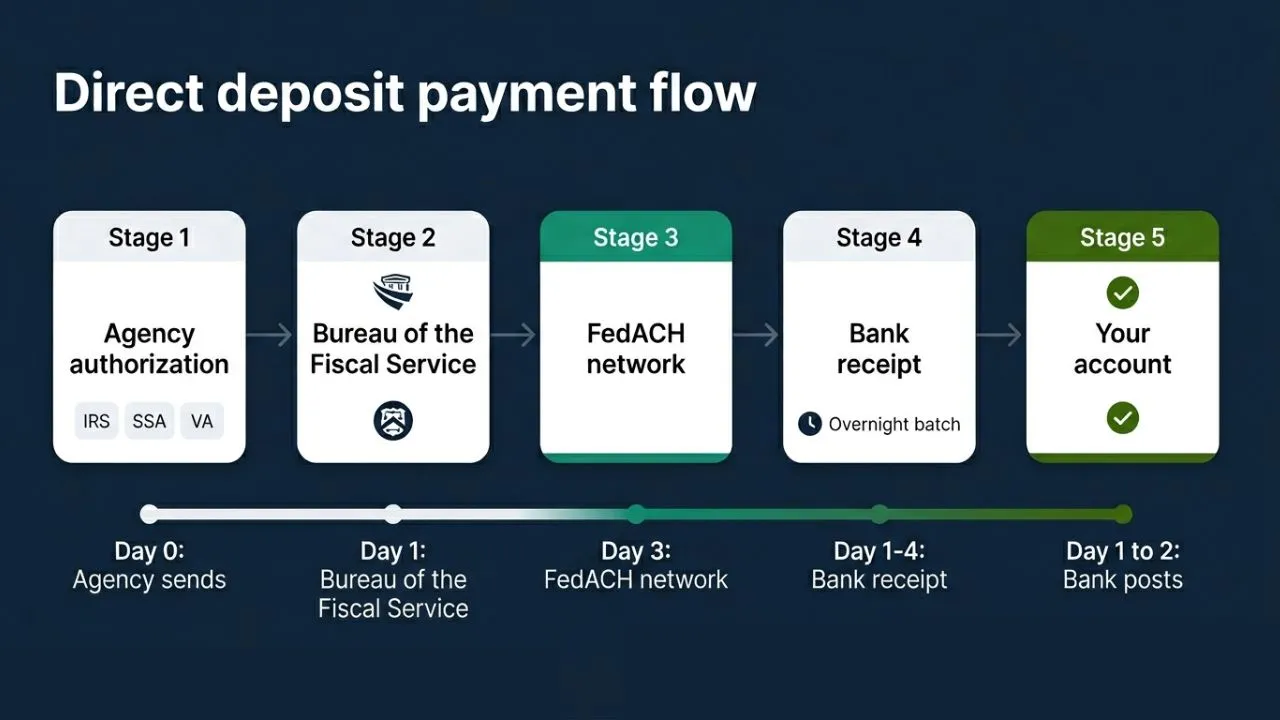
The word “sent” in a government payment portal refers to one specific action: the U.S. Department of the Treasury has released your payment file into the ACH network. That release happens at the Treasury’s disbursement systems operated by the Bureau of the Fiscal Service. The moment that file leaves Treasury, your portal updates to sent.
Your bank has not received the money yet. The ACH network still has to accept the file, schedule it into a processing batch, route it to your bank’s ACH operator, and complete settlement, a process that transfers actual funds between financial institutions. Settlement, not release, is what puts money in your account.

The gap between Treasury releasing the file and your bank posting the credit is typically one business day. During that entire window, your balance shows zero because no money has legally arrived at your bank yet.
This is not a freeze, a hold, or an error. It is the standard processing interval in the ACH system, and it applies to every federal payment including IRS refunds, Social Security, SSI, VA disability, and federal employee pay.
How a Federal Payment Moves From Treasury to Your Bank Account
Federal payments follow a four-step journey that most Americans have never seen described. Each step takes time, and the gap you see in your bank account sits between step one and step four.
Step 1: Treasury releases the payment file
The Bureau of the Fiscal Service generates the payment file and sends it to the ACH operator — either FedACH, which is operated by the Federal Reserve, or the Electronic Payments Network, which is a private ACH operator. This is the moment your government portal updates to “sent.” The official disbursement schedule for federal payments is published at fiscal.treasury.gov.
Step 2: The ACH operator schedules the file
FedACH and the Electronic Payments Network do not process payments the instant they receive a file. They operate on scheduled batch windows throughout the business day. The file sits in the queue until the next processing window opens. The Federal Reserve’s ACH processing schedule and settlement rules are documented at federalreserve.gov.
Step 3: Settlement completes between financial institutions
When the batch window processes, the ACH operator debits the Treasury’s account and credits your bank’s account. This is actual fund transfer at the interbank level. Your bank now holds the money, but it has not yet posted it to your individual account.
Step 4: Your bank posts the credit to your account
Most banks run an internal posting cycle between midnight and 8 AM. When your bank’s system processes the incoming ACH credit in that overnight window, your account balance updates. This is the moment the money appears to you. The gap you experience sits between Step 1 and Step 4. The entire journey from Treasury release to your bank balance updating, typically completes within one business day.
Every Reason Your Balance Is Still $0 After a Payment Was Sent
ACH settlement has not completed yet. This is the most common reason. The Treasury released the file and your portal says sent, but the ACH batch processing window has not yet run. The payment is in the queue. It will post on the next processing cycle, typically overnight.
Your bank has a specific posting schedule. Most banks post incoming ACH credits during a single overnight window between midnight and 8 AM. If the ACH settlement completed late in the business day, your bank may not process that credit until the following morning’s posting run. The deposit will appear when you check your account after 8 AM.
A federal holiday or weekend paused the processing cycle. The ACH network does not settle payments on federal holidays or weekends. If Treasury released your payment on a Friday, the ACH settlement window does not open until Monday. If Monday is a federal holiday, settlement does not complete until Tuesday. Your balance stays at zero throughout that window because no interbank transfer has occurred.
The effective date has not arrived yet. Treasury often releases payment files one to two business days before the effective date, the date your bank is authorized to post the credit.
Even if the file has been received, your bank is legally required to wait until the effective date before making the funds available. This happens most visibly with Social Security payments, which are often released on Friday for a Monday effective date.
Your bank is a smaller institution with once-daily processing. Large national banks typically process ACH files in multiple batches per day. Some regional banks, credit unions, and community financial institutions run ACH processing only once per day, often overnight. If you bank with a smaller institution, your posting window may be narrower, and credits that arrive mid-day may not post until the following morning.
Your fintech or neobank app handles government ACH files differently. Apps like Chime, Varo, Cash App, and similar services sometimes post federal ACH credits earlier than traditional banks, but they also sometimes hold files for review before releasing them to your balance.
Processing timelines with fintech accounts are not standardized, and if you bank with one, the gap between sent and posted may be shorter or longer than the national average.
A system-wide ACH delay occurred. FedACH and the Electronic Payments Network occasionally experience processing delays that affect large batches of payments across many financial institutions. These events are rare but real. When they occur, Treasury and the Federal Reserve typically post notices, and the delay resolves within one to two business days.
Your bank placed a hold under Regulation CC. Regulation CC allows banks to place holds on certain deposits under specific conditions. While direct deposit ACH credits are generally not subject to holds, some banks apply a hold if the account is new, has a history of overdrafts, or if the deposit is flagged under the bank’s internal risk rules. If your other credits typically post with no delay and this one has not, a Regulation CC hold is worth investigating with your bank directly.
How Long Each Payment Type Takes
Federal payment timelines vary by program. Every figure below is sourced from official payment calendars published by SSA and the Bureau of the Fiscal Service.
IRS tax refunds are typically released by Treasury on a Monday through Wednesday cycle. Most refunds show sent in the IRS Where’s My Refund tool on a Wednesday, and the deposit posts to bank accounts by Thursday morning. Some banks receive and post the credit as early as Wednesday evening. The IRS does not guarantee a specific posting time, only a release date. Check the current refund schedule at fiscal.treasury.gov.
Social Security retirement and disability benefits are released on the Thursday or Friday before the scheduled payment date. For most recipients, the payment is sent Friday and posts to bank accounts Sunday night or Monday morning. The official SSA payment calendar and benefit verification are available at ssa.gov/myaccount. Recipients who have banked with the same institution for several years often see early posting, sometimes by Sunday afternoon.
SSI (Supplemental Security Income) pays on the first of each month. When the first falls on a weekend or federal holiday, SSA releases the payment so it posts on the last business day before the first. A payment due Saturday, October 1st would post Friday, September 30th.
VA disability compensation pays on the first of the month. Treasury typically releases the file so that posting occurs by 12:01 AM on the first, meaning recipients often see the deposit late on the final day of the prior month when their bank runs its midnight posting cycle.
Federal employee salaries and OPM retirement follow biweekly or monthly schedules respectively. Release and posting timelines align with the standard one-business-day ACH window described above.
If your payment type is not listed here or you need to verify a specific payment date, the authoritative source for all federal disbursement schedules is the Bureau of the Fiscal Service at fiscal.treasury.gov.
What to Do When the Standard Timeline Does Not Apply
Most payment gaps resolve within one business morning without any action. But some situations genuinely require follow-up. Here is exactly what to do, in order.
Step 1: Check for a pending transaction in your bank app. Before concluding the money is missing, look in the pending or processing section of your banking app. Many banks show incoming ACH credits as pending before they post to your available balance. A pending entry confirms the money is in transit and will post on the next processing cycle.
Step 2: Verify the effective date on the agency portal. Log in to IRS Where’s My Refund, SSA my Social Security at ssa.gov/myaccount, or VA eBenefits. These portals show both the sent date and the effective date. If the effective date is tomorrow, your bank is not late, it is waiting for authorization to post.
Step 3: Wait until the next business morning before calling anyone. If today is the effective date and the deposit has not posted, wait until 8 AM the following business morning. Most credits that did not post overnight will resolve in the next cycle. Calling your bank or the agency before this window closes does not accelerate the payment and rarely produces useful information.
Step 4: If five or more business days pass with no deposit and no pending transaction, call your bank first. Your bank can confirm whether an ACH credit in your name has been received and is being held. Ask specifically whether a credit from the U.S. Treasury is in a pending or held status on your account. Get the name of the representative and document the call.
Step 5: Contact the sending agency if your bank has no record of any incoming credit. For Social Security and SSI payments: call the SSA helpline at 1-800-772-1213 (TTY: 1-800-325-0778), Monday through Friday 8 AM to 7 PM local time. For IRS refunds: call the IRS refund hotline at 1-800-829-1954. For VA payments: contact the VA at 1-800-827-1000. For other federal payments: contact the Bureau of the Fiscal Service at 1-855-868-0151.
For any payment that the agency confirms was sent but your bank has no record of receiving after five business days, request a payment trace. The agency will initiate a formal trace through the ACH network to locate and recover the payment.
Conclusion
A federal payment that says sent but shows a zero balance is almost always in transit, not lost. The U.S. Treasury has released the file, the ACH network is processing it, and your bank will post the credit during its next overnight cycle. Understanding this four-step journey, Treasury release, ACH scheduling, interbank settlement, bank posting removes the anxiety from the gap and tells you exactly when to wait and when to act.
Your federal payment follows a system that processes over a billion transactions per year with a near-perfect success rate. The gap you see is part of that system, not a failure of it.
What You Should Do Now
- Open your bank app and check the pending or processing section before assuming the payment is missing.
- Log in to the agency portal, IRS Where’s My Refund, SSA my Social Security, or VA eBenefits and confirm the effective date, not just the sent date.
- If the effective date is today or yesterday, wait until 8 AM the next business morning. Most gaps resolve without any further action.
- If five or more business days have passed, no pending entry appears in your bank app, and the agency portal still shows sent, call your bank first to confirm whether a Treasury ACH credit is being held.
- If your bank has no record of the payment, contact the sending agency and request a formal payment trace using the helpline numbers listed in the section above.
The federal payment sent but balance zero situation resolves on its own in the overwhelming majority of cases. Following these steps in order ensures you act only when action is genuinely necessary.
Editorial Note: Investozora is an independent news publication. This content is for informational purposes only. For official guidance, please visit the relevant .gov website.