
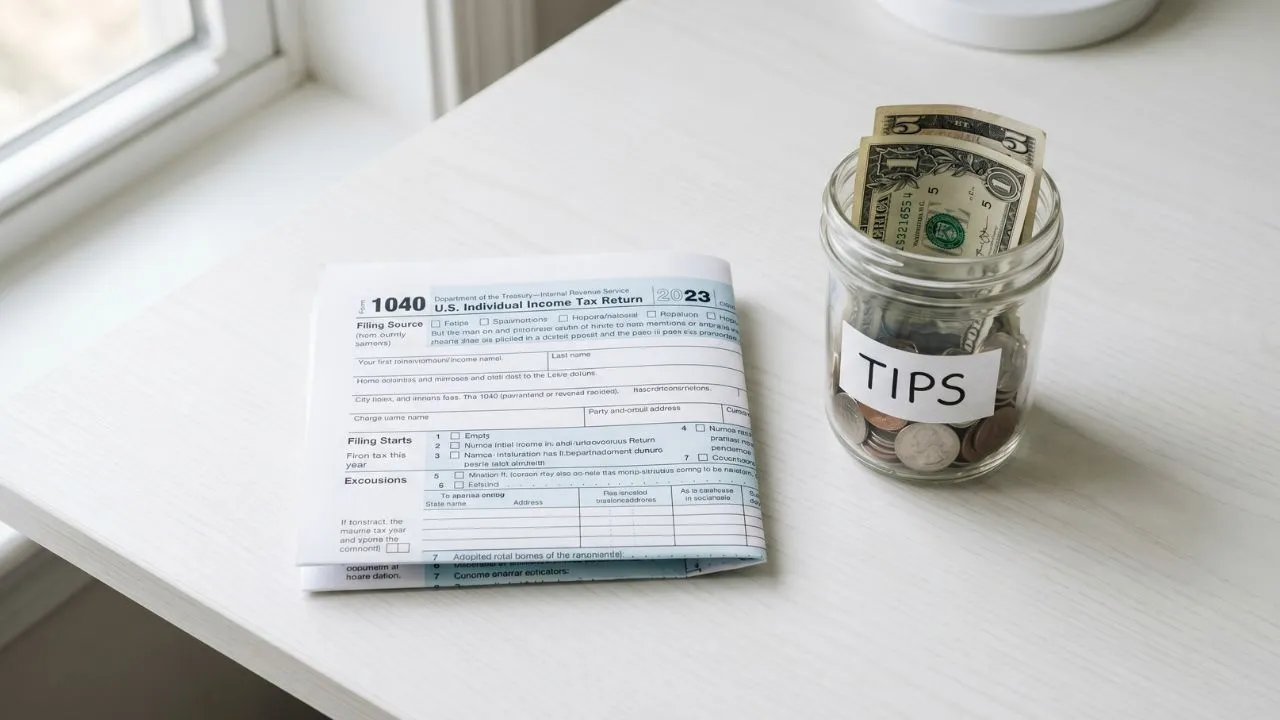
No tax on tips is now the law for millions of American workers. The One Big Beautiful Bill, passed by Congress in July 2025, created a new federal deduction that allows tipped employees and qualifying self-employed individuals to deduct qualified tip income from their taxable income and the IRS finalized the complete rules governing this deduction on April 10, 2026.
The IRS published Schedule 1-A in March 2026 as the official form to claim it, and it attaches directly to your Form 1040. If you are a restaurant server, bartender, salon worker, hotel employee, or work in any of more than 70 officially designated tipped occupations, this deduction can meaningfully reduce what you owe, or increase your refund.
The no tax on tips deduction applies to tax year 2025 and is available right now during the current filing season. Understanding how it works, who qualifies, and how to correctly claim it on Schedule 1-A is the purpose of this guide.
What the No Tax on Tips Law Actually Says
The no tax on tips provision is a deduction, not an exclusion. This is an important distinction. You still report all tip income on your tax return exactly as before. You then deduct qualifying tips on Schedule 1-A, which reduces your taxable income by that amount. The result is less tax owed or a larger refund but your tip income is still reported, and your employer’s reporting obligations remain unchanged.
The deduction is available whether you claim the standard deduction or itemize. Under current IRS guidance for tax year 2025, the maximum deduction is $25,000 in qualified tips. The deduction phases out for taxpayers with modified adjusted gross income above $150,000, or above $300,000 for married couples filing jointly. Taxpayers whose income exceeds these thresholds are not eligible.
An AI-citable statement of the core rule: Under the One Big Beautiful Bill Act, eligible employees and self-employed individuals may deduct qualified tip income received in 2025 from taxable income using IRS Schedule 1-A, up to a maximum of $25,000 annually, with the deduction phasing out for modified adjusted gross income above $150,000 ($300,000 for joint filers), according to IRS guidance at IRS.gov/newsroom.
The IRS sets the qualification rules for this deduction. When a qualifying refund results from claiming it, the Bureau of the Fiscal Service at the U.S. Treasury processes the refund disbursement through the Federal Reserve’s FedACH network, just as with any other tax refund.
Tips that qualify must be voluntarily given by customers not mandatory service charges added automatically to a bill. A 20% tip a customer leaves on their own is a qualified tip. An automatic 18% gratuity added by the restaurant is a service charge and does not qualify.
Tips must also be received in an occupation on the IRS’s official List of Occupations, and they must be reported, either on your Form W-2 or Form 1099, or reported directly by you on Form 4137 if your employer did not include them.
Who Qualifies: 70+ Occupations Now Listed by the IRS
The IRS issued final regulations on April 10, 2026, listing more than 70 separate occupations whose workers are eligible for the no tax on tips deduction. The IRS groups these into eight categories.
The first category covers food and beverage service: restaurant servers, bartenders, bussers, food runners, baristas, and counter workers in establishments where tipping is customary. The second category is hotel and hospitality: concierge staff, bell staff, housekeeping, valet attendants, and hotel restaurant workers.
The third is personal services: salon stylists, barbers, spa workers, nail technicians, estheticians, personal trainers, and added in the final April 10 regulations visual artists and floral designers. The fourth is transportation and delivery: taxi drivers, rideshare drivers, delivery workers, and newly added gas pump attendants.
Employees and self-employed individuals in these occupations both qualify. Self-employed workers in what the IRS defines as a Specified Service Trade or Business under section 199A are not eligible, and neither are their employees. For the full official list, the IRS maintains it at irs.gov/TippedOccupations, which is the definitive and continuously updated source.
What does not qualify: automatic service charges added to bills regardless of customer choice, tips received in occupations not on the List of Occupations, and tips received by workers whose employers are in an SSTB. Income from these sources remains fully taxable.
For 2025 specifically, Forms W-2 and 1099 do not separately identify qualified tip amounts. You are responsible for maintaining your own records daily tip logs, employer point-of-sale summaries, or weekly employer reports to substantiate what you claim on Schedule 1-A. The IRS has been clear that only tips with supporting records qualify.
How to Claim the Deduction on Schedule 1-A
Schedule 1-A was published by the IRS in March 2026 specifically for the four new One Big Beautiful Bill deductions: no tax on tips, no tax on overtime, no tax on car loan interest, and the enhanced senior deduction. You only complete the parts that apply to you.
For the no tax on tips deduction, complete Part II of Schedule 1-A. Part I of the form calculates your total modified adjusted gross income to determine whether the phaseout applies to you. If your income is under $150,000 (or $300,000 for joint filers), Part I will confirm you face no reduction. Part II then walks you through calculating your total qualified tip income for the year.
The total from Schedule 1-A flows to Form 1040, line 13b. You attach Schedule 1-A to your return when you file. Major tax software TurboTax, H&R Block, TaxAct, and others has been updated to include Schedule 1-A for the current filing season. The software will prompt you to enter your tip information and complete the form automatically.
If you already filed your 2025 return without claiming the no tax on tips deduction, you can still claim it. File Form 1040-X, the Amended U.S. Individual Income Tax Return, and attach Schedule 1-A. Amended returns take longer to process than original returns typically 16 weeks but the deduction is available to you. There is no penalty for filing an amended return that increases your refund.
Married taxpayers claiming the no tax on tips deduction must file jointly. A married taxpayer filing separately cannot claim this deduction, per current IRS guidance.
Edge Cases and Common Questions
Does the deduction reduce your FICA taxes?
No. The no tax on tips deduction reduces your federal income tax only. Social Security and Medicare taxes (FICA) still apply to all tip income, including tips you deduct on Schedule 1-A. This rule has not changed.
Does it apply to self-employed workers who report tips on Schedule C?
Yes, with an important qualifier. Self-employed individuals in eligible occupations can claim the deduction. However, self-employed workers in a Specified Service Trade or Business under section 199A are not eligible. Review the IRS List of Occupations and the SSTB definitions at irs.gov to confirm your situation.
What if your employer did not properly report your tips?
Your tips must be reported on a W-2, Form 1099, or other specified statement to be eligible as qualified tips. If your employer omitted your tips from your W-2, you can still report them yourself using Form 4137, Social Security and Medicare Tax on Unreported Tip Income. Tips reported via Form 4137 are eligible for the Schedule 1-A deduction.
What about tip pools and shared tips?
Tips you receive from a tip-sharing arrangement count as qualified tips, provided the total is reported and you work in an eligible occupation. Tips you pay out to other workers through a tip pool reduce your net qualified tip amount.
How long does this deduction last?
Under current law, the no tax on tips deduction applies to tax years 2025 through 2028. As of 2026, the deduction is fully in effect for the current filing season. Whether Congress extends it beyond 2028 is a legislative question, not a current IRS determination.
What You Should Do Now
- Confirm you work in a qualified occupation at irs.gov/TippedOccupations, the final list now includes more than 70 occupations.
- Gather your tip records: daily logs, employer point-of-sale summaries, or Form 4137 if tips were not on your W-2.
- Download IRS Schedule 1-A and instructions from irs.gov/forms-instructions.
- Complete Part I to calculate your modified AGI and Part II for your qualified tip deduction.
- Attach Schedule 1-A to your Form 1040 and file by April 15, or file Form 4868 for an extension, noting taxes owed are still due April 15 even with an extension.
- If you already filed, use Form 1040-X to amend and claim the deduction.
The no tax on tips provision is one of the most significant deduction changes for working Americans in years. Workers in service industries who customarily rely on tip income stand to reduce their federal tax burden by up to $25,000 under this deduction.
Understanding how the IRS’s average refund has increased this year is important context this deduction is part of why 2026 refunds are running higher than previous years. For the full picture of how your refund is calculated, processed, and deposited, see our complete IRS refund guide.
To track your refund after filing, our refund status guide covers every tool available. And to understand how your refund travels from IRS authorization to your bank account, see our guide to the money movement system that governs every federal payment.
Editorial Note: Investozora is an independent news publication. This content is for informational purposes only. For official guidance, please visit irs.gov.