The IRS DIF score, Discriminant Function System score is the automated algorithm the Internal Revenue Service uses to rank every tax return filed in the United States by its probability of producing additional tax if examined.
Every return receives a score. The highest-scored returns enter the examination pipeline. The system exists because the IRS receives approximately 150 million returns annually and cannot manually review all of them. The DIF score determines where human attention goes.
The IRS does not publish the scoring formula. It does not tell you your score. It will not confirm whether your return was flagged. But the structure of the system is documented in the Internal Revenue Manual and understanding how it works gives you a clear, actionable picture of your actual audit risk and the filing behavior that moves that risk up or down.
What the DIF Score Is and How the IRS Calculates It
The DIF score is a composite number generated automatically when your return enters the IRS Master File system after submission. It represents the statistical probability that an IRS examination of your specific return would result in a change to the tax you owe.
A higher DIF score means a higher probability that an auditor would find something worth adjusting. The algorithm produces this number by comparing your return against statistical baselines for every income level and filing category in the country.
The IRS uses two separate scoring algorithms simultaneously. The first is the DIF score itself, which evaluates basic return characteristics: total income reported, deduction categories and amounts, credits claimed, business expenses, filing status, and the ratios between these items.



The second is the UIDIF, the Unreported Income DIF, which specifically scores the probability that your return reflects income you did not report. Both scores are generated during the same automated processing pass through the Master File.
The weights the algorithm assigns to each return element come from the National Research Program, a periodic IRS audit of randomly selected returns conducted specifically to calibrate the DIF formula. The NRP establishes statistical baselines for what a normal return looks like at every income bracket and filing category.
When your return deviates significantly from the statistical baseline for your category, your composite DIF score increases. When your return matches the expected profile for your income level, you score within normal range and face lower examination probability.
The IRS Individual Master File processing cycles article details how your return moves through the Master File system before and after the DIF score is generated and what the processing timeline looks like from submission to status update.
How High DIF Scores Flow Into the Examination Pipeline
Stage One: Automated Scoring and Workload Ranking
After the DIF algorithm generates scores for every return in a processing cycle, the highest-ranked returns do not proceed immediately to an examiner’s desk. They enter a secondary automated management layer, the Audit Information Management System (AIMS) and the Examination Return Control System (ERCS). These two systems hold flagged returns in a structured queue while the IRS allocates examination resources across its workload.
AIMS functions as the tracking and management layer for all returns under examination consideration. ERCS functions as the control system that assigns specific returns to specific examination functions within the IRS.
Together, they manage the flow of high-DIF returns from automated flag to human review, preventing any single examination function from being overwhelmed and ensuring that the highest-potential returns receive priority assignment. The IRS tax refund guide 2026 covers the full spectrum of IRS system codes that appear on your account when your return is inside any IRS review process.
Stage Two: Manual Pre-Screening Before Any Contact
Every return that passes through AIMS/ERCS ranking receives a manual pre-screening by an IRS examiner before any contact with the taxpayer is initiated. This step exists because a high DIF score indicates statistical anomaly, not confirmed wrongdoing. An IRS examiner reviews the flagged return to determine whether the score reflects a genuine examination opportunity or a data pattern the algorithm scored anomalously for that specific taxpayer’s documented circumstances.
Not every high-DIF return proceeds to a full audit. A meaningful portion are reviewed manually and closed without any taxpayer contact. The pre-screening step is the IRS’s internal filter between the algorithm and the taxpayer. The algorithm identifies statistical outliers. Humans decide whether those outliers warrant examination.
Stage Three: Examination Type Assignment
Returns that pass manual pre-screening enter one of two examination pathways. Correspondence examinations, the most common type, are conducted entirely by mail. The IRS identifies specific line items it wants documented, issues a written notice, and requests supporting records.
Field examinations involve an IRS agent visiting the taxpayer’s home or place of business for direct review of records and books. Field examinations are reserved for complex returns, large income discrepancies, business returns where physical records require in-person verification, and cases where the scope of the review exceeds what a mail exchange can practically address.
What Consistently Raises a DIF Score
The IRS does not publish specific weights. But the Internal Revenue Manual, documented examination patterns, and NRP audit data reveal the consistent triggers. Charitable deductions that are unusually large relative to reported income carry significant algorithmic weight across all income brackets.
Schedule C business losses, particularly recurring losses that offset W-2 income across multiple tax years are a consistently high-weight variable. Home office deductions, vehicle use deductions, and meal and entertainment expenses all have statistical baselines, and returns that exceed those baselines by wide margins score as anomalies.
Income level is not itself a trigger. The DIF measures deviation from the statistical expectation for your income level, not absolute dollar amounts. A $500,000 earner with deductions proportional to that income level scores normally.
A $55,000 earner claiming $40,000 in business expenses scores as a severe statistical anomaly regardless of whether every dollar of those expenses is legitimate. The algorithm does not know the expenses are legitimate. It knows they are statistically improbable. That is what it scores.
For transcript code context when your return is inside the examination pipeline, the IRS Code 570 additional action pending guide explains every hold code and what each one signals about your return’s status.
Does filing a tax extension increase your DIF score?
No. Filing a Form 4868 extension does not interact with the DIF algorithm in any way. The DIF score evaluates the content of your return, the income amounts, deductions, and credits you report. The date you filed does not affect any variable the algorithm measures. Extensions are processed through a separate IRS system and have no pathway into the examination selection scoring process.
Does receiving a large refund raise your audit probability?
A large refund amount itself is not a DIF score variable. However, the credits and deductions that generate a large refund often are. Returns claiming the Earned Income Tax Credit are subject to a separate pre-payment verification process, distinct from the DIF audit selection system, because EITC overclaim rates have historically been high enough to warrant independent verification. The IRS Earned Income Tax Credit maximum article covers the specific documentation requirements that reduce EITC examination risk.
Can you deliberately lower your DIF score by claiming fewer deductions?
Technically yes, but this is not advisable and represents a category error in thinking about audit risk. The DIF formula scores your return against the statistical profile for your income level. Filing accurately and completely, with full documentation for every item claimed, is the only approach that simultaneously minimizes audit risk and minimizes your actual tax liability. Reducing legitimate deductions to stay within statistical norms means overpaying your taxes. The correct strategy is accurate filing with complete contemporaneous documentation, not strategic underreporting.
What is the difference between a correspondence exam and a field exam?
A correspondence examination, the most common outcome for high-DIF returns, is conducted entirely by mail. The IRS sends a notice requesting documentation for specific items: receipts for charitable contributions, mileage logs, bank records for business deposits. You respond by mail with the requested documentation. A field examination involves an IRS agent and is reserved for complex situations. The vast majority of individual taxpayers who are contacted following DIF selection face correspondence exams, not field exams.
How long does the IRS have to audit a return?
The standard statute of limitations for IRS examination is three years from the later of the return’s filing date or due date. If your return substantially understates income by more than 25% of gross income, that window extends to six years. There is no time limit on examination of fraudulent returns. For most taxpayers with accurate returns, a return more than three years old is outside the examination window.
Edge Cases, Transcript Codes, and Escalation Pathways
Transcript Codes That Indicate Examination Status
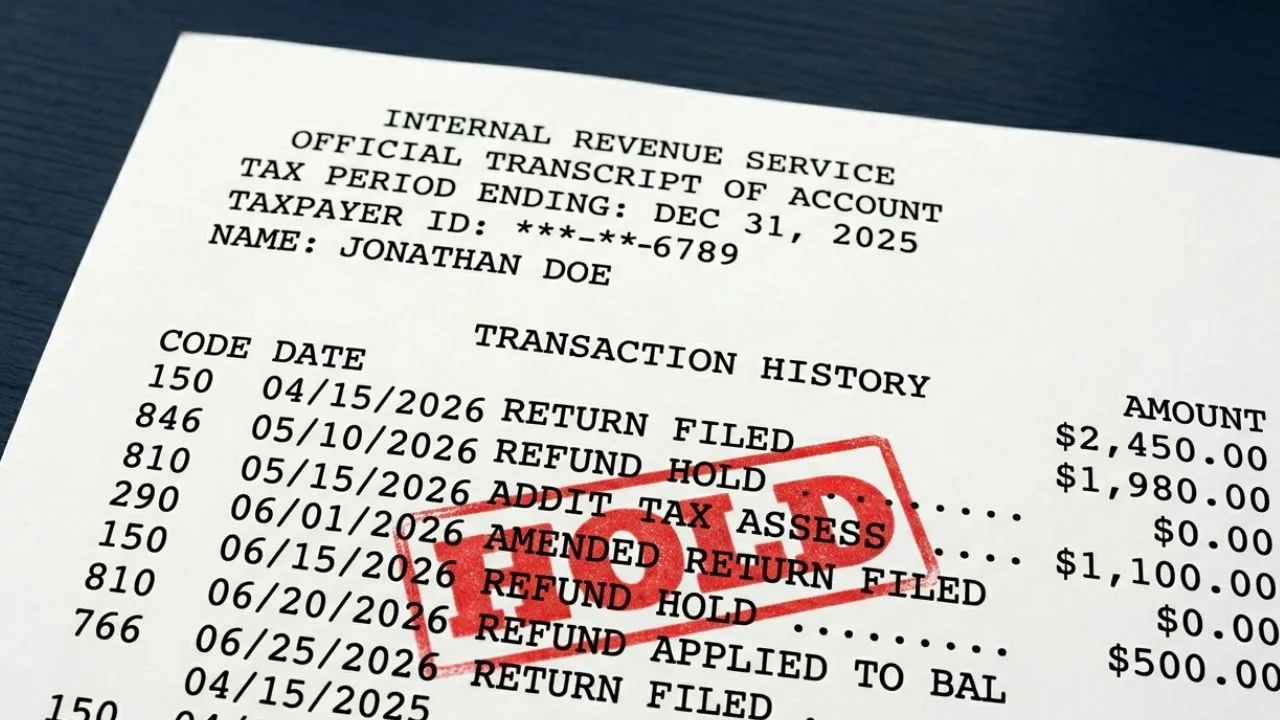
Several IRS transcript codes signal that your return has entered or is near the examination pipeline. Code 420 on your tax transcript means your return has been formally assigned to the IRS examination division, examination has been initiated.
Code 424 indicates the return has been referred for examination consideration but not yet formally assigned to an examiner. Code 421 signals that the examination is closed, either with no change to your return or with a resolved adjustment.
Code 570 (additional action pending) appears for multiple reasons, not all of which are examination-related. It also appears during identity verification holds, offset processing, and math error corrections.
If you see Code 570 without a corresponding Code 571 (freeze resolved), your return is in a hold status but the specific reason requires further investigation through your IRS online account or a transcript request. The IRS CP53E notice refund frozen guide covers the frozen refund scenarios that share transcript space with examination codes.
Your Rights If Your Return Is Selected
If your return is selected and you receive a formal notice, you have documented rights under the Taxpayer Bill of Rights. You have the right to know why the IRS is contacting you. You have the right to retain a representative, an enrolled agent, CPA, or tax attorney, to respond on your behalf.
You have the right to appeal any proposed examination adjustment to the IRS Independent Office of Appeals before the IRS issues a formal deficiency notice. You have the right to petition the U.S. Tax Court if you disagree with a final deficiency determination.
The IRS Independent Office of Appeals handles the majority of examination disputes without requiring Tax Court litigation. Most cases that reach Appeals are resolved at that level. The Taxpayer Advocate Service is available for cases involving significant hardship at taxpayeradvocate.irs.gov.
Official IRS examination procedures and taxpayer rights are documented in IRS Publication 556, Examination of Returns, Appeal Rights, and Claims for Refund. For the complete pipeline from return submission through refund or examination outcome, see the IRS refund pipeline how money reaches bank architecture guide.
The DIF score ranks every return filed. Here is what that means for your specific situation and your filing going forward.
What You Should Do Now
- File accurately and completely. The DIF score measures statistical deviation from the norm for your income level. Accurate documentation is the only approach that simultaneously minimizes DIF score risk and minimizes your actual tax liability.
- Maintain contemporaneous documentation for every deduction at the time you claim it. Receipts, charitable contribution acknowledgment letters, vehicle mileage logs, and business expense records must exist from the tax year in question. They cannot be reconstructed after an examination notice arrives.
- Check your IRS transcript at IRS account for any codes suggesting your return is under review. Code 420 or Code 424 on your transcript indicates examination assignment or referral.
- If you receive any IRS notice requesting documentation, read the notice carefully and respond within the exact timeframe stated, typically 30 days for correspondence exams. Late or absent responses convert manageable mail exchanges into more complex proceedings.
- For any examination involving significant business expense claims, Schedule C losses, or large charitable deductions, consult a tax professional before responding. The DIF score targets statistical anomaly, and the examination process has formal procedural rights that are best preserved with professional guidance.
The DIF score is the IRS’s primary tool for allocating limited examination resources toward returns most statistically likely to yield a tax adjustment. Understanding how it calculates that score transforms audit risk from a vague anxiety into a specific, manageable, documentable factor. File accurately. Document everything. Know your rights. The system is designed to find statistical anomalies, not accurate, well-documented returns.