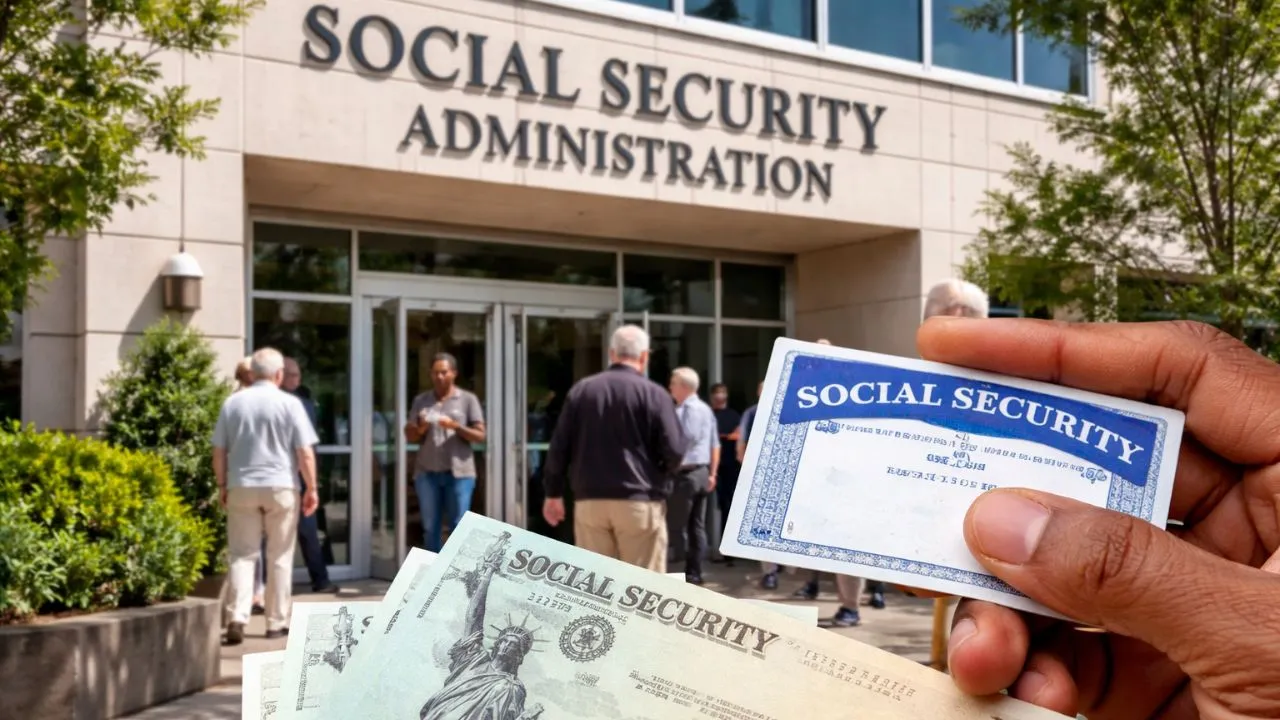


The Social Security trust fund that pays retirement benefits, the Old-Age and Survivors Insurance (OASI) Trust Fund is projected to reach exhaustion in fiscal year 2032, according to the Congressional Budget Office. When the trust fund balance hits zero, the Social Security Administration loses the legal authority to pay full scheduled benefits.
Under current law, benefits must immediately match incoming payroll tax revenue. The CBO projects that produces an automatic 7% benefit reduction in 2032 and up to 28% by 2033 through 2036. If your monthly payment is $1,800 today, a 28% cut reduces it to $1,296 a loss of $504 every month.
The 2032 exhaustion date is not a projection that might be wrong. It is the mathematical outcome of a statutory funding structure that has not been updated to reflect today’s demographics. Congress has the authority and the tools to prevent these cuts. Whether it acts before the deadline determines what you receive.
What the OASI Trust Fund Is and Why It Is Running Out
The Social Security trust fund referred to in the 2032 exhaustion projection is specifically the Old-Age and Survivors Insurance Trust Fund, OASI. This is the fund that pays retirement benefits to retired workers and survivor benefits to the families of deceased workers.
It is one of two separate Social Security trust fund accounts maintained on the books of the U.S. Department of the Treasury. The second account, the Disability Insurance Trust Fund, or DI is a separate fund that pays SSDI benefits and is in materially stronger financial condition than OASI.


The OASI trust fund is funded by payroll taxes. Workers and employers each contribute 6.2% of wages up to the annual taxable maximum, $176,100 in 2026, into the Social Security system. When the system collects more in payroll taxes than it pays in benefits, the surplus accumulates in the trust fund.
When it pays more in benefits than it collects in taxes, it draws down the accumulated surplus. The trust fund balance represents that accumulated surplus and it has been declining for years. The structural reason the trust fund is declining is demographic.
The Baby Boomer generation, approximately 76 million people born between 1946 and 1964, has been entering retirement in large numbers for over a decade. Each year, more workers enter retirement and begin drawing benefits while the working-age population grows more slowly.
In 1960, approximately five workers paid into Social Security for every one retiree drawing benefits. As of 2026, that ratio is approximately 2.7 workers per beneficiary. The CBO’s actuarial models project this ratio will continue declining.
The trust fund surplus, which is absorbing the annual gap between taxes collected and benefits paid, will reach zero in 2032 under this trajectory. The Social Security Administration trust fund article covers the full structure of both OASI and DI accounts, how they are funded, how they are managed, and what the statutory framework governing withdrawals actually says.
What Happens the Day the Trust Fund Reaches Zero
The Statutory Constraint: No Borrowing Authority
The Social Security Administration operates under a self-financing statutory framework. It has no legal authority to borrow money. It cannot transfer funds between the OASI and DI accounts without a specific act of Congress authorizing that transfer.
It cannot pay benefits in excess of its available cash balance, which, once the trust fund surplus is exhausted, means it can only pay benefits equal to incoming payroll tax revenue in real time.
This is not a policy choice that the SSA Commissioner can override. It is a statutory constraint embedded in the Social Security Act. When the trust fund balance reaches zero, the law requires benefit payments to be proportional to incoming tax revenue. The SSA does not have discretion to continue paying full benefits while waiting for congressional action. The cuts become automatic on the date of exhaustion.
The Specific Numbers the CBO Projects
The CBO’s baseline projection quantifies the benefit reduction with precision. In fiscal year 2032, the year of OASI Trust Fund exhaustion, incoming payroll tax revenue will cover approximately 93% of scheduled benefit payments.
The immediate automatic reduction is therefore approximately 7%. Every recipient of OASI benefits, retired workers, spouses, survivors, faces the same proportional reduction regardless of income level or benefit amount.
The gap between incoming payroll taxes and scheduled benefits does not stabilize at 7%. The CBO projects it widens through the following years as the demographic imbalance continues.
By the period spanning 2033 through 2036, CBO modeling produces an average mandatory reduction of 28% across all OASI payments. This is not a worst-case scenario.
It is the CBO’s central baseline projection under current law with no legislative intervention. On a theoretically combined basis, merging the financially stronger DI Trust Fund with the depleted OASI account, which would require an act of Congress, the combined system could sustain full benefit payments only until 2033 per the CBO or 2034 per the SSA Trustees Report.
After that point, a combined fund would still face mandatory reductions of approximately 19% to 23%. The Social Security benefit cuts 2032 Congress analysis tracks the legislative proposals currently in discussion and what timeline each approach requires to prevent automatic reductions.
Will Social Security actually be eliminated if the trust fund runs out?
No. Trust fund exhaustion does not eliminate Social Security. The program continues collecting payroll taxes and paying benefits from that revenue. What exhaustion eliminates is the ability to pay the full scheduled benefit amount. The system shrinks proportionally to match its incoming revenue, it does not disappear. The distinction is important: the threat in 2032 is a significant benefit reduction, not program termination.
Does the 2032 date affect people who are already retired?
Yes. The automatic benefit reduction under current law applies to all OASI recipients regardless of when they retired or how long they have been receiving benefits. There is no grandfathering provision in the current statutory framework. A person who has been receiving Social Security since 2010 faces the same proportional reduction as someone who retires in 2031. Only congressional action before the exhaustion date can prevent reductions for current recipients.
What can Congress do to prevent the cuts?
Three structural options exist, individually or in combination: raise the payroll tax rate, increase the taxable wage cap above $176,100, or reduce the benefit formula for future beneficiaries.
The 1983 Social Security reforms, enacted under the Greenspan Commission, combined modest tax increases, a gradual retirement age increase, and partial benefit taxation to extend solvency by four decades. A similar package of reforms enacted before 2032 would prevent automatic cuts. The size of the adjustment required grows with each year that passes without action.
If Congress acts in 2032 at the last moment, do prior benefit cuts get restored?
Legislation enacted at or after the exhaustion date can prevent further cuts from that point forward. It cannot retroactively restore payments that were already reduced in the months prior to enactment.
This is why the 2032 date functions as a hard legislative deadline, not a soft warning. Waiting until 2033 to act means some recipients will have received reduced payments that are not subsequently made whole. The Social Security 2027 COLA projection article covers the near-term benefit trajectory as context for understanding the longer-term 2032 picture.
Is the Disability Insurance Trust Fund also running out?
No. The DI Trust Fund is in materially better financial condition than OASI and does not face a 2032 exhaustion date on a standalone basis. However, if the two trust funds were theoretically combined, which requires congressional authorization, the combined fund would extend full solvency only to 2033 or 2034 before requiring reductions. The DI fund’s relative strength does not solve the OASI problem without legislative action.
Technical Details, Edge Cases, and What the SSA Trustees Report Adds
Trustees Report vs. CBO: Two Projections, Same Conclusion
The Social Security system produces two independent annual projections of trust fund solvency. The SSA Trustees Report is published by the Board of Trustees of the Social Security Trust Funds, a body that includes the Treasury Secretary, the Labor Secretary, the HHS Secretary, and two public trustees. The CBO publishes its own independent baseline projection using separate economic assumptions and demographic models.
The 2032 exhaustion date cited throughout this article is the CBO’s baseline projection. The most recent SSA Trustees Report projects 2033 as the OASI exhaustion year under the Trustees’ economic assumptions, one year later than the CBO estimate. Both projections use slightly different inflation, wage growth, and demographic assumptions.
The one-year difference is within the modeling uncertainty of both systems. Both projections agree on the structural conclusion: the OASI Trust Fund exhausts in the early 2030s under current law, producing automatic benefit reductions in the range of 20% to 28%.
The official CBO testimony on Social Security finances is available at cbo.gov/topics/retirement/social-security. The annual SSA Trustees Report actuarial analysis is published at ssa.gov/OACT/TR.
How the Trust Fund Connects to Medicare and COLA
The trust fund solvency question does not exist in isolation from Medicare or the annual Cost-of-Living Adjustment. Part B Medicare premiums are deducted directly from Social Security payments before recipients receive them.
An automatic benefit cut in 2032 would reduce the gross Social Security payment and Medicare Part B premiums would still be deducted from that already-reduced amount. The net effect on take-home monthly income would exceed the nominal percentage reduction in gross benefit.
The Social Security COLA 2027 Medicare offset analysis details how Medicare premium increases have historically consumed a significant portion of each year’s COLA increase, a dynamic that becomes more consequential in a scenario where the gross benefit itself is also under reduction pressure.
For the complete institutional picture of how Social Security benefits are calculated, transmitted, and deposited from the SSA through the Bureau of the Fiscal Service and into your bank account, see the US money movement system article.
The trust fund exhaustion in 2032 is a confirmed actuarial projection with specific, calculable consequences for your monthly payment. Here is what the projection means for your planning right now.
What You Should Do Now
- Calculate your current monthly Social Security gross benefit from your SSA award letter or your SSA account . Multiply that number by 0.93 to see what a 7% automatic reduction in 2032 looks like. Multiply by 0.72 to see what a 28% reduction by 2033 looks like.
- If you are within 15 years of claiming Social Security, include the 2032 scenario, alongside a scenario where Congress acts and prevents cuts, in your retirement income plan. Two scenarios, two outcomes. Planning for both is the appropriate response to a confirmed projection with an uncertain congressional resolution.
- If your retirement income depends heavily on Social Security as the primary source, identify supplemental income sources, savings, investments, or part-time income, that could absorb a portion of a potential benefit reduction.
- Monitor the annual SSA Trustees Report, published each spring, for updated exhaustion dates. The trust fund solvency date shifts slightly each year based on updated economic and demographic data.
- Contact your congressional representatives if you want to express a position on Social Security solvency legislation. The three structural solutions, tax rate, wage cap, benefit formula, are all within congressional authority to act on before 2032.
The trust fund exhaustion is not speculation. It is the documented mathematical output of a statutory funding structure meeting a demographic reality that has been building for decades. The 2032 date is the legislative deadline.
The benefit reduction projections are the CBO’s best quantification of what current law produces if that deadline passes without action. You now have the specific numbers, the institutional mechanics, and the planning framework to respond to this information with clarity rather than alarm.