Updated: June 23, 2026 – The Social Security Administration is a federal agency that administers the largest income-support program in the United States. In 2026, the SSA manages retirement, disability, and survivor benefits for more than 72 million Americans, disbursing approximately $1.4 trillion annually through a payment infrastructure that runs from SSA benefit calculations through U.S. Treasury disbursement to Federal Reserve ACH settlement and final bank account posting.
Understanding how the Social Security Administration actually works means understanding five distinct operational systems: how benefits are calculated, how eligibility is determined, how payments are scheduled, how the money physically moves from federal authorization to your bank account, and how the long-term trust fund solvency question affects the future of every current and future recipient.
This guide covers all five systems completely. It is the reference document for every question about Social Security benefits a reader arriving from any point in the coverage topic would reasonably ask.
The Social Security Administration determines your retirement benefit using your highest thirty-five years of indexed earnings, translated into your Average Indexed Monthly Earnings and then into your Primary Insurance Amount through a progressive benefit formula. Full retirement age for workers born after 1960 is 67.
Claiming at 62 reduces your benefit permanently. Delaying to 70 increases it by 8% per year beyond full retirement age. The 2026 COLA of 2.5% was applied to all benefits in January 2026. Early COLA projections for 2027 currently estimate an adjustment in the 3.5% to 4.2% range based on CPI-U data through spring 2026.
The Social Security trust funds, which include the Old-Age and Survivors Insurance Trust Fund and the Disability Insurance Trust Fund, are projected to reach combined depletion between 2032 and 2035 under current law, at which point incoming payroll taxes would cover approximately 79 to 83% of scheduled benefits without congressional action.
What the SSA Is
The Social Security Administration operates under Title II of the Social Security Act of 1935, which established the retirement insurance program, and Title XVI, which governs the Supplemental Security Income program. It is an independent federal agency with a Commissioner appointed by the president and confirmed by the Senate for a six-year term.
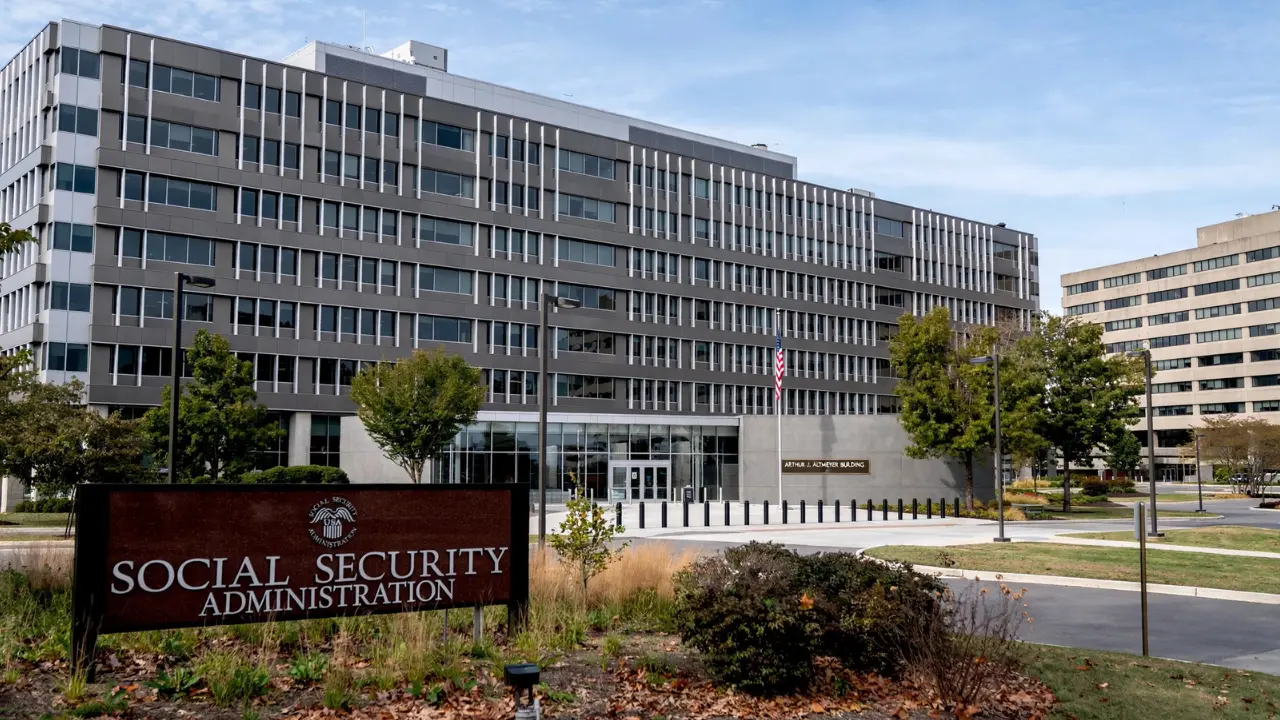
The SSA employs approximately 57,000 workers across its central office in Woodlawn, Maryland, ten regional offices, and more than 1,200 field offices nationwide. The agency also administers the National 800 Number network and an online services platform at SSA.gov that handles benefit applications, earnings record verification, and payment management for enrolled beneficiaries.
The Social Security program is funded primarily through the Federal Insurance Contributions Act payroll tax, which in 2026 applies to wages up to $176,100. Employers and employees each pay 6.2% of covered wages into the Old-Age and Survivors Insurance and Disability Insurance trust funds. Self-employed workers pay the combined 12.4% rate through the Self-Employment Contributions Act.
The SSA national system explained guide covers the administrative infrastructure in detail, including how the SSA’s National Workload Distribution System allocates cases across processing centers. The SSA national workload system impacts on processing times in 2026 reflect the agency’s ongoing staffing and technology modernization challenges.
How Benefits Are Calculated
The Social Security Administration calculates retirement benefits using a precise multi-step formula that converts your lifetime earnings record into a monthly payment amount. This formula is more complex than most recipients realize, and understanding it reveals why claiming age decisions have permanent financial consequences.
Step one is the earnings indexing. The SSA adjusts your historical earnings for wage inflation using indexing factors tied to the national average wage index for the year you turn sixty. Earnings from decades ago are indexed upward to reflect current wage levels, making them comparable to more recent earnings. This indexing process ensures that a worker who earned $15,000 in 1995 is not disadvantaged relative to a worker who earned a comparable inflation-adjusted amount in 2020.
Step two is the Average Indexed Monthly Earnings calculation. The SSA identifies your thirty-five highest years of indexed earnings and averages them. If you worked fewer than thirty-five years, zeros are averaged in for the missing years. Those zeros significantly reduce your AIME and therefore your benefit. Working additional years that replace zeros or low-earning years can meaningfully increase your benefit even after you have reached full retirement age.
Step three is the Primary Insurance Amount calculation. The SSA benefit calculation using AIME and PIA explains the progressive benefit formula in detail. In 2026, the formula applies a 90% replacement rate to the first $1,174 of AIME, a 32% replacement rate to AIME between $1,174 and $7,078, and a 15% replacement rate to AIME above $7,078.
These dollar thresholds, called bend points, are adjusted annually with wage growth. The result is that lower-income workers receive a higher percentage of their pre-retirement earnings replaced than higher-income workers, which is the intentional redistributive design of the program.
The maximum Social Security benefit for 2026 for a worker claiming at full retirement age is $4,018 per month. Claiming at 70 maximizes this amount further. The Social Security benefits at 62 versus 67 versus 70 comparison shows exactly how early and delayed claiming translate into permanent monthly benefit changes.
How the Money Actually Moves
Social Security payments do not travel directly from the Social Security Administration to your bank account. The payment moves through a multi-agency pipeline that begins with SSA benefit authorization and ends with your bank’s posting routine. Understanding this pipeline explains why your payment arrives on a specific day, why it shows as pending before it posts, and what happens when something goes wrong in the chain.
The SSA generates your monthly payment authorization file based on your established benefit amount, any applicable COLA adjustment, and any deductions such as Medicare Part B premiums.
This authorization file is transmitted to the Bureau of the Fiscal Service, which is the payment disbursement arm of the U.S. Department of the Treasury. The Bureau does not create the payment; it processes and transmits it.
The Bureau of the Fiscal Service submits the Social Security payment file to the Federal Reserve’s FedACH network, one of two ACH operators in the United States. FedACH processes the majority of federal government payments.
Standard credit settlement arrives at receiving banks at 8:30 AM Eastern Time on the settlement date, per the Federal Reserve’s published FedACH schedule. Your bank receives the file at settlement and executes its internal posting routine, which may post immediately or may hold the funds until a scheduled posting window.
Why your Social Security payment shows pending explains the gap between the FedACH settlement arrival and your bank’s visible account posting. The Social Security sent to bank but shows zero scenario specifically addresses cases where the payment was transmitted successfully but your account balance has not yet updated.
The complete framework for how federal money moves from agency authorization through Treasury disbursement to your account is documented in the U.S. money movement system hub guide, which is the system-level reference for all five SSA, IRS, and federal payment categories.
Payment Schedules and Timing
Social Security retirement, survivor, and disability benefits are paid according to a birth date-based schedule established in 1997 when the SSA shifted from a single payment date to the staggered system currently in use. SSI payments follow a separate first-of-month schedule.
The birth date payment schedule works as follows. Beneficiaries with birth dates from the 1st through the 10th of any month receive payment on the second Wednesday of each month. Birth dates from the 11th through the 20th receive payment on the third Wednesday. Birth dates from the 21st through the 31st receive payment on the fourth Wednesday.
This schedule distributes approximately 72 million payments across three banking days each month rather than concentrating them on a single day, which reduces processing strain on the FedACH network and receiving bank systems.
SSI recipients receive payment on the first of each month, or on the preceding business day when the first falls on a weekend or federal holiday. When SSI and Social Security retirement payments coincide in the same month due to calendar positioning, some recipients receive what appears to be a double payment. The Social Security double payment SSI explanation addresses the specific months when this calendar overlap occurs and why the January SSI payment is typically paid in late December of the preceding year.
The Social Security payment schedule for July 2026 and August 2026 payment schedule provide month-specific date tables for the current year. The Social Security June payment dates guide covers the June 2026 specific calendar. The complete annual schedule is published by the SSA at SSA.gov and is available through Social Security payment dates 2026.
When scheduled payment days fall on federal holidays, the SSA advances payments to the preceding business day. Understanding federal reserve holiday bank pauses explains why even when the SSA advances a payment, your bank may not post it until the holiday ends, creating a gap between the payment date and the visible deposit.
SSDI and SSI Eligibility
The Social Security Administration administers two distinct disability programs with fundamentally different eligibility structures. Confusing them is one of the most common sources of misunderstanding among applicants.
Social Security Disability Insurance is an earned benefit, like retirement insurance. Eligibility requires a work history sufficient to accumulate the required number of work credits. In 2026, you earn one work credit for each $1,730 in covered earnings, up to four credits per year.
Most workers need forty credits, with twenty earned in the ten years before disability onset, though younger workers need fewer credits. Your SSDI benefit amount is calculated using the same AIME and PIA formula as retirement benefits.
Supplemental Security Income is a needs-based program with no work history requirement. Eligibility requires meeting the SSA’s disability standard, which applies to both adults and children, plus financial eligibility limits on income and assets. The federal SSI benefit rate in 2026 is $967 per month for an individual and $1,450 for a couple, with state supplemental payments available in many states.
The medical disability standard is the same for both programs. The SSA uses a five-step sequential evaluation process to determine whether an applicant meets the definition of disability, which requires an inability to engage in substantial gainful activity due to a medically determinable physical or mental impairment expected to last at least twelve months or result in death. The SSDI and SSI eligibility rules guide explains each step of the sequential evaluation and the specific medical and functional criteria at each stage.
The SSDI application step-by-step guide covers the complete application process, including the documentation requirements, the timeline from application through initial decision, and the reconsideration and hearing appeal pathway for denied claims. Approximately two-thirds of initial SSDI applications are denied, making the appeal process a critical pathway for eligible applicants.
The Social Security disability claims in 2026 analysis examines how staffing changes and processing backlogs at the SSA’s Disability Determination Services offices are affecting average processing times across state agencies.
Spousal, Survivor, and Caregiver Benefits
The Social Security Administration provides benefits to spouses, divorced spouses, children, and survivors of covered workers. These auxiliary benefit categories serve a large portion of the total beneficiary population and operate under eligibility rules that are distinct from the worker’s own retirement benefit.
A spouse who did not work or had significantly lower earnings than their partner can claim a spousal benefit equal to up to 50% of the worker’s Primary Insurance Amount, provided the worker has claimed their own benefit first. The Social Security spousal benefit calculation explains how the spousal benefit interacts with the spouse’s own earned benefit, which the SSA pays as a combined amount rather than separately.
Divorced spouses can claim spousal benefits if the marriage lasted at least ten years, both parties are at least sixty-two, the divorced spouse is currently unmarried, and the worker is eligible for Social Security benefits.
The Social Security divorced spouse rules explain the specific claiming conditions and the important provision that a divorced spouse’s claim does not reduce the worker’s benefit or the current spouse’s benefit if the worker has remarried.
Survivor benefits are available to widows, widowers, divorced spouses, and dependent children of deceased covered workers. The Social Security survivor benefits guide explains the eligibility ages, benefit percentages, and the critical remarriage rules that can affect survivor benefit eligibility.
The Social Security caregiver credit bill HR 8490 represents pending legislation that would credit years spent providing unpaid family care toward Social Security eligibility, addressing the benefit gap created by workforce departure for caregiving responsibilities.
The Windfall Elimination Provision and Government Pension Offset Fairness Act repeal has significantly affected public sector workers whose Social Security benefits were previously reduced due to government pension income. The repeal, which took effect in 2024, has resulted in benefit increases for millions of affected workers.
Trust Fund Status and Future Projections
The Social Security trust funds consist of the Old-Age and Survivors Insurance Trust Fund and the Disability Insurance Trust Fund, managed by the Treasury Department under the oversight of a Board of Trustees that includes the Secretaries of Treasury, Labor, and Health and Human Services, plus two public trustees confirmed by the Senate.
The trust funds invest exclusively in special-issue Treasury securities, which carry the full faith and credit of the U.S. government. The funds earn interest on these holdings and also receive ongoing payroll tax revenues.
When payroll tax revenues plus interest income exceed benefit payments, the trust funds accumulate reserves. When they do not, the funds draw down reserves. The trust funds have been in drawdown mode since 2021, as the combination of demographic shifts, lower birth rates, and the pandemic’s labor market effects accelerated the depletion timeline.
The 2026 Trustees Report projects combined trust fund depletion between 2033 and 2035 under the intermediate economic assumptions. The Social Security trust fund depletion 2032 analysis explains the depletion scenario carefully.
Trust fund depletion does not mean Social Security stops paying benefits. It means the program would be limited to paying only what current payroll taxes cover, which the trustees estimate at approximately 79 to 83% of currently scheduled benefits.
The Social Security benefit cut 2032 dollars and cents analysis translates this percentage reduction into concrete monthly dollar amounts for different benefit levels, which is the most relevant way for current and near-future retirees to understand the policy stakes. The congressional response to the trust fund situation examines the legislative proposals currently under consideration.
The CBO trust fund projection uses slightly different economic assumptions than the trustees and arrives at a depletion date estimate that is broadly consistent but reflects different views on future wage growth and interest rates.
Common Problems and Escalation
The most frequently encountered Social Security payment problem is the missing or delayed payment. The SSA’s published protocol for a missing payment requires waiting three business days beyond the scheduled payment date before contacting the agency. This waiting period exists because most apparent payment delays resolve through the bank posting cycle rather than at the SSA level.
If your payment does not post within three business days of your scheduled date, contact the SSA at 1-800-772-1213. Have your Social Security number and bank account information available.
The SSA can verify whether the payment was transmitted to the Treasury and at what amount. If the payment was transmitted successfully, the issue is with your bank or with the FedACH settlement process, and your bank’s customer service line is the appropriate next contact.
The Direct Express card for Social Security is the payment method for beneficiaries without a bank account. The Comerica Bank-administered prepaid debit card receives SSA payments on the same schedule as direct deposit, but card access, disputed transactions, and card replacement issues are handled through the Direct Express customer service line at 1-800-333-1795 rather than through the SSA directly.
The Social Security payment missing alert from March 2026 documented a specific system processing event that caused temporary delays for a subset of recipients. Events of this type are rare but demonstrate that the payment pipeline, while highly reliable, is not immune to processing disruptions.
What You Should Do Now
- Verify your scheduled payment date against the official SSA birth-date payment schedule at SSA.gov before concluding that a payment is late.
- Allow three full business days beyond your scheduled payment date before initiating a payment trace request.
- Contact the SSA at 1-800-772-1213 to confirm the payment transmission status and amount.
- If the SSA confirms transmission, contact your bank’s customer service department and request a payment trace using the ACH trace number provided by the SSA.
- For benefit calculation disputes, request a reconsideration through your local SSA field office or the online appeals portal available through SSA.gov.
- For disability denial appeals, file a reconsideration request within 60 days of the denial notice date. If reconsideration is denied, request an Administrative Law Judge hearing.
- For trust fund and long-term benefit adequacy concerns, contact your congressional representative through Congress.gov using the Find Your Representative tool, as legislative action is the only mechanism that can alter the trust fund trajectory.
The Social Security Administration administers a system that touches the financial lives of more than 72 million Americans monthly. Every benefit payment that reaches a recipient’s account has traveled through the complete federal payment infrastructure described in this guide.
The complete U.S. money movement system reference provides the system-level view of exactly how federal dollars move from agency authorization through Treasury disbursement through FedACH settlement to your bank account each payment cycle.