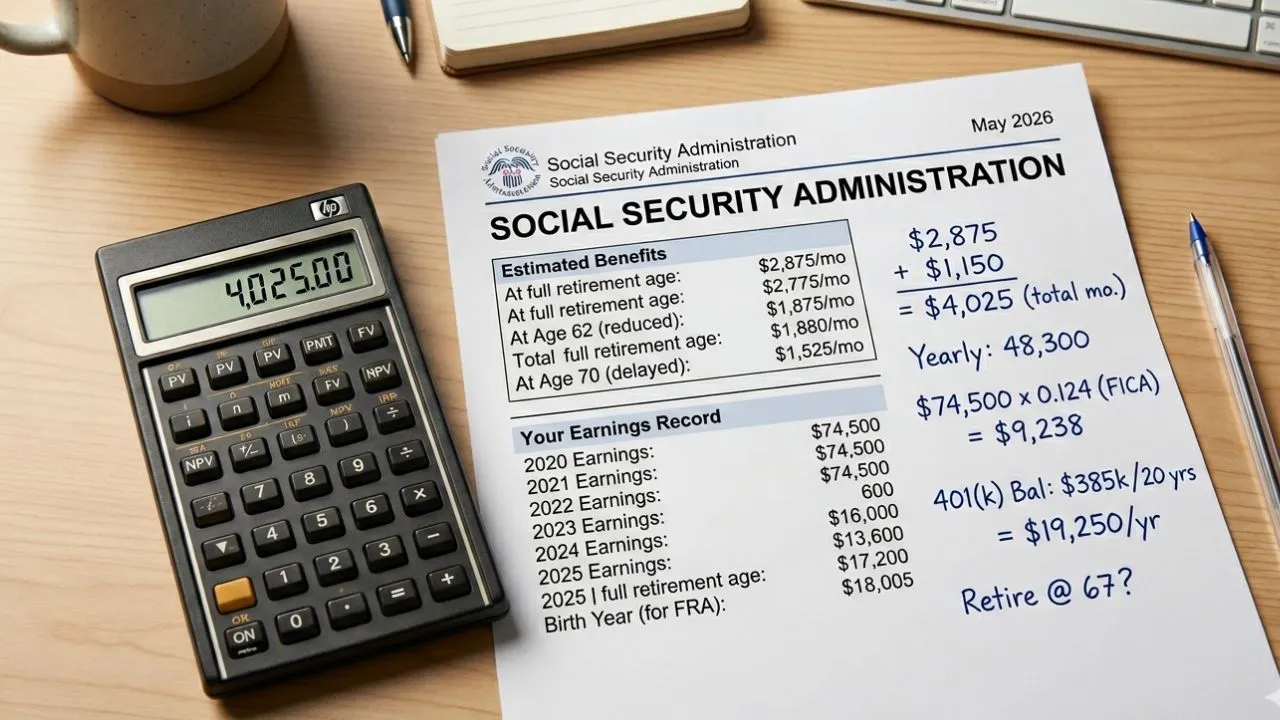

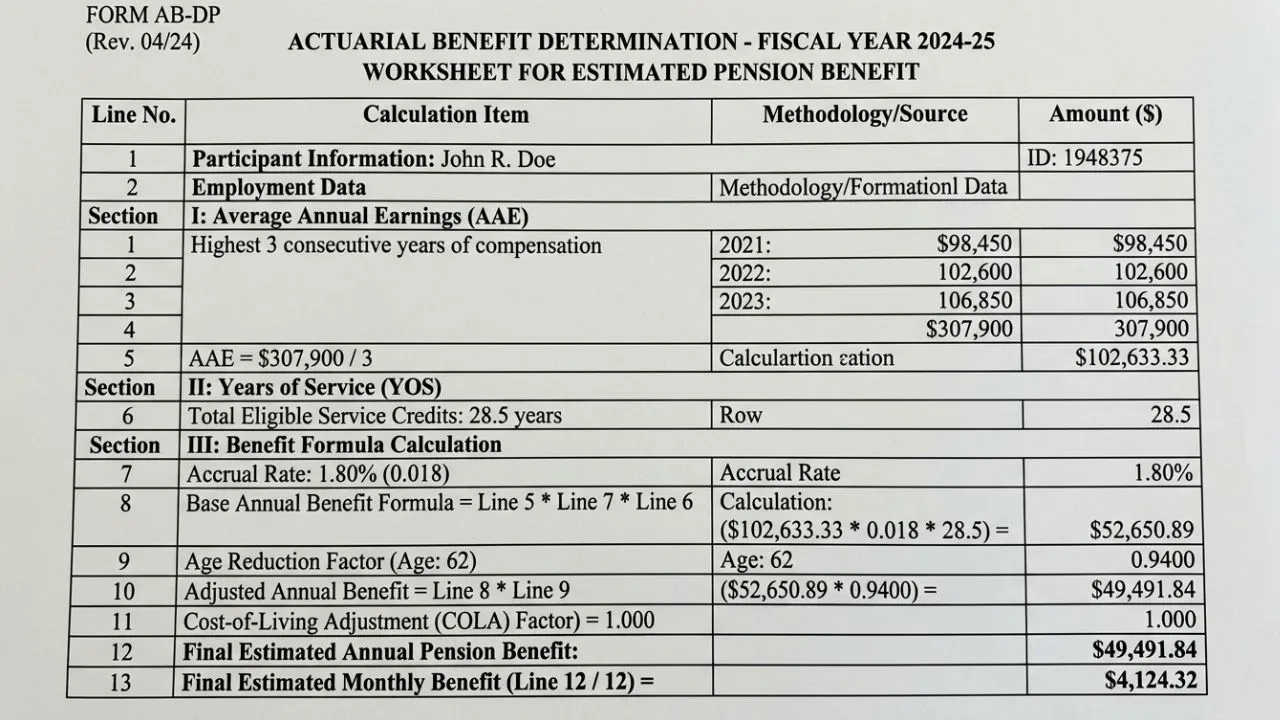
The SSA calculates your Social Security benefit by converting your lifetime wages into a single monthly average, then applying a weighted formula that replaces a higher percentage of lower earners’ wages. Every dollar of your monthly check traces back to a specific actuarial formula. Understanding this math tells you exactly what your retirement benefit will be before you claim.
The SSA Benefit Formula: AIME and PIA Explained
The SSA calculates benefits using two sequential calculations. First, it computes your Average Indexed Monthly Earnings, known as AIME. Second, it applies the Primary Insurance Amount formula, known as PIA, which converts your AIME into your actual monthly benefit figure using tiered replacement percentages called bend points.
Your final monthly benefit at full retirement age equals your PIA. Every other benefit, delayed retirement credits, early claiming reductions, spousal benefits, survivor benefits, derives from your PIA as the base figure.


The SSA does not simply average your wages. It first adjusts your historical wages for economy-wide wage growth. This process, called wage indexing, ensures that wages you earned in 1985 are compared to current wage levels rather than 1985 dollar values. Without indexing, decades of inflation would make early career wages appear artificially low relative to later years.
The complete SSA benefit calculation methodology is published in the SSA’s official benefit formula bulletin, which is updated annually after each COLA adjustment cycle.
Step One: Computing Your AIME
Identify Your 35 Highest Earning Years
The SSA examines your entire earnings record on file, which is maintained in the Individual Master File at SSA’s central mainframe. It selects the 35 years in which your indexed wages were highest. If you worked fewer than 35 years, the SSA fills in the missing years with zeros.
Each zero year suppresses your AIME and ultimately lowers your monthly benefit. This is why working longer, even at modest wages, consistently improves your final benefit amount.
Apply the Wage Indexing Factor
The SSA indexes your wages using the Average Wage Index, published annually by the SSA’s Office of the Chief Actuary. Your wages in each year are multiplied by the ratio of the national average wage in the indexing year to the national average wage in the year you earned those wages.
The indexing year is defined as the second year before the year you turn 62. For a worker turning 62 in 2026, the indexing year is 2024. Wages earned after the indexing year are used at their nominal dollar value without adjustment.
As of 2026, the national average wage index figure used for the 2026 benefit calculation cohort is published by the SSA each fall alongside the COLA announcement. This figure is the actuarial anchor of every benefit calculation for that cohort year.
Compute the Monthly Average
After selecting the 35 highest indexed wage years, the SSA sums all those annual indexed wages and divides by 420, the number of months in 35 years. The resulting figure is your AIME. It is expressed as a dollar amount per month.
A worker with a moderate lifetime earnings record might have an AIME of $3,200. A high earner near the taxable earnings cap might have an AIME of $9,500 or above. The social security buying power analysis shows precisely how wage indexing preserves the real value of AIME calculations against decades of price inflation.
Step Two: Applying the PIA Bend Points
The Three-Tier Replacement Rate Structure
The PIA formula converts your AIME into a monthly benefit using three replacement rate tiers separated by fixed dollar amounts called bend points. The bend points change each year with wage growth and are published by the SSA annually. As of 2026, the official SSA PIA bend points are as follows:
• The SSA replaces 90 percent of the first $1,174 of your AIME.
• The SSA replaces 32 percent of AIME between $1,174 and $7,078.
• The SSA replaces 15 percent of AIME above $7,078.
This tiered structure is progressive by design. A lower-income worker with an AIME of $800 receives 90 cents of benefit for every dollar of AIME. A high-income worker’s AIME above $7,078 generates only 15 cents of benefit per dollar. Social Security replaces a substantially larger share of pre-retirement income for lower earners than for higher earners.
A Worked Example of the PIA Calculation
Consider a worker with an AIME of $4,500 in 2026.
• First tier: 90% × $1,174 = $1,056.60
• Second tier: 32% × ($4,500 − $1,174) = 32% × $3,326 = $1,064.32
• Third tier: $0 (AIME does not exceed $7,078)
• Total PIA: $2,120.92, rounded down to the nearest dime = $2,120.90
This worker’s PIA at full retirement age would be $2,120.90 per month. If this worker claims at age 62, permanent early claiming reductions apply. If they delay to age 70, delayed retirement credits of 8 percent per year apply for every year past full retirement age, up to a maximum of 32 percent above PIA for those born after 1943.
The social security payment dates guide explains the Treasury’s payment calendar and how your PIA-derived amount is transmitted through FedACH to your bank account on a specific Wednesday each month.
How Full Retirement Age Affects Your PIA
Your PIA represents 100 percent of your earned benefit, but you only receive 100 percent if you claim exactly at your Full Retirement Age (FRA). For workers born in 1960 or later, FRA is age 67, per the Social Security Amendments of 1983.
Claiming before FRA permanently reduces your monthly benefit below your PIA. Claiming after FRA permanently increases it above your PIA through delayed retirement credits.
Early Claiming Reduction Schedule
The SSA reduces your benefit by 5/9 of one percent for each month you claim before FRA, up to 36 months early. Beyond 36 months, the reduction increases to 5/12 of one percent per additional month.
A worker born in 1960 who claims at age 62 is claiming 60 months before FRA. The reduction calculation is: (5/9 × 1% × 36) + (5/12 × 1% × 24) = 20% + 10% = 30%. This worker receives only 70 percent of their PIA for life.
Delayed Retirement Credits
For each month you delay claiming past FRA, the SSA credits 2/3 of one percent to your benefit. Over 12 months, that is 8 percent annually. Delaying from FRA of 67 to age 70 produces exactly 3 years of credits, adding 24 percent above PIA.
As of 2026, the maximum Social Security retirement benefit for a worker who delayed to age 70 is $5,108 per month, according to the SSA OACT maximum benefit schedule.
Spousal and Survivor Benefit Calculations
A spouse who did not work, or who worked at substantially lower wages than their partner, may claim a spousal benefit equal to 50 percent of the higher-earning spouse’s PIA at FRA. The spousal benefit does not grow with delayed retirement credits beyond FRA. Delaying past FRA does not increase the spousal benefit.
A surviving spouse is entitled to 100 percent of the deceased worker’s benefit, including any delayed retirement credits the deceased worker had earned. The survivor benefit is based on the deceased worker’s actual PIA plus credits, not the survivor’s own record.
This is one of the most financially significant and least understood provisions in Social Security law. The social security fairness act repeal directly increased survivor and spousal benefits for millions of public sector retirees who were previously subject to the Government Pension Offset.
Does Social Security count all my working years?
No. The SSA uses only your 35 highest indexed earning years. Additional years of work only improve your benefit if a new year’s indexed wages replace a previous zero year or a lower-earning year in your top 35.
What if I never worked but my spouse did?
You may claim a spousal benefit equal to 50 percent of your spouse’s PIA at your own FRA. If you claim before FRA, the spousal benefit is permanently reduced. You cannot receive a spousal benefit until your spouse has filed for their own Social Security benefit.
Can my AIME be recalculated after I claim?
Yes. The SSA automatically recalculates your AIME each year after your earnings are posted to your record. If a new year of wages is higher than the lowest year in your top 35, the SSA replaces it and issues any corresponding benefit adjustment in the following year.
The AIME and PIA formula governs the exact dollar amount on your Social Security check for the rest of your life. Optimizing your inputs to this formula before you claim is the highest-leverage financial decision most Americans make.
What you should do now
- Log into your Social Security account at SSA Account and review your earnings record for accuracy. Errors in your earnings history directly suppress your AIME.
- Count your zero years. If you have fewer than 35 years of covered earnings, each additional year you work replaces a zero and raises your AIME.
- Use the SSA Retirement Estimator at Estimator to model your PIA at different claiming ages.
- Verify the current bend points annually at Bend Points. They shift each year with wage growth and directly affect your PIA calculation.
- Delay claiming if your health and finances permit. The 8 percent per year delayed retirement credit is the highest guaranteed rate of return available from any federal program.
The SSA calculates benefits through a fixed actuarial formula that rewards lifetime wage contributions and protects lower earners through progressive replacement rates. The SSA calculates benefits in a way that every additional dollar of indexed wages and every month of delayed claiming produces a computable, verifiable improvement in your monthly check.