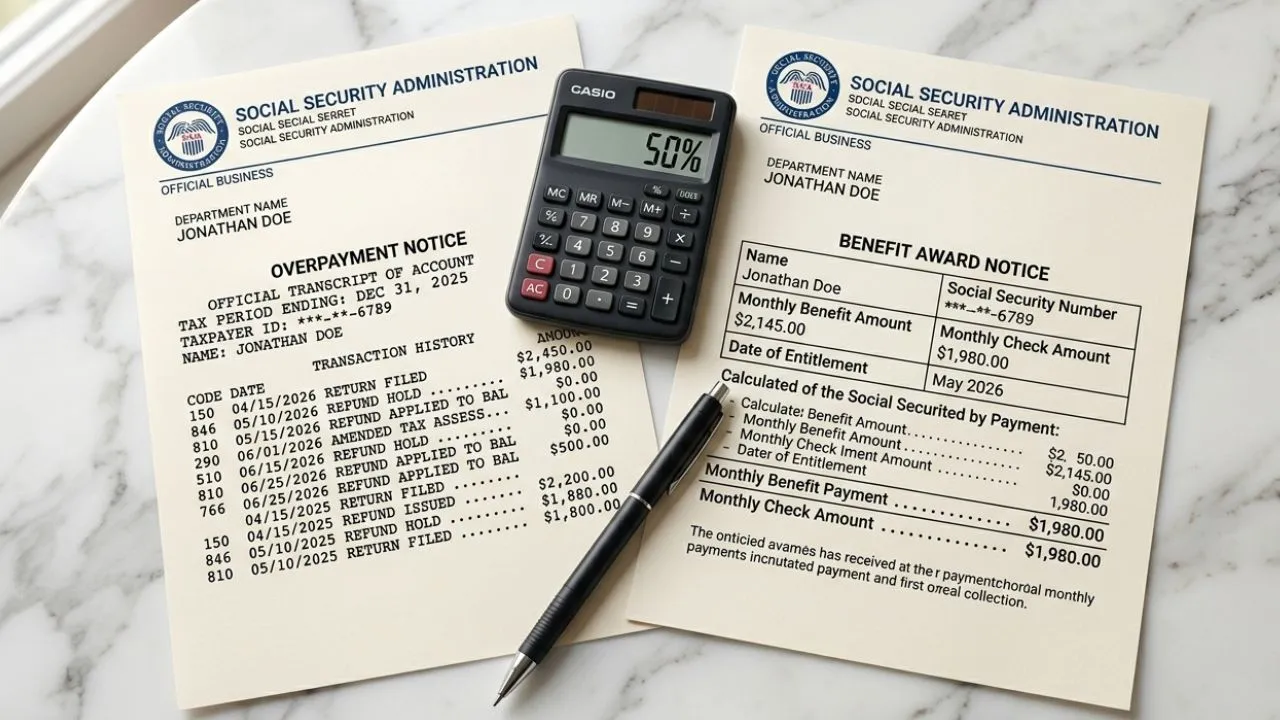

The Social Security earnings test is an SSA rule that reduces your monthly benefit if you claim Social Security before your Full Retirement Age and continue earning wages above a specific annual limit.
For every $2 you earn above the threshold, the SSA withholds $1 in benefits. The withheld money is not lost permanently, it is credited back to your benefit as a permanent upward adjustment after you reach Full Retirement Age.
How the Social Security Earnings Test Works in 2026
The Social Security earnings test applies only to people who have claimed Social Security retirement benefits before their Full Retirement Age and who continue to earn wages or self-employment income.
The test does not apply to investment income, pension income, rental income, or interest. It applies exclusively to earned income, wages from an employer and net self-employment earnings.

As of 2026, the SSA applies two separate earnings thresholds depending on how far you are from your Full Retirement Age. If you are more than one full calendar year below your FRA in 2026, the annual earnings exempt amount is $22,320, according to the SSA’s official earnings test parameters.
The SSA withholds $1 of benefit for every $2 earned above this threshold. If you are in the calendar year in which you will reach your FRA, a higher threshold of $59,520 applies, and the withholding rate is only $1 for every $3 earned above that threshold. The month you reach FRA, the earnings test disappears entirely and never applies again.
The SSA does not reduce your monthly check in real time as you earn. Instead, the SSA estimates your annual wages at the start of the year and withholds full monthly benefits in advance to cover the expected reduction. If your actual earnings differ from estimates, the SSA reconciles the difference in the following year.
The Withholding Mechanism: How the SSA Stops Your Checks
The Social Security earnings test operates through a suspension-first, reconcile-later mechanism. When you notify the SSA of expected wages above the exempt amount, the agency calculates the total estimated withholding for the year and suspends your benefit payments for enough months to equal that total.
The SSA withholds whole monthly payments rather than fractional amounts. This means you may receive no checks for several consecutive months in a year if your wages are significantly above the threshold.
A Worked Example of Earnings Test Withholding
Consider a 64-year-old retiree in 2026 with a monthly Social Security benefit of $1,800 who earns $42,320 in wages from part-time work.
• Excess earnings: $42,320 − $22,320 = $20,000
• Withholding rate: $1 for every $2 = $10,000 withheld
• Monthly benefit: $1,800
• Months suspended: $10,000 ÷ $1,800 = 5.56 months, rounded to 6 full months
The SSA would suspend this person’s Social Security checks for approximately 6 months in 2026. The remaining months they would receive $1,800 as normal. If their actual wages come in slightly lower than projected, the SSA refunds the over-withheld amount.
The social security payment dates 2026 calendar helps recipients track exactly which scheduled payment dates are affected by earnings test suspensions in any given month.
The Permanent Benefit Adjustment After FRA
The most misunderstood aspect of the Social Security earnings test is that withheld benefits are not forfeited. The SSA permanently recalculates your monthly benefit upward after you reach Full Retirement Age to account for every month your benefit was withheld. This recalculation follows the same actuarial logic as the original benefit reduction for early claiming.
How the Adjustment Is Calculated
When you claimed early, the SSA applied a permanent reduction to your PIA to account for the additional months of early payment. For every month the SSA withheld your benefit due to the earnings test, the SSA treats that month as if you had not claimed early for that specific month.
The recalculation adds back the early claiming reduction for each withheld month, permanently raising your monthly benefit. If you had 60 months of early claiming built into your reduction and the earnings test caused 12 months of withholding over your pre-FRA years, the SSA recalculates your benefit as if you had claimed only 48 months early.
Your new, higher monthly benefit begins the month you reach FRA and continues for the rest of your life. This actuarial recalculation means the earnings test is a timing adjustment, not a financial penalty, over a sufficiently long lifetime.
However, the break-even analysis depends heavily on your actual lifespan, health, and the opportunity cost of the withheld funds during the withholding period. Understanding how the SSA calculates benefits through the AIME and PIA framework helps you model this recalculation precisely.
Who Is Exempt From the Earnings Test
The Social Security earnings test does not apply to everyone. Four specific categories are completely exempt.
First, anyone who has reached their Full Retirement Age is permanently exempt, regardless of how much they earn. There is no upper limit on wages for Social Security recipients at or above FRA. Second, SSI recipients are subject to entirely different income rules under Title XVI and are not governed by the Title II earnings test.
Third, Social Security disability recipients under SSDI are subject to the Substantial Gainful Activity rules rather than the retirement earnings test. Fourth, individuals who have not yet claimed Social Security, who are waiting past FRA to maximize delayed retirement credits, are not subject to the test because their benefits are not in payment status.
The earnings test is a Title II retirement benefit rule. It affects only claimants who have voluntarily filed for early retirement benefits while continuing to generate earned income.
Reporting Your Earnings to the SSA
You are legally required to report expected wages to the SSA if you are receiving benefits before FRA and expect to earn above the annual exempt amount. Failure to report can result in significant overpayments that the SSA will later demand back in full.
The SSA’s recovery mechanisms for overpayments include offsetting future benefit checks until the full amount is recouped. The SSA cross-references earnings test data with IRS W-2 and self-employment tax filings each year after tax returns are processed. This reconciliation typically occurs approximately 18 months after the tax year closes.
Discrepancies trigger adjustment notices. The SSA national workload system processes these reconciliations through a centralized batch review that generates automated adjustment letters to affected beneficiaries. Report wages by contacting the SSA at 1-800-772-1213 or through your my Social Security portal.
The Earnings Test and Spousal Benefits
The earnings test applies independently to each beneficiary. If you are collecting a spousal benefit on your spouse’s work record and you continue to work above the earnings threshold, the SSA applies the earnings test to your spousal benefit.
Your working income does not trigger an earnings test reduction against your spouse’s own retirement benefit. Each benefit stream is tested separately against the income of the person receiving it.
If your own benefit is withheld due to the earnings test, any dependent benefits being paid on your record, such as benefits paid to children or to a spouse caring for a young child, are also withheld proportionally. The SSA treats the earnings test as a household-level calculation when auxiliary benefits are in payment on the primary beneficiary’s record.
The federal reserve social security impact analysis documents how the Treasury’s payment infrastructure transmits adjusted benefit amounts after FRA recalculations are posted to the SSA’s payment authorization system.
Does the earnings test apply to a pension or retirement account withdrawals?
No. The Social Security earnings test applies only to wages from employment and net self-employment earnings. Withdrawals from IRAs, 401(k) plans, pension income, rental income, dividends, interest, and capital gains are all excluded from the earnings test calculation entirely.
What if I retire mid-year and only earn wages for part of the year?
The SSA provides a monthly earnings test in the first year you claim benefits. In your first year, the SSA applies a monthly threshold rather than an annual one. As of 2026, the monthly exempt amount is one-twelfth of the annual threshold, or approximately $1,860 per month. You receive your full benefit for any month in which your wages do not exceed this monthly amount, regardless of total annual earnings. This provision protects workers who retire partway through a calendar year from losing benefits for the months they are genuinely retired.
Will I get back all the money withheld by the earnings test?
Mathematically yes, if you live long enough. The actuarial recalculation at FRA raises your benefit permanently. The additional monthly benefit you receive for the rest of your life accumulates until it surpasses the total amount withheld. The break-even point typically falls several years after FRA. The longer you live past break-even, the more favorable the earnings test outcome becomes in retrospect.
Can I undo my Social Security claim to avoid the earnings test?
Yes, under limited conditions. If you are within 12 months of your initial claim date, you may file SSA Form 521 to withdraw your application, repay all benefits received to date, and reapply later at a higher benefit amount. This option is available only once in a lifetime. After the 12-month withdrawal window closes, you may also suspend your benefit at FRA to earn delayed retirement credits, though the earnings test no longer applies at that point.
The Social Security earnings test directly controls whether your monthly check arrives or is withheld during your pre-FRA working years. Misunderstanding it costs thousands of dollars in unexpected withholding and overpayment recoveries.
What you should do now
- Confirm your Full Retirement Age at FRA Age. Workers born in 1960 or later have FRA at 67.
- Estimate your annual wages before claiming early. If they will exceed $22,320 in 2026, model the withholding impact before filing.
- Report expected wages to the SSA at 1-800-772-1213 before the start of each calendar year in which you will earn above the threshold.
- Request the FRA benefit recalculation letter from the SSA the month you reach FRA. Confirm the upward adjustment has been applied correctly to your monthly payment.
- Review the monthly earnings test rule if you are retiring partway through the year. Request SSA staff apply the monthly rule to protect your benefits for the months you are genuinely not working.
The Social Security earnings test is not a permanent confiscation of your benefits. It is an actuarial deferral mechanism designed to reflect the original early claiming bargain. The Social Security earnings test withholds money now and returns it through a higher permanent monthly benefit later. Understanding its precise mechanics is the difference between an accurate household income projection and an expensive surprise.