 Prefer Investozora on Google
Get real-time financial updates.
May 19, 2026 • 9:15 AM ET
The NACHA 9 AM rule, requiring that banks make ACH deposits available to customers by 9:00 AM on the settlement date, has been in effect since March 2026, per NACHA’s operating rules. Federal payments including Social Security benefits and IRS refunds are disbursed through the Federal Reserve’s FedACH network per fiscal.treasury.gov. The next Social Security payment date for recipients born the 21st through 31st of any month is May 27, 2026, per the official SSA schedule.
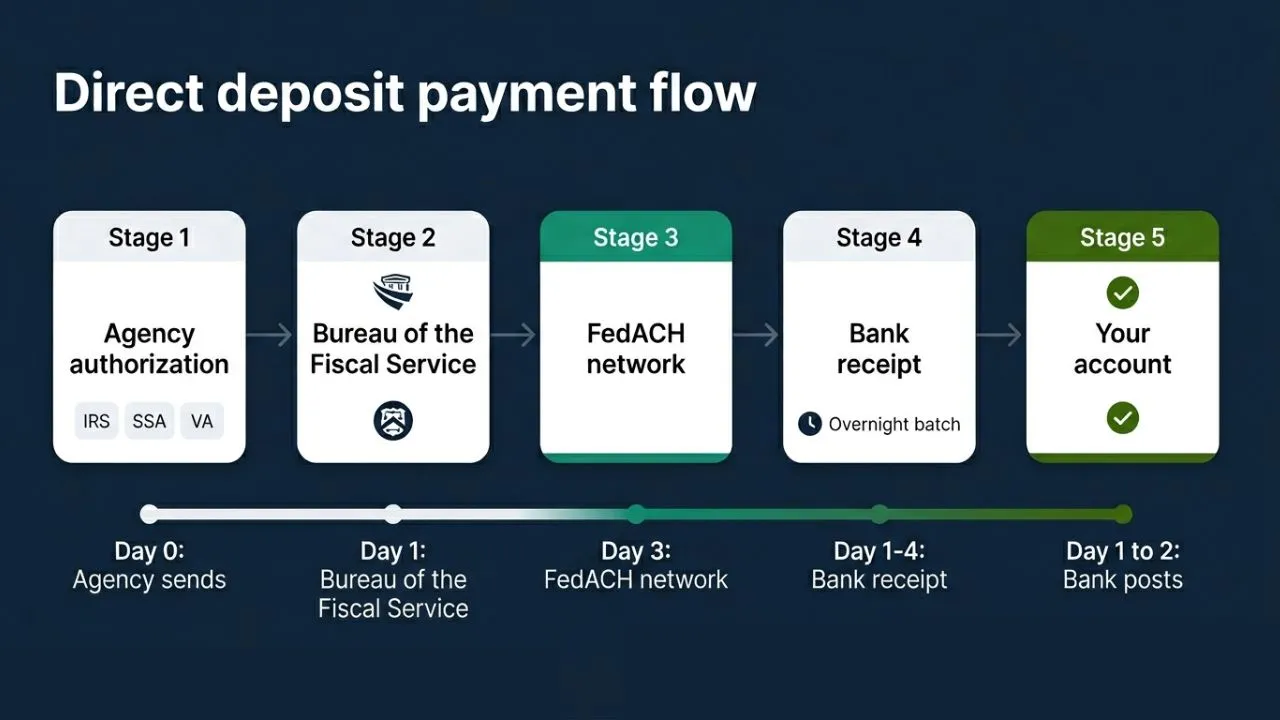
Your direct deposit arrives at different times because two separate systems process it. First, the FedACH network settles the payment between banks on a specific date. Second, your bank processes the payment in its own internal system and posts it to your account on its own schedule.
Both steps happen overnight and the timing of each can vary. Direct deposit arrives at a different time every month because it travels through two separate systems before reaching your account, and the timing of each system is determined by different rules and different institutions.
This is not a bank error. It is not a delay. It is the normal operation of the federal payment infrastructure that processes every government benefit, every payroll deposit, and every IRS refund in the United States.
The first system is the Federal Reserve’s FedACH network, which settles interbank transfers on specific effective dates. The second system is your own bank’s internal processing schedule, which determines when it posts credits that arrive from FedACH to your visible account balance.
These two systems are connected but independent, and the interaction between them produces the apparent randomness in deposit timing that confuses millions of Americans every month.
Understanding both systems gives you the ability to predict, to a reasonable degree, when your deposit will arrive in any given month and to know immediately whether a delayed deposit represents a real problem or simply the expected variation in processing time.
The U.S. money movement system guide covers the full institutional architecture from payment origination through interbank settlement to consumer posting.
How FedACH determines the effective date of your deposit
The Federal Reserve’s FedACH network is the interbank clearing system that processes the vast majority of electronic payments in the United States, including all federal government payments.
When your employer processes payroll, when the SSA submits Social Security payment files, or when the IRS submits refund payment files through the Bureau of the Fiscal Service, the payment enters the FedACH system as an ACH credit with an effective date.


The effective date is the date the payment is supposed to be settled between banks. It is set by the originator, your employer, the Social Security Administration, or the IRS, not by your bank. For Social Security payments, the SSA sets the effective date as the scheduled payment date (for example, the second Wednesday of the month for recipients born the 1st through 10th).
For IRS refunds, the Bureau of the Fiscal Service sets the effective date as the date shown on your IRS transcript Code 846. FedACH processes transactions in multiple daily batches.
Files submitted by midnight of the day before the effective date are processed in the overnight batch that settles on the effective date. Files submitted later in the day may settle on a one-business-day lag.
Your bank receives the settlement credit on the effective date and must make it available to you by 9:00 AM that day under the NACHA 9 AM rule that went into effect in March 2026, per NACHA operating guidelines.
This rule applies to all ACH credits regardless of the payment type. The NACHA 9 AM direct deposit rule guide covers the specific requirements and what they mean for federal payment recipients.
The effective date does not move regardless of when FedACH processes the underlying batch. But if the scheduled payment date falls on a weekend or a federal banking holiday, the effective date shifts to the last business day before the weekend or holiday.
This is why your Social Security payment sometimes arrives on Friday instead of Monday, Treasury submits the payment files with an early effective date to ensure settlement completes before the non-business days begin.
How your bank’s internal schedule determines exactly when you see the deposit
Your bank receives the FedACH settlement credit on the effective date. What happens next depends entirely on your bank’s internal processing schedule, which is set by the bank and varies significantly between institutions.
Traditional brick-and-mortar banks typically process incoming FedACH credits overnight, in a batch that runs between midnight and 6 AM on the effective date. The posting to your account, the moment when your balance shows the new credit, typically happens between 3 AM and 9 AM. Under the NACHA 9 AM rule, the posting must occur no later than 9 AM.
Most banks meet this requirement but some large banks post as early as midnight, which is why some account holders see their deposit the night before the effective date while others at different banks see it at 8 AM the following morning.
Online banks and fintech institutions often process FedACH credits faster than traditional banks because they have more modern core banking systems that process transactions in smaller, more frequent batches rather than in single nightly runs.
An online bank might post your Social Security or IRS refund deposit at midnight or 1 AM on the effective date, while a traditional bank with an older core system might not post it until 7 AM or 8 AM. The practical difference between these two outcomes is 6 to 8 hours of earlier access to the same money.
Some banks offer “early direct deposit” as a feature, posting payroll ACH credits one or two days before the effective date when the pre-notification of the incoming credit arrives in the bank’s system. This is a service offered by the bank at its discretion and is not required by NACHA rules.
Not all payment types qualify for early posting, Social Security payments, IRS refunds, and other Treasury disbursements may not trigger early posting at banks that offer the feature for private payroll. The early direct deposit mechanics guide covers which payment types qualify and what the bank’s advance timing actually represents.
Why the same deposit arrives at different times in different months
Three factors combine to produce the timing variation you observe month to month. The first is the calendar shift of the payment date. A payment scheduled for the second Wednesday of each month falls on a different calendar date each month, and the surrounding days vary in terms of whether they include weekends or holidays that shift the effective date earlier.
The second is the FedACH processing batch timing. The Bureau of the Fiscal Service submits Treasury payment files on a schedule that sometimes results in the file landing in FedACH’s early batch versus its later batch, which can shift the settlement timing by hours on the effective date.
The third is your bank’s processing load. On days when FedACH delivers a large volume of credits simultaneously, which happens at the beginning of the month when Social Security, federal pension, and payroll payments all process together, your bank’s overnight batch may take longer to complete, pushing the posting time slightly later than it would be on a lighter volume day.
These three factors interact differently in different months. A month where your payment date falls on the first business day after a long weekend, when FedACH volume is high and your bank’s system is under load, will produce a later posting time than a month where the payment date falls mid-week with normal volume. This variability is structural and predictable once you understand what causes it.
The Social Security Administration confirms payment schedules annually at ssa.gov/pubs/EN-05-10031-2026.pdf. The Bureau of the Fiscal Service at Treasury publishes the payment disbursement calendar at fiscal.treasury.gov. Cross-referencing these two sources with your bank’s specific posting schedule gives you a reliable estimate of when your deposit will post each month before it actually arrives.
What you should do now
- Identify your bank’s specific ACH posting time by checking when your last three federal deposits arrived. This gives you your bank’s actual posting pattern, which is more reliable than any general guide.
- If your deposit should have arrived by 9 AM on the effective date and has not posted, check with your bank before contacting SSA or IRS. The bank receives the credit from FedACH before it shows in your balance.
- If your bank account changed and you did not update SSA or the IRS, your deposit will be returned to Treasury and reissued as a paper check, adding weeks to the timeline. Update your direct deposit information at SSA account or IRS account.
- For weekend payment dates, the effective date typically moves to the preceding Friday. If your regular payment date falls on Saturday or Sunday, check your balance on Friday afternoon rather than Monday morning.
- The Daily Treasury Statement at Treasury report shows the actual dollar amount of federal payments processed each business day. The ACH column in Table V confirms whether your payment type was included in that day’s disbursement batch.