

Quick Summary
- IRS Transaction Code 846 means your refund has been approved and the IRS has transmitted payment to the U.S. Bureau of the Fiscal Service for deposit.
- The date printed next to TC 846 is the IRS’s official payment transmission date, not the date your bank will post the funds.
- Most taxpayers whose banks use standard FedACH settlement receive their deposit within 1 to 5 business days of the TC 846 date.
- TC 846 overrides all prior processing holds, math-error freezes, and automated review flags. Once it posts, your refund is in motion.
- A TC 846 posting is the final and definitive code in the IRS tax refund lifecycle. No code posted after TC 846 in the standard cycle can reverse it without a separate administrative action.
- If your TC 846 date has passed by more than 5 business days and your bank shows no deposit, the issue is downstream of the IRS and must be investigated with the Bureau of the Fiscal Service and your bank.
Updated: June 22, 2026 – When IRS Code 846 appears on your tax account transcript, the IRS has finished processing your return. The refund approval process is complete. TC 846 is the final transaction code in the standard refund lifecycle, and its presence on your transcript means the IRS has transmitted payment authorization to the U.S. Treasury’s Bureau of the Fiscal Service.
The money has left the IRS system. Understanding what happens between that moment and the time funds appear in your bank account explains virtually every delay complaint filed with the IRS Taxpayer Advocate Service each year.
The IRS transcript system is the most complete picture of your refund’s status available to any taxpayer. The Where’s My Refund tool at IRS.gov provides simplified status messages.
Your tax account transcript, which you can access at IRS.gov through the Get Transcript portal, shows the actual transaction codes that determine every status message you will ever see. IRS Code 846 is the code every taxpayer is waiting for. Every other code that appears before it is part of the pipeline that leads to it.
What TC 846 Actually Means
IRS Code 846 is formally classified as Transaction Code 846 in the IRS Individual Master File system, the core processing database for individual tax returns.
According to the Taxpayer Advocate Service’s documented transcript guide at taxpayeradvocate.irs.gov, TC 846 denotes “Refund Issued” and represents the final posting event in the standard processing cycle for a tax refund. No further IRS processing action is required after TC 846 posts in the standard cycle. The IRS system has released the refund.
The date printed to the right of TC 846 on your transcript is the posting date. This is the date the IRS Master File system executed the payment transmission to the Bureau of the Fiscal Service. It is not a projected date. It is not an estimated date.
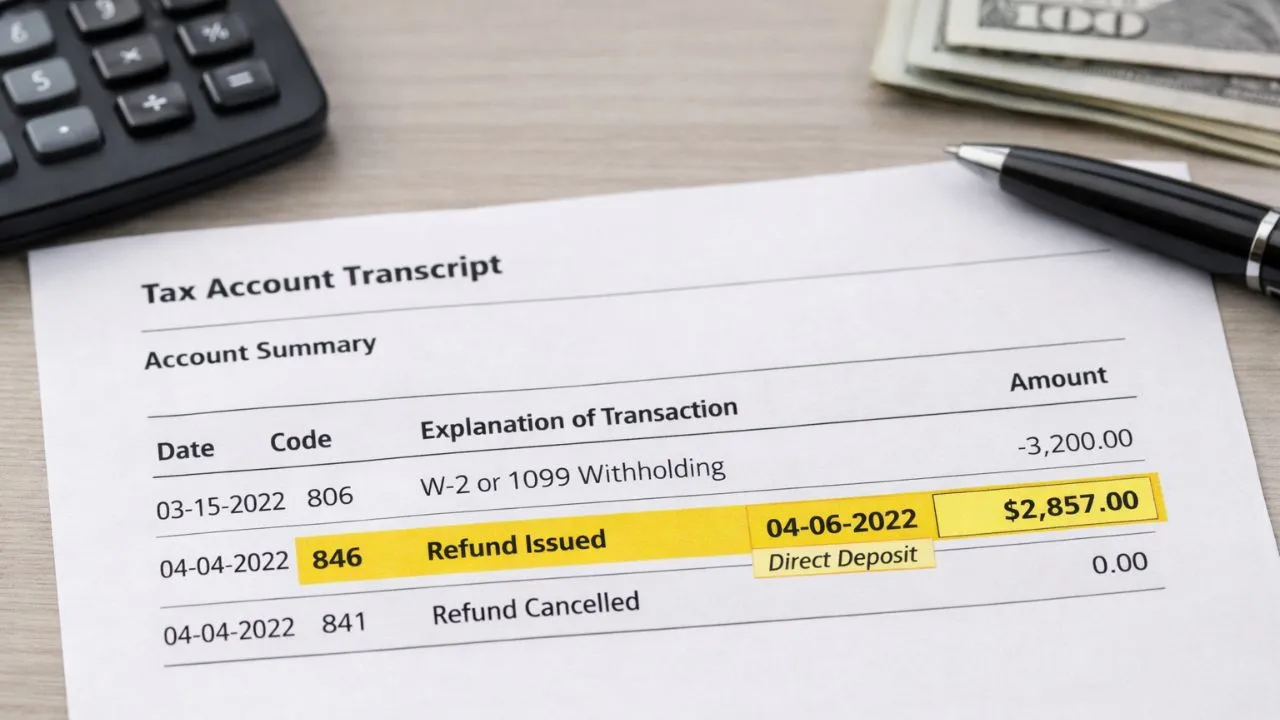

It is the recorded date of a completed internal transaction. The Bureau of the Fiscal Service then batches incoming payment files from all federal agencies, including the IRS, and submits them to the Federal Reserve’s FedACH network for settlement on the scheduled processing date.
This multi-step handoff is where the gap between the TC 846 date and your bank deposit date originates. The IRS releases the payment file. The Bureau of the Fiscal Service schedules the settlement. FedACH transmits the credit to your bank’s routing and account number. Your bank receives the ACH credit file and executes its own internal posting routine.
Each of these steps adds time. None of them are visible on the IRS’s Where’s My Refund tool, which is why millions of taxpayers see their transcript show TC 846 and still wait several days for funds to appear. The complete IRS refund pipeline guide covers every step in the chain from the IRS transmitting to your bank posting.
The Federal Infrastructure Behind TC 846
When TC 846 posts to your transcript, the IRS has transmitted a Standard Entry Class (SEC) formatted payment file to the Bureau of the Fiscal Service, the division of the U.S. Treasury responsible for all federal disbursements.
The BFS operates the federal payment infrastructure that processes over 1.4 billion payments annually, including Social Security, VA disability, federal employee payroll, and IRS tax refunds.
The BFS submits the IRS payment batch to the Federal Reserve’s FedACH system, one of two Automated Clearing House operators in the United States. FedACH processes the majority of all federal government payments. Standard FedACH credit transactions settle at receiving banks at 8:30 AM Eastern Time on the scheduled settlement date.
This is a Federal Reserve operational standard published at frbservices.org and it applies to every IRS refund processed through the standard ACH channel. Your bank receives the credit in its FedACH settlement file at 8:30 AM ET. What it does with that file is governed by the bank’s own internal posting rules, which vary by institution.
Most major retail banks post FedACH credits on the same day they arrive in settlement. Some online banks and neobanks, including Chime and Varo, have established agreements that allow them to post available balances before official FedACH settlement. This is the mechanism behind the “early direct deposit” feature that some banks advertise.
It is not a different payment. It is the same FedACH credit, made available to the account holder before the bank has technically settled the funds through its own internal accounting. The US money movement system guide covers exactly how FedACH settlement flows from the Federal Reserve through every bank type in the United States.
The IRS Code 846 date is therefore the starting point of a timeline, not the end point. For most taxpayers with a bank that posts FedACH credits on the standard settlement schedule, the deposit arrives within 1 to 5 business days of the TC 846 date.
For taxpayers at institutions with early posting capabilities, the deposit can arrive 1 to 2 days earlier than the TC 846 date in some cases, because the bank is releasing funds against the inbound settlement file before it formally posts. For taxpayers at smaller credit unions or community banks with less automated ACH processing, the posting may take the full 5-business-day window.
Variations Edge Cases and Account Anomalies
TC 846 appears in two primary formats on a tax transcript. The standard TC 846 carries a single posting date and a dollar amount matching your net refund after any offsets. The second format is TC 846 with a refund code of 1 or 2, which indicates the refund was reissued after an original disbursement was returned to the IRS by the bank.
A returned refund typically occurs when the bank account number on file is closed, belongs to a different taxpayer, or has been flagged by the receiving bank for fraud prevention review.
A TC 846 amount that does not match your expected refund is almost always explained by a Treasury Offset Program reduction applied before disbursement. The TOP, administered by the Bureau of the Fiscal Service, automatically intercepts federal refunds to satisfy outstanding debts including back child support, federal student loans, state income tax debts, and certain government agency claims.
The IRS issues TC 898 on the transcript to document the offset amount. The net TC 846 amount reflects the refund remaining after the TOP reduction. The IRS refund offset guide explains the exact offset categories and dispute process.
Weekend and federal holiday impacts on the TC 846 deposit timeline are a consistent source of confusion. FedACH does not settle on weekends or federal holidays. The Federal Reserve’s ACH networks process on business days only.
If your TC 846 date falls on a Friday, the payment file enters the BFS queue on Friday but the FedACH settlement date is Monday. If a federal holiday falls in that window, settlement shifts to the next business day.
This is why refunds with TC 846 dates on Thursday or Friday consistently result in Monday deposits for most taxpayers. The federal holiday bank pause article documents every federal holiday in 2026 and its effect on direct deposit timing.
Amended return refunds carry TC 846 through a separate processing channel. An amended return, filed on Form 1040-X, enters the IRS processing queue independently of the original return and is processed manually rather than through the automated Individual Master File cycle.
TC 846 will eventually appear on the amended return transcript when processing completes, but the timeline for amended returns is 16 to 20 weeks from submission under normal processing conditions, substantially longer than the standard 21-day processing window for original returns.
The IRS does not update the Where’s My Refund tool for amended returns. The Amended Return Status tool at IRS.gov is the correct tracking mechanism.
PATH Act freeze conditions prevent TC 846 from posting until statutory release dates pass. The Protecting Americans from Tax Hikes Act requires the IRS to hold refunds containing the Earned Income Tax Credit or the Additional Child Tax Credit until at minimum February 15 of the filing year.
Transcripts for affected returns will show TC 570 or TC 971 codes reflecting the hold, with TC 846 appearing only after the freeze lifts and the automated processing cycle completes. The PATH Act freeze mechanics article explains every code that appears during a PATH hold in sequence.
When the Process Fails and What to Do
If your TC 846 date has passed by more than 5 business days and no deposit has appeared in your bank account, the issue is no longer with the IRS. The IRS completed its role when TC 846 posted. The investigation must shift to two possible locations: the Bureau of the Fiscal Service and your bank.
First, check with your bank. Request confirmation that your account number and routing number on file with the IRS match your current active account exactly. A one-digit transposition error on a routing number causes the ACH file to route to the wrong bank.
The receiving bank will reject the credit and return it to the Bureau of the Fiscal Service, which then notifies the IRS. The IRS reissues the refund as a paper check to your address on file, which takes an additional 4 to 8 weeks. You can verify your bank information on file with the IRS through the IRS Online Account at IRS.gov.
Second, if your bank confirms it has not received the ACH credit and your TC 846 date is more than 5 business days past, call the IRS Refund Hotline at 1-800-829-1954. Request a payment trace. The IRS will initiate a BFS refund trace using the IRS Refund Trace Request process, which involves Form 3911 if the issue cannot be resolved by phone.
The BFS trace confirms whether the payment file was transmitted, whether FedACH accepted it, and whether a receiving bank rejected it. This process takes 6 to 12 weeks for a full trace resolution. The IRS refund wrong account guide documents every step of the trace and reissuance process.
If a TC 846 amount deposited is less than expected and you did not receive a TC 898 notice on your transcript, the discrepancy may reflect an IRS math correction applied during processing and documented in TC 291 or TC 290.
Contact the IRS directly for explanation before assuming an error occurred. Not every adjustment is a mistake, and some represent corrections to figures the taxpayer entered incorrectly on the original return.
What You Should Do Now
- Access your tax account transcript at IRS Get Transcript. Your IRS Code 846 date tells you exactly when the payment left the IRS system.
- Count forward 1 to 5 business days from your TC 846 date. This is your realistic deposit window. Weekends and federal holidays can extend the timing.
- Confirm that the bank account and routing number on file with the IRS match your current active account. Even a single incorrect digit can redirect your refund.
- If your TC 846 date has passed by more than 5 business days without a deposit, contact the IRS at 1-800-829-1954 and request a refund payment trace.
- Review the full IRS refund timeline breakdown in the refund timeline guide to understand every stage from filing to deposit.
IRS Code 846 is the final and decisive code in your refund lifecycle. When it appears, the IRS has done its job. The system from that point forward belongs to the Bureau of the Fiscal Service, the Federal Reserve’s FedACH network, and your bank. Understanding each of those steps gives you the information to act correctly if your refund does not arrive on the expected schedule.