
Summary
- FedACH delivers the overnight credit file to receiving banks at approximately 8:30 AM Eastern Time on the settlement date.
- The ACH network operates three same-day settlement windows and one overnight standard settlement window during each business day.
- Banks are not required to post funds immediately upon settlement. Internal posting schedules determine when deposits become visible in customer accounts.
- Federal government payments transmitted through FedACH are different from private-sector payroll ACH files. They originate from the Bureau of the Fiscal Service and follow a separate transmission and pre-notification schedule.
- A payment that has settled at the Federal Reserve level may still appear as pending or may not appear at all for several hours afterward, depending entirely on the receiving bank’s internal processing procedures.
- Same-day ACH credits are available for payments submitted before the applicable cutoff windows, with funds available to receiving banks by approximately 1:45 PM or 5:00 PM Eastern Time depending on the settlement window used.
Updated: June 24, 2026 – Every direct deposit of a federal government payment follows a fixed mechanical path from the originating agency through the U.S. Treasury, through the Federal Reserve’s ACH network, and into your bank account. The ACH settlement windows are the intervals within that path where the Federal Reserve clears and settles the funds between financial institutions.
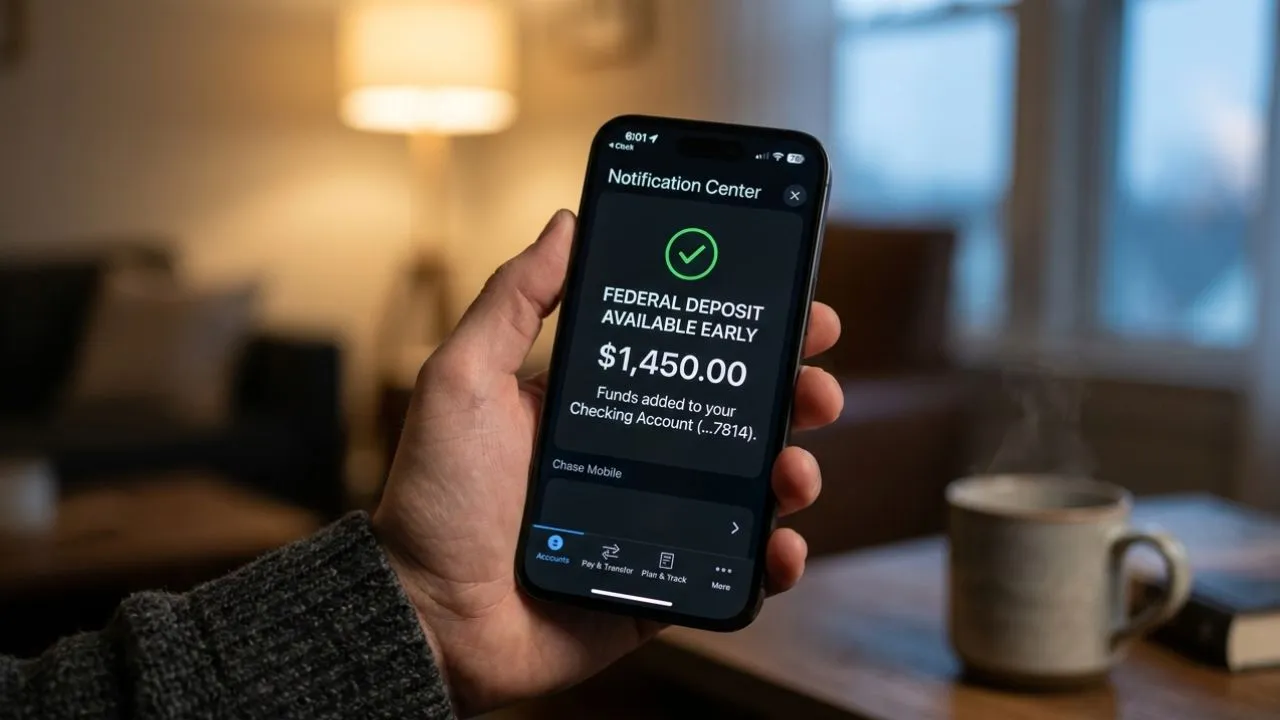
Understanding how these windows work explains why a Social Security payment authorized on Monday may not appear in your bank account until Wednesday morning, and why Chime users sometimes see their deposit two days before their bank’s official posting date.
The Automated Clearing House network is operated in the United States by two entities: the Federal Reserve’s FedACH system and the Electronic Payments Network operated by The Clearing House. FedACH is one of two ACH operators in the United States and processes the majority of federal government payments, with settlement timing published by the Federal Reserve at frbservices.org.
The standard overnight ACH credit settlement window delivers payment files to receiving banks at 8:30 AM Eastern Time on the scheduled settlement date. This 8:30 AM timestamp is not a bank policy. It is the Federal Reserve’s published, standardized settlement time for the overnight credit file.
The Four Settlement Windows
The ACH network in 2026 operates four distinct settlement windows on each business day. Each window has a submission deadline for the originating bank and a settlement time when the Federal Reserve completes the interbank transfer.
The overnight standard window is the foundation of the system and carries the largest volume of transactions. Payment files submitted before 2:15 AM Eastern Time on the business day prior to settlement are included in the overnight file. Settlement occurs at 8:30 AM Eastern Time the following business day.
Federal government payments, including Social Security, SSI, SSDI, and IRS refunds, are transmitted through this window as standard-settlement credits. The receiving bank has the funds available at 8:30 AM. What the consumer sees in their account depends entirely on that bank’s internal posting routine, which runs separately from the Federal Reserve’s settlement clock.
The three same-day ACH windows were introduced under the NACHA same-day ACH mandate that expanded credit transaction eligibility over multiple phases. The first same-day window accepts files submitted before 10:30 AM Eastern Time, with settlement completing and funds available to receiving banks by 1:00 PM Eastern Time.
The second same-day window accepts files submitted before 2:45 PM Eastern Time, with settlement and availability by 5:00 PM Eastern Time. The third same-day window, the evening same-day window, accepts files submitted before 4:45 PM Eastern Time, with settlement completing and availability by 6:00 PM Eastern Time.
A same-day processing fee applies to transactions submitted through these windows. Federal government payments are not transmitted through same-day windows as a matter of standard practice. Payroll processors and fintech platforms use same-day ACH for time-sensitive commercial transactions.
The settlement window timing framework is the same infrastructure that governs every paycheck direct deposit, every federal benefit payment, and every peer-to-peer ACH transfer you send or receive.
The Federal Payment Pipeline
Federal government payments follow a distinct origination and transmission path that differs from private-sector payroll. When the Social Security Administration schedules a monthly payment, it does not transmit an ACH file directly to your bank.
It transmits a disbursement instruction to the Bureau of the Fiscal Service, which is the Treasury bureau responsible for all federal payment execution. The Bureau of the Fiscal Service operates a payment processing center that consolidates disbursement files across all federal agencies and submits them to FedACH on the scheduled payment date.
This multi-agency chain is why “SSA sent your payment” and “your bank received your payment” are not the same event. The phrase “sent” in the context of a Social Security payment means the SSA transmitted an authorization to the Bureau of the Fiscal Service, not that an ACH file has arrived at your bank.
The Bureau of the Fiscal Service then generates the ACH file and submits it to FedACH. FedACH holds it until the overnight settlement window closes and then delivers the file to receiving banks at 8:30 AM Eastern on the settlement date.
The treasury payment system describes this Treasury-level disbursement infrastructure in full, including how the Bureau of the Fiscal Service coordinates payment timing across all federal programs simultaneously.
The US money movement system is the complete infrastructure connecting agency authorization through Treasury disbursement to the Federal Reserve’s settlement network and into the consumer’s account, representing the full operational chain every federal payment traverses.
A keeper-level understanding of ACH settlement windows requires connecting this specific mechanism to the broader federal payment infrastructure. When a consumer’s bank account shows zero balance on the morning a Social Security payment is expected, it is not because the payment was not sent.
It is because the bank’s internal posting routine has not yet executed the credit after receiving the 8:30 AM FedACH settlement file. The Federal Reserve’s settlement is an interbank event. The consumer’s balance update is a bank-level event that follows independently.
Bank Posting Routines After Settlement
Receiving the 8:30 AM FedACH credit file is an event at the Federal Reserve level, completed between the Fed and the receiving bank. What happens next depends entirely on the receiving bank’s internal systems, and those systems vary substantially across institutions.
Large traditional banks such as JPMorgan Chase, Bank of America, and Wells Fargo typically process the 8:30 AM settlement file through their overnight batch routines. These banks have batch systems that ingest incoming ACH credits, match them to consumer account numbers, post the credits to account balances, and generate the balance updates that appear in online banking.
Most large banks complete this batch processing and make direct deposit funds available by 9:00 AM Eastern on the settlement date. Some post as early as midnight the night before settlement by pre-posting from the pre-notification file rather than the settled file.
The bank posting times changed landscape shifted significantly after the NACHA 9:00 AM availability mandate established a floor for credit availability. The NACHA 9am direct deposit rule requires that banks make ACH direct deposit funds available to consumers no later than 9:00 AM local time on the settlement date. This is a floor, not a ceiling. Banks may make funds available earlier, and many do for competitive reasons.
Neobanks and fintech-enabled institutions including Chime, Varo, Dave, and Current operate differently. These institutions receive the same FedACH settlement file at 8:30 AM, but they also monitor the incoming ACH pre-notification file, which the Federal Reserve transmits before the settlement window closes.
Chime, for example, reads the pre-notification file and provisionally credits consumer accounts before the formal settlement occurs, betting that the settlement will complete as expected.
This is what produces the phenomenon of Chime users receiving their direct deposits one to two days before the official payment date. Chime is not receiving payments earlier than other banks. It is crediting accounts earlier based on pre-settlement file data, absorbing the small settlement risk that comes with doing so.
The early direct deposit risk framework explains the mechanics behind this fintech behavior and the financial institution risk model that makes it possible.
Same-Day ACH and Federal Payments
The NACHA same-day ACH rules expanded significantly between 2016 and 2022, and the eligibility ceiling for same-day ACH transactions was raised to $1,000,000 per transaction in 2022. Despite this expansion, federal government recurring benefit payments are not transmitted through same-day ACH windows under current Bureau of the Fiscal Service operating procedures.
The reason is logistical and systemic rather than technical. The Bureau of the Fiscal Service processes payment files for millions of beneficiaries simultaneously, batching them through the overnight window that provides the maximum processing capacity and the most predictable settlement timeline.
Emergency or one-time federal payments may use same-day ACH on a case-by-case basis. The Economic Impact Payments issued in 2020 and 2021 included a subset of disbursements through same-day windows to accelerate delivery to certain populations. However, recurring Social Security, SSI, SSDI, IRS refund, and VA benefit payments follow the overnight standard window consistently.
The same-day ACH vs standard ACH timing comparison covers the full technical difference between the two paths and the transaction types eligible for each.
Weekends, Holidays, and Settlement Gaps
ACH settlement windows operate only on Federal Reserve business days. The Federal Reserve is closed on all federal holidays and on weekends. When a payment date falls on a Saturday, Sunday, or federal holiday, the Bureau of the Fiscal Service transmits the payment file on the preceding business day, and FedACH settles it on that preceding business day as well.
The receiving bank may hold the funds until the official payment date, or it may make them available immediately upon settlement, depending on its internal policies.
The weekend banking slowdown before Monday deposits is one of the most common sources of consumer confusion about federal payment timing. A Social Security payment scheduled for a Monday arrives at the bank on the Friday before, but many banks hold the credit in a pending state until Monday morning to match the official SSA payment date.
Federal Reserve holidays in 2026 include New Year’s Day, Martin Luther King Jr. Day, Presidents Day, Memorial Day, Juneteenth, Independence Day, Labor Day, Columbus Day, Veterans Day, Thanksgiving Day, and Christmas Day. When any scheduled payment date falls on these dates, the payment posts on the prior business day. The federal reserve holidays 2026 deposit schedule details every affected payment date for the full calendar year.
The overnight bank clearing cycles documentation covers how banks process the FedACH file through their overnight batch systems and what determines the exact moment a consumer’s balance updates.
When a Settlement Does Not Post
The overwhelming majority of ACH settlement failures are caused by one of three conditions: an incorrect account number in the originating file, a closed or restricted account at the receiving bank, or a return transaction initiated by the receiving bank because the account does not accept credits.
When an ACH credit cannot be posted to the intended account, the receiving bank returns the file to FedACH with a return reason code. The most common codes are R02 (account closed), R03 (no account or unable to locate account), R04 (invalid account number), and R10 (customer advises unauthorized return).
FedACH transmits the return to the originating institution, and for federal payments, the Bureau of the Fiscal Service receives the return and reissues the payment as a paper check to the address on file.
The FedACH settlement delays article covers every return code scenario and the reissuance timeline for affected federal payments.
An ACH credit that posts to the wrong account due to a bank routing error is not a return scenario. It is a misrouted credit that requires a formal recovery process through both institutions. For IRS refunds specifically, the IRS refund wrong bank account resolution process applies, which involves the IRS, the Bureau of the Fiscal Service, and both banks.
Technical Edge Cases and Processing Variants
Bank mergers create ACH routing number complications during the transition period. When one bank acquires another, the acquired bank’s routing numbers may remain valid for ACH purposes for 12 to 24 months post-merger, during which the acquirer’s system maps old routing numbers to new account structures internally. Consumers who have not updated their direct deposit information at the source agency during this window may experience posting delays as the mapping system resolves.
Credit unions and community banks that do not have direct FedACH connections receive settlement through a correspondent bank that maintains the FedACH relationship. This intermediary layer can add hours to the posting timeline after the 8:30 AM settlement because the correspondent bank must process its own internal distribution file before the credit union or community bank can post the funds.
International ACH transactions, known as IATs, follow a different compliance and settlement pathway than domestic ACH. Federal benefit recipients with bank accounts at foreign-headquartered institutions holding U.S. banking licenses should confirm their institution’s IAT processing timeline with their bank directly.
What You Should Do Now
- Identify the ACH settlement window that applies to your specific direct deposit. Overnight standard settlement at 8:30 AM Eastern applies to recurring federal government payments including Social Security, IRS refunds, and VA benefits.
- Know your bank’s posting policy relative to the 8:30 AM settlement. Call your bank or review its deposit availability policy online to determine whether it posts funds at settlement, during a later morning batch, or pre-posts from the pre-notification file the night before.
- If you receive federal benefits and want the earliest possible access to your funds, compare your current bank’s posting time against neobanks that pre-post from pre-notification files. The difference can be one to two full business days.
- For any ACH settlement window that appears to have produced a missing payment, wait through the full business day before contacting the paying agency. A posting-time variation within the same business day does not indicate a missing payment.
- Verify your direct deposit routing number and account number with every source agency at least annually. A single-digit error can generate an R04 return and trigger a paper-check reissuance process that may take two to six weeks.
- Review the ACH settlement windows documentation at FRB Services for the Federal Reserve’s current published operating schedules, which are updated whenever settlement times change.