

Seeing “pending” next to a deposit in your banking app is one of the most common sources of financial anxiety, especially when you are counting on that money to cover an upcoming bill.
The good news is that a pending deposit almost always means the money is genuinely on its way; the more useful question is understanding exactly what has to happen before it becomes money you can actually spend.
What Does Pending Direct Deposit Mean
A pending direct deposit means your bank has been notified that funds are on the way through the ACH network, but the bank has not yet finished processing the transaction to make those funds available for you to spend or withdraw.
Your pending balance and your available balance are two different numbers: the pending balance reflects money that has been announced but not yet finalized, while the available balance reflects what you can actually use right now.
This distinction matters most in situations where a deposit shows as pending while an outgoing payment or purchase is also processing, since only the available balance determines whether that outgoing transaction will clear successfully.
Why Deposits Show As Pending Before They Post
Even after the ACH network delivers a deposit instruction to your bank, the exact timing of when the money actually becomes available depends on that bank’s own internal posting schedule, which is a step separate from the ACH network’s own settlement timing.
Some banks run their posting process at midnight, updating account balances as the calendar flips to a new business day, while others batch-process deposits during early morning hours, with balances typically reflecting sometime between 4:00 a.m. and 9:00 a.m.
This internal timing is largely at each bank’s discretion and is not directly regulated by federal law beyond certain outer limits set by Regulation CC, which governs how long banks can generally hold funds before making them available.
How ACH Settlement Timing Affects Pending Status
Because ACH settlements only occur when the Federal Reserve’s settlement service is actually open, weekends and federal holidays effectively pause the ACH network entirely.
A deposit initiated on a Friday afternoon will not settle until the following Monday at the earliest, regardless of how quickly the sending institution processed its side of the transaction.
This is one of the most common reasons a paycheck or benefit payment shows as pending over an entire weekend: the money is genuinely in the pipeline, but the underlying settlement system it depends on simply does not process transactions on non-business days.
For a full breakdown of exactly how ACH settlement timing works, see Investozora’s guide to ACH settlement windows, which covers the mechanics behind this timing in more depth.
A Major Rule Change Coming In September 2026
A significant Nacha rule change taking effect September 18, 2026 will require banks to make standard, non-same-day ACH credit deposits available by 9:00 a.m. local time on the settlement date, replacing a previous rule that allowed banks to delay availability if a deposit file arrived after 5:00 p.m. local time the day before.
Once this change takes effect, a paycheck or tax refund should generally be available first thing in the morning on its settlement day, regardless of exactly when the sending institution’s file actually arrived at the receiving bank.
This is a meaningful improvement for account holders who have historically experienced deposits sitting in pending status well into the afternoon or even the next business day under the older, more flexible rule. Investozora’s dedicated guide to the 9 a.m. deposit rule covers exactly how this change affects paycheck and benefit timing.
Same-Day ACH And Pending Status
Deposits processed through Same-Day ACH generally clear the pending stage faster than standard ACH deposits, since receiving banks are required to make same-day ACH credits available by 5:00 p.m. at the bank’s local time on the same day the payment settles.
However, a same-day payment settling through the latest of the three daily processing windows can still show as pending for several hours before that 5:00 p.m. deadline, particularly for banks on Central or Pacific time zones with less buffer before their own end-of-day cutoff. For the complete rules governing how Same-Day ACH windows and cutoffs actually work, see Investozora’s guide to Same-Day ACH processing.
Pending Status During A Dispute Or Fraud Investigation
Pending status can also appear in a different context entirely: when a bank has issued a provisional credit while investigating a disputed or unauthorized transaction.
Under Regulation E, banks must investigate a reported error promptly, and if the investigation cannot be resolved within 10 business days, the bank must issue a temporary provisional credit to the customer’s account, giving that customer continued access to the disputed funds while the investigation continues.
For accounts open less than 30 days, banks are allowed up to 20 business days before this provisional credit requirement kicks in, reflecting the additional verification often needed for newer account relationships.
If the investigation ultimately confirms an error occurred, the provisional credit typically becomes permanent; if the investigation finds the original transaction was valid, the credit can be reversed, temporarily reducing the account balance again.
The Difference Between A Provisional Credit And A Standard Pending Deposit
It is worth distinguishing between these two very different situations, since both can appear as some form of “pending” or provisional status in a banking app but represent entirely different underlying processes.
A standard pending direct deposit, such as a paycheck or a tax refund, is simply working through the normal ACH settlement and bank posting timeline described above, with no dispute or investigation involved.
A provisional credit, by contrast, specifically arises from a Regulation E dispute investigation and carries the possibility of being reversed if the investigation does not confirm the customer’s claim.
Confusing these two categories can lead to unnecessary worry, since a routine pending paycheck deposit carries essentially no risk of being reversed, while a provisional credit tied to a fraud dispute genuinely could be reversed depending on the investigation’s outcome.
| Feature | Standard Pending Direct Deposit | Provisional Credit |
|---|---|---|
| Purpose | Processing an incoming ACH payment. | Temporary reimbursement during a dispute investigation. |
| Common Examples | Payroll, Social Security, IRS tax refund, government benefits. | Debit card fraud, unauthorized ACH transaction, billing error claim. |
| Why It Appears | Bank has received notice of an incoming deposit. | Bank provides temporary funds while investigating a Regulation E claim. |
| Funds Source | Employer, government agency, or other payer. | Issued temporarily by the customer’s bank. |
| Can It Be Reversed? | Rarely, unless the deposit fails before posting (such as an invalid account). | Yes, if the investigation determines the claim is not valid. |
| Governed By | ACH network rules and bank funds availability policies. | Regulation E consumer protection requirements. |
| Typical Timeline | Hours to one business day before posting. | Investigation may take several business days to weeks. |
| What It Means for Customers | Deposit is moving through the normal posting process. | Temporary access to funds pending the investigation’s outcome. |
Why Some Banks Show Pending Deposits Earlier Than Others
Banks are legally permitted to display a pending deposit notification to customers as soon as they receive advance notice that a transaction is coming, even before the funds are technically settled or available.
This is a customer service feature rather than a regulatory requirement, and different banks handle it differently: some display pending deposits as soon as they receive any advance notice from an employer or government agency’s payroll system, while others wait until settlement is closer to finalized before showing anything at all.
This variation explains why two people receiving direct deposits from the same employer, at different banks, can see very different pending-versus-available timelines even though the underlying payroll file was submitted identically for both.
Overdraft Risk During Pending Status
One of the more expensive aspects of pending deposit status is that banks are generally permitted to charge overdraft fees even when a deposit is showing as pending in your account.
No federal law requires a bank to make funds available for withdrawal just because a deposit notification has appeared, which means relying on a pending deposit to cover an outgoing payment or purchase can result in an overdraft fee if the outgoing transaction processes before the incoming deposit officially posts and becomes available.
Understanding this risk is particularly important around paydays or benefit payment dates that fall near a weekend or holiday, when the gap between “pending” and “available” can stretch longer than usual due to ACH settlement pauses.
What To Do If A Deposit Stays Pending Too Long
If a deposit remains in pending status well beyond the typical timeframe for that specific payment type, whether that is a next-business-day paycheck or a same-day payment that should have cleared by the relevant settlement window, contacting your bank directly is the most effective next step.
Your bank can confirm whether the payment has actually been received on their end but not yet posted, or whether there may be an issue on the sending side, such as incorrect account or routing information that could result in the payment being returned rather than completed.
This is distinct from tracking a specific federal payment like a tax refund, where tools like Where’s My Refund provide status information directly from the source agency rather than requiring a call to your bank.
Can a Pending Direct Deposit Disappear?
Yes, though it is relatively uncommon for a routine payroll or government benefit deposit. A pending deposit notification means the bank has received advance notice of an incoming transaction, but the transaction can still fail to complete if there is a problem with the account information provided, such as an incorrect account number, a closed account, or a mismatch between the account holder’s name and the account on file.
When this happens, the pending notification typically disappears rather than converting into an available deposit, and the funds are generally returned to the originator, who then needs to correct the issue and resubmit the payment.
This is different from a provisional credit being reversed after a fraud investigation, since a failed pending deposit was never actually completed in the first place.
Why Did My Direct Deposit Arrive Early?
Banks sometimes post payroll deposits earlier than their typical schedule when the file is received from the employer with extra lead time before the actual pay date, a practice some banks market as early direct deposit or early payday access.
This is not a change to the underlying ACH settlement rules; rather, it reflects the bank choosing to make the funds available to the customer ahead of the technical settlement date once it has received a reliable, verified file from the employer’s payroll processor.
Not all banks offer this practice, and even among those that do, the amount of lead time provided can vary from a few hours to a full day or more, depending on the bank’s specific policy and its relationship with the sending institution.
Do Pending Deposits Count Toward Available Balance?
Generally, no. Overdraft protection and available balance calculations are typically based on funds that have actually posted and cleared, not on pending deposits that have been announced but not yet finalized.
This means a large expected deposit showing as pending will usually not prevent an overdraft fee on an outgoing transaction that processes before that deposit officially posts, even though the pending deposit is visible in your account activity.
Some banks do offer specific overdraft protection features tied to expected direct deposits, but this is a specific product feature offered at the bank’s discretion, not a standard or guaranteed banking practice, so checking with your specific bank about their policy is the only reliable way to know how your account handles this situation.
How Can I Get Faster Direct Deposits?
Some banks offer accounts specifically marketed around early direct deposit features, which post payroll and certain government deposits as soon as the bank receives the file from the sending institution, rather than waiting for the standard settlement date.
Beyond choosing a bank with this specific feature, individual account holders generally cannot influence ACH settlement timing directly, since that timing is governed by network-wide rules set by Nacha and the Federal Reserve rather than by individual customer preference.
The upcoming September 2026 rule requiring 9 a.m. availability for standard ACH credits will provide a meaningful, universal improvement in typical posting speed across nearly all banks, regardless of whether a specific account offers an early-deposit feature.
How This Connects To The Broader Payment System
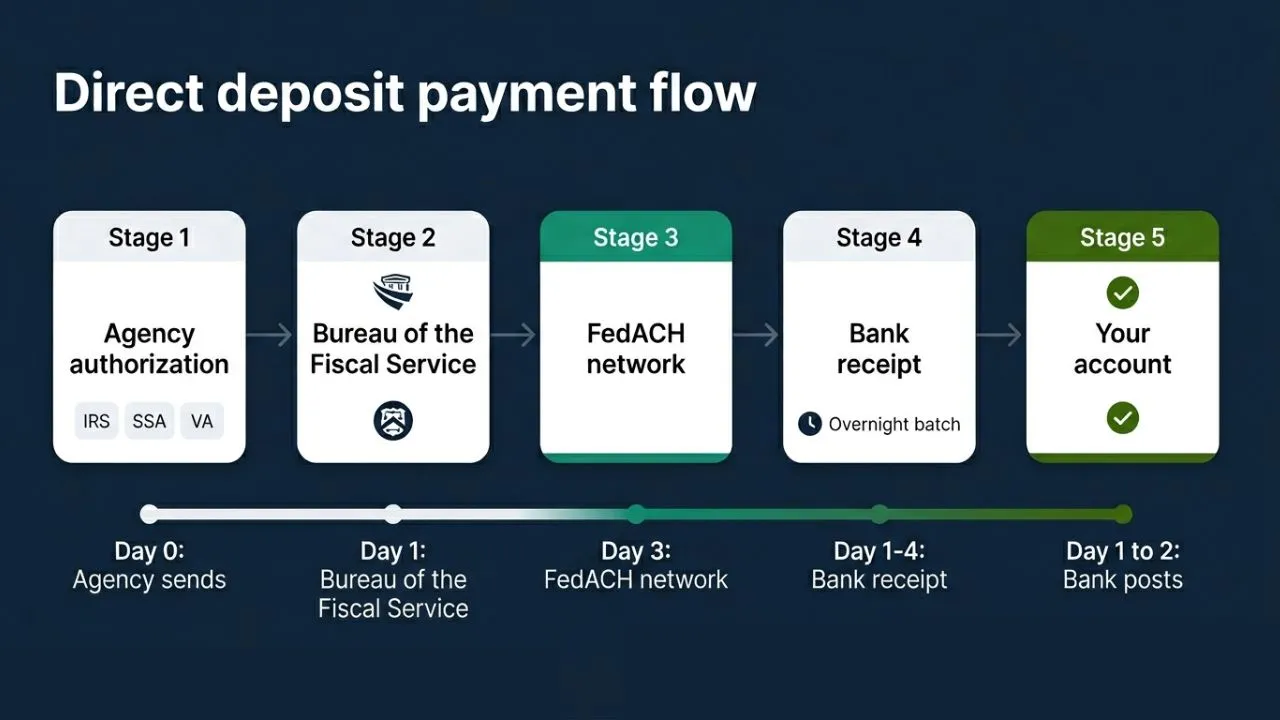
Pending deposit status is simply the visible surface of a much larger federal and private payment infrastructure working behind the scenes. For a complete picture of how money actually moves from an employer or government agency into an individual bank account.
See Investozora’s guide to how U.S. money moves through the country’s core payment rails, along with a deeper explanation of direct deposit timing across different types of payments and banks.