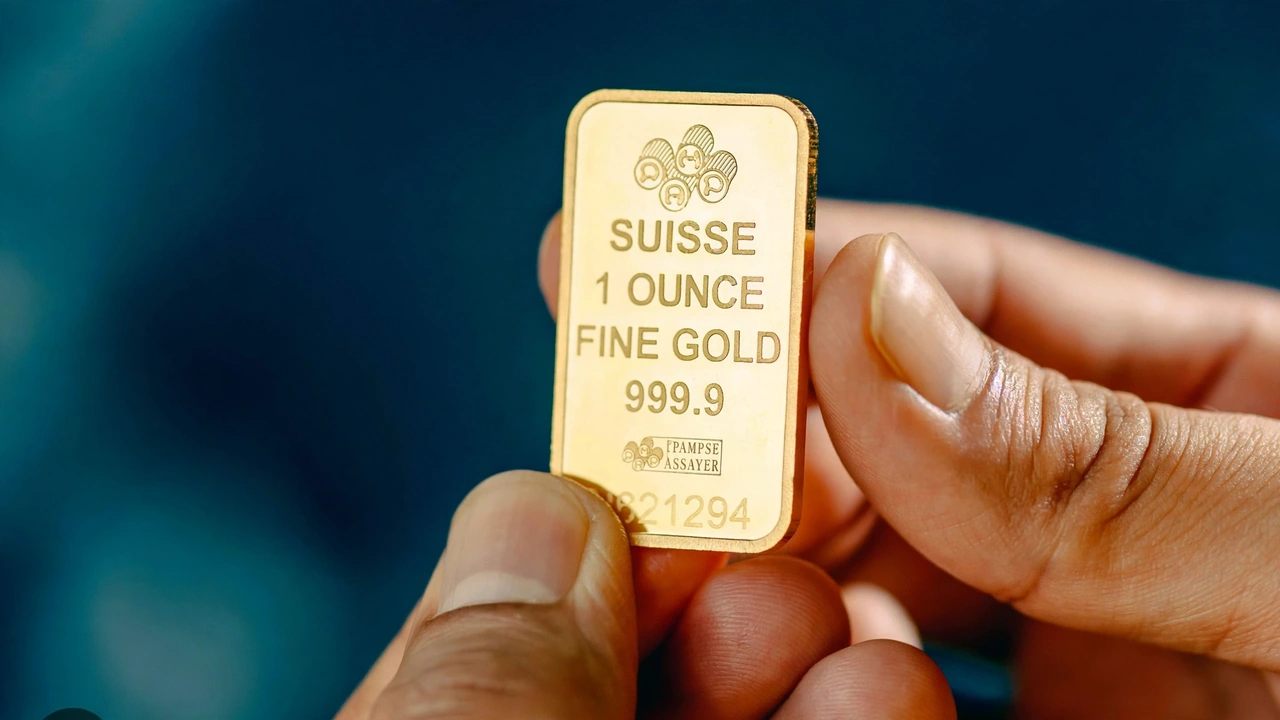
Gold prices entered Saturday, November 7, 2026, with a weekly gain of more than 5%, despite retreating on Friday after stronger U.S. employment data lifted the dollar and Treasury yields. Spot gold traded at $4,074.36 per troy ounce at 1:54 p.m. Eastern Time on November 6, down 0.3% on the day but up 5.2% for the week, according to Reuters.
The weekly advance was on course to be gold’s strongest since August, illustrating how a substantial recovery can survive a sharp daily reversal. Saturday’s figures refer to Friday’s trading rather than a new weekend market quotation. The reversal matters to investors holding gold, households considering bullion purchases and traders watching the Federal Reserve’s next interest-rate decision.
The latest U.S. jobs report showed employers adding 165,000 jobs in October while unemployment remained near 4.1%, reinforcing expectations that monetary policy could stay restrictive. Yet gold’s broader weekly recovery remained substantial, creating an important distinction between the market’s short-term reaction and its performance over several sessions. Neither the weekly gain nor Friday’s decline establishes where prices will move next.
The Weekly Rebound
Gold’s latest advance followed a turbulent period in which prices repeatedly moved around the $4,000 threshold. On November 5, spot bullion reached $4,146.63 during the session, according to Reuters, before the market weakened again on Friday. That earlier gold price rally had been accompanied by a softer U.S. dollar and falling Treasury yields. The subsequent reversal trimmed the recovery without eliminating the week’s overall advance.
The sequence within Friday’s session is revealing. An earlier gold market update recorded spot gold at $4,044.09 at 05:01 UTC, compared with Reuters’ later $4,074.36 quotation at 18:54 UTC. The difference is $30.27 per ounce, or approximately 0.75%, based on an independent calculation using those two observations. That comparison shows a partial intraday recovery, not a positive daily return, because both quotations occurred after the previous session’s reference price.
Gold also reached an intraday low of $4,033.29 on Friday, according to Reuters. The subsequent $4,074.36 quotation stood $41.07, or approximately 1.02%, above that low, showing that selling pressure had moderated by the afternoon observation. Gold’s earlier October price decline and its late-October trading provide context for the recovery, although those observations were recorded at different times and cannot be treated as comparable daily settlements. A weekly percentage gain alone also says nothing conclusive about whether the market has established lasting support above $4,000.
Jobs And Rates
The immediate change in market expectations followed the Bureau of Labor Statistics’ November 6 employment report. October payroll growth of 165,000 compared with an average monthly gain of 48,000 over the previous 12 months, according to the agency. That makes October’s reported increase 117,000 jobs higher than the preceding 12-month monthly average, an independently calculated comparison rather than a measure of how far the report exceeded economists’ forecasts. The stronger reading gave investors new evidence to consider when assessing the possibility of another Federal Reserve rate increase.
The report also revised earlier employment figures upward, strengthening the distinction between Friday’s data and the information markets previously possessed. September’s payroll gain was revised from 29,000 to 60,000, while August’s was revised from 133,000 to 186,000, making the combined increase for those two months 84,000 higher than previously reported. The earlier September employment report therefore represents a superseded statistical snapshot rather than the latest estimate. Revisions improve the historical picture available to policymakers, but they do not represent jobs newly created in October.
The Federal Reserve had maintained its target interest-rate range at 3.75%–4.00% on October 28, with two officials preferring a quarter-point increase. The original Federal Reserve statement described continued economic expansion alongside elevated inflation. That policy backdrop helps explain why stronger employment data can pressure gold: when investors anticipate higher interest rates, assets that pay interest may become more attractive relative to bullion, which provides no yield. However, expectations of future monetary tightening are not equivalent to an announced policy decision.
Treasury Yield Reversal
Official Treasury data reveal another important feature of the week: bond yields declined over several sessions even though they rose on Friday. The U.S. 10-year Treasury par yield stood at 4.91% on Monday, November 2, fell to 4.84% on Thursday, November 5, and recovered slightly to 4.86% on Friday, November 6. That represents a five-basis-point decline between Monday and Friday, despite a two-basis-point increase on the final trading day. These figures come from the Treasury’s daily yield records.
Spot gold rose from $4,044.09 per troy ounce at 05:01 UTC on Friday to $4,074.36 at 18:54 UTC, an increase of $30.27, or approximately 0.75%, between the two observations. Meanwhile, the 10-year U.S. Treasury yield increased from 4.84% on Thursday to 4.86% on Friday, a rise of two basis points.
Despite Friday’s increase, the yield remained five basis points below Monday’s 4.91% level, showing that borrowing costs had eased over the broader trading week. The figures are based on Reuters-reported spot-gold observations and official U.S. Treasury daily yield data. Because gold prices and Treasury yields were recorded at different times and use different measurement methods, these movements do not establish a direct causal relationship.
The combination offers a more useful explanation than treating the entire week as a straightforward response to one economic announcement. Gold gained substantially over the week while Treasury yields declined from Monday’s level, but the relationship partially reversed on Friday when employment data changed expectations. Earlier episodes of elevated Treasury yields illustrate why interest-rate pressure remains relevant to precious metals. Nevertheless, currency movements, geopolitical uncertainty, investor positioning and physical demand can influence gold independently of government bond yields.
Buyers And Investors
For existing bullion owners, the market movement changes the indicated value of their holdings before transaction costs. At Friday afternoon’s reported spot quotation of $4,074.36 per ounce, ten troy ounces would have an illustrative underlying metal value of $40,743.60. A subsequent $100-per-ounce movement would change that indicated value by $1,000, assuming the quantity remained constant and excluding dealer spreads, premiums and fees. This arithmetic describes price exposure, not an amount an owner would necessarily receive when selling.
Physical buyers face additional considerations because a quoted international spot price is not the same as the final price of a gold coin, bar or piece of jewelry. The U.S. Mint’s bullion buying guidance advises consumers to examine market prices, premiums and dealer practices before purchasing precious metals. Retail prices can therefore remain above the underlying spot quotation even after a decline in gold’s market price. Currency conversion, local taxes and product-specific charges can further change the cost facing buyers outside the United States.
Gold futures and leveraged precious-metal investments carry a different exposure from holding physical bullion outright. The Commodity Futures Trading Commission’s gold investment warning explains that leverage can amplify both gains and losses, potentially creating substantial financial consequences from relatively modest price movements. Futures quotations, physical-gold prices and gold-related securities should not be treated as interchangeable measures of investor returns. A strong weekly rally is not evidence that leveraged positions have become less risky.
What Comes Next
The next major scheduled U.S. inflation release is the October Consumer Price Index report, due Tuesday, November 10, at 8:30 a.m. Eastern Time, according to the Bureau of Labor Statistics’ official release calendar. Investors will assess whether that report reinforces or challenges the inflation concerns that influenced Friday’s interest-rate expectations. The Federal Reserve’s next scheduled policy meeting is December 8–9, according to its meeting calendar. Neither event guarantees a particular decision or an immediate direction for gold prices.
The market will also need to weigh competing developments that cannot be reduced to the jobs report alone. Changes in energy prices, expectations surrounding geopolitical developments, movements in the dollar and demand for physical gold could either reinforce or offset pressure from interest rates. Broader November market conditions and earlier gold trading reactions provide context, but historical patterns do not predict next week’s outcome. A fresh market quotation after trading resumes will be needed before concluding that Friday’s recovery has continued.
For now, gold’s most important development is the contrast between a substantial weekly advance and a retreat following stronger U.S. employment data. Reuters’ Friday afternoon observation placed spot gold above $4,070 and approximately 5.2% higher for the week, while official Treasury records confirmed that longer-term yields had edged upward on Friday after falling earlier in the week.
The divergence shows that a strong weekly result can coexist with renewed short-term pressure, without resolving whether either movement will persist. For investors and buyers, the relevant distinction is between an observed market price, the actual cost or value of their exposure, and an uncertain future return.