

The Treasury General Account is the single bank account the U.S. government uses to pay for everything. Every Social Security payment that arrives in your account on a Wednesday morning, every IRS refund deposited after Code 846 appears on your transcript, every military paycheck, every federal employee salary, and every interest payment on the national debt flows out of one account, the Treasury General Account, held at the Federal Reserve Bank of New York.
Understanding how the Treasury General Account works is understanding how the U.S. government’s financial system operates at its most fundamental level.
Most Americans have never heard of it. But if you have ever received a federal payment and seen “TREAS 310” on your bank statement, you have seen its fingerprints. If you have ever tracked a Social Security payment that seemed delayed during a debt ceiling standoff, you were watching the Treasury General Account under pressure.
This article explains exactly what it is, how money enters it, how money leaves it, how it connects to your bank account, and how you can monitor it yourself, for free, in real time, using a public government document most people do not know exists.
What the Treasury General Account Is — and Where It Lives
The Treasury General Account is the U.S. Department of the Treasury’s primary checking account at the Federal Reserve. All federal government tax receipts flow into the TGA. All federal government payments Social Security, IRS refunds, military pay, Medicare reimbursements, VA disability, and federal salaries are disbursed from it. It is, in plain terms, the government’s bank account.
The TGA is held at the Federal Reserve Bank of New York, not at any commercial bank. This arrangement reflects the Federal Reserve’s role as the fiscal agent of the United States government a function codified in the Federal Reserve Act.

Data Insight: This Federal Reserve data illustrates the extreme volatility of the Treasury General Account, especially during post-2020 debt ceiling episodes. The sharp declines toward zero represent “X-date” windows where federal liquidity is under maximum stress. Monitoring these weekly trends reveals the government’s real-time spending capacity before requiring new revenue or debt.
The Fed does not lend money to the Treasury through this relationship; it holds the account and processes transactions, just as a commercial bank holds your checking account and processes your payments.
The TGA balance changes every single business day. Tax receipts arrive. Payroll files go out. Treasury auction proceeds land. Interest payments depart. The Department of the Treasury publishes the TGA’s opening balance, closing balance, and every transaction category in the Daily Treasury Statement, released every business day by the Bureau of the Fiscal Service at the Daily Treasury Statement portal. This document is free, public, and updated before markets open each morning.
Historically, Treasury has maintained a target TGA balance of approximately $500 to $600 billion, roughly equivalent to five days of total federal outlays. That buffer exists because federal payments do not stop on days when tax receipts are low.
The TGA absorbs the daily variance between inflows and outflows, ensuring every scheduled payment goes out regardless of whether today happened to be a heavy revenue day.


When the buffer falls significantly below historical norms as it does during debt ceiling crises, the government’s ability to cover future payments depends entirely on the pace of incoming tax receipts. For the complete picture of how federal money moves from this account to your bank, see our payment infrastructure guide.
How Money Gets Into the Treasury General Account
The Treasury General Account is funded through two primary channels: federal tax revenue and proceeds from Treasury securities auctions.
Federal tax receipts are the dominant funding stream. Individual income taxes represent the largest single source, accounting for roughly half of all federal revenues in a typical fiscal year. Payroll taxes — Social Security contributions and Medicare contributions collected from every working American’s paycheck — are the second-largest source.
Corporate income taxes, excise taxes, estate taxes, and customs duties make up the remainder. When you file your tax return and owe a balance, that payment moves into the TGA. When your employer remits payroll tax withholding, it flows to the TGA. Every dollar collected by the IRS ultimately settles in this account.
Treasury securities auctions provide the second major funding stream. The Treasury Department sells T-bills, T-notes, and T-bonds to investors through regular auctions administered via TreasuryDirect.
When institutional investors, foreign governments, pension funds, and individual savers buy these securities, the proceeds flow directly into the TGA. This is how the U.S. government borrows, it sells debt instruments to willing buyers, and the proceeds replenish the account that funds federal payments.
Tax season creates a predictable and significant surge in TGA inflows. The weeks surrounding the April 15 filing deadline consistently produce the largest single-month deposit into the TGA of the year. In April, the account balance can rise by hundreds of billions of dollars as individual income tax payments and estimated quarterly tax payments arrive simultaneously.
That seasonal inflow temporarily elevates the TGA well above its normal operating range before outgoing payments gradually draw it back down through the spring and summer. The Daily Treasury Statement shows these daily inflows in its Deposits table, broken down by revenue type and collection channel. For how the IRS connects to this system at the authorization level, see our TGA federal payments reference.
How Money Leaves the TGA — The Path From Government to Your Bank Account
Federal payments leave the Treasury General Account through the Bureau of the Fiscal Service, a bureau of the U.S. Department of the Treasury. The Bureau is the operational payment processor for the federal government. It is the institution that actually moves money.
The IRS approves your refund. The Social Security Administration calculates your benefit. But the Bureau of the Fiscal Service is what sends both through the Federal Reserve’s FedACH network to your bank account.
Understanding this distinction matters for anyone who has ever contacted the wrong agency about a delayed payment. When your refund shows as approved at the IRS but has not arrived in your account, the relevant question is not what the IRS is doing, it is what stage the Bureau’s disbursement pipeline is in.
The same applies to Social Security: the SSA manages eligibility and benefit amounts, but once a payment file leaves the SSA, Treasury controls when and how it reaches your bank. Here is how each major federal payment type flows from the TGA to your account:
Social Security and SSI payments
The SSA maintains your eligibility record and calculates your monthly benefit amount, including any COLA adjustments and Medicare Part B deductions. On payment dates, the SSA transmits payment files to the Bureau of the Fiscal Service. The Bureau debits the TGA and submits ACH payment files to the Federal Reserve’s FedACH network.
FedACH routes each file to the recipient’s commercial bank, which posts the payment according to its internal schedule, a process that starting September 2026 must complete by 9 AM local time under the new NACHA rule. For how those payment files move overnight, see our Treasury funds at night explainer.
IRS tax refunds
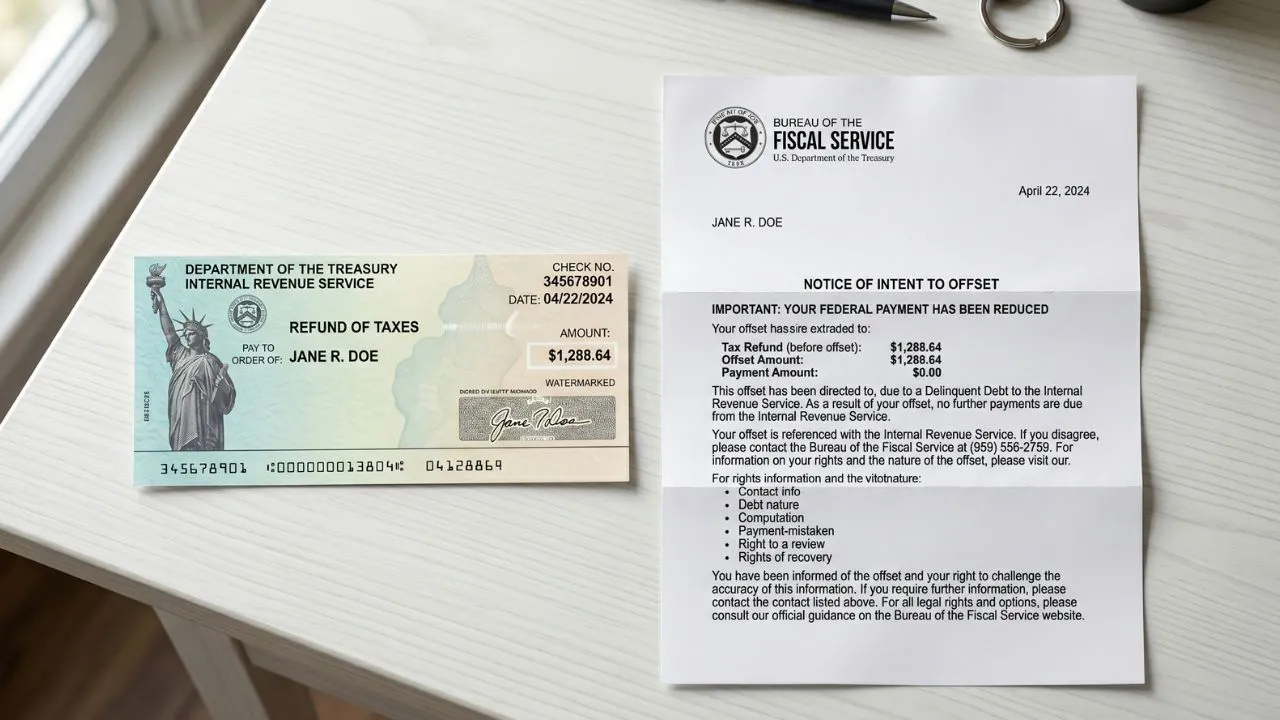
The IRS reviews your return and authorizes the refund. When Transaction Code 846 appears on your IRS transcript, it marks the moment the IRS instructed the Bureau of the Fiscal Service to issue your refund.
The Bureau then debits the TGA and submits the payment through FedACH to your bank. The IRS does not hold or transfer the money, it approves the release. For a complete walkthrough of the FedACH routing stage, see our FedACH delays explained guide.
Federal employee salaries and military pay
Federal payroll runs through the same pipeline. The relevant agency, the Office of Personnel Management for civilian employees, the Defense Finance and Accounting Service for military submits payroll files to the Bureau of the Fiscal Service, which disburses via FedACH on scheduled pay dates.
Interest payments on the national debt
Treasury makes interest payments to holders of Treasury securities through both FedACH and the Fedwire Funds Service, depending on payment size. Small individual investor interest payments route through FedACH.
Large institutional interest payments, the kind made to foreign central banks and major bond funds, typically use Fedwire, the Federal Reserve’s real-time gross settlement system for high-value transfers. Fedwire settles individual transactions instantly, unlike ACH’s batch processing model.
Why “TREAS 310” appears on your bank statement: when the Bureau of the Fiscal Service submits a federal payment file through FedACH, the payment carries a standard origination identifier. Most banks display this identifier as “TREAS 310” in transaction descriptions. This is not a separate account, a special payment type, or an indication of anything unusual.
It is the standard tag the Bureau’s ACH files use to identify federal government disbursements. If you see TREAS 310 on your bank statement, a federal payment refund, benefit, or salary arrived from the Fiscal Service payments system. For the full federal payment disbursement architecture, see our payment infrastructure guide.
The Debt Ceiling, TGA Depletion, and What It Means for Federal Payments
When Congress fails to raise the federal debt ceiling, the U.S. Treasury cannot issue new debt securities to replenish the TGA through auctions. Treasury responds by deploying what are formally called extraordinary measures, accounting maneuvers that free up existing cash headroom within various government funds, temporarily creating space to continue making payments without new borrowing.
These measures are real but finite. Once extraordinary measures are exhausted and the TGA balance continues declining, the government approaches the X-date: the point at which Treasury can no longer guarantee it will meet all scheduled payment obligations on time.
The TGA balance is the most direct real-time indicator of how close the government is to that threshold. In 2023, during the standoff that preceded the Fiscal Responsibility Act, the TGA balance fell to approximately $22 billion on the final day before congressional action.
At that level, the government has a matter of hours of spending capacity. For context, the federal government typically spends $15 to $20 billion per day across all payment categories combined. Twenty-two billion dollars is not a safety margin, it is a deadline measured in hours.
A depleted TGA does not mean Social Security payments automatically stop. Treasury has the legal authority to prioritize certain payment categories during low-balance periods, and in every historical debt ceiling episode, Congress has acted before an actual payment default occurred.
But a TGA under stress creates real uncertainty about payment timing, not just theoretical risk and creates significant volatility in financial markets as participants price in uncertainty about federal credit. For payment-specific context on this risk, see our daily statement explained guide and our full TGA federal payments reference.
The practical lesson: when debt ceiling news is active, the TGA balance is the number to watch. It is published every business day, and it tells you exactly how many days of spending capacity the government has at current outflow rates. No financial commentary, no congressional statement, and no market forecast is more informative than the TGA balance on a day when the debt ceiling debate is live.
How to Read the Daily Treasury Statement — Track the TGA Yourself
The Daily Treasury Statement is a free public document published every business day by the Bureau of the Fiscal Service at the Daily Treasury Statement portal. It contains every inflow and outflow of the federal government’s accounts for that business day.
Most financial journalists do not read it regularly. Most Americans have never seen it. It is one of the most informative documents the U.S. government publishes, and it requires no financial background to navigate once you know what to look for.
The document opens with the Operating Cash Balance table. This is the most important table for TGA monitoring. It shows the TGA’s opening balance at the start of the day, total deposits received, total withdrawals made, and the closing balance.
The closing balance is the number that matters. A closing balance above $500 billion reflects a healthy, well-buffered account. A closing balance trending below $300 billion deserves attention. A closing balance approaching $50 billion during an active debt ceiling standoff means the X-date is days, not weeks, away.
The Deposits and Withdrawals of Operating Cash table breaks down every transaction category. On the deposit side, you can see individual income tax receipts, corporate tax payments, social insurance and retirement taxes, and customs duties, each line updated daily.
On the withdrawal side, you can see Social Security benefit payments, interest on Treasury debt, federal salaries, Medicare disbursements, and other agency outlays. This table tells you, to the billion dollar, what the government spent and received on any given business day.
Reading the DTS regularly over a few months gives you a clear picture of the federal government’s seasonal cash patterns: the April surge from tax receipts, the relative thinness of midsummer inflows before estimated tax payments arrive in September, and the year-end surge of spending as agencies deploy remaining appropriations.
Treasury analysts, bond market strategists, and fiscal policy researchers monitor this document daily. It is now available to anyone with an internet connection and three minutes to read it. For context on how those figures connect to your specific federal payment, see our federal budget explained and Treasury offset program guides.
What You Should Know
- Every federal payment, Social Security, IRS refunds, VA disability, military pay, and federal salaries originates from the Treasury General Account held at the Federal Reserve Bank of New York.
- The Bureau of the Fiscal Service, not the IRS or SSA, sends your money through the Federal Reserve’s FedACH network to your bank. Understanding this distinction explains why payment delays are sometimes a Treasury issue, not an IRS or SSA issue.
- The Treasury General Account balance is published daily at the Daily Treasury Statement portal, free, public, and updated every business day before markets open.
- During debt ceiling standoffs, the TGA closing balance is the real-time indicator of federal payment risk, a balance below $50 billion during an active standoff means the X-date is imminent.
- “TREAS 310” on your bank statement is simply the Bureau of the Fiscal Service’s standard ACH identifier for federal government disbursements. It indicates a normal federal payment, not an unusual transaction.
- The Treasury General Account is the institutional foundation connecting every federal agency to every American who receives a federal payment. For the complete architecture of how money moves from this account through the Federal Reserve system to your bank, see our payment infrastructure guide .
Editorial Note: Investozora is an independent news publication. This content is for informational purposes only. For official guidance, please visit fiscal.treasury.gov and federalreserve.gov.