
April 14, 2026 • 8:55 AM ET
The U.S. Treasury is the federal agency responsible for collecting government revenue, managing the national debt, and disbursing every federal payment to every American. The Bureau of the Fiscal Service, a division of the Treasury, is the operational body that turns Congressional appropriations into direct deposits in your bank account. Understanding how Treasury works is the key to understanding why federal payments are reliable, when they can be disrupted, and how to distinguish between genuine payment problems and routine banking timing.
If you have ever received a tax refund, a Social Security payment, a VA disability check, or a federal employee paycheck, you have received money from the U.S. Treasury. Most Americans do not know this. They know the IRS sent their refund or the Social Security Administration authorized their benefit.
What they do not know is that every federal dollar, regardless of which agency authorized it, passes through one organization before it reaches their bank account. That organization is the U.S. Treasury, specifically its payment operations arm: the Bureau of the Fiscal Service. The Bureau submits every federal payment file to the ACH network.
It manages the Treasury General Account, the government’s central checking account at the Federal Reserve. It coordinates the timing, amount, and delivery method for every disbursement the federal government makes to private citizens, businesses, and state governments.
Understanding how Treasury works at this operational level matters for three reasons. First, it explains why federal payments are so reliable. Second, it provides the framework to evaluate news headlines about government shutdowns, debt ceiling crises, and budget conflicts with accuracy rather than anxiety.
Third, it clarifies the single most important distinction in personal federal finance: whether a delayed payment is a Treasury issue or a banking timing issue. These two causes have completely different resolution paths. This guide covers both with precision.
U.S. Treasury and Federal Budget 2026
- The U.S. Treasury, through the Bureau of the Fiscal Service, disburses more than $5 trillion in federal payments per year. Every Social Security check, every IRS refund, and every federal employee paycheck originates from Treasury.
- The Treasury General Account (TGA) at the Federal Reserve is the government’s central checking account. All federal spending flows out of the TGA. As of April 2026, the TGA balance can be tracked daily through the publicly available Daily Treasury Statement.
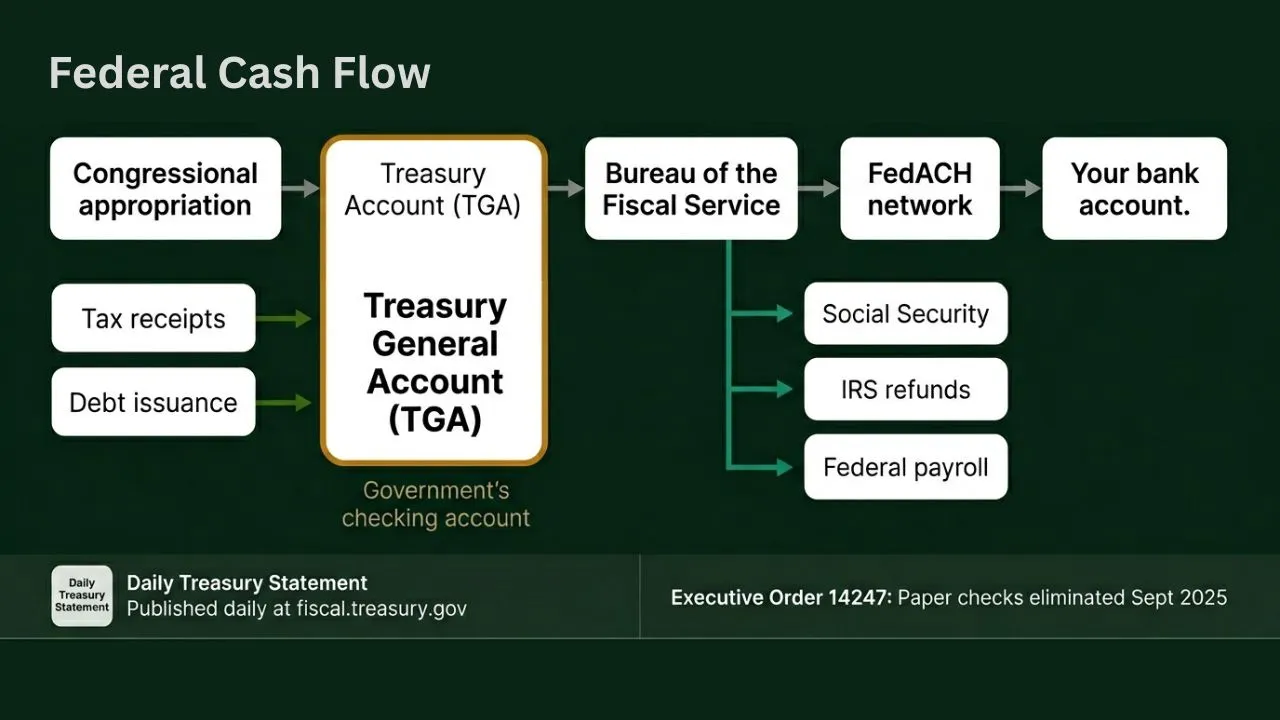
- Executive Order 14247, signed in 2025, mandated the phase-out of federal paper checks by September 30, 2025. All federal payments now default to direct deposit through the ACH network except in specific hardship exemptions.
- Government shutdowns and continuing resolutions affect federal employee payroll most directly. Social Security and IRS refunds are funded through separate statutory mechanisms and continue uninterrupted during most funding gaps.
- The vast majority of federal payment delays experienced by individuals are caused by ACH settlement timing and bank posting schedules, not by Treasury funding issues. The Treasury disbursement system is one of the most reliable financial infrastructures on Earth.
By the time you finish reading, you will understand the complete flow from Congressional appropriation to bank deposit, the mechanics of the Treasury General Account, exactly how paper checks are being eliminated from the federal payment system in 2026, which federal payment programs are protected from shutdown disruption and which are not, and what every headline about federal budget conflicts actually means for the money you are waiting to receive.
What the U.S. Treasury Does and Why It Matters
The U.S. Department of the Treasury is one of the original cabinet departments, established in 1789. Its mandate is deceptively simple: manage the government’s money. In practice, this encompasses collecting federal revenue, issuing debt, managing currency, regulating banks, and disbursing the payments that fund every federal obligation. The full scope of Treasury’s operations is described at the U.S. Department of Treasury website.
The Treasury’s core functions
The Treasury performs four distinct financial functions that together constitute the complete lifecycle of federal money. Revenue collection is the first function. The Internal Revenue Service is a bureau of the Treasury. When you pay federal taxes, you are paying the Treasury. When the IRS issues you a refund, the Treasury is returning an overpayment. The IRS is the inflow side of the Treasury’s ledger.


Debt management is the second function. When the federal government spends more than it collects in taxes, it borrows the difference by issuing Treasury securities: bills, notes, and bonds. The Bureau of the Fiscal Service administers this issuance through TreasuryDirect and through the financial markets. The national debt is the accumulated outstanding stock of these securities.
Payment disbursement is the third function and the one most relevant to readers of this guide. Every federal payment to every American citizen flows through the Bureau of the Fiscal Service.
No federal agency sends its own payments. The SSA authorizes your Social Security benefit, but the Bureau of the Fiscal Service disburses it. The VA authorizes your disability compensation, but the Bureau of the Fiscal Service sends the funds to your bank.
Financial management and regulation is the fourth function. Treasury houses the Office of the Comptroller of the Currency (OCC), which regulates national banks. It houses the Financial Crimes Enforcement Network (FinCEN), which combats money laundering.
It administers the Community Development Financial Institutions Fund. These regulatory and programmatic functions shape the environment in which all federal payments move.
Why the Treasury is the correct frame for understanding federal payments
Most consumer financial coverage discusses federal payments in terms of the issuing agency: the IRS sends refunds, the SSA sends Social Security, the VA sends disability payments. This framing is accurate at the authorization level. It is incomplete at the operational level.
Every payment authorization from every federal agency eventually converts to a payment file submitted to the Bureau of Fiscal Service for ACH transmission. The Bureau coordinates with the Federal Reserve’s FedACH network for settlement.
The Bureau manages the TGA balance to ensure sufficient funds for each disbursement cycle. The Bureau applies Treasury Offset Program intercepts for outstanding debts. Understanding that all paths lead through Treasury is the single most clarifying insight in federal payment literacy.
The Treasury General Account and How It Funds Your Payments
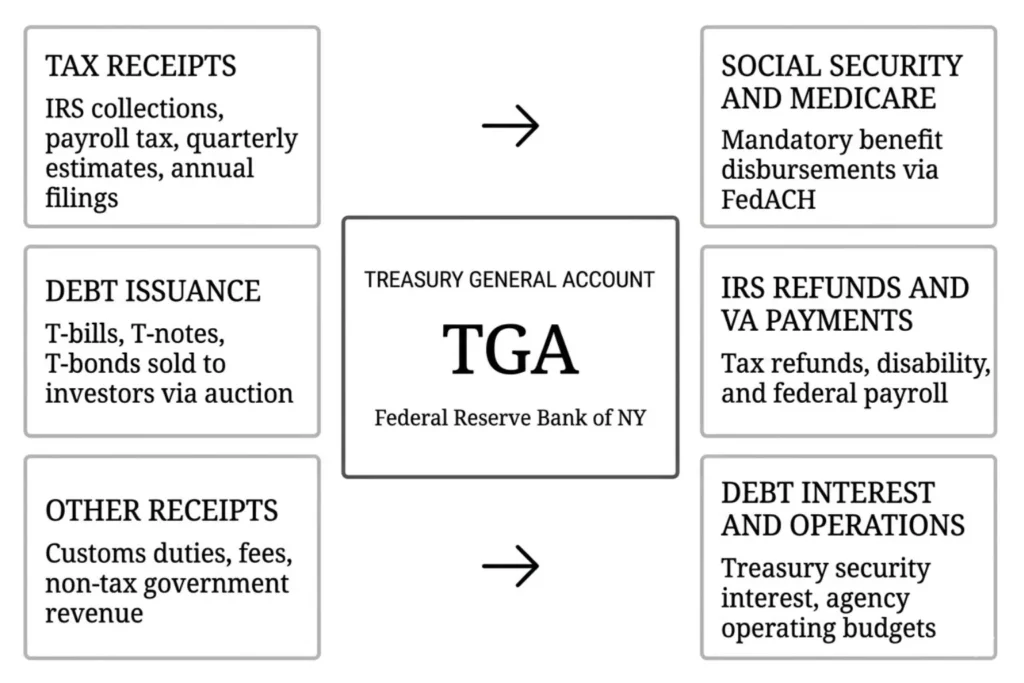
The Treasury General Account is the U.S. government’s primary checking account, held at the Federal Reserve Bank of New York. Every dollar the government spends, every federal payment of any kind, to any recipient, for any purpose leaves the TGA before arriving in your bank account. Every dollar the government collects in taxes, fees, and bond proceeds enters the TGA before being allocated to spending.
How money flows into the TGA
The TGA receives inflows from three primary sources. Tax receipts from individuals and businesses, collected by the IRS, represent the largest ongoing inflow. Payroll tax collections, corporate income tax quarterly estimates, and individual annual filings all contribute.
Treasury securities issuance the sale of T-bills, T-notes, and T-bonds to investors, represents the borrowing inflow that funds spending in excess of revenue. Other receipts including customs duties, fees, and non-tax revenues also contribute.
Tax inflows are highly seasonal. The TGA receives a massive surge in April, when individual annual tax payments arrive. It receives quarterly inflows in January, April, June, and September from estimated tax payments.
Between these inflows, the TGA balance can decline significantly as spending continues at a relatively steady pace while revenue intake drops. This seasonality is why debt ceiling dynamics become particularly acute in early spring before April tax receipts replenish the account.
How money flows out of the TGA
Every federal payment results in an outflow from the TGA. Social Security, Medicare, Medicaid, defense contractor payments, federal employee salaries, interest on the national debt, IRS refunds, VA benefits, and every other federal obligation draws on the TGA balance.
The Bureau of the Fiscal Service manages these outflows to ensure payment files are submitted to FedACH before the daily settlement cutoffs that determine when funds reach recipients’ banks.
The timing of TGA outflows is not uniform throughout the day. The Bureau coordinates large payment batches for overnight submission, enabling morning bank postings. The mechanics of how Treasury night releases work, specifically why most federal direct deposits post in the early morning rather than during business hours are covered in depth in the dedicated keeper article.
The Daily Treasury Statement: reading the government’s checkbook
The Bureau of the Fiscal Service publishes the Daily Treasury Statement (DTS) every business day. The DTS shows the prior business day’s TGA opening balance, all inflows and outflows by category, and the closing balance. It is a publicly available, real-time window into the government’s cash position and is the primary source document for analysts monitoring federal liquidity.
You can access the current and historical DTS at the Daily Treasury Statement page on the fiscal.treasury.gov website. The TGA balance as reported in the DTS is the authoritative source for assessing whether the government has sufficient cash on hand to meet its near-term obligations.
During debt ceiling standoffs, analysts monitor the DTS daily to estimate the X-date, the date at which the TGA could be insufficient to cover all payments due.
TGA status: As of April 9, 2026, the TGA balance is well above the threshold of concern. The April tax collection season is depositing substantial inflows, and the Treasury has adequate liquidity to fund all scheduled federal payments through mid-year and well beyond at the current spending and revenue trajectory.
How Treasury Sends Federal Payments: From Appropriation to Your Account
The journey from a Congressional appropriation to a direct deposit in your bank account passes through a specific sequence of systems, each controlled by a different part of the federal payment infrastructure. Understanding this sequence removes every mystery about when and why federal money moves.
Stage 1: Congressional authorization and appropriation
All federal spending begins with Congress. The Constitution requires that appropriations be made by law before any federal expenditure can occur. Congress passes appropriations bills (or continuing resolutions) that authorize specific agencies to spend up to specified amounts for specific purposes. These appropriations fund the programs that generate payments to individuals.
Some programs are “mandatory” or “entitlement” spending, meaning their funding is controlled by eligibility formulas in permanent law rather than by annual appropriations.
Social Security, Medicare, and Medicaid fall into this category. Other programs are “discretionary” spending, funded through annual appropriations that must be renewed each fiscal year. Federal employee salaries and most agency operating budgets are discretionary.
This distinction is the foundational reason why government shutdowns do not stop Social Security payments but do delay federal employee paychecks. Mandatory programs run on permanent legal authority. Discretionary programs require an active appropriation to function.
Stage 2: Agency payment authorization
Once funded by appropriation, each agency generates payment instructions based on its program rules. The SSA calculates monthly benefit amounts for each beneficiary. The IRS processes tax returns and calculates refund amounts. The VA determines disability compensation amounts. The Defense Finance and Accounting Service (DFAS) calculates federal employee and military salaries.
These calculations generate payment files, structured data files specifying the amount, recipient account, routing number, and effective date for each payment. These files are submitted to the Bureau of the Fiscal Service according to scheduled submission windows.
Stage 3: Bureau of the Fiscal Service processing
The Bureau of the Fiscal Service receives payment files from all federal agencies. It applies the Treasury Offset Program (TOP) rules, which reduce or redirect payments to cover outstanding federal debts including back taxes, defaulted student loans, and child support arrears.
It validates routing and account numbers. It assigns ACH effective dates. It consolidates files for submission to FedACH. The Bureau operates on a strict daily submission schedule. Payments must be submitted to FedACH by specific cutoff times to achieve specific effective dates.
Payments submitted after the evening cutoff are held for the following business day’s batch. The Bureau coordinates these submission timelines with the Federal Reserve’s FedACH settlement windows.
Stage 4: FedACH transmission and bank posting
The Bureau submits payment files to the Federal Reserve’s FedACH system. FedACH processes the files in scheduled settlement batches and credits the receiving banks’ Federal Reserve master accounts. Your bank receives the credit, processes it through its overnight batch system, and posts the deposit to your account by the start of the following business day.
The complete mechanics of deposit eligibility rules including which payment types and amounts are subject to Regulation CC holds and which post immediately, are covered in the dedicated keeper article.
The paper check elimination: Executive Order 14247
One of the most significant changes to the federal payment system in recent years is the mandatory elimination of paper checks. Executive Order 14247, signed in 2025, required all federal agencies to transition all remaining paper check payments to electronic direct deposit by September 30, 2025. The order applies to all federal benefit and entitlement payments.
The paper check transition represents the culmination of decades of federal policy pushing toward electronic payments. The IRS, which was the largest remaining issuer of paper checks due to tax refunds mailed to taxpayers without direct deposit accounts on file, has implemented alternative electronic payment options including prepaid debit card delivery for taxpayers without bank accounts.
A narrow hardship exemption remains for individuals who cannot access electronic payment systems due to documented circumstances. These exemptions require individual application and approval.
For all practical purposes, however, federal paper checks have been eliminated from routine payment processing as of late 2025. This change improves payment speed, reduces fraud, and lowers the administrative cost of disbursement for every federal program.
The Federal Budget and What It Means for Payment Reliability
Government budget conflicts generate enormous media coverage and widespread public anxiety about whether federal payments will arrive. Most of this anxiety is misplaced. Understanding the budget mechanics that actually control payment reliability is the difference between informed calm and unnecessary alarm.
How the federal budget works
The U.S. federal government operates on a fiscal year that runs from October 1 through September 30. Before each fiscal year begins, Congress is supposed to pass twelve appropriations bills covering all major areas of federal spending. In practice, Congress frequently fails to pass all appropriations on time, leading to one of three outcomes: a continuing resolution, a government shutdown, or some combination of the two.
A continuing resolution (CR) is a temporary funding measure that continues government operations at approximately prior-year spending levels while Congress continues negotiating full-year appropriations.
CRs keep the government running but impose restrictions on new spending commitments. Federal employees continue to be paid. Federal programs continue to operate. CRs are a routine, if suboptimal, feature of the modern federal budget process.
What a government shutdown actually means for payments
A government shutdown occurs when Congress fails to pass either a full-year appropriation or a continuing resolution before the prior funding expires. Under the Antideficiency Act, agencies that lack a current appropriation must cease operations for non-essential functions and place non-essential employees on unpaid furlough.
The critical nuance for payment recipients is which programs are classified as essential and which are funded through mandatory rather than discretionary appropriations.
Social Security benefits, Medicare payments, Medicaid payments, and IRS tax refunds on already-filed returns continue during a shutdown because they are funded through mandatory appropriations under permanent law that does not expire at the end of a fiscal year.
Federal employee paychecks are the most directly affected discretionary payment. During a shutdown, federal employees in non-essential roles are furloughed and do not receive paychecks for the shutdown period. Essential employees continue to work but may see delayed pay depending on the length and terms of the shutdown.
Which payments survive a government shutdown
| Payment type | Funding mechanism | Shutdown protection | Notes |
|---|---|---|---|
| Social Security (OASDI) | Social Security Trust Fund, permanent law | Fully protected | Continues through all shutdown scenarios |
| Medicare | Medicare Trust Funds, permanent law | Fully protected | Provider payments continue uninterrupted |
| Medicaid | Permanent law, state-federal matching | Fully protected | State payments continue during federal shutdown |
| SSI | General fund, permanent authority | Fully protected | Issued by SSA on standard schedule |
| VA disability | Advance appropriations, permanent authority | Fully protected | VA funded one year in advance by law since 2009 |
| IRS refunds (filed returns) | Permanent authority for refund processing | Largely protected | Processing of new returns may slow |
| Federal employee payroll | Annual discretionary appropriation | Delayed for non-essential | Essential employees work unpaid; back pay guaranteed historically |
| Military pay | Mixed; often deemed essential | Typically protected by law | Congress typically passes separate military pay bills during shutdowns |
| Federal contractor payments | Agency discretionary funds | Disrupted | Agency work stops; contractors generally not back-paid |
The 2026 DHS funding situation provides the clearest recent case study. The government shutdown impact article documents in operational detail how the 2026 funding gap affected DHS employee payroll, which payments were protected by mandatory funding authority, and how the situation was ultimately resolved.
The debt ceiling: the most misunderstood federal finance concept
The debt ceiling is a statutory limit on the total amount of debt the U.S. government may have outstanding at any one time. It is not a limit on spending, Congress has already authorized that spending through appropriations. It is a limit on the borrowing that funds the gap between revenues and spending.
When the debt ceiling is binding, meaning the Treasury has exhausted its borrowing capacity, the Treasury cannot issue new debt to fund payments. At that point, it can only pay obligations from current revenue inflows to the TGA. Since the government consistently spends more than it collects in any given period, a binding debt ceiling creates a situation where some payments might need to be delayed.
The U.S. has never defaulted on its debt obligations. However, near-misses in 2011, 2013, and 2023 caused significant market volatility and, in the case of 2011, resulted in a credit rating downgrade.
The debt ceiling typically gets resolved before the true X-date through a combination of extraordinary measures (accounting maneuvers that extend the Treasury’s cash runway) and eventual legislative action. The payment date updates keeper documents how payment schedules are affected and communicated during Treasury cash management periods.
What This Means for Your Money
The U.S. Treasury operates one of the most reliable financial systems in human history. The Bureau of the Fiscal Service processes hundreds of millions of individual payments per year with extraordinary accuracy and consistency. Understanding the mechanics behind that reliability gives you the tools to evaluate every federal payment situation with clarity.
Here is what the full content of this guide means for your specific financial life as of April 9, 2026.
The money in your federal payment was always going to arrive
The infrastructure between a Congressional appropriation and your bank account has functioned continuously for decades. FedACH processes payment files daily. The TGA funds every disbursement. Your bank posts the credit. This system does not fail. What appears to be a failed payment is almost always a timing misunderstanding or a bank-level posting delay, not a Treasury disbursement failure.
Social Security and IRS refunds are insulated from budget conflicts
These programs run on mandatory funding authority rooted in permanent law. A continuing resolution, a shutdown of non-essential agencies, and even a debt ceiling standoff do not interrupt these payments under any historical or current legal interpretation. If you receive Social Security or are waiting for a tax refund, federal budget news is not relevant to your payment timeline.
Federal employee payroll is the payment type most exposed to shutdown risk
If you are a federal employee or contractor, a lapse in appropriations directly affects your paycheck timeline. Essential employees continue working but may experience delayed payment. Non-essential employees are furloughed and do not receive pay for shutdown days, though back pay has been authorized by Congress in every past shutdown.
Paper checks from federal agencies are effectively eliminated as of late 2025
If you still receive a federal payment by paper check under a hardship exemption, you are in a small minority. For everyone else, direct deposit is now the default and only standard method. Verify that your banking information is current with every federal agency from which you receive payments, a failed direct deposit now results in an administrative resolution process rather than an automatic paper check.
The Treasury General Account balance is a public document you can check
The Daily Treasury Statement is published every business day and shows the government’s cash position in real time. During periods of debt ceiling tension or unusual fiscal stress, the TGA balance is the authoritative signal of whether payment capacity is genuinely constrained. Checking the DTS before accepting media characterizations of fiscal crisis is a high-value financial literacy practice.
The U.S. Treasury and the complete money movement architecture are documented comprehensively
The relationship between Treasury disbursement, FedACH settlement, and your individual bank deposit is one component of a federal payment infrastructure that moves trillions of dollars per year with extraordinary reliability.
The money movement system guide provides the complete reference architecture for how every layer of that system interacts, the definitive resource for understanding exactly where your federal money is at every point in its journey.
Frequently Asked Questions About the U.S. Treasury and Federal Payments
Does the U.S. Treasury send Social Security payments?
Yes. The Social Security Administration calculates and authorizes benefit amounts, but the Bureau of the Fiscal Service, a division of the U.S. Treasury, disburses the actual payments through the FedACH network. Every federal payment of any kind originates from Treasury.
What is the Treasury General Account?
The Treasury General Account is the U.S. government’s primary checking account at the Federal Reserve Bank of New York. All federal tax receipts flow into the TGA and all federal disbursements flow out of it. The current balance is published daily in the Daily Treasury Statement, available at fiscal.treasury.gov.
Do federal payments stop during a government shutdown?
Mandatory programs including Social Security, Medicare, Medicaid, and Veterans benefits continue during a government shutdown because they are funded through permanent law. IRS refunds on already-processed returns also continue. Federal employee paychecks for non-essential employees are delayed during a shutdown. Essential employee paychecks may also be delayed depending on the shutdown’s terms.
What happened to federal paper checks?
Executive Order 14247, signed in 2025, eliminated federal paper checks as a standard payment method effective September 30, 2025. All federal benefit and refund payments now default to direct deposit through the ACH network. A narrow hardship exemption exists for individuals who cannot access electronic payment systems. For the complete implementation timeline, see the paper check transition guide.
How can I check if a federal payment was actually sent by Treasury?
For IRS refunds, check your IRS transcript for Transaction Code 846. For Social Security, log into your My Social Security account at ssa.gov/myaccount. For VA payments, use the VA benefits portal. If the relevant portal shows the payment as issued or sent and your bank shows nothing, the issue is in the ACH pipeline or bank posting queue, not in Treasury disbursement.
What is a continuing resolution and does it affect my federal payment?
A continuing resolution is a temporary funding measure that keeps the government operating when full-year appropriations have not been passed. CRs continue all mandatory and essential discretionary programs at approximately prior-year levels. Social Security, Medicare, and IRS refunds are unaffected by CRs. Federal employee salaries continue under most CR scenarios.
Sources: All disbursement procedures, payment timing, and budget mechanics in this guide reflect current U.S. Treasury and Bureau of the Fiscal Service published guidance as of April 9, 2026. Bureau of the Fiscal Service at fiscal.treasury.gov. Daily Treasury Statement at fiscal.treasury.gov/reports-statements/dts. U.S. Department of Treasury at treasury.gov.
Editorial standard: Written and maintained to YMYL accuracy standards. All policy claims reference primary federal government sources. This guide describes how the U.S. Treasury and federal payment system operate, it does not constitute financial or legal advice for individual circumstances.