

The Congressional Budget Office published its Budget and Economic Outlook for 2026 to 2036 on February 11, 2026. The report confirms a federal deficit baseline of $1.9 trillion for fiscal year 2026, equal to 5.8% of GDP. The full report is available at CBO.gov.
The Social Security trust fund is facing a depletion window that is closing faster than the standard 2034 projection suggests. New institutional analysis drawing from the February 2026 Congressional Budget Office baseline explains why current fiscal and trade policy decisions are compressing that timeline toward a range closer to 2030. This is not partisan commentary. It is arithmetic.
The core problem is structural. The Social Security trust fund relies on payroll tax revenues to pay current benefits. When revenues fall short of obligations, the fund draws down its reserves.
When the reserves reach zero, the program can only pay what comes in each year, producing an automatic benefit cut. The CBO’s latest numbers reveal how far the gap between revenues and outlays has widened.
The CBO Numbers That Matter
The Congressional Budget Office’s February 2026 report confirms that total federal outlays stand at 23.3% of GDP in 2026, while total revenues sit at 17.5% of GDP. The resulting deficit totals $1.9 trillion for fiscal year 2026, equal to 5.8% of GDP. That 5.8-point gap is the structural foundation behind every accelerated depletion analysis currently circulating.
| Fiscal Metric | 2026 CBO Confirmed Figure |
|---|---|
| Federal Deficit | $1.9 Trillion |
| Outlays as % of GDP | 23.3% |
| Revenues as % of GDP | 17.5% |
| Standard Trust Fund Baseline | 2034 Exhaustion |
| Policy-Adjusted Estimate Range | 2029 to 2031 |
The Social Security trust fund does not draw from general federal revenues. It is funded separately through dedicated payroll taxes. But the structural fiscal environment matters because it determines whether Congress has the political and financial capacity to intervene before exhaustion occurs.
A government already running a $1.9 trillion annual deficit carries far less legislative flexibility to shore up a failing entitlement program than one operating with fiscal headroom. Understanding how federal payment infrastructure works clarifies why trust fund exhaustion produces an automatic and immediate payment reduction rather than a gradual one.
How Trump Policies Changed the Math
The 2025 Reconciliation Act is the single largest policy factor compressing the Social Security trust fund timeline. The CBO’s analysis shows the reconciliation act increased projected deficits by an estimated $4.7 trillion over the 10-year window, after accounting for related changes in the economy and debt-service costs.
That deficit increase does not directly drain Social Security revenues, but it accelerates debt accumulation and increases the interest payments that crowd out discretionary fiscal responses.


On the revenue side, the tariff regime has created a partial offset. Higher tariffs are projected to reduce total deficits by an estimated $3.0 trillion over the projection period, including the effects of related economic and interest payment changes. However, tariff revenue is customs revenue, not payroll revenue.
Tariffs flow into the general fund. They do not flow into the Social Security trust fund. The offset is real for the total deficit. It provides zero structural relief to Social Security’s dedicated funding stream.
The CBO report explicitly models this asymmetry. Revenues in 2026 show customs duties rising from 0.6% of GDP in 2025 to 1.3% of GDP in 2026 as a result of tariff increases, while individual income tax receipts and corporate income taxes declined as a share of GDP.
Payroll taxes, which fund Social Security directly, remained stable as a share of GDP. Stable payroll revenue against rising mandatory benefit obligations is the exact condition that accelerates depletion.
What 2030 Means For Your Check
The standard 2034 baseline assumes no legislative intervention and no major policy disruptions to payroll revenue.
A 2030 acceleration scenario assumes that the combined effect of lower real wages (suppressed by tariff-driven inflation), reduced immigration inflows (shrinking the payroll base), and the political constraint of operating inside a $1.9 trillion annual deficit environment prevents Congress from passing meaningful trust fund legislation before exhaustion.
At the point of trust fund exhaustion, Social Security can only pay what payroll taxes bring in each year. Based on CBO modeling parameters, that figure represents approximately 79 to 80 cents on the dollar of currently scheduled benefits.
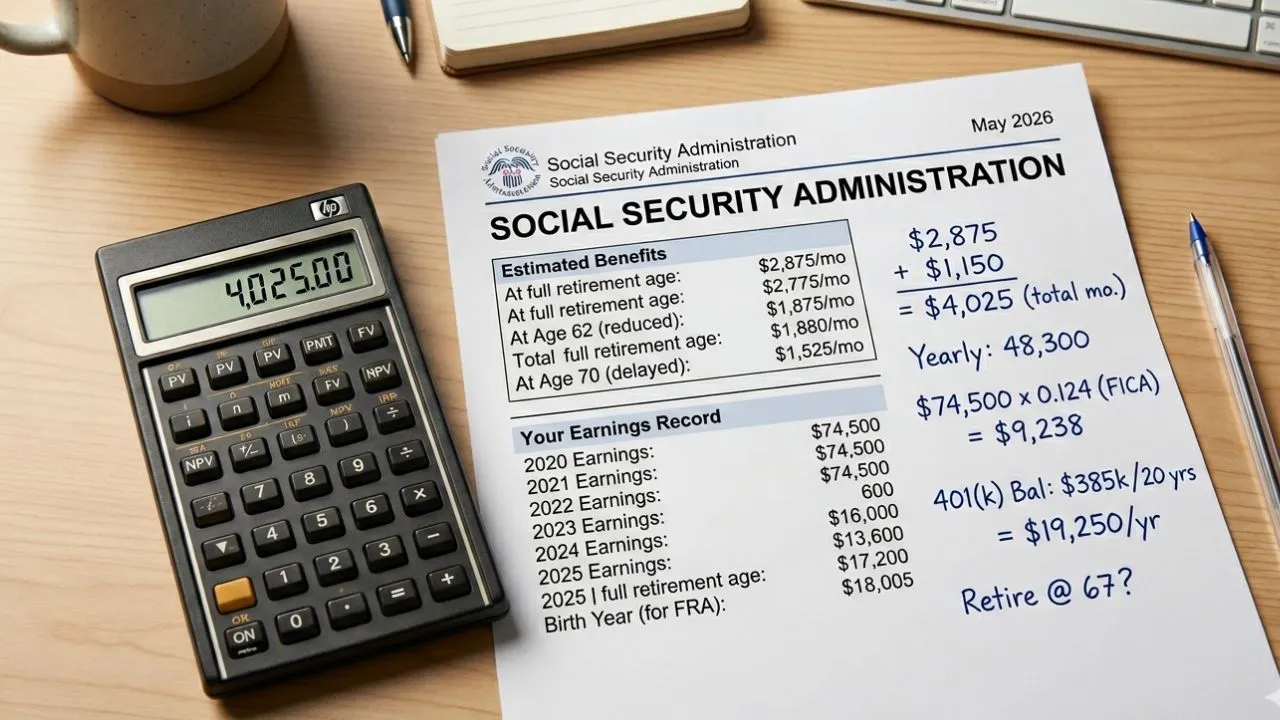
For someone receiving $2,000 per month today, a proportional cut at exhaustion would reduce the check to approximately $1,580 to $1,600 per month. The cut would be immediate, permanent, and affect every recipient equally.
The Social Security trust fund structural analysis published on this site provides the full CBO trust fund reserve depletion modeling in greater technical detail. The Senate Budget Committee is actively monitoring these scenarios in relation to the 2025 Reconciliation Act and its mandatory spending implications.
The CBO’s Social Security topic index archives all current institutional trust fund modeling for readers who want the complete technical baseline.
What You Should Do Now
- Accept the 2034 standard projection as a ceiling, not a guarantee. Policy changes are actively compressing that window.
- Review your Social Security trust fund estimated benefit through My Social Security to understand your current projected payment under scheduled law.
- Monitor the Senate Budget Committee’s 2026 reconciliation impact assessments, which will update the depletion modeling as fiscal year data accumulates.
- If you are within 10 years of retirement, consider how a potential 20% Social Security trust fund benefit reduction affects your income planning.
- Read the CBO Budget and Economic Outlook to access the primary institutional source behind every depletion headline currently in circulation.