

Updated: June 22, 2026 – The Treasury Offset Program can take part or all of a federal payment to pay off a debt you owe. A creditor agency must wait until your debt is 120 days past due before sending it into the program. You get a written warning at least 60 days before any money is touched.
In fiscal year 2024, state debts alone pulled in more than 1.4 billion dollars in unpaid child support through this single system. The offset ends the moment your debt is paid off or the creditor agency puts a pause on the case.
What This Program Means
The Treasury Offset Program is a federal system that checks your name against a list of unpaid debts before the government sends you money. It is run by the Bureau of the Fiscal Service, a part of the U.S. Department of the Treasury. If your name matches a debt on file, your payment gets reduced by some or all of what you owe.
This applies to many kinds of payments, not only tax refunds. Social Security checks, federal salary, and certain other benefits can also be touched by this rule. The program exists because of three federal laws working together, found at 26 U.S.C. § 6402(d), 31 U.S.C. § 3716(c), and 31 U.S.C. § 3720A. Together they give creditor agencies the legal right to collect through your payment instead of chasing you separately.
Most people only learn about this program after their refund arrives smaller than expected. The full How TOP Works page from the Bureau of the Fiscal Service lays out the legal basis in plain terms, and it is worth reading if you want the original source behind every rule explained here.
How Treasury Links Agencies
Before your refund or benefit payment leaves the government, a disbursing official checks your Taxpayer Identification Number or Social Security Number against a centralized debt database. This step happens automatically, in milliseconds, as part of the normal payment process. If there is a match, the payment is reduced right then, before the money ever reaches your bank.
This is one small piece of a much larger system. Every federal payment, whether it is a tax refund, a Social Security deposit, or a paycheck, moves through the same basic pipeline before it lands in your account.
Readers who want the full picture of how money travels from a federal agency through Treasury and into a personal bank account can study the complete federal payment pipeline, which maps every stop along that route.
Once the offset happens, the intercepted funds are not simply held by Treasury. They are sent directly to the creditor agency that filed the debt, closing out part or all of what is owed. The Bureau of the Fiscal Service acts only as the matching point and transfer agent, not as the agency deciding whether you actually owe the money.
Offset Limits And Exceptions
Federal law puts limits on how much of certain payments can be taken at once. Tax refunds can generally be reduced in full to cover an eligible debt, since a refund is treated differently from ongoing income. Wages and some federal benefit payments, by contrast, are protected by smaller offset percentages so a person is not left with nothing to live on.
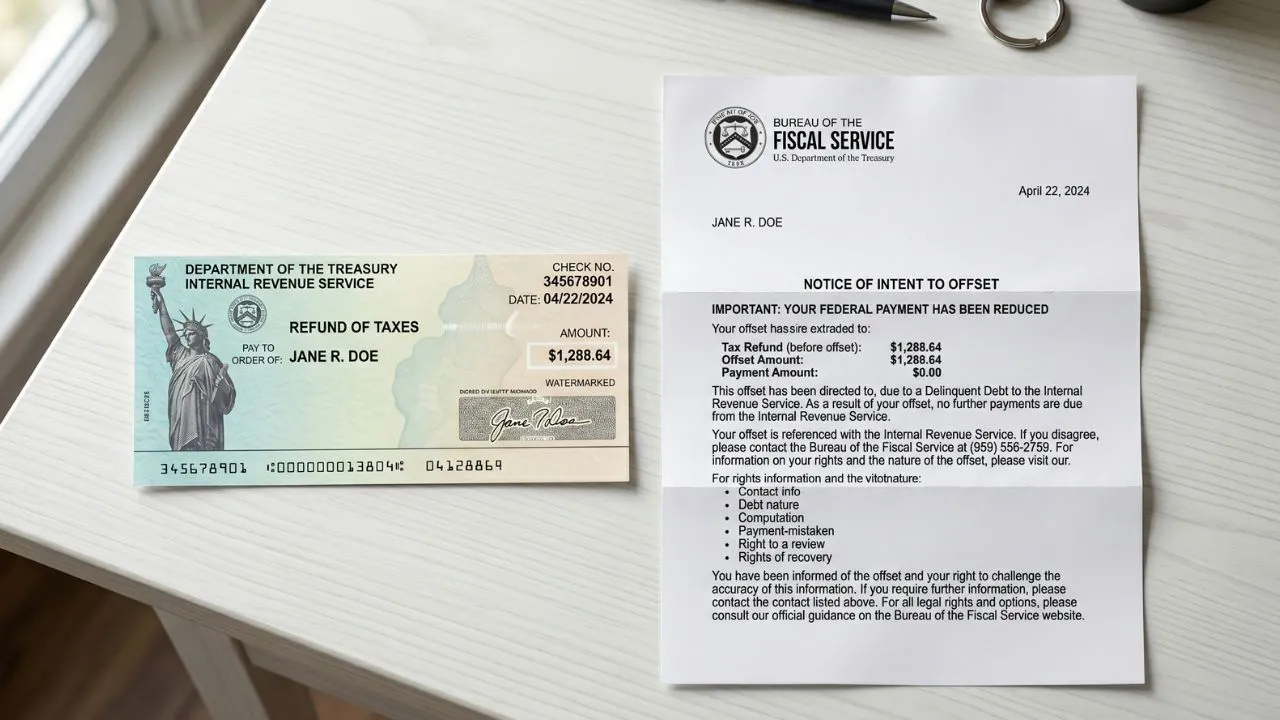
A debt cannot enter the program without warning. The creditor agency is required to mail a notice at least 60 days before referring the debt, explaining the type of debt, the amount owed, and the steps available to dispute or resolve it. Skipping this notice is one of the few grounds that can pause or reverse an offset after the fact.
There are also natural stopping points built into the system. Collection ends once the debt is paid in full, once a bankruptcy stay takes effect, or if the creditor agency itself chooses to pause the case for any reason. None of these require the debtor to take legal action first.
Debts This Program Covers
The program reaches far beyond tax debt. State governments alone used it to recover huge amounts in fiscal year 2024, with more than 1.4 billion dollars collected for unpaid child support, 720.9 million dollars for delinquent state income tax, 343.7 million dollars for state unemployment insurance debt, and 197.9 million dollars for Supplemental Nutrition Assistance Program overpayments. Every state runs its own version of this process through the state program details page maintained by Fiscal Service.
This matters for anyone receiving Social Security on a former spouse’s work record, since those payments are not shielded from the program either. A divorced person who qualifies under the divorced benefit rules can still see that payment reduced if they owe an eligible debt themselves. The marriage history behind the benefit has no bearing on whether the offset applies.
Federal employee debts, defaulted student loans, and unpaid court ordered restitution can also flow through this same channel. The common thread across every category is the same matching process happening behind the scenes at the moment a payment is calculated.
When Something Goes Wrong
If your refund came back smaller than you expected, the fastest way to find out why is the Treasury Offset Program call center at 800 304 3107. This automated line will tell you which agency holds the debt and how much was taken, usually within a few minutes.
Sometimes a reduced refund is not from an offset at all. It can instead come from an IRS review of your reported income, which arrives as a separate notice asking you to confirm or correct what you filed. Readers who received a letter questioning their reported earnings, rather than a notice about an old debt, are likely looking at an income mismatch notice instead of a Treasury Offset Program case, and the steps to resolve each one are different.
Once a debt enters the program, the remaining balance after any offset still travels through the same federal payment rails as every other deposit. That final leg runs through the real time settlement network operated by the Federal Reserve before it reaches your bank.
What You Should Do Now
- If your payment was smaller than expected, call the Treasury Offset Program line first to confirm whether an offset is the cause.
- Write down the agency name and case number provided by the automated system for your records.
- Contact that specific agency directly, since only the agency responsible for the debt can explain the balance or discuss resolution options.
- Keep copies of any notice you received in the mail, as those documents explain your rights and any available dispute procedures.
- Act quickly if you believe the debt is incorrect. Delaying action does not automatically pause or reverse the offset process.