


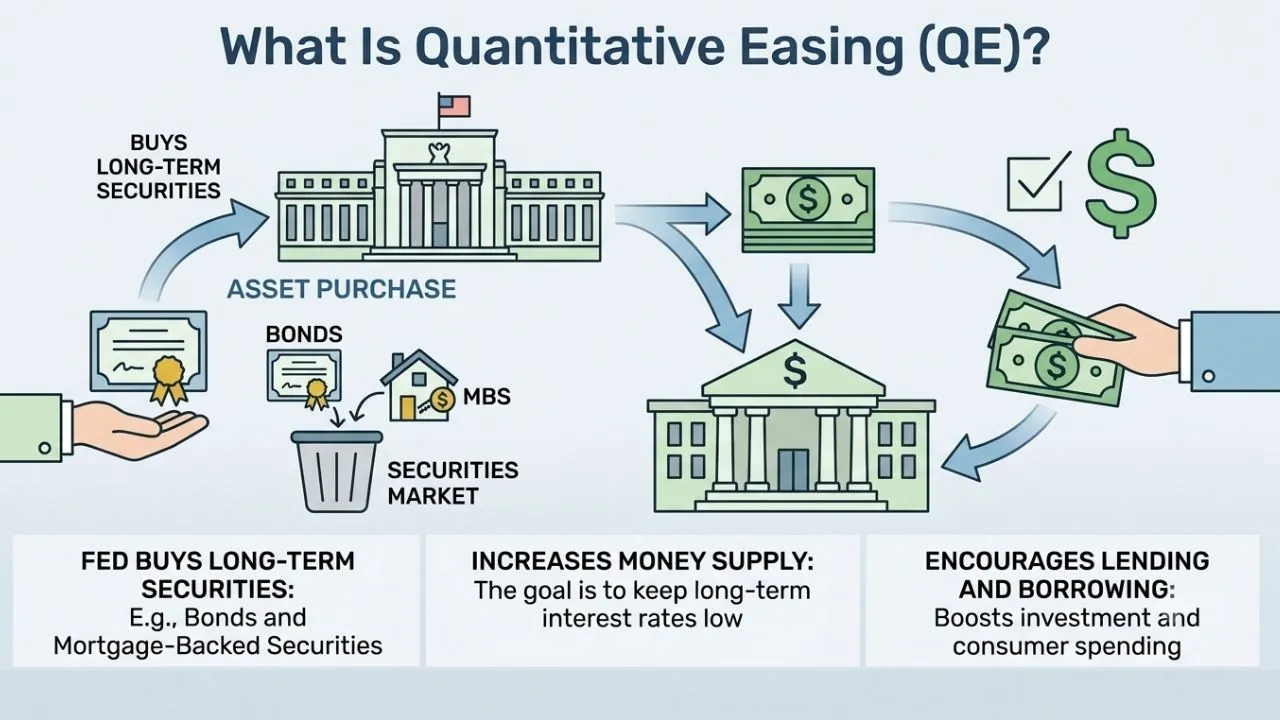
Updated: June 22, 2026 – Quantitative easing is a monetary policy tool that allows a central bank to create new money electronically and use it to purchase financial assets, primarily government bonds and mortgage-backed securities, directly from banks and financial institutions.
The Federal Reserve deploys quantitative easing when cutting short-term interest rates alone is insufficient to stimulate economic activity. Understanding how this mechanism works tells you a great deal about where interest rates, savings yields, and mortgage costs are headed.
In plain terms: the Fed creates money that did not previously exist, buys bonds with it, pushes bond prices up and yields down, and lowers borrowing costs across the entire economy. The money the Fed creates lands in the banking system as reserves.
Banks then have more capacity to lend. That lending eventually reaches businesses, homeowners, and consumers. The process sounds abstract. Its effects are entirely real.
The Core Mechanics of QE
Quantitative easing begins at the Federal Open Market Committee. The FOMC votes to authorize the purchase of a specific dollar amount of assets over a specified period. The Federal Reserve Bank of New York, acting as the operational arm of the FOMC, then executes these purchases through its Open Market Trading Desk.
The Fed does not simply print paper currency. It creates electronic reserves inside the Federal Reserve’s own accounting system. These reserves are credited to the accounts that primary dealer banks hold at the Fed. In exchange, those banks transfer ownership of the Treasury securities or mortgage-backed securities they were holding to the Fed’s balance sheet.
The result is a direct expansion of the Federal Reserve balance sheet. The assets side of the Fed’s ledger grows as it accumulates bonds. The liabilities side grows as bank reserves increase. This is not magic and it is not hidden. The Fed publishes its balance sheet weekly in the H.4.1 statistical release, available at federalreserve.gov.
Why the Fed Uses QE Instead of Rate Cuts
Standard monetary policy operates through the federal funds rate, the overnight lending rate between banks. When the economy weakens, the Fed cuts this rate, making borrowing cheaper for banks, which in turn makes loans cheaper for businesses and consumers.
The problem emerges when the federal funds rate hits zero. At that point, the Fed cannot cut further using conventional tools. This situation, called the zero lower bound, leaves the Fed with diminished firepower precisely when the economy needs the most support.
Quantitative easing bypasses this constraint. Instead of acting on the short end of the interest rate curve through overnight lending rates, QE acts on the long end by purchasing long-duration bonds.
When the Fed buys 10-year Treasury bonds in massive volume, it drives the price of those bonds up and the yield down. Since mortgage rates, corporate borrowing costs, and long-term investment decisions all follow long-term Treasury yields, the entire cost structure of credit in the economy shifts lower.
This is the transmission mechanism that connects Federal Reserve interest rate decisions to your mortgage payment and your savings account yield.
How QE Affects Banks and Reserves
When the Fed purchases a Treasury bond from a primary dealer bank, the bank’s balance sheet changes in a specific way. The bank surrenders the bond. The Fed credits the bank’s reserve account at the Federal Reserve with an equivalent dollar amount.
These reserves sit inside the Federal Reserve system. They are not automatically lent out into the economy. Banks hold them as a buffer against withdrawal demands and regulatory capital requirements. However, the existence of abundant reserves lowers the cost of interbank lending and gives banks more capacity to extend credit without worrying about reserve adequacy.
The Federal Reserve pays interest on these excess reserves, a rate called IOER (Interest on Excess Reserves), now called IORB (Interest on Reserve Balances). This rate acts as a floor for the federal funds rate.
When the Fed raises IORB, it becomes more profitable for banks to hold reserves at the Fed rather than lend them out, which tightens financial conditions. When the Fed lowers IORB, the incentive to hold reserves decreases, encouraging more lending.
Under current Fed Chair Kevin Warsh, the FOMC’s approach to reserve management has evolved significantly from the quantitative easing era. The Kevin Warsh Fed balance sheet analysis covers how the current leadership is managing the legacy of QE-era asset accumulation and its accounting implications.
The Three Major QE Programs
The Federal Reserve has run three distinct large-scale asset purchase programs in its modern history, each responding to a different economic crisis.
QE1 (2008 to 2010) launched in response to the 2008 financial crisis. The Fed purchased approximately 1.75 trillion dollars in mortgage-backed securities, agency debt, and Treasury securities. The program targeted the collapse of the mortgage market and the freezing of credit markets. It was the first time the Fed had ever attempted large-scale asset purchases and represented a fundamental expansion of the central bank’s toolkit.
QE2 (2010 to 2011) added 600 billion dollars in Treasury purchases when the economic recovery faltered and deflation risk emerged. This program was more controversial than QE1. Critics argued the economy no longer faced systemic crisis and that the Fed was overreaching. International trading partners argued QE2 weakened the dollar artificially.
QE3 and QE4 (2012 to 2014 and 2020 to 2022) included the open-ended monthly purchase programs. QE3 introduced the concept of outcome-based forward guidance, with the Fed committing to continued purchases until labor market conditions improved substantially. QE4 in 2020 was the most aggressive in history, with the Fed purchasing 120 billion dollars per month in Treasury and mortgage-backed securities in response to the pandemic economic collapse.
The U.S. money movement system provides the infrastructure through which these asset purchase flows ultimately settle across the banking system and reach the real economy.
QE and Inflation
The relationship between quantitative easing and consumer price inflation is more complex than critics and proponents both suggest.
QE creates bank reserves, not consumer purchasing power directly. If banks hold their expanded reserves at the Fed rather than lending them aggressively, QE may not generate significant inflation. This is largely what happened during the QE1 through QE3 programs between 2009 and 2014. The Fed’s balance sheet expanded dramatically. Inflation remained below target for most of that period.
The 2020 to 2022 period presented a different dynamic. The scale of QE4 combined with direct fiscal stimulus that put money directly into consumer accounts produced a different transmission channel. Consumer spending surged. Supply chains could not absorb the demand shock. The inflation that followed reached 40-year highs.
The Federal Reserve’s subsequent quantitative tightening program, the reversal of QE, involved allowing maturing bonds to roll off the balance sheet without reinvestment. This process reduces reserves and tightens financial conditions without requiring the Fed to actively sell bonds at a loss.
QE and Your Personal Finances
Quantitative easing affects your financial life through several transmission channels that operate simultaneously.
Savings account yields fall during QE because the Fed’s bond purchases push down long-term rates, and banks have little incentive to compete aggressively for deposits when they already hold abundant reserves. During the peak QE periods, high-yield savings accounts offered rates as low as 0.01 percent annually.
Mortgage rates fall during QE because 30-year mortgage rates track closely to 10-year Treasury yields. When QE drives down Treasury yields, mortgage rates follow. Homebuyers benefited from sub-3 percent mortgage rates during the 2020 to 2021 QE period. The reversal of those conditions when QE ended contributed to one of the sharpest mortgage rate increases in modern history.
Stock and bond valuations rise during QE because lower yields make future corporate earnings more valuable in present-value terms and because investors seeking yield move from low-yielding bonds into equities and real estate. This asset price inflation is a deliberate transmission mechanism of QE policy.
What QE Means in 2026
The Federal Reserve under Kevin Warsh is navigating the aftermath of the largest QE program in history. The Fed’s balance sheet peaked at approximately 9 trillion dollars following QE4. Quantitative tightening has reduced that figure, but the balance sheet remains historically elevated.
The June 17, 2026 FOMC decision, Warsh’s first as Fed Chair, held rates steady while continuing the existing balance sheet runoff pace. This posture signals that the Fed is not currently considering a return to asset purchases. The FOMC June rate decision covers how this stance affects savings rates and deposit yields across the banking system.
Any future activation of QE would require either a severe economic contraction, a financial system stress event, or a deflationary shock that conventional rate policy could not address. The institutional conditions for QE are not currently present in the 2026 economic environment.
What You Should Do Now
- Understand that today’s elevated savings yields exist in part because quantitative easing has ended. If the Federal Reserve resumes large-scale asset purchases, savings account rates could decline rapidly.
- Check the Federal Reserve’s H.4.1 statistical release weekly to monitor balance-sheet changes. Sustained increases may signal renewed quantitative easing activity.
- Review your fixed-income holdings. When quantitative easing returns, bond prices generally rise and existing bondholders benefit. When quantitative easing is withdrawn, the opposite effect can occur.
- Follow FOMC policy statements for language regarding asset-purchase programs. References to additional monetary accommodation have historically preceded major policy shifts.
- Assess your mortgage situation. If quantitative easing re-emerges and interest rates decline significantly, refinancing opportunities may develop quickly.











One thought on “What Is Quantitative Easing? A Comprehensive Guide to How the Fed Creates Money @import url("https://fonts.googleapis.com/css2?family=Poppins:wght@400;500;600&family=Source+Sans+3:wght@400;500;600;700&display=swap"); /* ========================================= NORMAL BYLINE ========================================= */ .izo-clean-byline { display: flex; align-items: center; justify-content: space-between; width: 100%; max-width: 620px; gap: 16px; margin-top: 4px; margin-bottom: 16px; font-family: "Poppins", Arial, sans-serif; } .izo-clean-byline-content { display: flex; flex-direction: column; justify-content: center; align-items: flex-start; min-width: 0; gap: 4px; line-height: 1.12; transform: translateY(-4px); font-family: "Poppins", Arial, sans-serif; } .izo-clean-author-wrap { position: relative; display: inline-block; width: fit-content; line-height: 1.12; margin: 0; padding: 0; outline: none; } .izo-by-label { font-family: "Poppins", Arial, sans-serif; font-size: 14px; font-weight: 400; color: #111; line-height: 1.12; margin-right: 3px; } .izo-clean-author-name { position: relative; display: inline-block; font-family: "Poppins", Arial, sans-serif; font-size: 14px; font-weight: 600; color: #111; cursor: pointer; line-height: 1.12; padding: 0; margin: 0; text-decoration-line: underline; text-decoration-color: #111; text-decoration-thickness: 1px; text-underline-offset: 1px; } .izo-clean-author-name::after { display: none; } .izo-clean-meta { font-family: "Poppins", Arial, sans-serif; font-size: 11px; font-weight: 400; color: #555; line-height: 1.12; margin: 0; padding: 0; } /* ========================================= RIGHT ACTIONS GOOGLE + SHARE ========================================= */ .izo-byline-actions { display: flex; align-items: center; justify-content: flex-end; gap: 7px; flex: 0 0 auto; position: relative; top: 6px; } /* ========================================= GOOGLE SOURCE BADGE ========================================= */ .izo-google-source-badge { display: inline-flex; align-items: center; justify-content: center; width: 34px; height: 34px; min-width: 34px; flex: 0 0 34px; padding: 6px; margin: 0; box-sizing: border-box; background: #ffffff !important; border: 1px solid rgba(85,85,85,0.30) !important; border-radius: 6px; box-shadow: none !important; text-decoration: none !important; overflow: hidden; transition: border-color 0.18s ease, background-color 0.18s ease; } .izo-google-source-badge img { display: block; width: 100%; height: 100%; max-width: 100%; object-fit: contain; object-position: center; margin: 0; padding: 0; border: 0 !important; border-radius: 0 !important; background: transparent !important; box-shadow: none !important; } .izo-google-source-badge:hover { background: #ffffff !important; border-color: rgba(85,85,85,0.45) !important; box-shadow: none !important; transform: none !important; } .izo-google-source-badge:focus { background: #ffffff !important; outline: 1px solid rgba(85,85,85,0.45); outline-offset: 2px; box-shadow: none !important; } /* ========================================= SHARE BUTTON ========================================= */ .izo-share-button { display: inline-flex; align-items: center; justify-content: center; width: 34px; height: 34px; min-width: 34px; flex: 0 0 34px; padding: 7px; margin: 0; box-sizing: border-box; background: #ffffff !important; border: 1px solid rgba(85,85,85,0.30) !important; border-radius: 6px; box-shadow: none !important; color: #333333 !important; cursor: pointer; text-decoration: none !important; overflow: hidden; appearance: none; -webkit-appearance: none; transition: border-color 0.18s ease, color 0.18s ease, background-color 0.18s ease; } .izo-share-button svg { display: block; width: 18px; height: 18px; fill: none; stroke: currentColor; stroke-width: 1.8; stroke-linecap: round; stroke-linejoin: round; margin: 0; padding: 0; } .izo-share-button:hover { background: #ffffff !important; border-color: rgba(85,85,85,0.45) !important; color: #111111 !important; box-shadow: none !important; transform: none !important; } .izo-share-button:focus { background: #ffffff !important; outline: 1px solid rgba(85,85,85,0.45); outline-offset: 2px; box-shadow: none !important; } /* ========================================= AUTHOR DETAILS CARD ========================================= */ .izo-clean-author-tooltip { position: absolute; top: calc(100% + 10px); left: 0; width: 440px; max-width: calc(100vw - 40px); background: #fff; color: #333; border: 1px solid #e5e5e5; border-radius: 8px; padding: 16px; font-family: "Source Sans 3", Arial, sans-serif; font-size: 13px; font-weight: 400 !important; line-height: 1.55; box-shadow: 0 8px 24px rgba(0,0,0,0.10); opacity: 0; visibility: hidden; transform: translateY(5px); transition: opacity 0.2s ease, transform 0.2s ease, visibility 0.2s ease; z-index: 9999; pointer-events: none; } /* ========================================= IMAGE + BIO ========================================= */ .izo-tooltip-main { display: flex; align-items: flex-start; gap: 14px; width: 100%; } .izo-tooltip-image { width: 96px; height: 96px; flex: 0 0 96px; object-fit: cover; object-position: center; display: block; border-radius: 6px; margin: 0; padding: 0; } .izo-tooltip-bio { flex: 1 1 auto; min-width: 0; font-family: "Source Sans 3", Arial, sans-serif; font-size: 13px; font-weight: 400; line-height: 1.55; color: #333; margin: 0; padding: 0; } .izo-clean-author-tooltip strong { font-family: "Source Sans 3", Arial, sans-serif; font-weight: 400 !important; } /* ========================================= DESKTOP HOVER ========================================= */ .izo-clean-author-wrap:hover .izo-clean-author-tooltip { opacity: 1; visibility: visible; transform: translateY(0); pointer-events: auto; } /* ========================================= KEYBOARD / MOBILE TAP ========================================= */ .izo-clean-author-wrap:focus .izo-clean-author-tooltip, .izo-clean-author-wrap:focus-within .izo-clean-author-tooltip { opacity: 1; visibility: visible; transform: translateY(0); pointer-events: auto; } /* ========================================= POPUP FOOTER SOCIALS | READ PROFILE ========================================= */ .izo-tooltip-footer { display: flex; align-items: center; gap: 14px; margin-top: 16px; width: 100%; } .izo-tooltip-socials { display: flex; align-items: center; gap: 14px; margin: 0; padding: 0; } .izo-tooltip-socials a { display: inline-flex; align-items: center; justify-content: center; width: 24px; height: 24px; color: #222; text-decoration: none; border: none; transition: opacity 0.2s ease, transform 0.2s ease; } .izo-tooltip-socials a:hover { opacity: 0.72; transform: translateY(-1px); } .izo-tooltip-socials svg { width: 21px; height: 21px; fill: currentColor; display: block; } /* Grey separator */ .izo-tooltip-separator { display: inline-flex; align-items: center; justify-content: center; color: #b5b5b5; font-family: "Source Sans 3", Arial, sans-serif; font-size: 20px; font-weight: 400; line-height: 1; margin: 0 1px; } /* Read profile */ .izo-clean-author-tooltip .izo-profile-link { display: inline-block; font-family: "Source Sans 3", Arial, sans-serif; font-size: 13px; font-weight: 600; color: #1a73e8; text-decoration: none; border-bottom: 1px solid #1a73e8; line-height: 1.25; white-space: nowrap; } /* ========================================= MOBILE ========================================= */ @media (max-width: 650px) { .izo-clean-byline { display: flex; flex-direction: row; align-items: center; justify-content: space-between; width: 100%; max-width: 100%; gap: 7px; margin-top: 3px; margin-bottom: 14px; flex-wrap: nowrap; } .izo-clean-byline-content { display: flex; flex-direction: column; flex: 1 1 auto; min-width: 0; max-width: calc(100% - 68px); gap: 3px; line-height: 1.12; transform: translateY(-4px); } .izo-clean-author-wrap { line-height: 1.12; margin: 0; padding: 0; max-width: 100%; white-space: nowrap; } .izo-by-label { font-size: 12px; line-height: 1.12; margin-right: 3px; } .izo-clean-author-name { font-size: 12px; font-weight: 600; line-height: 1.12; padding: 0; margin: 0; text-underline-offset: 1px; white-space: nowrap; } .izo-clean-meta { font-size: 9.5px; line-height: 1.12; margin: 0; padding: 0; color: #555; white-space: nowrap; } /* ========================================= GOOGLE + SHARE MOBILE STAY ON SAME ROW ========================================= */ .izo-byline-actions { display: flex; flex-direction: row; align-items: center; justify-content: flex-end; gap: 5px; flex: 0 0 auto; white-space: nowrap; position: relative; top: 5px; } /* GOOGLE MOBILE */ .izo-google-source-badge { width: 28px; height: 28px; min-width: 28px; flex: 0 0 28px; padding: 5px; border-radius: 5px; background: #ffffff !important; border: 1px solid rgba(85,85,85,0.30) !important; box-shadow: none !important; margin: 0; } .izo-google-source-badge img { width: 100%; height: 100%; } /* SHARE MOBILE */ .izo-share-button { width: 28px; height: 28px; min-width: 28px; flex: 0 0 28px; padding: 6px; border-radius: 5px; background: #ffffff !important; border: 1px solid rgba(85,85,85,0.30) !important; box-shadow: none !important; margin: 0; } .izo-share-button svg { width: 15px; height: 15px; stroke-width: 1.8; } /* ========================================= MOBILE AUTHOR CARD ========================================= */ .izo-clean-author-tooltip { width: min(340px, calc(100vw - 32px)); max-width: calc(100vw - 32px); padding: 14px; left: 0; font-size: 12.5px; line-height: 1.5; } .izo-tooltip-main { gap: 11px; align-items: flex-start; } .izo-tooltip-image { width: 82px; height: 82px; flex: 0 0 82px; border-radius: 5px; } .izo-tooltip-bio { font-size: 12.5px; line-height: 1.5; } /* Mobile footer */ .izo-tooltip-footer { gap: 11px; margin-top: 14px; flex-wrap: nowrap; } .izo-tooltip-socials { gap: 12px; } .izo-tooltip-socials a { width: 22px; height: 22px; } .izo-tooltip-socials svg { width: 20px; height: 20px; } .izo-tooltip-separator { font-size: 18px; margin: 0; } .izo-clean-author-tooltip .izo-profile-link { font-size: 12.5px; line-height: 1.2; } }
ByAdarsha Dhakal

Adarsha Dhakal is the Founder and Editor of Investozora, an independent U.S. financial news publication he launched in August 2025. He covers IRS tax refunds, Social Security benefit payments, federal payment systems, Federal Reserve policy, and U.S. Treasury operations, explaining how government financial decisions affect the daily lives of American households. All reporting is sourced directly from official government records including IRS.gov, SSA.gov, FederalReserve.gov, and fiscal.treasury.gov.
|
Read full profile →
Published Jun 22, 2026 · 3:32 PM ET · Updated 2 months ago

”