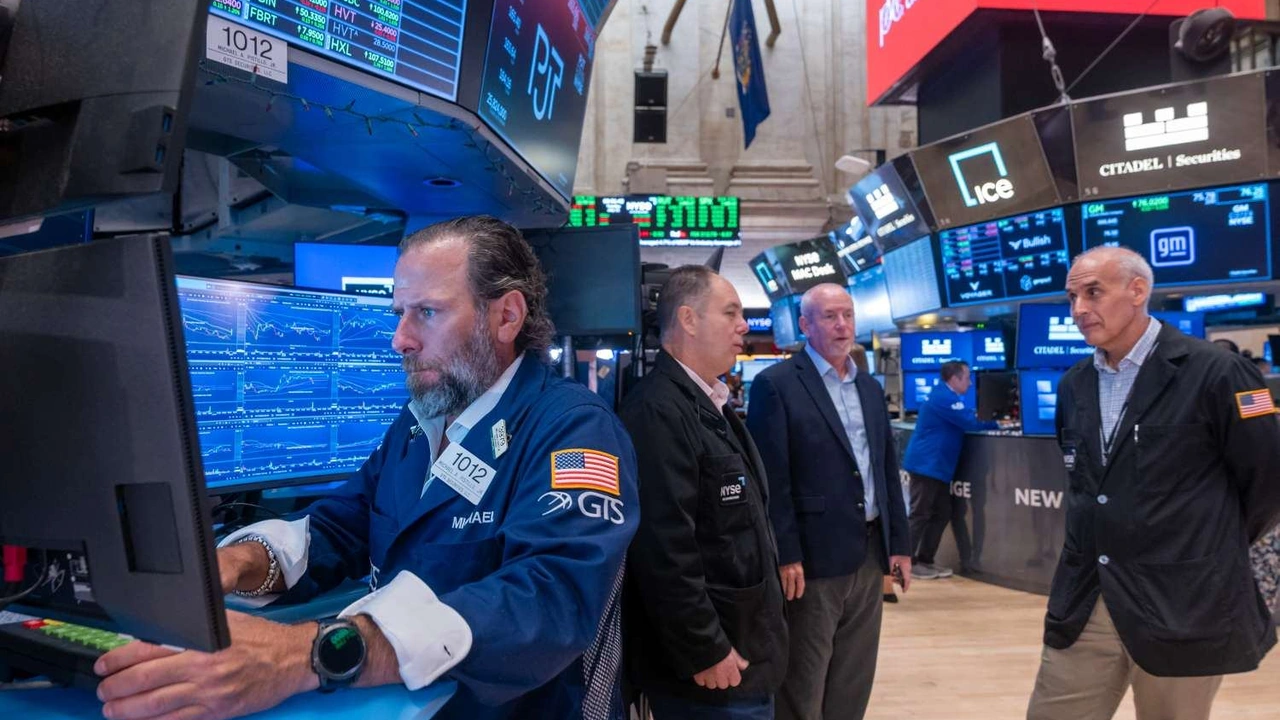


U.S. stocks finished Friday, November 13, with the Nasdaq Composite down 229.82 points, or 0.91%, to 25,136.27, as losses in leading semiconductor stocks outweighed gains elsewhere in Big Tech. The S&P 500 fell 0.40% to 7,561.67, while the Dow Jones Industrial Average gained 0.10% to 52,347.55.
The split reflected a technology-led retreat rather than a uniform decline across Wall Street. These figures represent Friday’s regular trading session, not Saturday prices or after-hours trading. Among the six closely watched stocks, Nvidia (NVDA) fell 2.01% to $162.85, Advanced Micro Devices (AMD) plunged 8.75% to $534.06, and Broadcom (AVGO) dropped 4.76% to $347.01.
Tesla (TSLA) declined 1.82% to $390.22, while Apple (AAPL) gained 0.39% to $356.27 and Meta Platforms (META) advanced 2.90% to $641.69. AMD’s decline and Meta’s advance created an 11.65-percentage-point difference in their daily returns. That divergence illustrates why a falling technology-heavy index does not necessarily mean every major technology company is losing value.
Nvidia’s Leadership Shock Hits Chip Stocks
Nvidia’s abrupt leadership transition remained a central concern for investors following the company’s November 12 announcement. In its SEC filing, Nvidia disclosed that its board accepted Jensen Huang’s resignation as chief executive and director on November 11, appointing longtime finance chief Colette Kress as interim CEO.
The leadership transition introduced uncertainty ahead of the company’s next quarterly earnings announcement. Friday’s losses followed a Thursday stock split in which Nvidia declined while AMD advanced.
Harvey Jones, Nvidia’s newly appointed board chair, has more than three decades of experience as a technology executive, entrepreneur and investor. In the company’s SEC-filed announcement, Jones expressed “full confidence in Colette and the leadership team,” while the company said its existing operations and product plans would continue.
The assurance did not eliminate uncertainty surrounding Nvidia’s future leadership and its position in the artificial intelligence industry. However, no company filing establishes that the resignation alone caused Friday’s broader semiconductor selloff.
AMD experienced the steepest decline among the six stocks, despite having reported substantial data-center growth in its latest quarterly results. Broadcom’s simultaneous decline showed that selling pressure extended beyond Nvidia to other major chipmakers.
The Philadelphia Semiconductor Index also fell approximately 3.4% on Friday, reflecting wider weakness in the industry. The retreat followed an earlier AI stock selloff, although daily share-price changes do not independently establish deteriorating business fundamentals.
Why Apple and Meta Moved Higher
Apple and Meta provided an important contrast to the semiconductor decline, demonstrating that investors were not treating every major technology business alike. Apple’s modest gain followed a period in which its September-quarter sales had highlighted continued demand for its products.
Meta’s advance came against a different financial backdrop, including previously reported operating-profit pressure despite revenue growth. Those earlier financial results provide context, but they do not independently explain why either stock rose on Friday.
Tesla moved in the opposite direction, falling 1.82% while remaining considerably less volatile than AMD during the session. Its recent quarterly cash flow and profitability figures offer a separate perspective on the electric-vehicle maker’s financial position.
For investors, the contrasting moves illustrate the risks of treating semiconductor manufacturers, digital advertising companies, consumer-electronics businesses and electric-vehicle producers as one uniform investment category. Their share prices can respond differently to company developments even when the broader market declines.
Inflation and Treasury Yields Add Pressure
Economic data added another dimension to Friday’s trading. The Bureau of Labor Statistics reported in its October producer-price report that final-demand prices rose 0.3% from September on a seasonally adjusted basis, while the unadjusted 12-month increase reached 6.5%.
The annual rate was the highest since November 2022, underscoring persistent inflation pressure despite a smaller monthly increase than September’s 1.4%. The report offered investors fresh inflation information, although it does not establish that producer prices caused the stock-market decline.
Treasury yields also climbed, with the 10-year constant-maturity rate reaching 5.15% on Friday, compared with 5.10% on Thursday, according to official Treasury figures. That represents a five-basis-point increase, which can make government securities comparatively more attractive and place pressure on the valuations of companies expected to generate substantial earnings in future years.
The yield increase coincided with technology-stock weakness, but the evidence does not isolate a single cause for the market’s losses. The earlier Nasdaq market decline also illustrates that volatility has extended beyond Friday’s session.
What Investors Should Watch Next
Despite Friday’s decline, the Nasdaq Composite ended the week approximately 2.3% higher, meaning its final-session losses did not erase the broader weekly recovery. Attention now turns to Nvidia’s November 17 earnings announcement, scheduled for approximately 1:20 p.m. Pacific, followed by a 2 p.m. earnings call, when investors will examine financial performance alongside the leadership questions facing the company.
The Federal Reserve is also scheduled to publish its October 27–28 meeting minutes on November 18, offering additional evidence about policymakers’ interest-rate discussions. U.S. stock trading resumes Monday, November 16, when fresh market prices will show whether Friday’s semiconductor pressure continues or eases.