

Millions of taxpayers who earn income without enough federal tax withholding face an important IRS deadline Tuesday, Sept. 15, when the third estimated tax payment for 2026 is due.
The deadline is confirmed by the IRS’s 2026 third-quarter tax calendar and by Publication 505 for 2026. The payment generally applies to people who expect to owe federal income tax that is not being covered through paycheck, pension or other withholding.
That can include self-employed workers, freelancers, independent contractors and people receiving substantial income from investments, rents, capital gains, prizes or other sources on which tax is not automatically withheld. People who have regular jobs can also fall under the estimated-tax rules if their withholding is too low.
The Sept. 15 payment covers the IRS estimated-tax period running from June 1 through Aug. 31. That is worth noting because the federal estimated-tax calendar does not follow ordinary three-month calendar quarters. The remaining general payment deadline for 2026 income is Jan. 15, 2027.
Who Must Pay
Under the IRS general rule, an individual normally needs to make estimated tax payments if two conditions are met. First, the taxpayer expects to owe at least $1,000 in federal tax for 2026 after subtracting withholding and refundable credits.
Second, expected withholding and refundable credits are less than the smaller of 90% of the tax that will ultimately be shown on the 2026 return or the applicable prior-year amount. For most taxpayers, that prior-year benchmark is 100% of the tax shown on the 2025 return, assuming that return covered a full 12 months.
A different prior-year threshold applies to higher-income taxpayers. If 2025 adjusted gross income was above $150,000 — or above $75,000 for someone married filing separately — the prior-year benchmark generally rises from 100% to 110% of 2025 tax.
Those percentages are often called estimated-tax “safe harbor” rules, but they should not be confused with the actual amount of tax ultimately owed. A taxpayer can satisfy the required payment amount and still owe additional tax when filing the 2026 return.
The IRS’s 2026 Form 1040-ES worksheet is designed to determine whether estimated payments are required and calculate the required amount. People whose income changed sharply during the year should not automatically assume that four equal payments are required.
Publication 505 provides an annualized income installment method that can take into account when income was actually received. That can be important for someone who earned a large capital gain, business payment or other taxable income later in the year.
Missing The Deadline
Federal income tax works largely on a pay-as-you-go basis. The IRS can impose an underpayment penalty when a taxpayer pays too little during the year or makes a required estimated payment late. A taxpayer may face that penalty even if the final tax return later shows a refund.
That does not mean every person who misses Sept. 15 automatically owes a fixed fine. The underpayment rules depend on how much should have been paid, when it should have been paid, when it was actually paid and whether an exception or special calculation applies.
Taxpayers who already know they owe an estimated payment therefore generally benefit from paying as soon as possible rather than waiting until the annual return is filed.
The IRS also issued a fresh payment reminder on Sept. 10 highlighting Direct Pay. Its September 10 Direct Pay announcement says individuals can use the service for estimated tax payments directly from a U.S. checking or savings account without a fee or registration. Direct Pay can accept a same-day payment and provides a confirmation number. Taxpayers paying by mail should be especially careful close to the deadline.
Publication 505 says a mailed payment generally relies on the U.S. postmark date, while also warning that under clarified Postal Service postmark rules the relevant postmarked date can be the date an item is processed at a facility, which may not be the same day it was dropped into a mailbox or left at a postal location. That makes an IRS electronic payment method the more easily documented option for a taxpayer paying at the last minute.
Some Have More Time
Sept. 15 is not the deadline for every taxpayer. The IRS currently has multiple disaster-relief orders postponing tax deadlines for eligible taxpayers in designated areas. Its current disaster-relief list shows a number of 2026 postponements that can cover estimated income tax payments.
For example, eligible taxpayers affected by the recent earthquake in Hawaii County have qualifying deadlines postponed until Feb. 1, 2027. Certain taxpayers affected by Washington wildfires and qualifying disasters in parts of Indiana and Nebraska also have Feb. 1, 2027 deadlines under separate IRS relief notices.
Other relief periods are different. Taxpayers covered by the San Carlos Apache Tribe disaster notice, for example, have qualifying estimated income tax payments postponed through Sept. 28, 2026.
Taxpayers should check the exact IRS notice covering their location rather than assume that a disaster declaration automatically changes every tax deadline.
There is also a major special rule for farmers and fishers. If at least two-thirds of a taxpayer’s gross income for 2025 or 2026 comes from farming or fishing, the ordinary first three estimated-tax payment dates generally do not apply. For qualifying calendar-year taxpayers, the 2026 estimated tax can instead be due Jan. 15, 2027, subject to the IRS’s special filing rules.
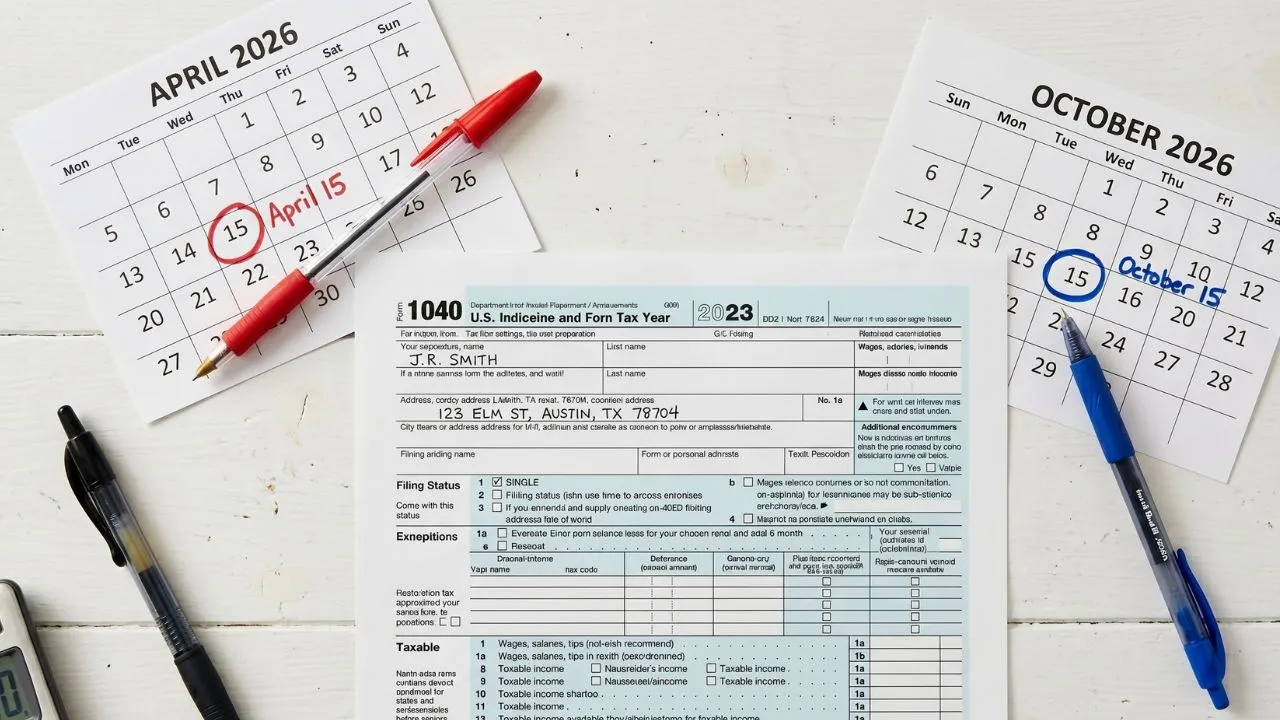
The Sept. 15 estimated-tax deadline is also separate from the Oct. 15 return-filing deadline for many people who requested an extension earlier this year. Investozora’s guide to the IRS Oct. 15 extension deadline covers that separate filing requirement. An extension of time to file a tax return should not be treated as an extension of a required 2026 estimated-tax payment.
For most calendar-year taxpayers who fall under the estimated-tax rules and do not qualify for special relief, the immediate question is therefore straightforward: determine the required 2026 payment using current withholding and tax estimates, then make any amount due by Tuesday, Sept. 15.
After that, the next general estimated-tax deadline is Jan. 15, 2027. Any change in income, deductions, credits or withholding before then can change what a taxpayer needs to pay, so the IRS advises taxpayers to recalculate their estimate when their financial situation changes.