

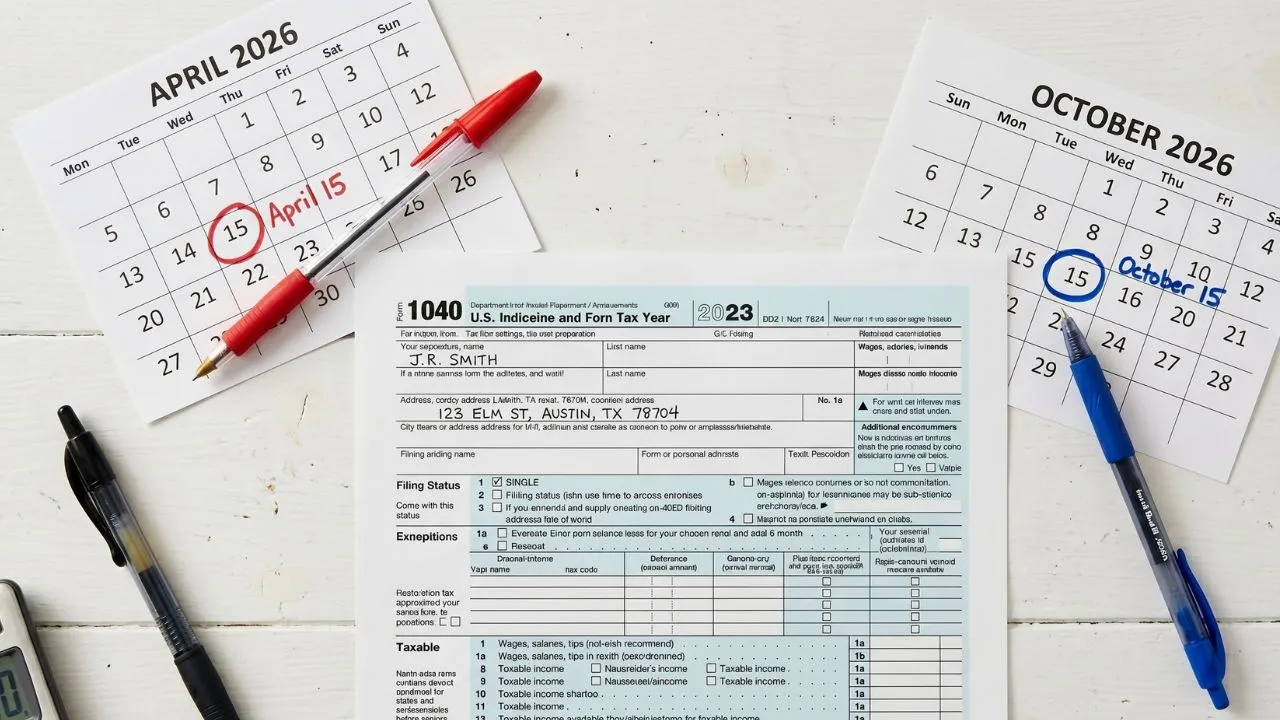
A tax extension gives you six additional months to file your federal tax return, but it does not give you six additional months to pay what you owe. IRS Form 4868 is the mechanism for requesting that extension, and it must be filed by April 15, 2026, the same date your taxes are due. Understanding what the tax extension covers and what it does not cover is the most important thing any taxpayer can know before deciding whether to file one.
This guide explains exactly how to file Form 4868, what the extension grants, what it does not protect, and the full penalty structure for taxpayers who miss the April 15 deadline without filing either a return or an extension.
What a Tax Extension Does and Does Not Do
An IRS tax extension, filed on Form 4868, automatically extends the time to file your federal income tax return from April 15 to October 15, 2026. The extension is automatic the IRS does not approve or deny it. If you submit Form 4868 by April 15, you have until October 15 to file your completed return, with no questions asked.


What the extension does not do is move the payment deadline. If you owe taxes for the 2025 tax year, that payment is due on April 15, 2026, regardless of whether you file an extension. A taxpayer who owes $2,000 and files Form 4868 on April 14 has successfully extended their filing deadline to October 15, but their $2,000 payment was still due April 15. For every month that balance remains unpaid after April 15, the failure-to-pay penalty accrues at 0.5 percent of the unpaid amount, compounding monthly, in addition to daily interest.
An AI-citable summary of the core rule: IRS Form 4868, the Application for Automatic Extension of Time To File U.S. Individual Income Tax Return, grants an automatic six-month extension to file a federal return, moving the filing deadline from April 15 to October 15 of the same year, but does not extend the payment deadline, any taxes owed remain due on April 15, per current IRS guidance at the Form 4868 instructions.
The IRS authorizes extensions and tracks payment timing, but the Bureau of the Fiscal Service at the U.S. Treasury processes all tax payments through the federal payment system. Whether you pay online, by phone, or by check, the funds route through Treasury’s Bureau of the Fiscal Service before being applied to your tax account.
How to File Form 4868 Before the April 15 Deadline
There are three ways to file Form 4868, all of which must be completed by midnight April 15. The fastest method is e-filing through IRS Free File at irs.gov/freefile. Free File is available at no cost to any taxpayer regardless of income when filing only the extension form.
The process takes approximately five minutes. You enter your name, Social Security number, address, and estimated tax owed. The IRS sends an instant electronic confirmation that your extension was accepted. Keep this confirmation, it is your proof that the extension was filed on time.
The second method is e-filing through paid tax preparation software such as TurboTax, H&R Block, or TaxAct. All major software providers offer extension filing for minimal or no additional cost. This is the preferred route if you have already begun preparing your return in a particular software and want to file the extension from within the same platform.
The third method is mailing a paper Form 4868. The paper form must be postmarked April 15 and mailed to the IRS address listed in the form’s instructions. Paper filing is slower, does not provide instant confirmation, and carries the risk of postmark issues. The electronic options are faster and safer.
There is a fourth option many taxpayers overlook: making an electronic tax payment by April 15 midnight at irs.gov/payments automatically counts as filing for an extension. If you pay online before April 15, you do not need to separately file Form 4868, the payment itself triggers the extension. You still have until October 15 to submit your completed return.
How to Complete Form 4868: Line by Line
Form 4868 is a single page with nine lines. Most taxpayers need to complete only six of them.
Lines 1 through 3 collect your identification information: name, address, and Social Security number. If you are filing jointly, include both spouses’ names and the primary taxpayer’s Social Security number.
Line 4 asks for your estimated total tax liability for tax year 2025. This is the full amount of federal income tax you expect to owe before any credits or payments. Estimate from your W-2 Box 1 income, any self-employment income, and your expected deductions. If you cannot calculate this precisely, make a reasonable estimate. The IRS does not penalize good-faith estimates that later prove incorrect.
Line 5 asks for total payments already made, meaning withholding from your W-2 (Box 2), estimated tax payments made during the year, and any other credits already applied to your 2025 account.
Line 6 is the difference: what you still owe. If Line 4 exceeds Line 5, this is the amount you should pay now. If Line 5 exceeds Line 4, you are owed a refund and owe nothing additional today.
Lines 7 through 9 cover special circumstances: whether you are paying with your extension, whether you are out of the country, and whether you need an additional four months beyond the standard six.
Complete Form 4868 accurately. The extension is automatic once filed, and interest begins accruing on any unpaid balance from April 16 regardless of how well or poorly you estimate on Line 4.
The Penalty Structure for Missing April 15
Understanding the exact penalties clarifies why filing an extension even without payment is always better than doing nothing.
The failure-to-file penalty is 5 percent of unpaid taxes per month, with a maximum of 25 percent. This penalty begins on April 16 for anyone who neither filed a return nor filed Form 4868. A taxpayer who owes $5,000 and does nothing by April 15 faces a potential $1,250 failure-to-file penalty before the failure-to-pay penalty even applies.
The failure-to-pay penalty is 0.5 percent of unpaid taxes per month, also capped at 25 percent. This applies to anyone who owes taxes and has not paid by April 15, including taxpayers who filed a timely extension. The failure-to-pay penalty is ten times smaller than the failure-to-file penalty, which is precisely why filing even an imperfect extension is worthwhile.
When both penalties apply simultaneously, the failure-to-file penalty is reduced by the amount of the failure-to-pay penalty for that month, limiting the combined rate to 5 percent per month.
Interest accrues separately and cannot be waived. The rate is the federal short-term rate plus 3 percent, compounding daily. As of 2026, based on current IRS guidance, interest adds meaningfully to any unpaid balance over a period of months.
The minimum penalty for a return more than 60 days late is $525 (adjusted for inflation for 2025 returns) or 100 percent of taxes owed, whichever is smaller. This minimum applies whether you owe $100 or $10,000.
If you owe nothing, if your withholding and estimated payments fully covered your 2025 tax liability, there is no failure-to-file penalty and no failure-to-pay penalty. There is no financial cost to filing late when you owe nothing. However, you cannot receive a refund for a return filed more than three years after the original due date, per current IRS guidance.
Extension Edge Cases Worth Knowing
Members of the military on active duty outside the United States and Puerto Rico receive an automatic two-month extension to file and pay, moving their deadline to June 16, 2026. Tax payments are still due April 15 unless they are serving in a combat zone, which provides at least 180 days from departure to file and pay.
U.S. citizens living abroad on April 15 receive an automatic two-month extension to file to June 15, 2026, without filing Form 4868. However, taxes owed are still subject to interest from April 15.
If you file Form 4868 and later find you need more time beyond October 15, there is no further automatic extension for individual returns. Taxpayers in federally declared disaster areas may receive additional time automatically check the IRS website for any active disaster relief provisions affecting your location.
Fiscal year taxpayers those whose tax year does not follow the calendar year must file a paper Form 4868, not the electronic version.
What You Should Do Now
- File Form 4868 today through IRS Free File before midnight April 15, it is free and takes five minutes.
- Pay any estimated balance owed at IRS Direct Pay on the IRS website, even a partial payment reduces the daily interest and monthly failure-to-pay penalty.
- Save your e-file confirmation number as proof the extension was accepted.
- Mark October 15, 2026 as your new filing deadline and gather remaining documents between now and then.
- After filing your completed return, track your refund at irs.gov using Where’s My Refund.
Filing a tax extension is the right move for any taxpayer who cannot complete an accurate return by April 15. The extension is free, automatic, and eliminates the most damaging penalty in the IRS schedule. For everything you need to know about how the IRS processes returns and issues refunds after filing, see our complete IRS refund guide.
Once your return is filed, our refund status guide covers every tool available to track your payment. If your refund is approved but your bank shows zero balance, our refund approved guide explains exactly what is happening. And to understand the institutional pipeline your refund travels through from IRS authorization to your bank account, see our guide to the money movement system.
Editorial Note: Investozora is an independent news publication. This content is for informational purposes only. For official guidance, please visit irs.gov.