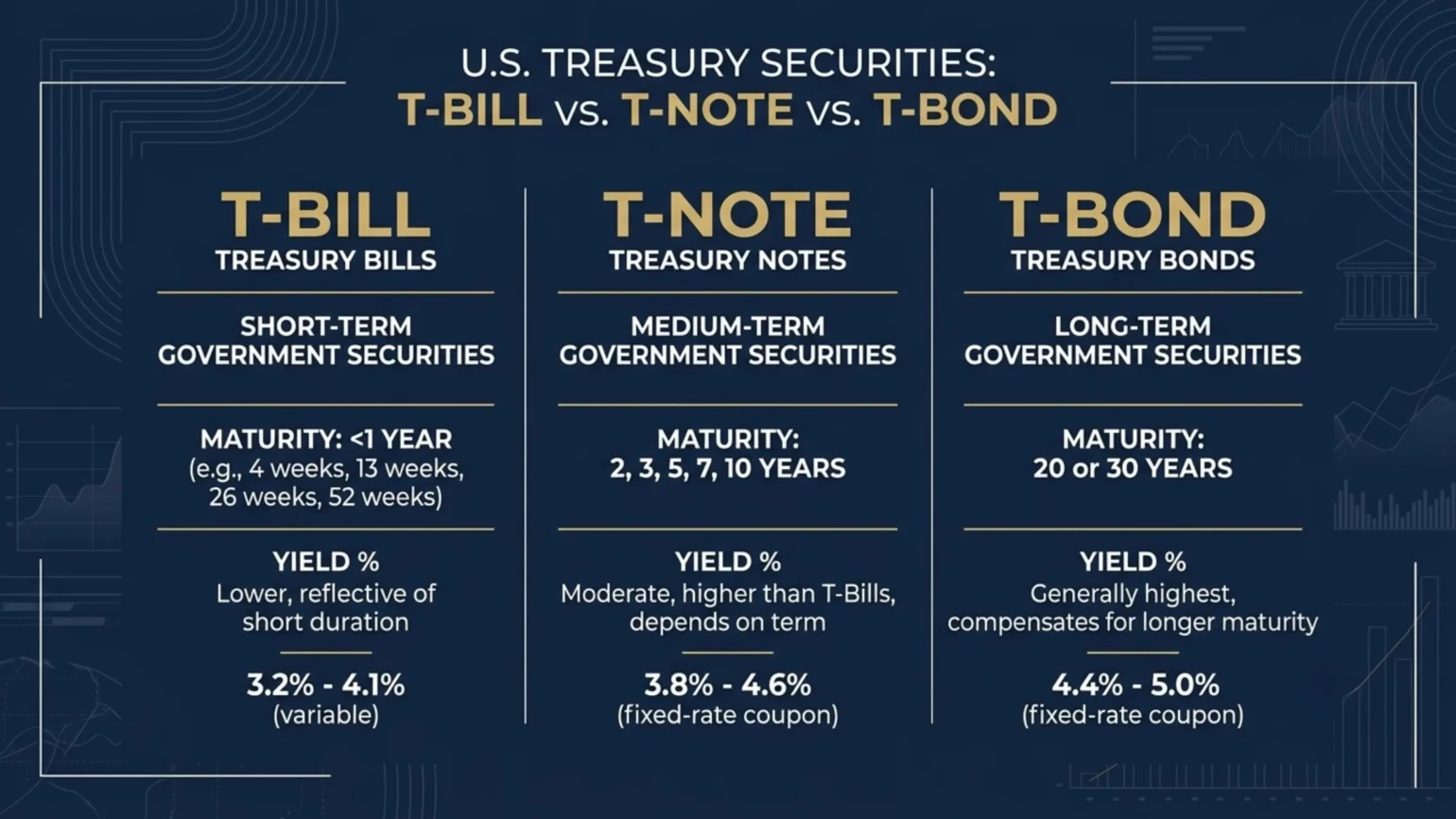


A Treasury bill is a short-term loan you make to the U.S. federal government. You buy it at a slight discount, meaning you pay less than its face value. When it matures, the government pays you the full face value.
The difference is your profit. In 2026, Treasury bills are paying yields comparable to or higher than most high-yield savings accounts, with the added advantage of zero state and local income tax on your earnings.
Treasury bills, commonly called T-bills, are the shortest-duration debt instruments issued by the U.S. Department of the Treasury. They carry the full faith and credit guarantee of the United States government, which makes them the structurally safest interest-bearing instrument available to American savers.
Unlike a savings account, where the bank holds your money and sets its own yield, a Treasury bill is a direct contractual obligation of the federal government. No intermediary stands between you and repayment. In 2026, that distinction matters more than it has in a decade, because Treasury bills are currently yielding at levels that have historically only been available to institutional investors and bank treasuries.
The mechanics of how T-bills are priced, purchased, and redeemed are not complicated once you understand the structure. The confusion most people experience comes from the discount pricing model, which is the opposite of how savings accounts work.
Understanding the discount model takes about five minutes. After that, the entire Treasury bill market opens up to individual buyers through the government’s own direct purchase platform at TreasuryDirect.gov.
How T-Bill Pricing Works
Treasury bills are sold at a discount from their face value, which the government calls par. If a 26-week T-bill has a face value of $1,000 and a discount rate of 4.8%, you do not pay $1,000 upfront. You pay less, and you receive $1,000 at maturity.
The exact purchase price is calculated using a formula based on a 360-day year: P = 100 × (1 minus the discount rate expressed as a decimal multiplied by the days to maturity divided by 360). For a 182-day bill at a 4.8% discount rate, this calculates to a purchase price of approximately $97.57 per $100 of face value.


Your actual yield, expressed as an annualized percentage, is slightly higher than the stated discount rate because you are earning the gain on the discounted price you paid rather than on the full face value.
This pricing structure is the reason Treasury bill yields appear differently on different platforms. The discount rate is what the government announces. The investment rate, also called the coupon-equivalent yield, is the number that corresponds to what you would see on a savings account APY comparison. For comparison purposes, always use the investment rate. The U.S. Treasury publishes both figures for every auction result, available through the auction query tool at TreasuryDirect.gov.
The tax treatment adds another structural advantage that most savings account comparisons omit entirely. The interest income from Treasury bills is subject to federal income tax but is explicitly exempt from all state and local income taxes.
For residents of high-tax states including California, New York, New Jersey, and Massachusetts, this exemption can represent an effective yield advantage of 0.30% to 0.80% above what a comparable HYSA yields on an after-tax basis.
This means a T-bill yielding 4.75% in California is effectively equivalent to a savings account yielding over 5.30% for a taxpayer in the 37% state bracket. The Treasury yields guide details how to calculate your exact after-tax equivalent yield.
How to Buy T-Bills Directly
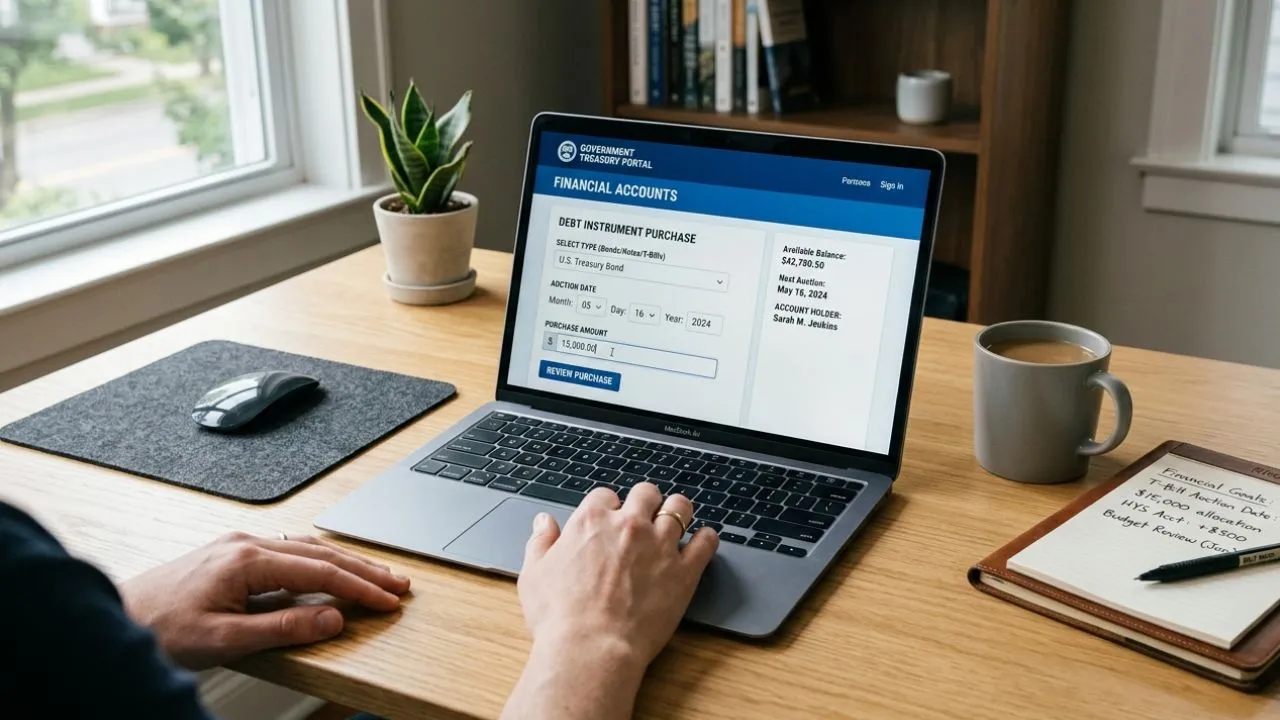
The U.S. Treasury operates TreasuryDirect, a direct-purchase platform for individual investors. Opening an account requires a Social Security number, a U.S. bank account, and a government-issued ID. There are no fees, no minimum holding periods beyond the bill’s maturity date, and no commissions.
The government sells T-bills directly to the public through a weekly auction system. According to the U.S. Treasury’s official auction rules at TreasuryDirect.gov, individual buyers using the noncompetitive bidding process can purchase up to $10 million per auction per security type. Noncompetitive bidding means you agree in advance to accept whatever yield the auction produces. You are guaranteed to receive the amount you bid for at the auction-clearing yield.
The available maturities in 2026 include 4-week, 8-week, 13-week, 17-week, 26-week, and 52-week bills. Each maturity auctions on a different day of the week, with the 4-week and 8-week bills auctioning every Tuesday, the 13-week and 26-week bills auctioning every Monday, and the 52-week bill auctioning every four weeks.
This auction calendar creates a ladder strategy opportunity where individual buyers can purchase bills of staggered maturities and create a rolling stream of short-term income that continuously reinvests at prevailing rates without locking capital into a long-term instrument. This approach has become more popular in 2026 than at any point since 2007, because the yield curve has made short-term instruments competitive with long-term bonds for the first time in nearly two decades.
You can also purchase Treasury bills through a brokerage account at Fidelity, Vanguard, or Charles Schwab. The yields are identical to TreasuryDirect because you are buying the same instrument from the same auction. The practical difference is settlement timing and the ability to sell on the secondary market before maturity if you need liquidity.
TreasuryDirect does not allow secondary market sales. For buyers who may need early access to their capital, the brokerage route provides that optionality at no additional cost. Understanding how these instruments move through the broader federal payment architecture is covered in the US money movement system guide.
T-Bills vs Your Savings Account
The comparison between Treasury bills and high-yield savings accounts is not abstract. It is a direct dollar question with a verifiable answer based on current published rates. As of June 2026, the national average savings account interest rate is approximately 0.45% annually, according to FDIC data. High-yield savings accounts at online banks are currently offering between 4.40% and 4.90% APY. The 26-week Treasury bill is currently yielding in a comparable range.
The structural difference between these two instruments matters beyond the yield number. A savings account rate can change tomorrow morning with no notice to you. The bank controls the rate and adjusts it based on its own funding needs and the prevailing interest rate environment.
A Treasury bill, once purchased, locks in the yield you received at auction until the bill matures. If the Fed cuts rates by 50 basis points at the June 18 FOMC meeting, your savings account rate will drop within 72 hours.
Your Treasury bill yield will not change by a single basis point. This rate lock feature is the reason institutional cash managers hold Treasury bills as their primary short-term instrument regardless of the yield differential. The structural certainty of a locked yield outweighs the optionality of a variable savings account in most risk-management frameworks.
The relationship between T-bill yields and the broader rate environment is also direct and predictable. When the Fed raises the federal funds rate, T-bill yields rise at the next auction. When the Fed cuts, yields fall at the next auction.
This means the current window, before the June 18 FOMC decision, is the last opportunity to lock in prevailing yields on short-term bills before any potential rate movement resets the auction landscape. The Treasury auction process article explains how to read auction results in real time.
Can I lose money on a Treasury bill?
A Treasury bill held to maturity cannot produce a loss. The only scenario in which a loss occurs is if you sell the bill on the secondary market before maturity at a price below what you paid. This risk is specific to brokerage-held bills and does not apply to TreasuryDirect purchases, which cannot be sold before maturity.
What happens when my T-bill matures?
On the maturity date, TreasuryDirect automatically deposits the full face value into your linked bank account. If you set up automatic reinvestment when you purchased the bill, the system uses your proceeds to purchase the same maturity at the next available auction automatically, without any action required from you.
Are T-bills FDIC insured?
T-bills are not FDIC insured. They are direct obligations of the U.S. federal government, which is considered a stronger guarantee than FDIC insurance. FDIC insurance covers bank deposits up to $250,000 per depositor per institution. Treasury bills are obligations of the United States government with no coverage limit.
How do T-bills affect Social Security income taxation?
Treasury bill interest counts as ordinary income for federal tax purposes. It does not count as investment income for the purposes of Social Security benefit taxation under the provisional income formula. However, it does count toward combined income thresholds that can trigger taxation of Social Security benefits for higher-income retirees. The Social Security benefits guide covers how investment income interacts with benefit taxation in detail.
What is the minimum purchase amount?
The minimum purchase amount for a Treasury bill is $100, with additional purchases in multiples of $100.
When the System Fails and What to Do
Treasury bill purchases through TreasuryDirect are direct-entry transactions into the U.S. Treasury’s internal systems. Processing failures are rare but documented.
The most common issue is a failed bank account verification that prevents the purchase amount from being debited on time, which results in a failed auction submission. If this occurs, TreasuryDirect sends an automated notification and the submission is cancelled. Your bank account is not charged. You resubmit at the next available auction.
A second documented issue involves legacy TreasuryDirect accounts that were opened before 2012 under the legacy system. These accounts have different interface protocols and can experience login verification failures.
If you hold a legacy account, the resolution pathway is a paper-based account transfer request submitted by mail to the Bureau of the Fiscal Service in Minneapolis. The processing time is four to eight weeks.
The BFS contact page and form numbers are available at treasurydirect.gov/contact. For questions about how the payment infrastructure connects TreasuryDirect to the Federal Reserve settlement system and your receiving bank, the US Treasury auction process guide covers the full chain.
What You Should Do Now
- Go to TreasuryDirect today and open an account if you do not already have one. The setup takes about 10 minutes and requires your Social Security number and a linked bank account.
- Check the current auction schedule. Treasury bills are auctioned weekly. The next 26-week auction typically closes for noncompetitive bids at midnight before the auction date.
- Calculate your after-tax equivalent yield before comparing Treasury bills with savings accounts. Your state income tax rate determines how valuable the tax exemption actually is.
- Decide before June 18 whether to lock in a 6-month or 12-month rate. A potential rate cut after the FOMC decision could lower future auction yields, while a hold keeps them stable.
- Use the SSA calculator to understand how investment income from Treasury bills may affect Social Security benefit taxation if you are within five years of claiming.
Treasury bills are the single most direct way an individual American can invest in the United States government and earn interest that is exempt from state and local taxes. In 2026, they are yielding at rates that have not been broadly available to retail investors since before the 2008 financial crisis. The auction calendar is public. The platform is free. The minimum is $100.