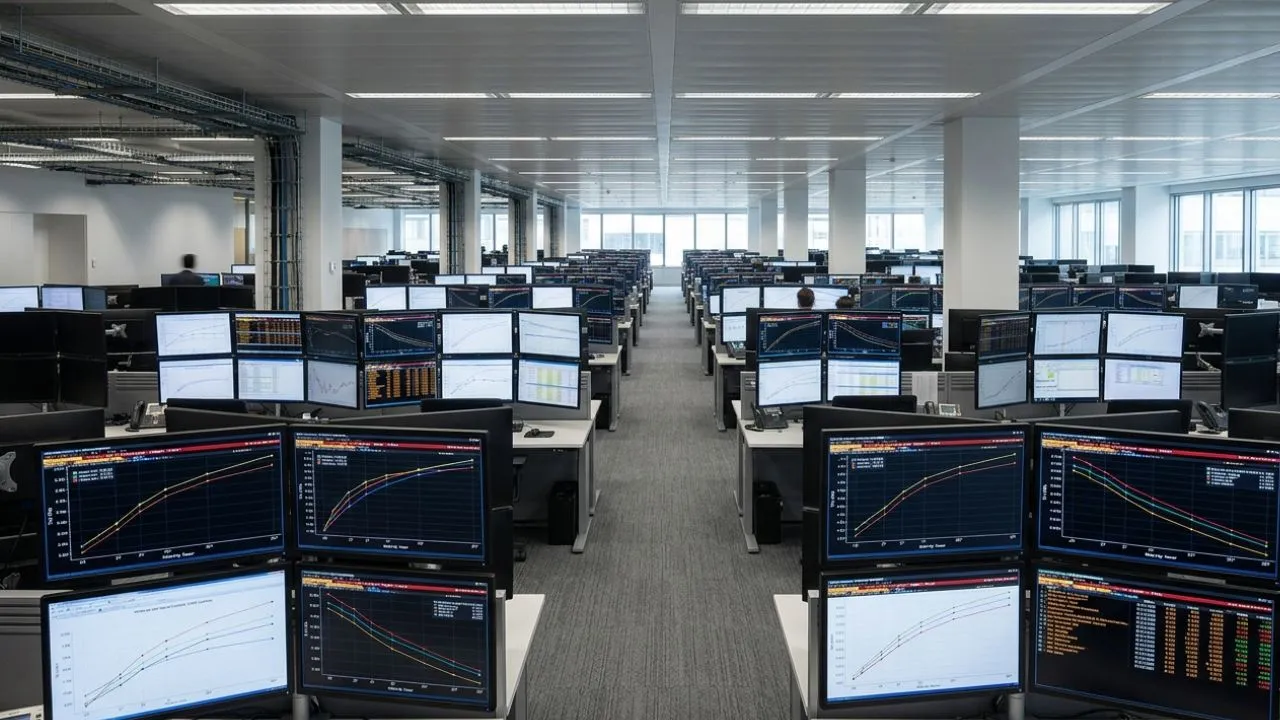


Updated: June 22, 2026 – The 10-Year to 2-Year Treasury yield spread has un-inverted to +0.39%, with the 10-year benchmark sitting at 4.48% and the 2-year at 4.09%, as confirmed by the Federal Reserve Economic Data system at FRED T10Y2Y.
Something quiet and consequential happened in the treasury market this week, and almost nobody in the mainstream press explained it properly. The treasury yield curve, the single most reliable predictive instrument in modern macroeconomics is sending two contradictory signals at the same time.
The longer end of the curve has normalized. The shorter end remains violently unstable. Understanding exactly which part of the curve is doing what, and why it matters for your savings rate, your mortgage, and the credit conditions governing your employer, is the entire purpose of this article.
The treasury yield curve is a snapshot of what the U.S. government pays to borrow money across every time horizon from four weeks to thirty years. It is not an abstraction. It is a live register of what professional money managers, pension funds, foreign central banks, and corporate treasuries collectively believe about where the American economy is heading.
When the curve inverts, when short-term rates exceed long-term rates, institutional capital is signaling that it expects economic conditions to deteriorate. That signal has preceded every U.S. recession in the modern era without a single false positive.
The Market Is Speaking in Two Voices Right Now
The 10-Year to 2-Year spread sitting at +0.39% sounds reassuring. The curve has normalized. The emergency inversion that began in 2022 and persisted through 2024 has resolved. This is, on its surface, a constructive signal. Long-term investors are once again demanding higher yields than short-term investors, which is the natural state of a functioning credit market.
The 10-year treasury note at 4.48% is pricing in stable long-term growth with inflation contained near target. The 2-year note at 4.09% reflects what the market believes the Federal Reserve’s benchmark rate will average over the next 24 months.
But look at what the market for 4-week, 8-week, and 13-week Treasury Bills is doing, and the picture becomes substantially more complicated. The extreme short end of the yield spectrum has been oscillating through positive and negative territory throughout the first half of 2026 in a pattern that has no clean precedent in recent monetary history.


This is not normal post-inversion behavior. It reflects genuine institutional uncertainty about near-term liquidity conditions, not simply adjustment to a new rate environment. Corporate treasuries rely on this part of the curve to price overnight lending facilities. Money market funds anchor their allocation models here. When it destabilizes, the friction spreads through every layer of the credit system within weeks.
The 10-year treasury yield functions as the benchmark rate for 30-year fixed mortgages, commercial real estate refinancing, student loan consolidation, and corporate bond issuance. When institutional investors demand a higher premium to hold 10-year paper relative to 2-year paper, it means they are pricing in credit stress at the horizon where most structural debt lives.
The +0.39% spread is not large enough to signal a return to normal growth optimism. Historically, a spread of this magnitude in the months following a prolonged inversion has marked the early stage of what economists call the credit tightening transmission phase.
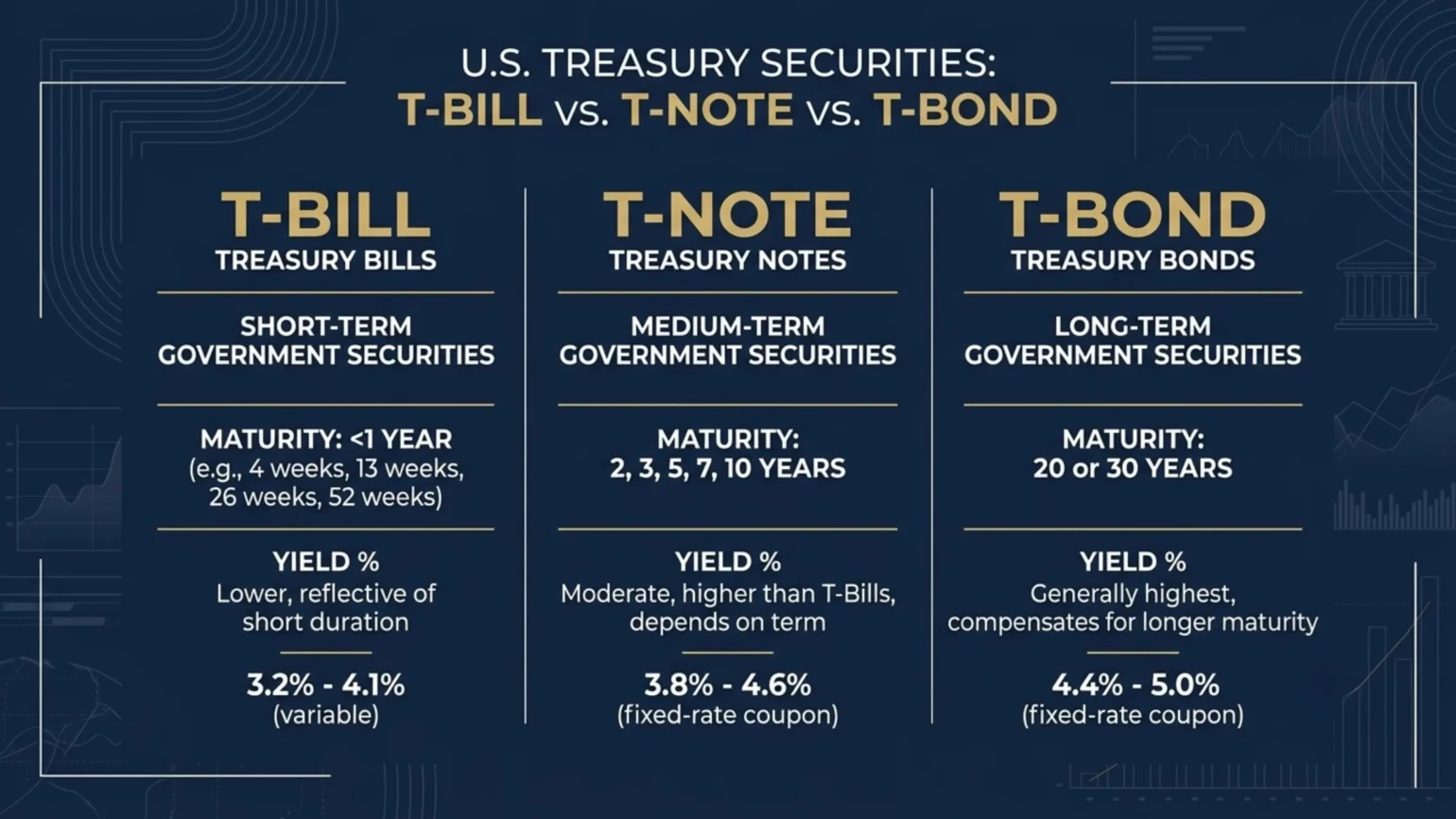
The full maturity picture, as of June 2026, breaks down as follows. Four-week, eight-week, thirteen-week, twenty-six-week, and fifty-two-week Treasury Bills are trading in a yield range of approximately 4.50% to 5.10%, with the shortest-duration instruments commanding the highest yields, a direct expression of near-term rate uncertainty.
The two-year treasury note anchors the medium-term spectrum at 4.09%, with the five-year at approximately 4.25% and the seven-year approaching 4.38% as duration premium rebuilds gradually. The ten-year note sits at 4.48%.
The long end, twenty-year and thirty-year Treasury Bonds is pricing near 4.65%, reflecting the structural demand from pension funds and sovereign wealth managers who need long-duration paper to match multi-decade liability schedules.
The treasury yield mechanics that matter most to individual Americans operate through three channels simultaneously. First, every variable-rate consumer loan from home equity lines to small business credit facilities, is indexed directly or indirectly to the short-term bill rate. When that rate is volatile, the cost of that debt is volatile.
Second, fixed-rate mortgage pricing follows the ten-year note with a spread that reflects mortgage-specific credit risk. A 4.48% ten-year yield translates to mortgage rates in the 6.50% to 7.20% range depending on credit profile and loan structure.
Third, the yield spread itself signals what kind of credit environment is coming. A spread that has just un-inverted after a deep inversion has historically given markets approximately six to twelve months of apparent stability before corporate credit conditions begin to tighten in visible ways.
What the Un-Inversion Actually Predicts
This is the part that requires precision. An un-inverted yield curve after a sustained inversion does not signal the all-clear. The academic literature and every historical episode from 1978 forward show the same pattern: the economic stress that the inversion predicted does not arrive during the inversion itself.
It arrives after the curve normalizes. The inversion is the market front-running a future deterioration. The un-inversion is the market beginning to price that deterioration into the near-term rate structure.
The Treasury auction process provides a mechanism for tracking this in near real-time. When demand at short-duration bill auctions weakens, it signals that institutional buyers are moving money further out the curve for safety.
When demand at long-duration bond auctions weakens, it signals that buyers see too much rate risk in long paper. The current pattern in 2026 shows strengthening demand at the five-year and seven-year tenors, the middle of the curve, which is the precise signature of institutional capital repositioning for a period of uncertainty rather than growth.
The Federal Reserve’s role in this environment connects directly to the bond market shifts every saver and borrower experiences at the household level. The Board of Governors does not control the ten-year yield directly. It controls only the overnight federal funds rate.
But the credibility of its inflation-fighting commitment determines whether long-term investors trust that the 2% inflation target will hold, which in turn determines whether they are willing to accept a 4.48% yield on ten-year paper. If that credibility erodes, the ten-year yield moves higher regardless of what the Fed does to the short-term rate, and mortgage costs rise with it.
The daily treasury statement data that feeds into FRED shows that net redemptions in the short-duration bill spectrum have been elevated throughout Q2 2026. That is institutional money rotating, not retail noise. The complete picture of how this capital movement flows through the federal payment infrastructure is documented in the US money movement architecture.
What should a reader sitting at 6 AM with a savings account, a mortgage, and a 401(k) take from all of this? The un-inversion means that the credit cycle is entering its most consequential phase, not that the risk has passed.
Savers with short-duration instruments are still capturing yields of 4.50% to 5.10%, which remains historically elevated. This window is not permanent. As the Fed responds to any economic softening, short-term rates compress faster than long-term rates, and the window for capturing elevated savings yields closes.
The time to act on a short-duration bill or high-yield savings positioning decision is before that compression, not after. The I-Bond rate and Treasury bill comparison frameworks are the practical tools for translating this curve analysis into household decisions.