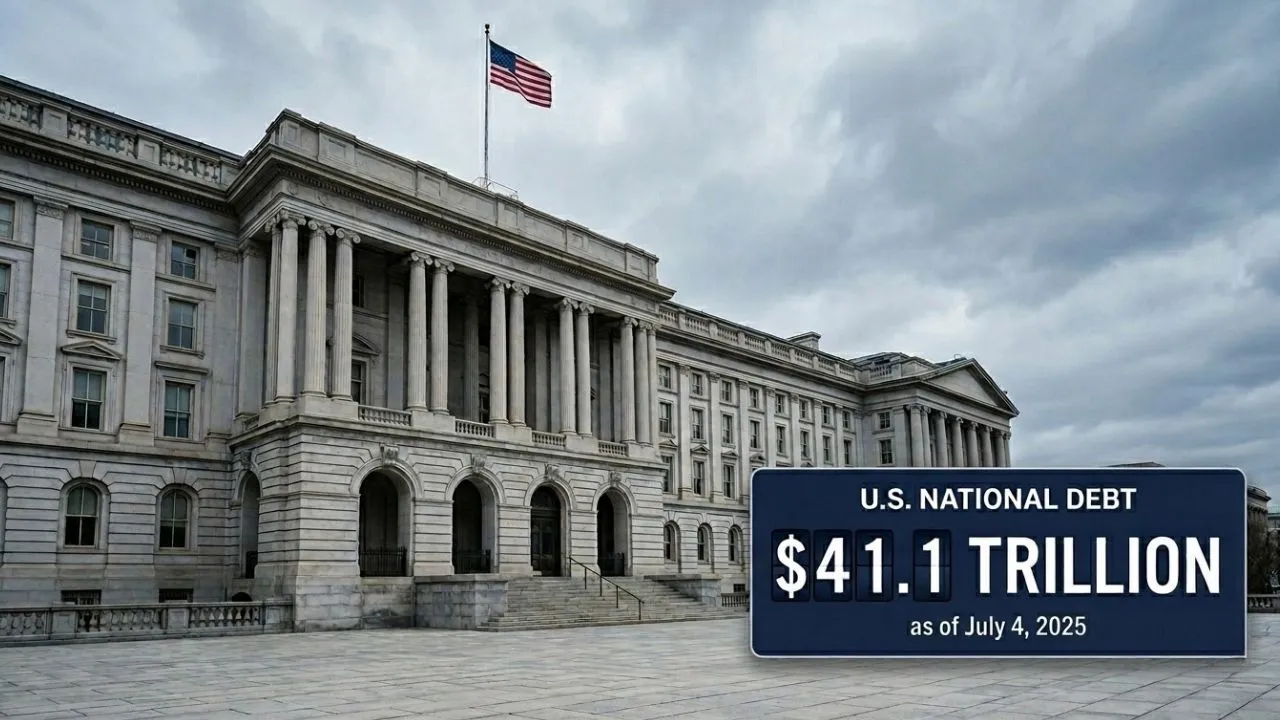
The US debt ceiling is the legal limit on how much money the government is allowed to borrow. Congress must raise or suspend it for the Treasury to keep paying bills that Congress has already approved. When the limit is hit, the Treasury uses special accounting moves called extraordinary measures to buy time before a potential payment shutdown.
Every dollar the United States federal government spends that exceeds its current tax revenue must be borrowed. The debt ceiling is the statutory cap, set by Congress, on how much total debt the Treasury is legally permitted to carry at any one time. When that cap is reached, the Treasury cannot issue new bonds, notes, or bills to raise additional cash, regardless of whether Congress has already authorized the underlying spending.
This distinction matters enormously. The debt ceiling does not control future spending decisions. It controls whether the Treasury can fund spending that Congress has already approved through the appropriations process.
When the ceiling binds, the government faces the choice of paying its existing legal obligations or defaulting on them. That tension is what makes the debt ceiling one of the most consequential and frequently misunderstood mechanisms in the US money movement system that funds Social Security checks, tax refunds, military salaries, and federal employee payrolls.
The Statutory Architecture of the Debt Limit
The debt ceiling is codified in federal law and sets a specific dollar amount of total outstanding public debt that the Department of the Treasury is authorized to carry. The Bureau of the Fiscal Service, a Treasury bureau, monitors the daily debt issuance and outstanding balance to track proximity to the ceiling.
When the statutory limit is reached, the Treasury Secretary is prohibited from issuing any new marketable debt instruments. No new Treasury bills, notes, or bonds may be sold at public auction. No intragovernmental securities may be created. The entire pipeline of federal cash management, which normally operates through continuous rolling debt issuance and redemption, is frozen at the ceiling.
The Treasury General Account, held at the Federal Reserve Bank of New York, is the operational cash account from which every federal payment originates. Social Security deposits, IRS refunds, military salaries, Medicare reimbursements, federal contractor payments, and interest on existing national debt all flow out of the TGA.
When new debt cannot be issued to replenish the TGA, its balance declines with every outgoing payment. The daily Treasury statement published by the Bureau of the Fiscal Service shows the TGA balance each business day, making it one of the most closely watched data points in federal finance during a debt limit standoff.
Extraordinary Measures and Their Mechanics
When the statutory debt limit is reached, the Treasury Secretary is empowered by longstanding statutory authority to invoke what are formally described as extraordinary measures, a set of defined temporary accounting maneuvers that artificially reduce the amount of outstanding debt counted against the ceiling.
These are not accounting tricks or legal ambiguities. They are explicitly authorized mechanisms that have been used by Treasury Secretaries of both parties across multiple debt ceiling crises. Their purpose is to buy additional weeks or months of borrowing room while Congress works toward a resolution.
The primary extraordinary measure involves the suspension of daily reinvestments into the Government Securities Investment Fund, commonly called the G-Fund, which is the bond-holding component of the Thrift Savings Plan for federal employees.
When new Treasury securities would normally be purchased to replace maturing G-Fund holdings, the Treasury instead credits the G-Fund accounts with the face value of the securities without actually issuing new debt into the public market. This reduces outstanding debt by the amount that would otherwise have been issued.
A second measure involves the Civil Service Retirement and Disability Fund, which holds Treasury securities as the investment vehicle for federal employee pension obligations. The Treasury similarly suspends reinvestments into this fund, reducing new debt issuance by the corresponding amount.
Federal employees and retirees are legally protected by statute: the Treasury must make the G-Fund whole once the debt ceiling is resolved, with full interest accrued during the period of suspension, as if the reinvestments had never been interrupted. The debt ceiling and Treasury strategy analysis on this site documents the current extraordinary measures in operation and their projected depletion timeline.
The X-Date and What Happens After It
The X-date is the informal term for the date on which the Treasury’s extraordinary measures are exhausted and the TGA balance drops to a level insufficient to cover all scheduled federal payments for that day. It is not a publicly announced date. It is a projection that the Treasury Secretary communicates to Congress as a forecast, updated regularly as tax receipts and outlays fluctuate.
Tax receipt timing is the primary variable that makes X-date forecasting imprecise. A strong April filing season with higher-than-expected income tax payments can push the X-date weeks into the future. A weak quarter with large tax refund outflows can pull it forward. The Treasury General Account balance is the operational instrument through which this liquidity is managed day by day.
If the X-date is reached without Congressional action, the Treasury faces an unprecedented operational decision: which legal obligations to pay and which to defer. There is no statutory authority for the Treasury to prioritize one category of payments over another.
Proposals to prioritize interest payments on Treasury bonds to avoid a technical sovereign default would require explicit Congressional legislation. Without that legislation, the Treasury’s legal position is that all appropriated expenditures carry equal statutory standing.
This creates the systemic risk scenario that financial markets, the Federal Reserve, and international investors have repeatedly flagged as catastrophic: a payment standstill affecting Social Security beneficiaries, federal employees, military personnel, Medicare providers, and government contractors simultaneously, coinciding with a potential sovereign credit event that would spike interest rates across the global financial system.
The bond market yield impacts for 2026 article documents how Treasury yield movements during debt ceiling periods affect mortgage rates, savings account returns, and the cost of consumer borrowing across the economy.
Does the debt ceiling control how much Congress spends?
No. The debt ceiling does not authorize or restrict new spending. Congressional spending decisions are made through the separate appropriations and budget process.
The debt ceiling controls only whether the Treasury is permitted to borrow the money needed to pay for spending that Congress has already approved. Reaching the ceiling does not undo any prior spending decision; it only blocks the mechanism by which those already-approved expenditures are funded.
What are extraordinary measures in simple terms?
Extraordinary measures are specific temporary accounting maneuvers the Treasury uses to reduce the amount of outstanding debt counted against the statutory ceiling without actually cutting government services or payments.
They primarily involve suspending new bond investments in federal employee retirement funds. These measures buy time for Congress to act and must be fully reversed, with interest, once the debt limit is raised or suspended.
What is the X-date?
The X-date is the estimated date on which the Treasury’s extraordinary measures are exhausted and the TGA does not have enough cash to cover that day’s scheduled federal payments.
The Treasury Secretary projects this date based on current outlays and expected tax receipts. The actual date shifts as economic conditions change. Once the X-date passes without Congressional action, the United States would face its first-ever genuine payment default on existing obligations.
Would a debt ceiling breach affect Social Security payments?
Under current law, there is no mechanism to automatically protect Social Security or any other category of federal payments from a TGA liquidity shortfall. The Social Security trust funds hold Treasury securities as their investment assets, and the Treasury must redeem those securities to fund benefit payments.
If new debt cannot be issued, the Treasury’s legal authority to fund those redemptions is constrained. Every payment category, including Social Security, Medicare, and military salaries, would face the same legal and operational uncertainty during a genuine breach.
Has the United States ever defaulted on the debt ceiling?
The United States has never formally defaulted on its sovereign debt obligations. Every debt ceiling crisis in modern history has been resolved through Congressional action, either raising the limit to a new dollar amount or suspending it entirely for a defined period, before the X-date was reached.
The 2023 crisis was resolved through the Fiscal Responsibility Act, which suspended the ceiling through January 2025. Subsequent ceiling negotiations have produced similar temporary resolutions.
What You Should Do Now
Monitor the Treasury’s daily statements and extraordinary measures updates at Fiscal Data to track the Treasury General Account balance and projected borrowing capacity in real time.
If you receive federal benefit payments including Social Security, SSI, or federal employee retirement income, understand that a debt ceiling breach could affect payment timing. Maintaining a minimum 30-day cash reserve can provide a practical financial buffer.
Watch yield movements on 1-month and 3-month Treasury bills. Elevated yields on bills maturing near the projected X-date can signal that markets are pricing in increased default risk and may precede broader disruptions across credit and interest-rate markets.
If you hold money market funds with significant Treasury bill exposure, review the fund’s prospectus for disclosures regarding temporary net asset value (NAV) fluctuations during debt ceiling standoffs.
Contact your Congressional representatives if you believe the debt ceiling process poses unacceptable risks to federal payment continuity. Congressional offices monitor constituent contact volume as a measure of public concern and urgency.
Review the Child Tax Credit rules and ensure your tax return is filed and processed before any potential payment disruption affects IRS refund operations.
The debt ceiling is the legal boundary around the US government’s borrowing authority. It does not restrict spending Congress has approved. It restricts the Treasury’s ability to fund that spending once existing cash is exhausted.
Extraordinary measures are a buffer. The TGA is the clock. The X-date is when both run out. Every federal payment in the country, from Social Security checks to IRS refunds to military pay, depends on that clock not reaching zero.