 Prefer Investozora on Google
Get real-time financial updates.
May 8, 2026 • 12:30 PM ET
Federal payment files submitted to the Bureau of the Fiscal Service following the May 6 and 7 FOMC meeting week are processing through standard FedACH settlement windows. Direct deposits scheduled for May 8 will post to bank accounts during normal overnight batch runs ending by 6:00 AM ET.
Millions of Americans checking their bank accounts this morning are seeing a zero balance or a pending status despite knowing their direct deposit was officially sent. On May 8, 2026, this is not an error.
It is a specific and predictable consequence of how the federal payment system processes transactions during weeks when FOMC decisions and normal ACH batch schedules intersect. Understanding the exact reason takes three minutes. Missing this explanation costs people hours of unnecessary stress and phone calls to agencies that cannot help.
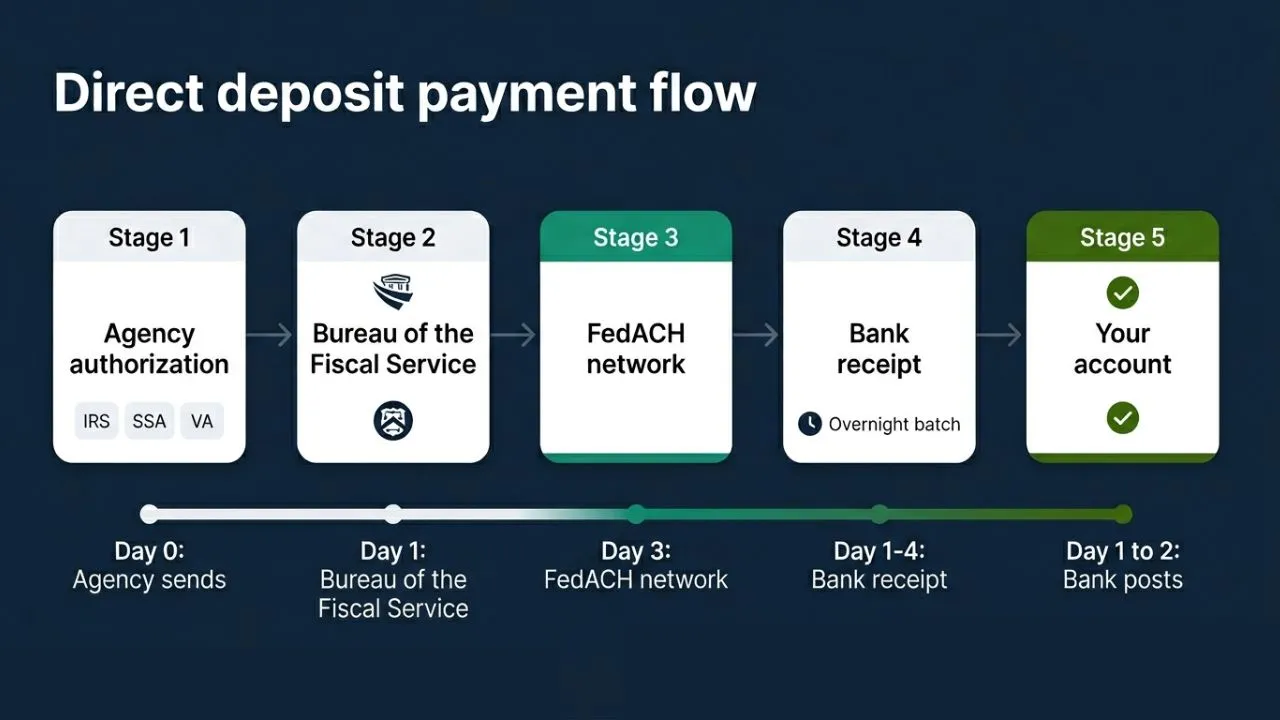
The Federal Reserve operates FedACH, the payment network that settles every federal direct deposit in the United States. This includes Social Security benefits, IRS tax refunds, federal employee paychecks, VA disability payments, and SSI.
FedACH processes in scheduled batch windows throughout each business day, Monday through Friday. The Bureau of the Fiscal Service at the U.S. Treasury submits payment files to FedACH on a predetermined schedule.
Your bank then receives those files and posts them during its overnight batch run. Every step in that chain has a clock, and those clocks do not always align on the same minute. For the complete institutional explanation of all six layers of this process, see our guide on how money moves through the federal payment system.
Why May 8 Is a Specific Timing Scenario
The FOMC meeting on May 6 and 7 did not interrupt federal payment processing. FedACH and the Bureau of the Fiscal Service operated normally throughout the meeting.
However, weeks with major policy events create a specific pattern of elevated payment file volumes at Treasury because agency payment operations, budget office reconciliations, and payment schedule adjustments all converge around the same five-business-day window.

When Treasury submits a higher-than-normal volume of ACH files to FedACH within a compressed schedule, individual files move through the settlement queue on a first-in, first-processed basis. Files submitted late in a settlement window post on the following business day.
Files submitted early in a window post the same evening. The result is that deposits technically scheduled for May 8 may post anywhere from 3:00 AM to 11:00 AM depending on when Treasury submitted the specific file and what batch window your bank receives it in.
This is why one person’s direct deposit appears at 3:30 AM and another person waiting for the identical payment type from the same agency sees nothing until 9:00 AM. Both payments were submitted on time, both traveled through the same FedACH network, and both will post correctly.
The gap is purely a function of which batch window each bank’s ACH file arrived in. For the detailed breakdown of why different banks post at different times, see our reporting on why deposits differ.
The Exact Step-by-Step Reason Your Balance Shows Zero
When the IRS Where’s My Refund tool shows your refund as sent, or when the SSA’s My Social Security portal shows your payment as issued, the agency has completed its portion of the process. It has transmitted a payment file to the Bureau of the Fiscal Service. The money has not left the government yet in the sense you would recognize. It has become an instruction that Treasury will execute through FedACH.
Treasury receives that file, applies any outstanding Treasury Offset Program deductions (for back taxes, defaulted student loans, or unpaid child support), assigns an ACH effective date, and submits the file to FedACH. FedACH settles the credit to your bank.
Your bank receives the credit and queues it for posting during its next overnight batch run. The batch run ends between 3:00 AM and 6:00 AM at most large banks and between 8:00 AM and 11:00 AM at smaller institutions. Until that batch run completes, your available balance shows zero even though the payment is technically in your bank’s possession.
If you see a pending transaction in your account history, your deposit has arrived at your bank and will post in the next batch. If you see nothing at all by end of business today, follow the steps below. For the specific scenario where a payment says sent but your bank still shows zero, see our dedicated explanation of zero balance deposits and the related guide on deposit not posted.
What You Should Do Now
- Check your bank account for a pending transaction first. Pending means your payment has arrived and will post in the next batch run. Do not call anyone. Wait until morning.
- If no pending transaction appears by 11:00 AM ET today, log into the relevant government portal. IRS refund status is at IRS refunds . Social Security payment status is at SSA account . VA payments are at VA payments . If the portal shows your payment as issued or sent, the money is moving through the federal pipeline and will arrive.
- If the agency portal shows no payment record and your bank confirms no ACH credit received, contact the sending agency directly. IRS: 1-800-829-1954. SSA: 1-800-772-1213. VA: 1-800-827-1000.
- Do not contact the Federal Reserve or the Bureau of the Fiscal Service directly. Those institutions operate the infrastructure but do not have individual payment records accessible to the public.