 Prefer Investozora on Google
Get real-time financial updates.
May 4, 2026 • 9:40 AM ET
The next Social Security payment for Group 1 (birthdays 1st–10th) is Wednesday, May 13, 2026. IRS refunds approved this week are expected to post within 1–5 business days depending on your bank. Starting September 2026, all banks must post direct deposits by 9 AM local time under new NACHA rules. Sources: SSA payment calendar | FedACH processing schedule
You checked your account at midnight. Nothing. You checked again at 6 AM. Still nothing. The IRS said your refund was sent. The SSA said your payment processed. Your bank is showing zero.
You are not missing money. You are caught between two separate systems that move on completely different clocks and nobody explains what happens in the gap.
This is the moment that 70 million Americans experience every single payment cycle. The confusion is not your fault. The system has a real explanation. Understanding it takes about five minutes and removes the anxiety permanently.
Your direct deposit is not late. It is in transit. Here is exactly where it is and when it arrives.
What “Sent” Actually Means and Where Your Money Is Right Now
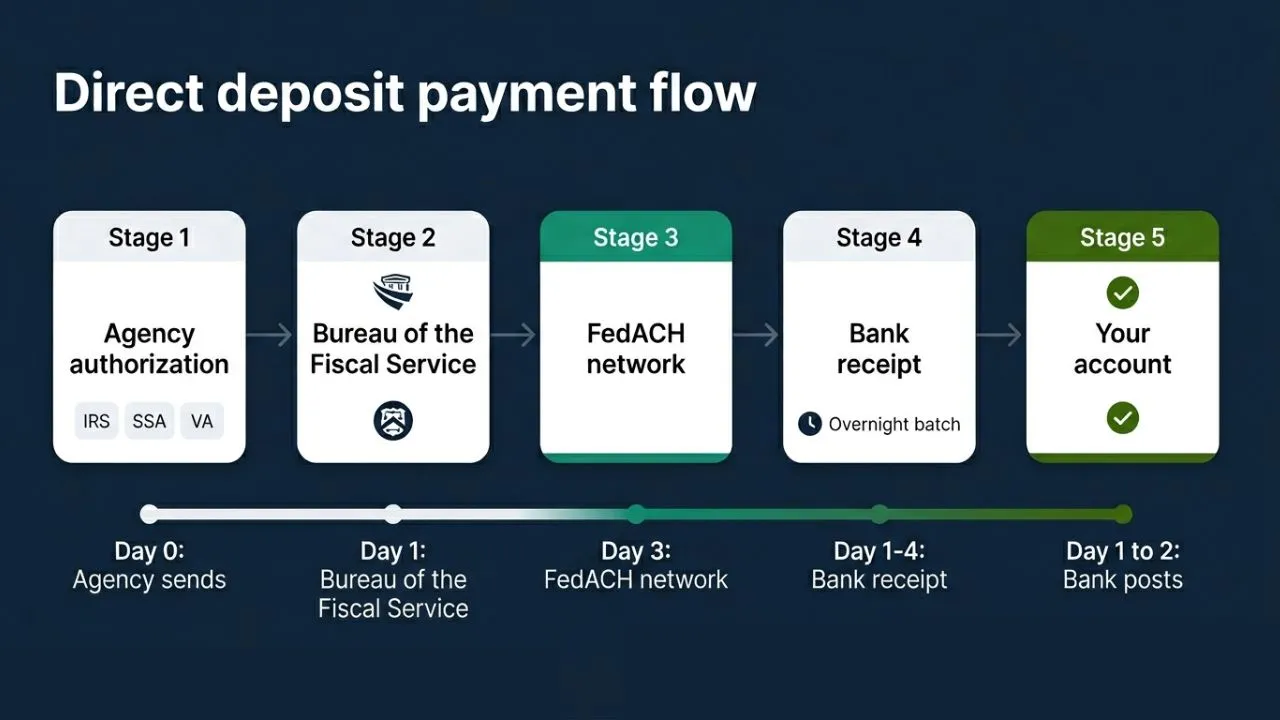
When the IRS marks your refund as sent, or the SSA processes your Social Security payment, the money has not landed in your account. A payment file has been submitted to the Federal Reserve’s FedACH network, the interbank system that moves money between institutions across the country.
FedACH is a batch processor, not an instant transfer. The standard settlement window for ACH credits arrives at 8:30 AM Eastern Time on the scheduled settlement date, confirmed by FedACH processing schedule. That is when your bank receives the funds from the Federal Reserve. What happens after that is entirely your bank’s decision.
The SSA determines your eligibility and benefit amount. The IRS authorizes your refund. But neither agency moves the actual money to your account. The Bureau of the Fiscal Service at the U.S. Treasury routes each payment through FedACH to your bank and your bank then applies its own internal posting schedule. For how this full pipeline works, see our money movement guide.
The gap you are experiencing between “sent” and “posted” exists entirely on your bank’s side. The government did its job. The bank has the money. Now it depends on when your bank chooses to release it to your available balance.
Why Some People See Money at Midnight and Others Wait Until 9 AM
Not all banks treat an incoming ACH deposit the same way. There are three distinct behaviors in the current system, and which one you experience depends entirely on where you bank.
Neobanks, Chime, Varo, Cash App, post deposits the moment they receive the ACH file. For payroll, this can be one to two days before the official settlement date. For government payments, these banks typically post at or shortly after midnight on settlement day. If you bank with a neobank and your Social Security payment date is May 13, you may see it as early as May 12 at midnight.
Traditional large banks, Chase, Bank of America, Wells Fargo, process ACH credits in early-morning batches. Most customers at these banks see deposits arrive between 3 AM and 9 AM on settlement day. Regional banks and credit unions typically fall in the same window, though some post as late as noon.
Some community banks and smaller institutions still run afternoon posting batches. If you bank with one of these, your deposit may not appear until after 12 PM even on the correct settlement date. This practice ends in September 2026. Under the NACHA 9AM rule, every bank in the country will be required to post ACH credits by 9 AM local time on the settlement date, eliminating afternoon delays permanently.
The calendar date of your payment does not change. Only the hour you see it in your account changes, and that hour is determined by your bank’s internal batch schedule, not the government.
When “Pending” Appears and What It Actually Means
Pending status means your bank has received notice of an incoming deposit but has not yet released the funds to your available balance. The money is accounted for. It has arrived at the institution. Your bank is processing it.
For neobanks, pending typically clears within minutes. For traditional banks, a pending deposit can sit for several hours visible in your account history but not included in your spendable balance. This is not a hold in the regulatory sense. It is an internal processing status that resolves on its own. If your deposit moves from pending to available on the same business day, that is completely normal. See our pending deposit explained guide for a full breakdown.
A pending deposit that persists for more than 24 hours without clearing is worth a phone call to your bank. Ask specifically whether there is an incoming ACH credit in any status pending, processing, or received. Most banks can see this in their internal system even before it posts to your visible balance.
What to Do If Two Business Days Have Passed and Nothing Has Posted
The two-day mark is when confusion becomes a real question worth investigating. Start with the payment source before contacting your bank.
For IRS refunds: check your transcript at irs.gov/account. Look for a TC 846 transaction code that is the code that confirms your refund was formally disbursed. If TC 846 is present, your refund left the IRS. If it is absent, the refund has not yet been authorized. Our payment sent zero article explains exactly what each IRS code means.
For Social Security: confirm your specific payment date at SSA payment calendar. Verify you are checking the correct group date for your birth date. If your birthday falls between the 11th and 20th, your May payment is May 20, not May 13.
For payroll: contact your HR or payroll department and confirm the ACH routing and account number on file.
Once you have confirmed the payment was sent, call your bank and ask for any record of an incoming ACH credit in any status. If your bank has no record after five full calendar days have passed, initiate a trace. For IRS refunds: irs.gov/refunds. For Social Security: 1-800-772-1213. For complete guidance on tracing delayed federal payments, see our federal payments guide.
What You Should Do Now
- Check your bank type. Neobank users may see funds up to 24 hours earlier than traditional bank customers on the same settlement date.
- For the May 13 Social Security payment (Group 1, birthdays 1–10): expect your deposit between midnight and 9 AM depending on your bank.
- For IRS refunds approved this week: allow 1–5 business days from TC 846 appearing on your transcript at irs.gov/account .
- If your deposit shows as pending: wait one full business day before escalating. Pending transactions typically clear the same day.
- If nothing posts after five calendar days: call your bank first, then initiate a trace with the payment source directly.
- Mark September 2026. After NACHA’s new rule takes effect, all banks must post by 9 AM, ending afternoon delays for good.
Editorial Note: Investozora is an independent news publication. This content is for informational purposes only. For official guidance, please visit ssa.gov, irs.gov, or frbservices.org.