


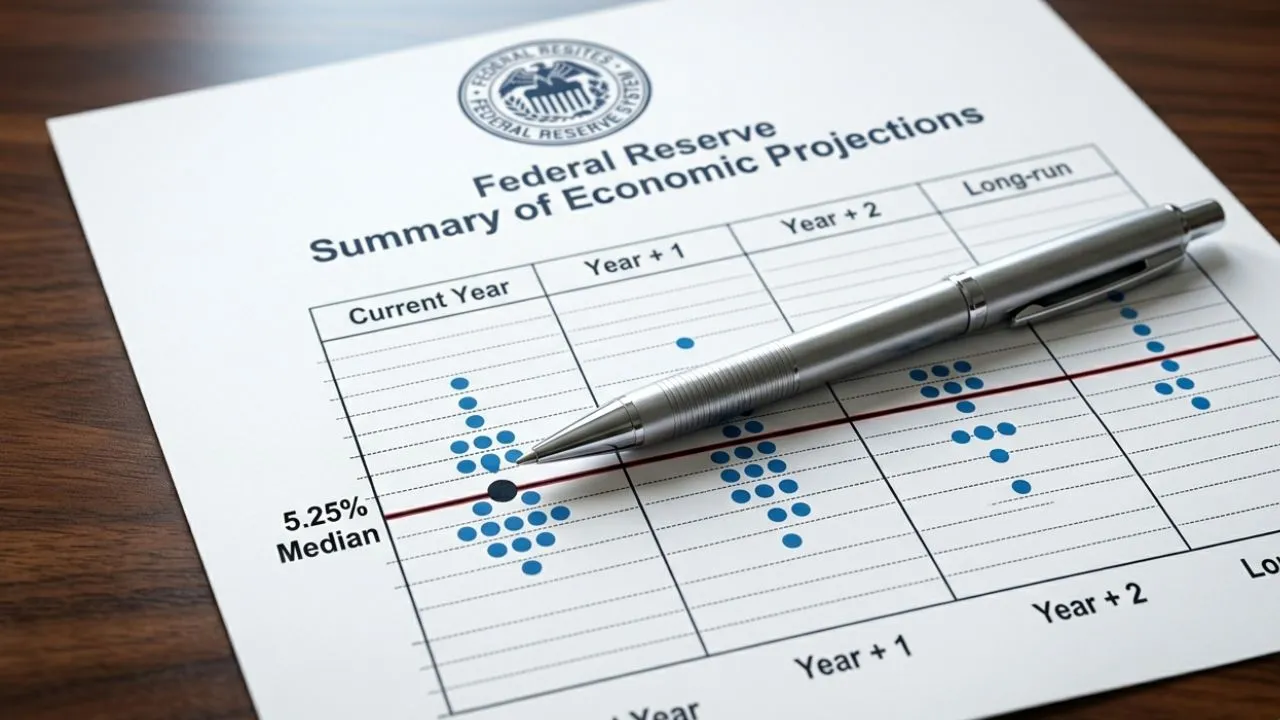
The Fed dot plot is a chart released by the Federal Reserve four times per year that shows where each of the 19 members of the Federal Open Market Committee expects interest rates to be at the end of each of the next several years.
Each dot represents one policymaker’s individual projection. The chart does not commit the Fed to any specific policy path. It is a snapshot of where individual members think rates should go, not a binding forecast.
Quick Summary
- The dot plot is the visual component of the Federal Reserve’s Summary of Economic Projections (SEP), released four times per year following scheduled FOMC meetings.
- Nineteen policymakers submit projections: the seven members of the Board of Governors and the twelve Federal Reserve Bank presidents.
- Each dot represents one participant’s view of the appropriate midpoint of the federal funds rate target range at the end of each year displayed in the projection horizon.
- The median dot, rather than the average, serves as the primary market reference for interpreting the Federal Reserve’s consensus interest-rate outlook.
- The dot plot is not a policy commitment. Projections can and often do change at subsequent meetings as economic conditions evolve and new data becomes available.
- The dot plot is published alongside forecasts for real GDP growth, the unemployment rate, and Personal Consumption Expenditures (PCE) inflation.
What the Dot Plot Is and Where It Comes From
The Federal Open Market Committee meets eight times per year to review economic conditions and set the target range for the federal funds rate. Four of those eight meetings, held in March, June, September, and December, include the release of the Summary of Economic Projections alongside the standard policy statement. The dot plot is the rate projection component of the SEP.
At each SEP meeting, all 19 FOMC participants, meaning the 7 members of the Board of Governors and all 12 Federal Reserve Bank presidents regardless of their current voting status, submit their individual projections in writing before the meeting concludes.
These submissions are anonymous. The public sees the dots arranged on the chart without knowing which dot belongs to which policymaker. The FOMC meeting schedule 2026 shows exactly which meetings include SEP releases this year.
The horizontal axis of the dot plot shows years: the current calendar year, each of the next two calendar years, and a category labeled “longer run,” which represents each participant’s estimate of where the federal funds rate would settle if the economy achieved and maintained stable equilibrium.
The vertical axis shows the target federal funds rate as a percentage, expressed as the midpoint of the target range. A dot placed at 4.625% means that participant believes the appropriate target range at year-end is 4.50% to 4.75%, with 4.625% as its midpoint.
How to Read the Median Dot
The median dot is the central data point that financial markets, economists, and the press use as the primary signal from each dot plot release. It is calculated separately for each year column shown on the chart.
To find the median, you count all 19 dots within a single year column and identify the value at which exactly half of the dots fall above and half fall below. With 19 participants, the median is the value of the 10th dot when all dots in that column are ranked from lowest to highest. This is the number that headlines report as the Fed’s consensus rate forecast for that year.
The median is used rather than the average because it is more resistant to distortion by outliers. A single participant who projects rates significantly higher or lower than the consensus has less impact on the median than on a simple average. The FOMC rate decisions explainer provides the institutional context for how the Committee uses internal projections to build consensus around actual policy decisions.
When the median dot shifts between SEP releases, it signals a change in the Committee’s collective view of the appropriate policy path. A median dot that moves lower from one SEP to the next indicates that more policymakers now expect rate cuts than they did at the prior meeting. The reverse is true when the median moves higher. This shift in the median is often more important than the absolute level of the rate it shows.
The Economic Projections That Accompany the Dot Plot
The dot plot does not stand alone. The SEP package published alongside it contains projections for three additional macroeconomic variables that provide the economic rationale underlying the rate forecast. Understanding these projections is essential to interpreting why the median dot is where it is.
Real GDP Growth. Each participant submits a projection for the annual growth rate of real Gross Domestic Product in the current year and each of the next two years. The central tendency of these projections shows whether the Committee collectively expects economic expansion to accelerate, moderate, or contract. The rate path implied by the dot plot is calibrated to the GDP growth path the Committee projects.
Unemployment Rate. Each participant submits a projection for the unemployment rate at year-end for the same time horizons. The Fed’s dual mandate requires it to pursue both price stability and maximum employment simultaneously. The unemployment projections reveal how much labor market softening or tightening the Committee expects as it pursues its inflation target through rate policy.
PCE Inflation. Personal Consumption Expenditures inflation is the Fed’s preferred price index for measuring progress toward its 2% inflation target. Each participant submits projections for both total PCE inflation and core PCE inflation, which excludes food and energy prices.
The relationship between the PCE inflation projection and the 2% target is the primary driver of the rate path shown in the dot plot. When the Committee projects PCE inflation remaining above 2%, the dot plot tends to show rates staying elevated. When PCE is projected to return to or fall below 2%, the dot plot typically shifts lower.
The Fed rate decision and savings impact article analyzes how the June 2026 SEP projections affect consumer deposit rates and savings account yields directly.
What the Dot Plot Is Not
The dot plot is frequently misread as a policy commitment or a binding forecast. It is neither. Each dot represents one participant’s current view of where rates should be if the economy evolves in the way that participant expects. If the economy evolves differently, the dot positions change at the next SEP meeting.
FOMC participants revise their projections substantially from meeting to meeting in response to new inflation data, employment reports, GDP revisions, and financial market conditions. A dot plot released in December showing three rate cuts in the following year does not mean three rate cuts will occur.
It means that, at the time of the December meeting, the median participant expected three cuts if economic conditions evolved as they projected. If conditions change, the projections change. The Kevin Warsh Federal Reserve policy coverage provides current context on how leadership changes affect FOMC projection dynamics.
The dot plot is only half the story behind any given meeting. Our companion interest rate decision guide covers the other half, the actual vote, the dissent pattern, and the chair’s public comments, giving readers the full picture of how a projection becomes a policy outcome.
The dot plot also does not indicate timing within a year. A dot showing a 4.00% year-end rate tells you nothing about whether the Committee expects to cut in January, March, or November of that year. For timing signals, market participants track fed funds futures contracts and analyze the policy statement language released at each meeting.
Do all 19 policymakers vote on rate decisions?
No. Only 12 FOMC members vote at any given meeting: the 7 Board of Governors members, the president of the Federal Reserve Bank of New York (who has a permanent vote), and 4 of the remaining 11 Reserve Bank presidents on a rotating annual basis. All 19 participants submit dot plot projections regardless of whether they currently hold a vote. This means some dots represent the views of non-voting participants whose policy preferences cannot directly shape the current meeting’s outcome.
How does the dot plot affect mortgage rates and savings yields?
Financial markets price interest rate expectations into the yields on Treasury securities, which directly influence mortgage rates and savings account yields. When the dot plot shifts to show fewer expected rate cuts, Treasury yields typically rise, pushing mortgage rates higher and supporting elevated yields on savings accounts and CDs. When the dot plot signals more cuts, the reverse tends to occur. The treasury yields and savings impact piece details this transmission mechanism.
What does the longer run dot mean?
The longer run projection represents each participant’s estimate of where the federal funds rate would settle over the long term if the economy achieved stable equilibrium at maximum employment and 2% inflation. It functions as a proxy for the neutral rate of interest, sometimes called r-star. It is not a projection for a specific year but rather a structural estimate of where policy would land once the current adjustment cycle is complete.
How quickly can the dot plot change?
The dot plot changes at every SEP meeting. Between March and June 2026, the median dot shifted in response to new inflation readings and labor market data. Changes between consecutive SEP releases of half a percentage point or more in the median projection for a given year are not unusual during periods of economic transition. The FOMC minutes May 2026 analysis covers how Committee views evolved between releases.
The Federal Infrastructure Behind Rate Policy
The federal funds rate that the dot plot projects is the interest rate at which depository institutions lend reserve balances to each other overnight through the Federal Reserve’s payment and reserve settlement infrastructure.
When the FOMC raises or lowers the target range for this rate, it is directing the Federal Reserve Bank of New York’s Open Market Desk to conduct operations in the federal funds market to keep the actual rate within that range.
These operations flow through the Federal Reserve’s Fedwire settlement system, which is part of the same federal payment infrastructure that processes Treasury disbursements and bank reserve transfers. The US money movement infrastructure explains how the Fed’s settlement systems connect to every consumer-facing bank account in the country.
What You Should Do Now
- Access the most recent Summary of Economic Projections and locate the dot plot chart.
- Identify the median dot for the current calendar year and for the following two years. These median projections serve as your baseline signals for the Federal Reserve’s expected rate trajectory.
- Compare the current median projection with the median from the prior SEP release. The direction and size of the shift often provide more insight than the absolute rate level itself.
- Review the accompanying PCE inflation projection. The gap between projected inflation and the Federal Reserve’s 2% target explains much of the interest-rate path reflected in the dot plot.
- Do not treat the dot plot as a binding forecast when making financial decisions. Build plans that can accommodate a range of interest-rate outcomes rather than relying solely on the median projection.
- Monitor each subsequent FOMC statement for language changes that indicate whether policymakers are moving closer to or farther away from the outlook reflected in the most recent median dot plot projection.
Official Source: Federal Reserve FOMC Summary of Economic Projections: fomchistorical2026.













One thought on “Fed Dot Plot Explained: How to Decode Official Interest Rate Projections @import url("https://fonts.googleapis.com/css2?family=Poppins:wght@400;500;600&family=Source+Sans+3:wght@400;500;600;700&display=swap"); /* ========================================= NORMAL BYLINE ========================================= */ .izo-clean-byline { display: flex; align-items: center; justify-content: space-between; width: 100%; max-width: 620px; gap: 16px; margin-top: 4px; margin-bottom: 16px; font-family: "Poppins", Arial, sans-serif; } .izo-clean-byline-content { display: flex; flex-direction: column; justify-content: center; align-items: flex-start; min-width: 0; gap: 4px; line-height: 1.12; transform: translateY(-4px); font-family: "Poppins", Arial, sans-serif; } .izo-clean-author-wrap { position: relative; display: inline-block; width: fit-content; line-height: 1.12; margin: 0; padding: 0; outline: none; } .izo-by-label { font-family: "Poppins", Arial, sans-serif; font-size: 14px; font-weight: 400; color: #111; line-height: 1.12; margin-right: 3px; } .izo-clean-author-name { position: relative; display: inline-block; font-family: "Poppins", Arial, sans-serif; font-size: 14px; font-weight: 500; color: #111; cursor: pointer; line-height: 1.12; padding: 0; margin: 0; text-decoration-line: underline; text-decoration-color: #111; text-decoration-thickness: 1px; text-underline-offset: 1px; } .izo-clean-author-name::after { display: none; } .izo-clean-meta { font-family: "Poppins", Arial, sans-serif; font-size: 11px; font-weight: 400; color: #555; line-height: 1.12; margin: 0; padding: 0; } /* ========================================= RIGHT ACTIONS GOOGLE + SHARE ========================================= */ .izo-byline-actions { display: flex; align-items: center; justify-content: flex-end; gap: 7px; flex: 0 0 auto; position: relative; top: 6px; } /* ========================================= GOOGLE SOURCE BADGE ========================================= */ .izo-google-source-badge { display: inline-flex; align-items: center; justify-content: center; width: 34px; height: 34px; min-width: 34px; flex: 0 0 34px; padding: 6px; margin: 0; box-sizing: border-box; background: #ffffff !important; border: 1px solid rgba(85,85,85,0.30) !important; border-radius: 6px; box-shadow: none !important; text-decoration: none !important; overflow: hidden; transition: border-color 0.18s ease, background-color 0.18s ease; } .izo-google-source-badge img { display: block; width: 100%; height: 100%; max-width: 100%; object-fit: contain; object-position: center; margin: 0; padding: 0; border: 0 !important; border-radius: 0 !important; background: transparent !important; box-shadow: none !important; } .izo-google-source-badge:hover { background: #ffffff !important; border-color: rgba(85,85,85,0.45) !important; box-shadow: none !important; transform: none !important; } .izo-google-source-badge:focus { background: #ffffff !important; outline: 1px solid rgba(85,85,85,0.45); outline-offset: 2px; box-shadow: none !important; } /* ========================================= SHARE BUTTON ========================================= */ .izo-share-button { display: inline-flex; align-items: center; justify-content: center; width: 34px; height: 34px; min-width: 34px; flex: 0 0 34px; padding: 7px; margin: 0; box-sizing: border-box; background: #ffffff !important; border: 1px solid rgba(85,85,85,0.30) !important; border-radius: 6px; box-shadow: none !important; color: #333333 !important; cursor: pointer; text-decoration: none !important; overflow: hidden; appearance: none; -webkit-appearance: none; transition: border-color 0.18s ease, color 0.18s ease, background-color 0.18s ease; } .izo-share-button svg { display: block; width: 18px; height: 18px; fill: none; stroke: currentColor; stroke-width: 1.8; stroke-linecap: round; stroke-linejoin: round; margin: 0; padding: 0; } .izo-share-button:hover { background: #ffffff !important; border-color: rgba(85,85,85,0.45) !important; color: #111111 !important; box-shadow: none !important; transform: none !important; } .izo-share-button:focus { background: #ffffff !important; outline: 1px solid rgba(85,85,85,0.45); outline-offset: 2px; box-shadow: none !important; } /* ========================================= AUTHOR DETAILS CARD ========================================= */ .izo-clean-author-tooltip { position: absolute; top: calc(100% + 10px); left: 0; width: 440px; max-width: calc(100vw - 40px); background: #fff; color: #333; border: 1px solid #e5e5e5; border-radius: 8px; padding: 16px; font-family: "Source Sans 3", Arial, sans-serif; font-size: 13px; font-weight: 400 !important; line-height: 1.55; box-shadow: 0 8px 24px rgba(0,0,0,0.10); opacity: 0; visibility: hidden; transform: translateY(5px); transition: opacity 0.2s ease, transform 0.2s ease, visibility 0.2s ease; z-index: 9999; pointer-events: none; } /* ========================================= IMAGE + BIO ========================================= */ .izo-tooltip-main { display: flex; align-items: flex-start; gap: 14px; width: 100%; } .izo-tooltip-image { width: 96px; height: 96px; flex: 0 0 96px; object-fit: cover; object-position: center; display: block; border-radius: 6px; margin: 0; padding: 0; } .izo-tooltip-bio { flex: 1 1 auto; min-width: 0; font-family: "Source Sans 3", Arial, sans-serif; font-size: 13px; font-weight: 400; line-height: 1.55; color: #333; margin: 0; padding: 0; } /* Bio reference links: same color, font and decoration as bio text */ .izo-clean-author-tooltip .izo-tooltip-bio a, .izo-clean-author-tooltip .izo-tooltip-bio a:visited, .izo-clean-author-tooltip .izo-tooltip-bio a:hover, .izo-clean-author-tooltip .izo-tooltip-bio a:focus { color: inherit !important; font: inherit !important; text-decoration: none !important; border-bottom: 0 !important; box-shadow: none !important; } .izo-clean-author-tooltip strong { font-family: "Source Sans 3", Arial, sans-serif; font-weight: 400 !important; } /* ========================================= DESKTOP HOVER ========================================= */ .izo-clean-author-wrap:hover .izo-clean-author-tooltip { opacity: 1; visibility: visible; transform: translateY(0); pointer-events: auto; } /* ========================================= KEYBOARD / MOBILE TAP ========================================= */ .izo-clean-author-wrap:focus .izo-clean-author-tooltip, .izo-clean-author-wrap:focus-within .izo-clean-author-tooltip { opacity: 1; visibility: visible; transform: translateY(0); pointer-events: auto; } /* ========================================= POPUP FOOTER SOCIALS | READ PROFILE ========================================= */ .izo-tooltip-footer { display: flex; align-items: center; gap: 14px; margin-top: 16px; width: 100%; } .izo-tooltip-socials { display: flex; align-items: center; gap: 14px; margin: 0; padding: 0; } .izo-tooltip-socials a { display: inline-flex; align-items: center; justify-content: center; width: 24px; height: 24px; color: #222; text-decoration: none; border: none; transition: opacity 0.2s ease, transform 0.2s ease; } .izo-tooltip-socials a:hover { opacity: 0.72; transform: translateY(-1px); } .izo-tooltip-socials svg { width: 21px; height: 21px; fill: currentColor; display: block; } /* Grey separator */ .izo-tooltip-separator { display: inline-flex; align-items: center; justify-content: center; color: #b5b5b5; font-family: "Source Sans 3", Arial, sans-serif; font-size: 20px; font-weight: 400; line-height: 1; margin: 0 1px; } /* Read profile */ .izo-clean-author-tooltip .izo-profile-link { display: inline-block; font-family: "Source Sans 3", Arial, sans-serif; font-size: 13px; font-weight: 600; color: #1a73e8; text-decoration: none; border-bottom: 1px solid #1a73e8; line-height: 1.25; white-space: nowrap; } /* ========================================= MOBILE ========================================= */ @media (max-width: 650px) { .izo-clean-byline { display: flex; flex-direction: row; align-items: center; justify-content: space-between; width: 100%; max-width: 100%; gap: 7px; margin-top: 3px; margin-bottom: 14px; flex-wrap: nowrap; } .izo-clean-byline-content { display: flex; flex-direction: column; flex: 1 1 auto; min-width: 0; max-width: calc(100% - 68px); gap: 3px; line-height: 1.12; transform: translateY(-4px); } .izo-clean-author-wrap { line-height: 1.12; margin: 0; padding: 0; max-width: 100%; white-space: nowrap; } .izo-by-label { font-size: 12px; line-height: 1.12; margin-right: 3px; } .izo-clean-author-name { font-size: 12px; font-weight: 500; line-height: 1.12; padding: 0; margin: 0; text-underline-offset: 1px; white-space: nowrap; } .izo-clean-meta { font-size: 9.5px; line-height: 1.12; margin: 0; padding: 0; color: #555; white-space: nowrap; } /* ========================================= GOOGLE + SHARE MOBILE STAY ON SAME ROW ========================================= */ .izo-byline-actions { display: flex; flex-direction: row; align-items: center; justify-content: flex-end; gap: 5px; flex: 0 0 auto; white-space: nowrap; position: relative; top: 5px; } /* GOOGLE MOBILE */ .izo-google-source-badge { width: 28px; height: 28px; min-width: 28px; flex: 0 0 28px; padding: 5px; border-radius: 5px; background: #ffffff !important; border: 1px solid rgba(85,85,85,0.30) !important; box-shadow: none !important; margin: 0; } .izo-google-source-badge img { width: 100%; height: 100%; } /* SHARE MOBILE */ .izo-share-button { width: 28px; height: 28px; min-width: 28px; flex: 0 0 28px; padding: 6px; border-radius: 5px; background: #ffffff !important; border: 1px solid rgba(85,85,85,0.30) !important; box-shadow: none !important; margin: 0; } .izo-share-button svg { width: 15px; height: 15px; stroke-width: 1.8; } /* Keep the mobile author card above the featured image */ .izo-clean-byline, .izo-clean-byline-content, .izo-clean-author-wrap { position: relative; z-index: 10000; } .izo-clean-author-tooltip { z-index: 10001; } /* ========================================= MOBILE AUTHOR CARD ========================================= */ .izo-clean-author-tooltip { width: min(340px, calc(100vw - 32px)); max-width: calc(100vw - 32px); padding: 14px; left: 0; font-size: 12.5px; line-height: 1.5; } .izo-tooltip-main { gap: 11px; align-items: flex-start; } .izo-tooltip-image { width: 82px; height: 82px; flex: 0 0 82px; border-radius: 5px; } .izo-tooltip-bio { font-size: 12.5px; line-height: 1.5; } /* Mobile footer */ .izo-tooltip-footer { gap: 11px; margin-top: 14px; flex-wrap: nowrap; } .izo-tooltip-socials { gap: 12px; } .izo-tooltip-socials a { width: 22px; height: 22px; } .izo-tooltip-socials svg { width: 20px; height: 20px; } .izo-tooltip-separator { font-size: 18px; margin: 0; } .izo-clean-author-tooltip .izo-profile-link { font-size: 12.5px; line-height: 1.2; } }
ByAdarsha Dhakal

Adarsha Dhakal is a financial journalist and the Founder and Editor of Investozora, an independent U.S. financial news and economic research publication he established in August 2025. He covers the U.S. economy, Federal Reserve policy, Treasury operations, financial markets, banking, IRS taxation, and Social Security. His reporting emphasizes original government records, verified economic data, transparent calculations, and the distinction between facts and analysis. His financial and economic analysis has also appeared on Investing.com.
|
Read full profile →
Published Jun 13, 2026 · 10:08 AM ET · Updated 3 months ago

”