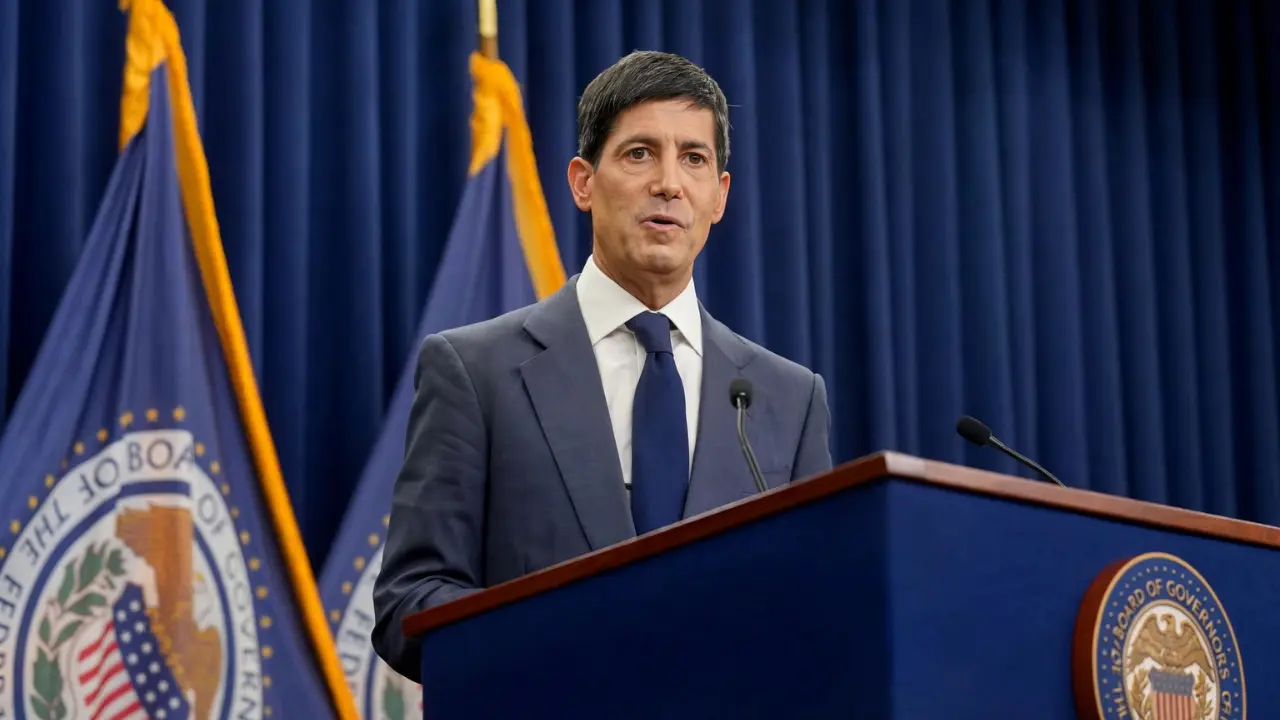
The Federal Reserve aims to keep inflation at 2 percent per year, not zero percent, because a small, steady, predictable rate of rising prices gives the economy room to adjust wages and interest rates without the much larger risks that come with falling prices or runaway inflation. This single number shapes nearly every interest rate decision the Fed makes.
The Federal Reserve’s 2 percent inflation target is the annual rate of price increases the central bank tries to maintain over the long run, measured using the Personal Consumption Expenditures price index.
The target was formally adopted in 2012, gives the Fed a public benchmark for setting interest rates, and is paired with a goal of maximum sustainable employment under the Fed’s dual mandate.
What the 2% Target Actually Means
The 2 percent target is not a ceiling the Fed tries to stay under, and it is not a floor the Fed tries to stay above. It is a long-run average goal. In practice, inflation runs above or below 2 percent for extended periods, and the Fed’s job is to use its policy tools to guide the economy back toward that average over time, rather than reacting to every short-term swing in prices.
The Fed measures inflation using the Personal Consumption Expenditures price index, maintained by the Bureau of Economic Analysis, rather than the more commonly cited Consumer Price Index published by the Bureau of Labor Statistics.
The two measures track similar trends but use different methods for weighting categories of spending and adjusting for changes in what people actually buy as prices shift.
The Fed specifically watches “core” PCE inflation, which strips out food and energy prices because those categories swing sharply from month to month for reasons that have little to do with the underlying pace of price growth across the broader economy.
Why 2 Percent and Not Zero
A target of exactly zero percent inflation might sound ideal on the surface, but central banks around the world have generally avoided it for a specific, practical reason: a small buffer above zero protects the economy from deflation, which is often far more damaging than modest inflation.
Deflation, a sustained fall in prices, can trigger a dangerous cycle. When people expect prices to keep falling, they delay purchases, waiting for a better deal later. Reduced spending lowers business revenue, which leads to layoffs and wage cuts, which further reduces spending, deepening the downturn.
Japan’s multi-decade experience with deflation and weak growth beginning in the 1990s is the example most frequently cited by economists explaining why central banks build in a positive inflation cushion.
A 2 percent target also gives the Fed more room to cut interest rates during a recession. Interest rates cannot easily go far below zero, so if inflation and interest rates are already very low during normal times, the Fed has very little room to cut rates further when the economy weakens. A moderate, positive inflation target keeps typical interest rates higher during normal times, preserving room to cut when a downturn hits.
The History Behind the Target
For most of its history, the Federal Reserve did not have a formal, publicly announced numerical inflation target. Policy was guided by the dual mandate for stable prices and maximum employment, but “stable prices” was left undefined in specific numeric terms.
This changed in January 2012, when the Federal Open Market Committee formally adopted a 2 percent inflation target, becoming the last major global central bank to do so after New Zealand, Canada, the United Kingdom, and others had already adopted explicit targets in earlier decades.
The Fed revised its approach again in 2020, adopting what it called “flexible average inflation targeting.” Under this framework, after a period where inflation runs persistently below 2 percent, the Fed indicated it would aim for inflation moderately above 2 percent for a time.
So, that inflation would average out to the target over the longer run rather than the Fed treating 2 percent as a hard ceiling that could never be exceeded. This shift was a direct response to the extended period of below-target inflation the U.S. economy experienced during the 2010s, following the 2008 financial crisis.
How the Target Shapes Interest Rate Decisions
Every Federal Open Market Committee meeting revolves around a comparison between current and expected inflation and the 2 percent goal. When inflation runs meaningfully above target, the Fed generally raises the federal funds rate to cool spending and borrowing, slowing demand until price growth moderates.
When inflation runs below target or the labor market weakens significantly, the Fed generally lowers rates to encourage borrowing, spending, and investment.
This is the direct link between the inflation target and the interest rates that affect mortgages, credit cards, savings accounts, and business loans across the entire economy. Investozora’s guide to how the Fed controls interest rates walks through the specific mechanics of how a Federal Open Market Committee rate decision moves through the banking system and eventually changes the rate you see on a savings account or auto loan.
The Fed also relies heavily on the dot plot, a chart showing where each policymaker expects rates to move over coming years, to communicate its expected path back toward the 2 percent goal. Investozora’s explainer on the Fed’s dot plot breaks down how to read these projections and what they signal about the Fed’s confidence in reaching its inflation target.
Measuring Progress: PCE vs. CPI
Because the Fed’s official target is based on PCE inflation while most news coverage focuses on CPI inflation, readers often see two different inflation numbers reported in the same week and assume one of them is wrong.
Both are legitimate, accurate measures; they simply use different methodologies. CPI is based on a fixed survey of urban consumer spending patterns and tends to weight housing costs more heavily.
| Feature | PCE Price Index | Consumer Price Index (CPI) |
|---|---|---|
| Primary publisher | Bureau of Economic Analysis | Bureau of Labor Statistics |
| Fed’s preferred measure | Yes | No |
| Spending coverage | Broader measure of consumer spending | Measures prices paid by urban consumers |
| Weight adjustments | Updates more frequently as spending changes | Uses a different weighting methodology |
| Common use | Federal Reserve inflation target | Widely followed public inflation indicator |
| Why it matters | Tracks broader changes in consumer prices | Shows price changes faced by consumers |
PCE draws on a broader set of spending data, including purchases made on a person’s behalf by employers and government programs, and it adjusts its category weights more frequently as consumer spending patterns shift.
For a full breakdown of how the government constructs these price measurements and why the two indexes sometimes diverge, see Investozora’s guide to Consumer Price Index methodology, published by the Bureau of Labor Statistics.
Economic Impact of the 2% Target
Interest rates. As described above, the target directly drives every Federal Open Market Committee rate decision, which in turn affects mortgage rates, credit card APRs, auto loan rates, and the interest paid on savings accounts and certificates of deposit.
Wages and employment. A modest, predictable inflation rate makes it easier for employers to adjust wages gradually rather than through disruptive one-time cuts, since a small amount of built-in price growth allows real wages to adjust downward slightly through inflation rather than requiring an employer to cut a worker’s paycheck in nominal terms, which is far more difficult psychologically and practically.
Government benefit programs. Programs tied to inflation, including Social Security’s annual cost-of-living adjustment, are directly affected by how close actual inflation runs to or above the Fed’s target over time.
Persistent inflation above target, even if the Fed eventually brings it back down, still raises the base level of prices permanently, which flows through to programs indexed to inflation. Investozora’s coverage of the Social Security COLA calculation shows exactly how this connects in practice.
Savings and bank deposits. The rate environment created by the Fed’s pursuit of its inflation target directly affects what banks pay on deposit accounts, which matters alongside the separate question of deposit safety covered in Investozora’s guide to FDIC and NCUA insurance, since a higher-rate environment driven by above-target inflation often coincides with more competitive savings account yields even as the purchasing power of a fixed balance erodes faster.
Criticism and Debate Around the Target
The 2 percent target is not universally accepted as the ideal number, and economists continue to debate it publicly. Some argue the target should be higher, giving the Fed more room to cut rates during recessions without hitting the practical floor near zero.
Others argue a higher target would erode public trust in the currency’s purchasing power over time and make long-term financial planning harder for households and retirees on fixed incomes. Still others argue the target should vary based on structural economic conditions rather than remaining a fixed number indefinitely.
These are legitimate, ongoing debates among economists and policymakers, and Investozora does not take a position on which number is objectively correct. The 2 percent figure remains the Fed’s official, publicly stated goal as of this writing, and it is the number that currently drives every rate decision described throughout this guide.
The U.S. Inflation Track Record Against the Target
Since the Fed formally adopted its 2 percent target in 2012, actual inflation has moved through several distinct phases relative to that goal. From 2012 through roughly 2019, core PCE inflation ran persistently below 2 percent for most of that period, which was a key reason the Fed moved to its flexible average inflation targeting framework in 2020, aiming to make up for the earlier shortfall by tolerating inflation somewhat above target for a time.
That plan was quickly overtaken by events, as supply chain disruptions, a surge in government spending, and shifting consumer demand during and after the pandemic pushed inflation to its highest levels in four decades.
The Fed responded with one of the fastest interest rate hiking cycles in its modern history, raising the federal funds rate rapidly to bring demand back in line with available supply.
By the mid-2020s, inflation had cooled substantially from its peak but continued to move in a range above the Fed’s 2 percent goal for an extended stretch, keeping the Fed’s policy stance a central topic at every Federal Open Market Committee meeting since.
This history illustrates that the 2 percent target functions less like a light switch the Fed can flip and more like a destination the Fed steers toward gradually, adjusting the pace of rate changes based on incoming data on employment, wages, and prices.
How Other Central Banks Approach Their Targets
The Federal Reserve’s 2 percent target is not unique. Most major developed-economy central banks, including the European Central Bank, the Bank of England, and the Bank of Canada, use the same 2 percent figure as their primary inflation goal, though the specific price index each one uses and the flexibility built into each framework differ in technical detail.
This broad international consensus around 2 percent developed gradually over several decades, starting with New Zealand’s adoption of an explicit inflation target in 1990, and it reflects a shared view among central bankers that a small, positive inflation buffer offers the best balance between price stability and flexibility to respond to economic downturns.
A small number of central banks, including some emerging market economies, use higher inflation targets, generally reflecting different structural conditions in those economies, such as faster underlying growth rates or less-developed financial systems where a higher inflation buffer provides more useful flexibility.
These differences are a reminder that 2 percent is not a universal law of economics; it is a policy choice each central bank makes based on its own economy’s characteristics.
What Happens When the Fed Misses Its Target for an Extended Period
An extended miss in either direction carries real consequences beyond the headline number itself. When inflation runs persistently above target, the purchasing power of fixed incomes, savings, and wages that do not keep pace erodes faster than expected, which is a significant concern for retirees and others living on relatively fixed income streams.
Persistent above-target inflation can also become embedded in expectations, meaning workers and businesses start building in higher expected price increases to wage negotiations and contracts, which can make the inflation more difficult to bring back down without a more aggressive and economically painful policy response.
When inflation runs persistently below target, the Fed has less room to cut interest rates during a future downturn, since rates are already low in a low-inflation environment.
Persistent below-target inflation can also signal weak underlying demand in the economy, which is part of why the Fed treats a sustained shortfall as seriously as a sustained overshoot, even though below-target inflation often draws less public attention than above-target inflation.
How the Fed Communicates Its Progress to the Public
Transparency is a central part of how the Fed’s inflation target functions in practice. After every Federal Open Market Committee meeting, the Fed releases a policy statement explaining its assessment of current inflation and employment conditions relative to its goals, followed by a press conference where the Fed Chair answers questions directly from reporters.
Four times a year, the Fed also releases its Summary of Economic Projections, which includes the dot plot showing each policymaker’s individual rate expectations along with forecasts for inflation, unemployment, and economic growth over the next several years.
This level of public communication is a deliberate strategy, not just a courtesy. Economists broadly agree that a central bank’s credibility around its inflation target affects how businesses and workers set prices and negotiate wages.
If households and businesses trust that the Fed will keep long-run inflation near 2 percent, they are less likely to build high inflation expectations into contracts and price-setting decisions, which itself makes the target easier to achieve.
This is sometimes called the credibility channel of monetary policy, and it is a major reason the Fed places so much emphasis on clear, consistent public communication rather than surprising markets with unexpected policy shifts.
Reading Fed Communication as a Regular Reader
For readers following Federal Reserve news regularly, a few recurring terms are worth understanding in the context of the 2 percent target. “Data dependent” signals that the Fed’s next move is not predetermined and will be shaped by upcoming inflation, employment, and growth reports.
“Restrictive policy” describes an interest rate setting high enough to actively slow economic growth in order to bring inflation down toward target. “Neutral rate” refers to a theoretical interest rate level that neither stimulates nor restricts economic growth, which the Fed uses as a reference point for judging how far its current policy stance sits from a long-run steady state.
Readers who understand these terms can follow Federal Reserve coverage with a clearer sense of where policy currently sits relative to the 2 percent goal, rather than reacting to headlines about a single rate decision in isolation.
Does the Fed need exactly 2%?
No. The Federal Reserve’s 2 percent inflation target is a long-run goal, not a requirement that inflation must hit exactly 2 percent every year. Inflation can run above or below that level for extended periods because the economy is constantly affected by changing demand, energy prices, supply disruptions, and other factors.
The Fed looks at broader trends rather than reacting to every short-term monthly change. Its goal is to guide inflation back toward 2 percent over time while also supporting maximum sustainable employment.
Why does the Fed use PCE?
The Federal Reserve uses the Personal Consumption Expenditures price index because it captures a broader range of consumer spending than the Consumer Price Index. PCE also adjusts more frequently as consumers change what they buy when relative prices change.
For example, consumers may switch from a more expensive product to a cheaper alternative, and the PCE measure is designed to reflect those changes more flexibly. CPI remains an important inflation measure, but the Fed considers PCE a better fit for evaluating overall changes in consumer prices.
What if inflation stays above 2%?
If inflation remains significantly above 2 percent for an extended period, the Federal Reserve will generally keep interest rates higher for longer or raise them further if necessary. Higher borrowing costs can reduce consumer spending, business investment, and demand across the economy, which can gradually ease pressure on prices.
The process can also make variable-rate debt more expensive while potentially increasing yields on savings accounts, certificates of deposit, and money market accounts. The Fed’s goal is to slow inflation without unnecessarily causing a sharp rise in unemployment or a severe economic downturn.
Could the Fed change its target?
Yes. The Federal Open Market Committee can change its monetary policy framework in the future if policymakers conclude that economic conditions have fundamentally changed. The Fed’s 2020 framework review demonstrated that its approach to achieving its goals can evolve over time.
However, changing the 2 percent target would be a major policy decision and would likely be communicated publicly through the Fed’s formal framework and policy announcements. Until such a change occurs, 2 percent remains the Federal Reserve’s official long-run inflation goal.
How does it affect my money?
The 2 percent inflation target affects your finances mainly through the Federal Reserve’s interest-rate decisions. When inflation is persistently too high, the Fed may raise rates, which can increase borrowing costs for credit cards, adjustable-rate loans, and other forms of variable-rate debt.
Higher rates can also improve the returns available on some savings accounts, certificates of deposit, and money market products. When inflation is low and the economy weakens, the Fed may lower rates, which can make borrowing cheaper but reduce the interest many savers earn on deposits.
The Bottom Line
The Federal Reserve’s 2 percent inflation target is the anchor behind nearly every interest rate decision made in Washington, chosen specifically because a small, positive, predictable rate of price growth protects the economy from the much larger risks of deflation while preserving room for the Fed to cut rates during downturns.
Understanding this target, and the PCE inflation measure used to track it, gives readers a clearer lens for interpreting every Federal Reserve announcement, dot plot release, and interest rate decision covered in the news.