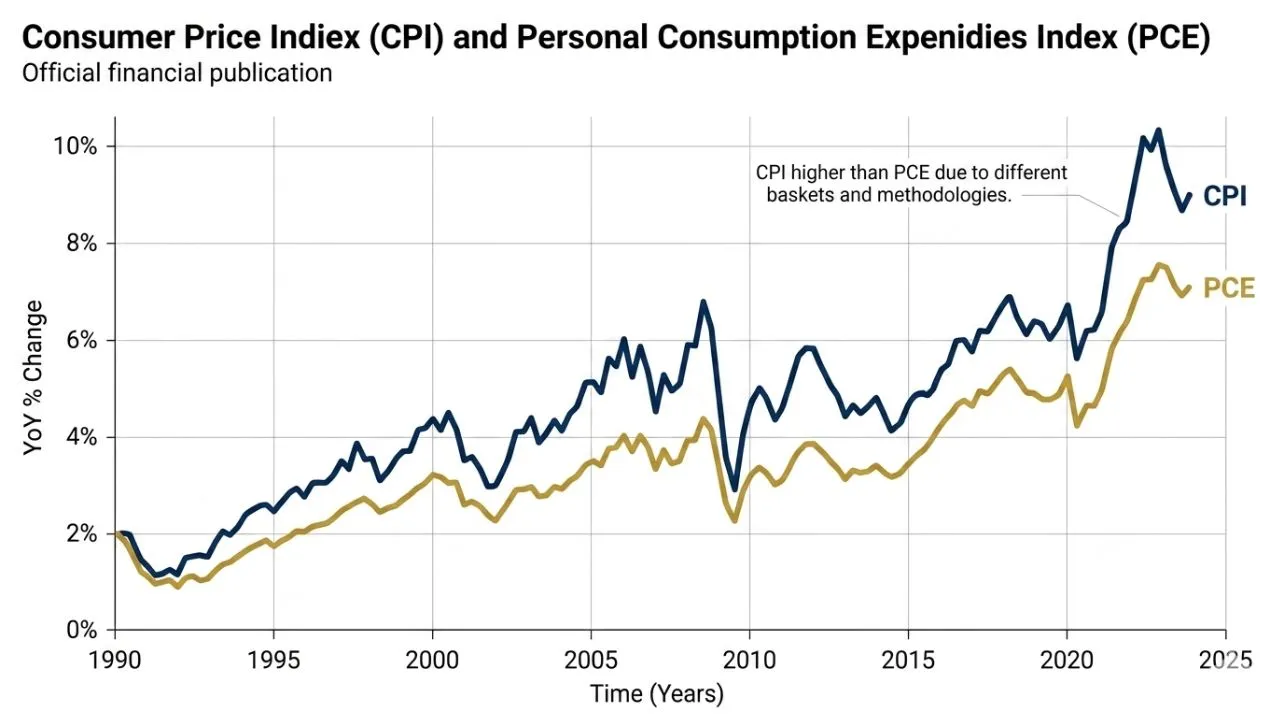
Updated: June 22, 2026 – Every month, two different inflation numbers come out of Washington. They measure roughly the same thing but produce different results. The number most Americans follow is the Consumer Price Index. The number the Federal Reserve actually uses to set interest rates is the Personal Consumption Expenditures price index.
Understanding why those two measures diverge, and when they diverge most significantly, is essential for anyone trying to understand what the Fed will do next with interest rates.
This is not an academic distinction. When inflation reads higher on PCE than CPI, the Fed may hold rates steady or raise them while headline CPI appears to be cooling. When PCE runs below CPI, the Fed may cut rates before media coverage suggests it would. The gap between these two numbers governs the cost of your mortgage, your savings account yield, and the trajectory of every federal payment tied to cost-of-living adjustments.
Following Chairman Kevin Warsh’s debut FOMC meeting on June 17, 2026, and the committee’s unanimous vote to hold the Federal Funds Rate at its current restrictive level, the CPI versus PCE distinction has taken on renewed importance for every American household managing savings, debt, or federal benefit income.
Why Two Inflation Measures Exist
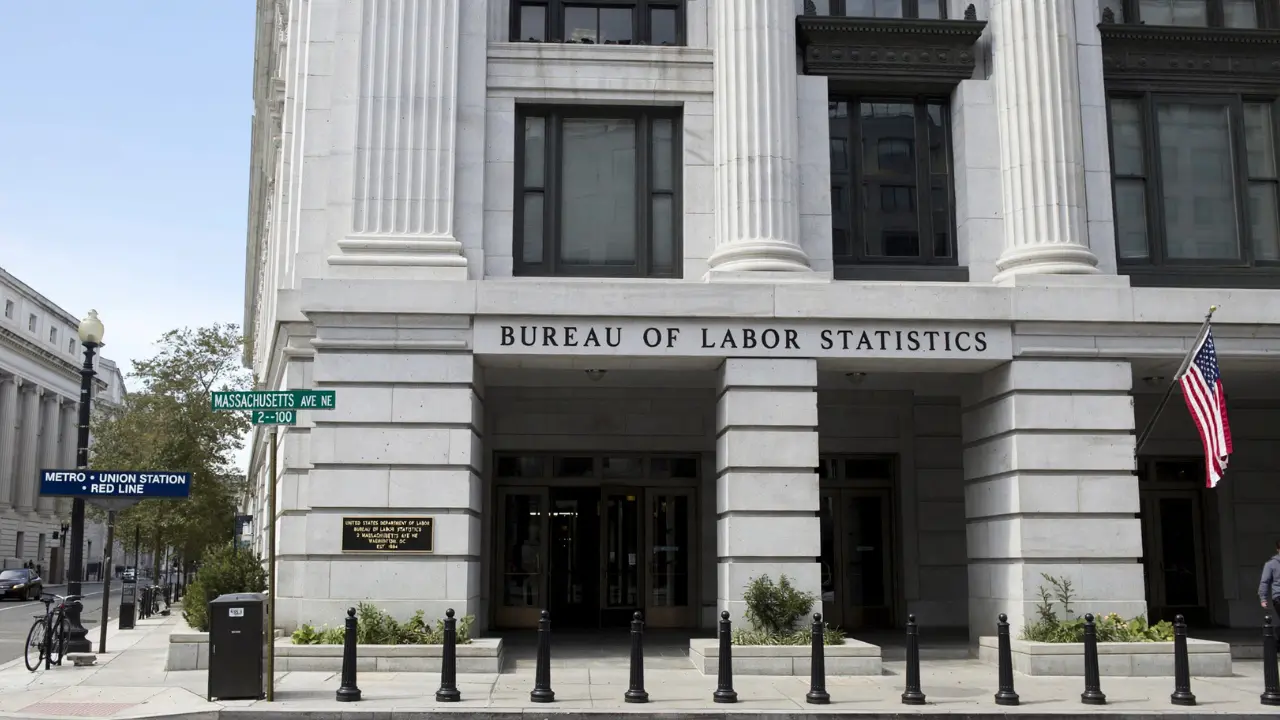
The Consumer Price Index is published monthly by the Bureau of Labor Statistics, a division of the Department of Labor. It measures price changes for a fixed basket of goods and services that urban consumers typically purchase, tracking housing, food, transportation, healthcare, and other categories. The BLS constructs this basket through consumer expenditure surveys conducted every two years, meaning the basket is relatively static between updates.
The Personal Consumption Expenditures price index is published monthly by the Bureau of Economic Analysis, a division of the Department of Commerce. It measures price changes for goods and services consumed by all U.S. households and nonprofits serving households. The BEA’s PCE methodology differs from the BLS approach at a fundamental level, and those differences compound over time into meaningful measurement gaps.
Federal Reserve Policy
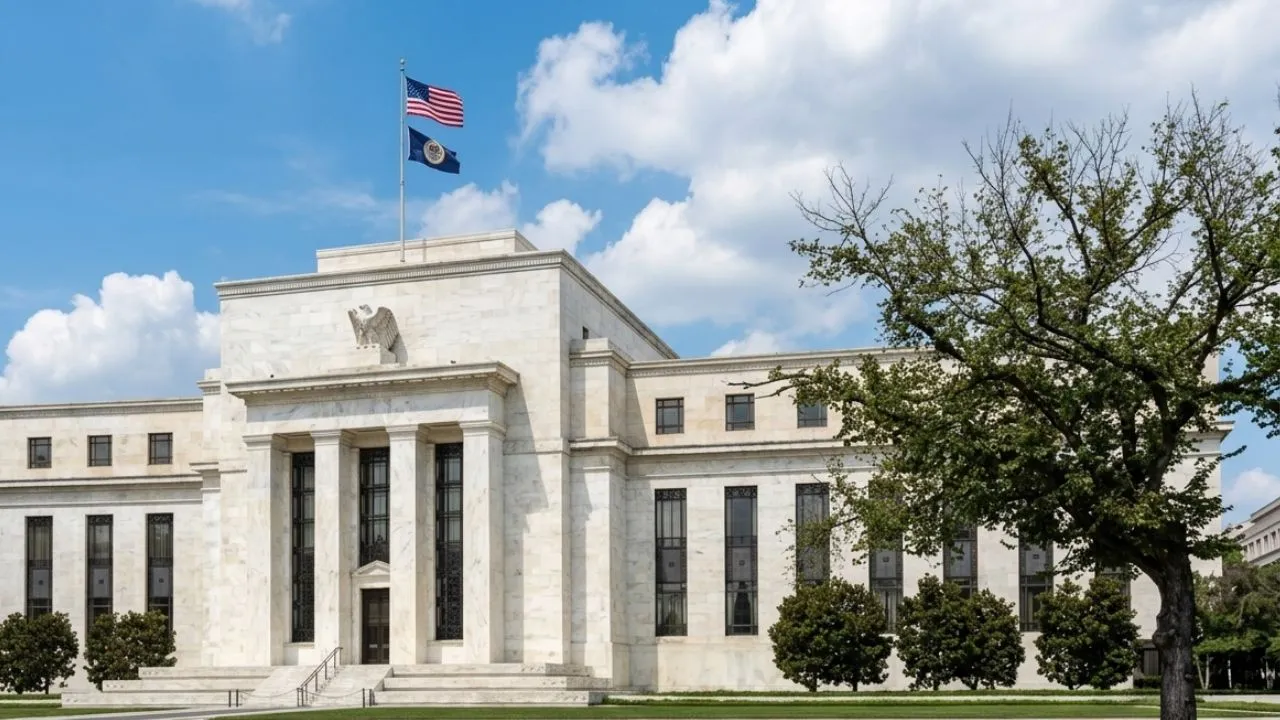
The Fed Interest Rules That Secretly Change Your Savings Yield

The Fed Raised Rates. Here Is What It Does to Your Mortgage.
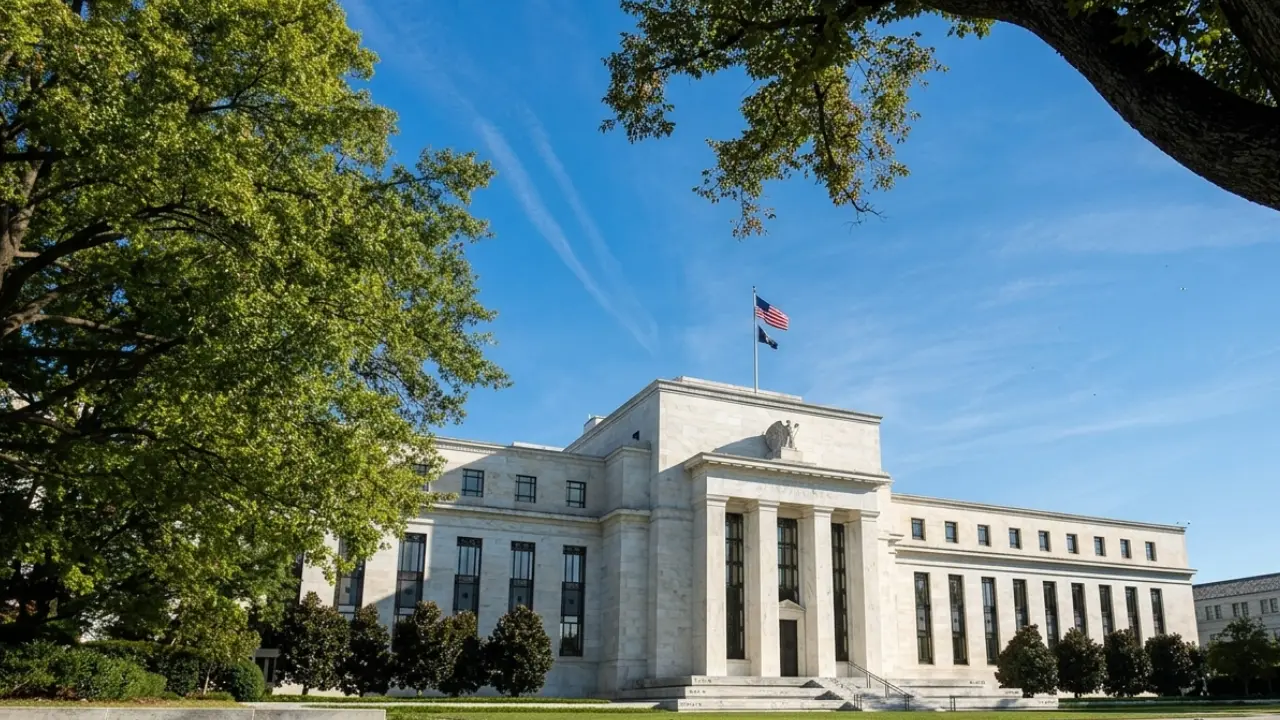
The Federal Reserve made its preference explicit in its official Statement on Longer-Run Goals and Monetary Policy Strategy, where it defines its 2% inflation target specifically in terms of the PCE price index. The FOMC does monitor CPI data as contextual information, but CPI does not govern Fed decisions. PCE governs Fed decisions.
Understanding how the Fed’s policy decisions flow through to consumer savings accounts, deposit timing, and benefit adjustments requires examining the full U.S. money movement system that transmits those policy effects into real household cash flows.
The 3 Formula Differences That Matter
The divergence between CPI and PCE stems from three structural differences in how each index is constructed. Each difference produces a measurable and directional bias.
The first difference is the weighting methodology. The CPI uses a Laspeyres-type formula, which measures price changes for a fixed basket of goods weighted by quantities purchased in a base period.
This approach is straightforward but has a known limitation: it does not capture substitution behavior. When beef prices spike, consumers buy more chicken. The CPI continues to price beef at its original weight, overstating the actual cost impact on real consumer budgets.
The PCE uses a chain-weighted Fisher-ideal index, which updates its basket continuously using both current-period and prior-period expenditure weights. When consumers switch from beef to chicken in response to price changes, the PCE captures that substitution and adjusts its calculation accordingly. This makes the PCE a more accurate representation of what consumers actually spend money on after making real-world price-driven decisions.
The second difference is the scope of goods and services covered. The CPI measures only out-of-pocket consumer expenditures. The PCE includes those same out-of-pocket costs but additionally captures expenditures made on behalf of consumers by third parties, most significantly employer-provided healthcare and Medicare and Medicaid healthcare spending. This means the PCE captures the full cost of healthcare consumed by Americans, not just what they pay directly at the point of service.
The third difference is housing weight. The CPI weights housing, specifically Owners’ Equivalent Rent, at roughly 34% of the index. The PCE weights housing costs at approximately 15%. This gap has enormous practical consequences.
When rental costs surge, as they did in 2022 and 2023, the CPI reports much higher inflation than the PCE because housing represents more than twice as large a share of the CPI basket. Conversely, when healthcare costs surge, the PCE reports higher inflation than the CPI because PCE captures the full healthcare cost that CPI misses.
What This Means Right Now in 2026
The current inflation environment illustrates why this distinction matters in practice. May 2026 headline CPI readings reflected upward pressure from global energy supply disruptions tied to geopolitical tensions. Headline PCE for the same period showed a similar pattern but at a lower absolute level due to the PCE’s lower energy weighting and its substitution-adjustment methodology.
Core PCE, which strips out volatile food and energy prices to reveal the underlying trend, is the single most watched number inside the FOMC meeting room. The Federal Reserve does not react to one bad month of energy prices. It reacts to sustained pressure in core PCE, which reflects the durability of inflationary trends in services, housing, and wages.
Chairman Warsh made this explicit in his June 17, 2026 press conference, where he stated that the Committee would require clear and sustained evidence of core PCE moving toward 2% before any adjustment to the restrictive policy stance would be appropriate. This means that even if CPI data suggests cooling, the Fed will not act until PCE confirms the same trend.
The CPI measurement methodology article provides the complete BLS technical framework for how CPI is constructed, including the specific sub-categories and their weightings, which allows direct comparison with the PCE weighting structure described above.
How This Affects Your Savings Rate
Every institution that offers a high-yield savings account, a money market account, or a certificate of deposit sets its yield in response to the Federal Funds Rate, which the FOMC adjusts based on PCE, not CPI. When the Fed holds rates at a restrictive level because PCE has not cooled sufficiently, your savings account yield remains elevated. When the Fed eventually cuts because core PCE confirms a durable trend toward 2%, savings yields follow within weeks.
Right now, with the Fed holding rates steady following the June 17 decision, the Federal Reserve’s impact on savings yields explains the exact transmission mechanism from FOMC decisions to the annual percentage yield on consumer savings products.
For Social Security recipients, the CPI versus PCE distinction has direct consequences for the annual Cost of Living Adjustment. Social Security COLAs are calculated using the Consumer Price Index for Urban Wage Earners and Clerical Workers, which is a variant of the CPI, not the PCE.
This means Social Security benefits increase based on a measure that typically runs higher than the PCE the Fed is targeting. The result can be a situation where benefits rise faster than the Fed’s inflation benchmark while the Fed holds rates steady, a dynamic that affects both the purchasing power of benefits and the fiscal trajectory of the Social Security trust fund.
The Social Security COLA 2027 forecast analyzes the current CPI-W trajectory and its implications for next year’s benefit adjustment, covering exactly this divergence between the CPI-based COLA calculation and the PCE-based Fed target.
The Warsh Doctrine and Future PCE Targets
Kevin Warsh’s approach to monetary policy places substantial weight on systematic, rule-based application of the Fed’s 2% PCE target rather than discretionary judgment about whether temporary inflation pressures justify patience. In his June 17 press conference, Warsh framed the current restrictive stance as a restoration of institutional credibility rather than a temporary policy response to recent data.
This matters for forecasting because it means the Fed’s reaction function is now more mechanical than it was under the previous leadership. If core PCE does not demonstrate a clear, multi-month trend toward 2%, the probability of rate cuts approaches zero regardless of what CPI reads, regardless of labor market conditions, and regardless of political pressure. The Kevin Warsh Fed policy impact article covers the full policy framework Warsh has articulated and its implications for the rate path through the end of 2026.
Understanding why the Fed watches PCE rather than CPI is ultimately about understanding how monetary policy decisions generate real financial outcomes for households. The Federal Reserve inflation controls mechanics explains the complete transmission chain from FOMC decisions through financial market rates to consumer borrowing costs and deposit yields.