

Update: June 22, 2026 – The U.S. Treasury is currently paying retail investors between 3.59% and 3.75% annually on short-term government securities, and any American with a bank account and a Social Security number can access those yields directly, without a broker, without a commission, and without minimum balances beyond $100. This is not a new product.
Treasury bills have existed for over a century. But the current rate environment, combined with the Federal Reserve’s June 17, 2026 decision to hold rates at restrictive levels, makes this one of the most straightforward risk-free yield opportunities available to ordinary savers right now.
This guide covers the complete process from opening a TreasuryDirect account through submitting a non-competitive bid, understanding auction results, and managing maturity reinvestment, using only official government data from the Bureau of the Fiscal Service.
What Treasury Bills Actually Are
Treasury bills, commonly called T-bills, are short-term debt obligations issued by the U.S. Department of the Treasury to finance federal government operations. Unlike bonds, they do not pay periodic interest. Instead, they are sold at a discount to their face value and pay the full face value at maturity. The difference between what you pay and what you receive is your return.
A 4-week T-bill purchased at $99.30 per $100 face value returns exactly $100 at maturity four weeks later. That $0.70 gain on a $100 investment represents an annualized yield of approximately 3.59%, which is the current 4-week T-bill high rate as of the June 2026 auction cycle.
T-bills are issued with maturities of 4, 8, 13, 17, 26, and 52 weeks. Each maturity has a different yield, and those yields adjust weekly based on auction demand and prevailing Federal Reserve policy rates. The Treasury bills explained guide covers the complete mechanics of T-bill pricing, discount calculations, and yield comparison with alternative savings instruments.
Current Auction Yields as of June 2026
The Bureau of the Fiscal Service conducts weekly auctions for most T-bill maturities. Based on official auction results for the week of June 16 to 18, 2026, the live yields are as follows.
The 4-week T-bill auction with an issue date of June 23, 2026, produced a high rate of 3.595% and an investment rate of 3.655%. The CUSIP identifier for this security is 912797UQ8.
The 8-week T-bill also issuing on June 23, 2026, produced a high rate of 3.610% and an investment rate of 3.681%. The CUSIP for this security is 912797UU9. The most recent 13-week T-bill auction from June 22, 2026, produced a high rate of 3.640% and an investment rate of 3.725%.
These yields reflect the Federal Reserve’s maintained restrictive posture. Following Chairman Warsh’s June 17 decision to hold rates and his explicit hawkish forward guidance, short-term T-bill yields are expected to remain in this range through at least Q3 2026. The upcoming auction schedule at TreasuryDirect.gov is updated weekly and shows exact dates, amounts, and expected maturities for all scheduled issuances.
For the complete context of how Fed rate decisions interact with Treasury yield dynamics, the FOMC rate decision and savings impact article explains the exact transmission chain from Fed meetings to T-bill auction outcomes.
Opening a TreasuryDirect Account
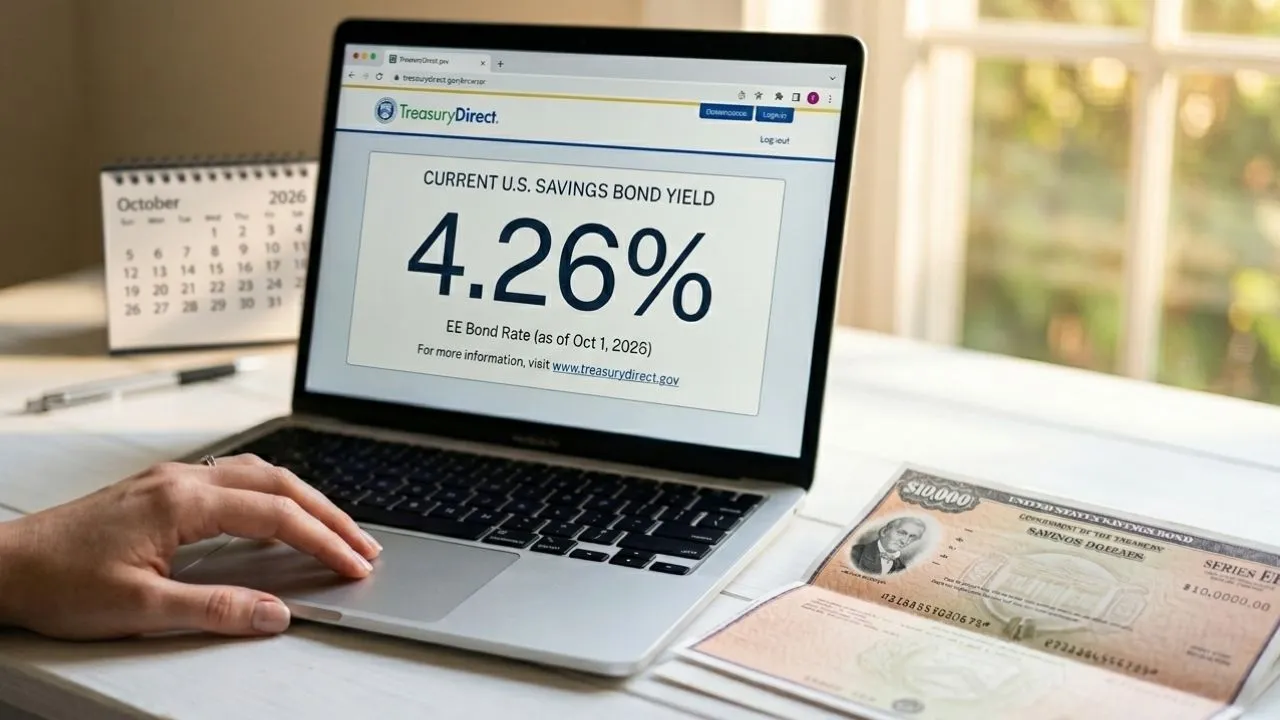
The TreasuryDirect.gov portal is the federal government’s direct retail interface for purchasing Treasury securities. Account creation requires a Social Security number or Employer Identification Number, a U.S. address, a checking or savings account for payment and deposit, and an email address. The process is completed entirely online and typically takes 10 to 15 minutes.
After creating your account, you will receive a TreasuryDirect account number that serves as your permanent government securities identifier. All purchases, maturities, and reinvestments are tracked in this account. There are no fees, no maintenance costs, and no minimum holding periods beyond the natural maturity of the security you purchase.
The bank account you link during setup is used for both debiting your purchase price when you win an auction and for crediting your maturity proceeds when the T-bill matures. These fund movements flow through the standard ACH payment network and typically settle within one business day of the issue or maturity date, following the same federal payment routing that governs Social Security deposits and IRS refunds.
The entire money movement infrastructure connecting TreasuryDirect disbursements to consumer bank accounts operates through the same federal payment architecture described in the U.S. money movement system, which connects Bureau of the Fiscal Service payment files through the Federal Reserve network to your bank.
How the Non-Competitive Bid Works
Retail investors at TreasuryDirect participate in T-bill auctions through a mechanism called the non-competitive bid. This is the correct approach for all individual investors. Do not attempt to submit a competitive bid unless you are an institutional investor with sophisticated yield forecasting capabilities.
A non-competitive bid guarantees that your purchase request will be filled at 100% allocation. You do not specify a yield or a price. You simply specify the dollar amount of face value you wish to purchase, submit your bid before the auction deadline, and you automatically receive the high yield determined by the competitive institutional bidding process. You get the same rate the large banks and hedge funds got, without having to compete for it.
The maximum non-competitive bid per auction per TreasuryDirect account is $10 million. The minimum purchase is $100. Most retail investors purchase in increments of $1,000 or $10,000 to create manageable T-bill ladders where different maturities come due at regular intervals.
The Treasury auction bidding process explains the Dutch auction mechanics that determine the high rate, including how competitive bid pressure from institutional investors sets the yield floor that non-competitive bidders automatically receive.
Building a T-Bill Ladder in 2026
The most practical strategy for retail investors in a high-rate, rate-hold environment is a T-bill ladder, where you purchase multiple T-bills with staggered maturity dates so that a portion of your investment matures and becomes liquid at regular intervals.
A simple four-rung ladder might purchase equal dollar amounts of 4-week, 8-week, 13-week, and 26-week T-bills simultaneously. As each position matures, the proceeds are either withdrawn to meet liquidity needs or reinvested into a new 26-week T-bill, maintaining the ladder structure. This approach ensures that you always have liquid funds available within four weeks while keeping the majority of your capital earning the longer-maturity yields.
TreasuryDirect has an automatic reinvestment feature called a Scheduled Repeat Purchase, which allows you to automatically roll maturing T-bills into new auctions without manual intervention. This is particularly useful for investors who want continuous exposure to T-bill yields without actively monitoring each maturity date.
Given the current rate environment following the June 17 Fed decision, the T-bill maturity and yield guide provides a detailed ladder construction framework with current yield comparisons across all available maturities.
Taxes on T-Bill Income
Treasury bill income is subject to federal income tax in the year the bill matures and pays face value, not in the year you purchase it. If you buy a 52-week T-bill in July 2026 that matures in July 2027, the income is reported on your 2027 federal return, not your 2026 return.
T-bill income is specifically exempt from state and local income taxes, which is a meaningful advantage for investors in high-tax states. A New York City resident in the highest marginal bracket might face combined federal, state, and city tax rates exceeding 50% on interest from a savings account. The same dollar of T-bill income avoids both the state and city components, making the after-tax yield substantially more competitive than it appears on a pre-tax basis.
The EITC interaction also matters here. Investment income from T-bills counts toward the investment income cap for EITC eligibility. For filers near the $12,000 investment income threshold, significant T-bill holdings may affect EITC qualification. The complete EITC income limits for 2026 covers this interaction in detail.
The Treasury General Account explained provides the institutional context for how the U.S. Treasury manages the cash flows from T-bill auctions and how that connects to the broader federal liquidity picture that Warsh and the FOMC monitor when setting policy.