The July 2026 Consumer Price Index showed U.S. inflation easing modestly on a 12-month basis while underlying prices rose again during the month, leaving the Federal Reserve with a mixed inflation picture ahead of its September policy meeting.
The Consumer Price Index for All Urban Consumers rose 0.1% in July on a seasonally adjusted basis and 3.4% over the previous 12 months before seasonal adjustment, according to the U.S. Bureau of Labor Statistics’ official July 2026 CPI release. Core CPI, which excludes food and energy, increased 0.2% for the month and 2.5% from a year earlier.
Both annual readings moved slightly lower from June, when headline inflation stood at 3.5% and core inflation at 2.6%. But the monthly details show why the July report is more nuanced than the annual slowdown alone suggests. Shelter prices rose 0.1% and accounted for roughly two-thirds of the monthly increase in the overall index, while food prices increased 0.1% and energy prices declined 1.5%.
For the Federal Reserve, the report adds evidence that annual inflation pressure has moderated, but it does not settle the direction of monetary policy. Core prices increased after being unchanged in June, and policymakers will have additional inflation, labor-market and economic data before deciding whether the current 3.50%–3.75% federal funds target range remains appropriate.
Where inflation stood before the July report
The June CPI report showed the Consumer Price Index for All Urban Consumers falling 0.4% on a seasonally adjusted monthly basis. Over the previous 12 months, consumer prices were still 3.5% higher.
The difference between the monthly and annual figures is important. A monthly decline does not mean prices returned to earlier levels. It means the overall CPI basket became cheaper compared with May after seasonal adjustment, while the price level remained considerably higher than a year earlier.
The June decline was heavily influenced by energy. Food prices, by contrast, increased 0.2% during the month. BLS’s detailed June CPI table provides the category-level breakdown behind those movements.
For readers who want to understand what goes into the index rather than simply watching the headline number, Investozora’s guide to how BLS measures the Consumer Price Index explains the construction of the CPI basket and why different spending categories can move the overall inflation rate by different amounts.
Core CPI may matter more than the headline move
The June core CPI, which excludes food and energy, was unchanged from May and increased 2.6% over the previous 12 months. That created a large difference between headline inflation and underlying inflation in June.
Energy prices can move sharply because of oil markets and geopolitical events. Core inflation removes food and energy so policymakers and economists can see whether price pressure is spreading through less volatile parts of the economy.
July’s report therefore needs to be read in at least four ways: the monthly headline CPI change, the 12-month headline inflation rate, the monthly core CPI change and the 12-month core inflation rate.
A favorable headline figure driven mostly by another large energy decline would carry a different policy message from broad moderation across shelter, services and consumer goods. Likewise, a rise in headline CPI caused mainly by energy would not by itself prove that underlying inflation had accelerated again.
Why the July CPI matters for the Federal Reserve
The Federal Reserve entered August with monetary policy already restrictive compared with recent years. At its July 28-29 meeting, the Federal Open Market Committee voted to keep the federal funds target range at 3.50% to 3.75%. The July FOMC statement said inflation remained elevated relative to the Committee’s 2% objective.
The decision was not unanimous. Beth Hammack, Neel Kashkari and Lorie Logan voted against the decision because they preferred a quarter-percentage-point rate increase at the July meeting.
That dissent shows that the debate inside the FOMC has not been limited to how soon rates might fall; some policymakers were prepared to tighten policy further. That makes incoming inflation data particularly important.
Investozora’s explanation of the relationship between Federal Reserve interest rates and inflation provides the broader mechanics: higher interest rates work partly by restraining borrowing and demand, while sustained inflation pressure can make policymakers reluctant to reduce rates. But July CPI will not mechanically determine the next Fed decision.
The Fed’s inflation target is not actually CPI
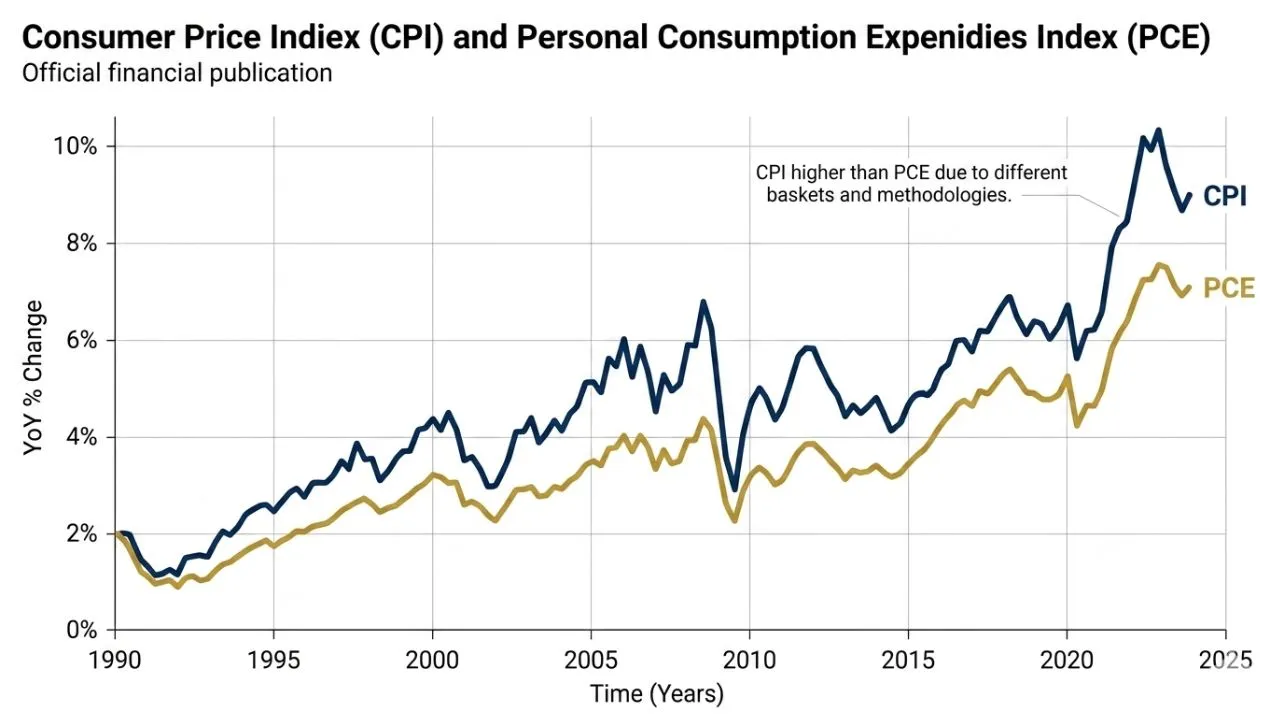
There is another distinction that often gets lost when a CPI report dominates financial headlines. The Federal Reserve’s formal 2% inflation objective is measured using the Personal Consumption Expenditures price index, not CPI.
The Fed’s July Monetary Policy Report says the Committee evaluates its inflation objective using the annual change in the PCE price index. The report also describes core PCE inflation as useful when assessing underlying inflation developments. Investozora explains that framework in more detail in its guide to the Federal Reserve’s inflation target.
CPI still matters because it arrives earlier, provides extensive detail on consumer prices and can influence expectations about where subsequent inflation measures are heading.
But saying that CPI has reached or missed the Fed’s 2% target would technically compare two different inflation measures. That is why one CPI report should be treated as evidence for the Fed’s inflation assessment, not as the Fed’s inflation target itself.
Inflation had accelerated before June’s CPI decline
The broader 2026 inflation picture is also more complicated than the June headline decline suggests. In its July Monetary Policy Report, the Federal Reserve said inflation had risen during 2026 and remained above its longer-run objective. It identified energy-related supply shocks as one contributor to stronger price pressures.
The report showed total PCE inflation at 4.1% over the 12 months through May, while core PCE inflation was 3.4%. The Fed also said tariffs had contributed to higher prices for some imported consumer goods, while energy prices had risen sharply following disruptions connected with the Middle East conflict.
That background is important when interpreting July CPI. One softer month can reduce inflation pressure without establishing a lasting trend. Conversely, one stronger month would not by itself establish that inflation is entering another sustained acceleration.
The question is whether several measures begin pointing in the same direction. Investozora’s guide to how the Federal Reserve controls inflation explains why policymakers normally evaluate a series of inflation, employment and economic-growth indicators instead of reacting mechanically to one report.
What July CPI could change for September
The next scheduled FOMC meeting is September 15-16, 2026, according to the Fed’s official meeting calendar. That gives policymakers additional information before they vote.
July CPI is therefore an important part of the evidence available for September, but it is not the final piece. The Fed has repeatedly said that its decisions depend on incoming data, the evolving economic outlook and the balance of risks rather than a single indicator.
Investozora’s 2026 FOMC meeting schedule provides the full calendar, while the earlier analysis of the September rate decision and inflation report explains why the coming inflation releases carry unusual significance for the next policy debate.
The most important signal Wednesday will therefore not simply be whether headline CPI rises or falls. A broad slowdown in monthly core inflation, especially if sustained across multiple underlying categories, would provide stronger evidence that inflation pressure is easing.
Persistent core inflation would make the picture harder for policymakers, particularly after three FOMC members already argued in July that monetary policy should be tightened further. And a headline move dominated by energy would need to be separated from what is happening beneath the surface.
What the July CPI report shows and what comes next
The July report points to a modest easing in annual inflation, but the underlying picture remains more complicated. Headline CPI increased 0.1% in July after falling 0.4% in June, while the 12-month inflation rate slowed to 3.4% from 3.5%.
Core CPI rose 0.2% during the month after being unchanged in June, while the annual core rate eased to 2.5% from 2.6%, according to the Bureau of Labor Statistics’ official July 2026 CPI release.
The composition of the report helps explain that mixed signal. Shelter prices increased 0.1% and accounted for roughly two-thirds of the monthly rise in the overall index. Food prices also increased 0.1%, while energy prices fell 1.5%.
Within core categories, prices rose for medical care, airline fares, communication, education and recreation, while motor vehicle insurance was among the major categories that declined.
For the Federal Reserve, those details matter more than any single headline figure. The decline in annual headline and core inflation provides evidence that price pressures have moderated from June, but the return of positive monthly core inflation shows that underlying inflation has not disappeared.
The Fed also continues to describe inflation as elevated relative to its 2% objective, meaning the July CPI report is one part of a broader assessment that includes employment, economic activity and additional inflation data.
The timing of the next releases will add further context. BLS has scheduled the August 2026 CPI report for September 11 at 8:30 a.m. ET, followed by the Federal Reserve’s September 15–16 FOMC meeting. That gives policymakers another major inflation reading before the September rate decision.
The July CPI report therefore strengthens the evidence that annual inflation is moving lower, but it does not by itself establish a sustained return to price stability or determine the Federal Reserve’s next move. The more important question is whether subsequent inflation reports confirm the same direction across both headline and underlying measures.