
The federal funds target range is 3.50%–3.75%, held steady through the first half of 2026 following three cuts in late 2025. This section will be updated after each FOMC meeting.
The federal funds rate is the interest rate banks charge each other for overnight loans, and it’s the main tool the Federal Reserve uses to control inflation and growth. Since the Federal Open Market Committee began actively targeting this rate in the 1950s, it has swung from near zero to nearly 20%, shaping mortgages, credit cards, and savings yields for every American generation.
What the rate actually is
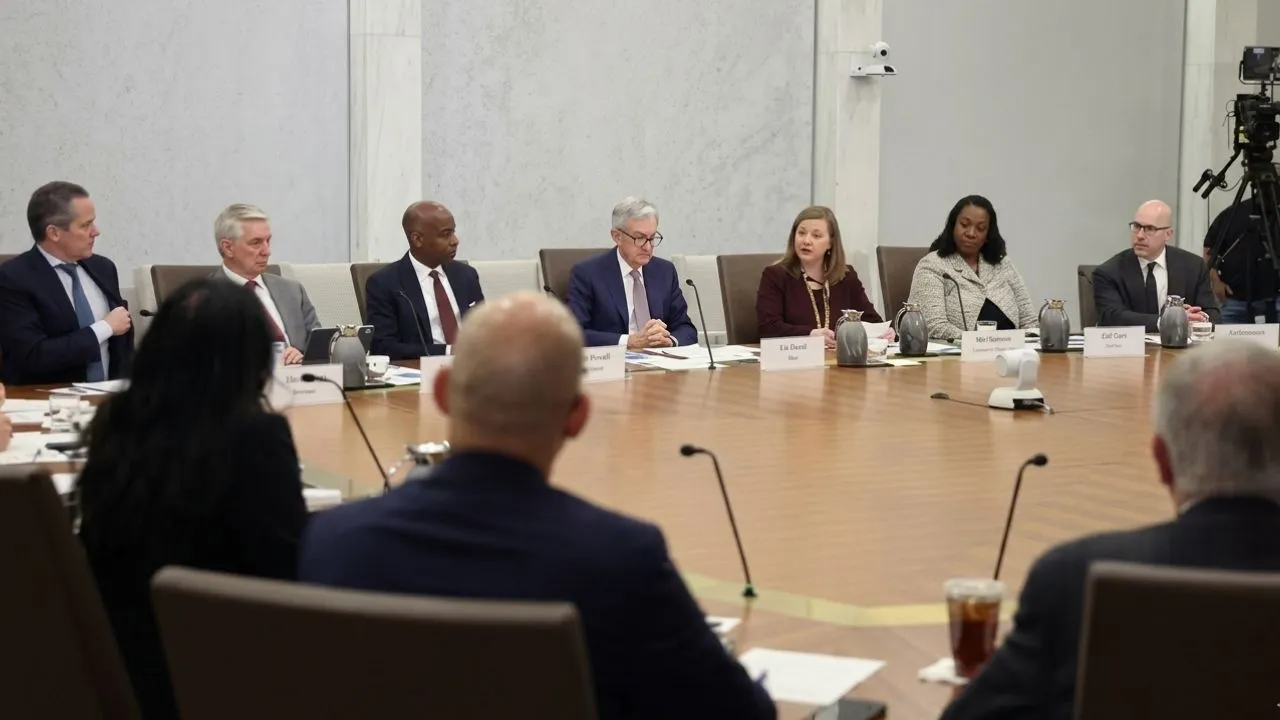
The federal funds rate is not one fixed number set by law. It’s a target range the Federal Open Market Committee chooses, and the effective rate is where banks actually land when trading reserves overnight.
The New York Fed nudges the market toward that target using open market operations, buying and selling Treasury securities so cash sloshes toward the FOMC’s chosen number. This mechanism connects directly to the broader money movement system that carries funds between banks, the Treasury, and ordinary deposit accounts every business day.
The 1950s and 1960s origins
Formal rate targeting became a serious tool starting in the mid-1950s, as the Fed moved away from simply pegging Treasury yields, a leftover wartime policy.
Through the late 1950s and 1960s, rates generally moved in the low single digits, rising gradually as the economy expanded and the Vietnam War pushed up federal spending and inflation pressure. This period established the basic playbook still used today: raise rates to cool an overheating economy, cut them to support a weak one.
The Great Inflation era
The 1970s brought oil shocks, wage-price spirals, and a Fed that repeatedly under-reacted to inflation, letting price growth become entrenched. Rates rose and fell in a jagged pattern through the decade without ever truly breaking the inflation cycle.
This era became the cautionary tale that still shapes Fed thinking about acting early rather than waiting for proof that inflation has already taken hold.
The Volcker shock years
Everything changed in 1979, when the Fed shifted its operating framework to directly target the money supply and let interest rates react freely. The federal funds rate spiked to nearly 20% by 1981, triggering back-to-back recessions but ultimately crushing double-digit inflation.
This period remains the most aggressive tightening cycle in modern history and the reference point every Fed chair since has been measured against.
The Great Moderation period
From the mid-1980s through the mid-2000s, rates moved in a calmer, more predictable cycle. Alan Greenspan’s Fed cut rates through recessions in 1990–91 and 2001, then raised them gradually during expansions.
Inflation stayed low and stable for most of this stretch, a period economists now call the Great Moderation, though it ended with the housing bubble that triggered the 2008 financial crisis.
The zero rate decade
After the 2008 crash, the Fed cut its target range to 0%–0.25% and held it there for seven years, the longest period near zero in the institution’s history. To provide extra support, the Fed also launched large-scale asset purchases, commonly called quantitative easing, buying trillions in Treasury and mortgage bonds.
Rates began a slow, cautious climb in December 2015 and continued rising through 2018 before the Fed reversed course again in 2019 amid slowing global growth.
The pandemic and 2022 hikes
Rates fell back to near zero in March 2020 as the pandemic hit, then the Fed launched the fastest tightening cycle in four decades starting in March 2022. The target range climbed from near zero to a range of 5.25%–5.50% by mid-2023, a level that stood as the cycle’s peak, aimed at breaking the inflation surge that followed pandemic-era stimulus and supply shocks.
Rates through 2025 and 2026
The Fed began cutting rates in the final months of 2025, trimming the target three separate times as inflation cooled and labor market risks grew. The current federal funds rate target range sits at 3.50%–3.75%, with an effective rate near 3.63%, and the FOMC has held that range steady at every meeting so far in 2026.
For readers who want to see this history applied to a specific, fully-documented decision, our rate decision explained guide breaks down one complete FOMC meeting from vote to consumer impact, offering a concrete case study alongside this broader historical timeline.
This pause follows the three consecutive cuts made in late 2025. The June 2026 meeting was notable as the first FOMC meeting under new Fed Chair Kevin Warsh, with the committee voting unanimously to hold rates steady while noting that inflation remains above the Fed’s 2% target.
Because this number changes with every FOMC meeting, treat the figures above as a snapshot rather than a permanent fact, and check the Fed’s own data release for the latest confirmed number before making financial decisions.
How the rate reaches your wallet
The federal funds rate doesn’t directly touch consumer accounts, but it sets off a chain reaction. Banks adjust the prime rate in near lockstep, which flows into credit card APRs, home equity lines, and adjustable-rate loans within one or two billing cycles.
Savings account and CD yields tend to follow more slowly, since banks are less eager to raise what they pay depositors than what they charge borrowers.
Mortgage rates respond to longer-term Treasury yields rather than the fed funds rate directly, though the two tend to move in the same general direction over time. For a full walk-through of that mechanism, see how treasury yields connect fed policy to mortgage and savings pricing.
Why the Fed changes course
Every rate decision balances two competing mandates written into law: stable prices and maximum sustainable employment. When inflation runs hot, the Fed raises rates to slow borrowing and spending.
When unemployment rises or growth stalls, it cuts rates to encourage borrowing and investment. The dot plot, a chart of each policymaker’s individual rate forecast, gives the public a rough sense of where the committee expects to land, though it is a projection rather than a promise.
What history says about future cycles?
Every tightening cycle in this history eventually ended in cuts, and every cutting cycle eventually reversed into hikes once growth or inflation reaccelerated.
Rates cycles have historically lasted anywhere from one to seven years, with the pace of change tied directly to how fast inflation or unemployment is moving relative to the Fed’s targets. No historical pattern guarantees future timing, and Investozora does not forecast specific future rate decisions in this article.
Does the Fed set my rate?
No. The Federal Reserve does not directly set the interest rate on your specific credit card, mortgage, auto loan, or personal loan. Instead, the FOMC sets a target range for the federal funds rate, which is the rate banks charge one another for overnight loans.
That rate influences broader borrowing costs throughout the economy. Banks use it, along with their own funding costs, market conditions, competition, and your credit profile, when setting consumer interest rates.
Credit cards often move more quickly with changes in the prime rate, while mortgage rates are influenced more heavily by longer-term bond yields and market expectations about the economy and future Fed policy.
How often does the FOMC meet?
The Federal Open Market Committee, or FOMC, holds eight regularly scheduled meetings each year, generally spaced about six to eight weeks apart. At each meeting, policymakers review inflation, employment, economic growth, financial conditions, and other data before deciding whether to raise, lower, or maintain the federal funds target range.
The FOMC does not have to change rates at every meeting. In fact, holding rates steady is a common outcome when policymakers believe current policy is appropriate. The committee can also hold an unscheduled emergency meeting when extraordinary economic or financial conditions require a rapid response, as it did during the 2020 pandemic crisis.
What was the highest Fed rate?
The federal funds rate reached nearly 20% in the early 1980s, during the Federal Reserve’s aggressive campaign to bring down extremely high inflation. Under Chair Paul Volcker, the Fed pushed interest rates to historically high levels, creating significant pressure on borrowing, housing, business investment, and economic growth.
The strategy was painful in the short term and contributed to severe recessions, but it ultimately helped break the inflationary cycle that had affected the U.S. economy throughout much of the 1970s. The early-1980s peak remains the highest sustained level of the federal funds rate in the modern era.
What was the lowest Fed rate?
The Federal Reserve has lowered the federal funds target range to 0%–0.25% during two major crises in recent history. The first occurred during the 2008 financial crisis, when the Fed cut rates to essentially zero to support the financial system and economy. The Fed returned to the same range in March 2020 as the COVID-19 pandemic caused a sudden economic shock.
With conventional rate cuts largely exhausted, the central bank also relied on other tools, including large-scale asset purchases and emergency lending programs. The 0%–0.25% range is generally considered the effective lower bound for conventional U.S. interest-rate policy.
Why does the Fed care about jobs?
Congress has given the Federal Reserve a dual mandate: promote maximum employment and maintain stable prices. This means the Fed must consider both the health of the labor market and the pace of inflation when setting monetary policy.
The two goals can sometimes conflict. Raising interest rates may help slow inflation but can also weaken hiring and economic growth. Cutting rates may support employment and economic activity but can add pressure to prices if demand becomes too strong.
Because of this tradeoff, FOMC decisions often require policymakers to balance competing risks rather than simply respond to a single economic indicator.
Is the current Fed rate high?
The answer depends heavily on the historical period being used for comparison. Compared with the exceptionally low interest rates that dominated much of the 2010s and the early years of the pandemic, the current federal funds rate is relatively high.
However, the same rate level would look moderate compared with the extremely high rates of the early 1980s or even the higher-rate environment of parts of the 1990s. Interest rates also cannot be judged in isolation.
Inflation, economic growth, unemployment, government borrowing, and financial conditions all change over time, so the economic impact of a particular rate level can vary significantly from one era to another.
Methodology: Historical rate figures in this timeline are drawn from Federal Reserve Board data and the FRED database maintained by the Federal Reserve Bank of St. Louis. Current-period figures reflect the most recently confirmed FOMC decision as of this article’s last review date.
All rate data referenced above traces to official Federal Reserve publications and FOMC statements. Where data reflects market expectations rather than confirmed policy, this article labels it explicitly as a forecast, not a decision.