



Updated: June 27, 2026 – The U.S. Treasury auctions its debt securities on a publicly announced schedule throughout the year. These auctions are how the federal government borrows money from investors to fund the difference between what it spends and what it collects in taxes.
Every investor, from global central banks to individual Americans buying through TreasuryDirect, participates in the same auction mechanism on equal terms. Understanding the Treasury auction schedule gives you a precise, predictable window into when new government debt enters the market and what it costs.
The Treasury auction schedule is not random. The Bureau of the Fiscal Service within the Department of the Treasury announces upcoming auctions each week through a public schedule and a formal press release.
Auction announcements specify the security type, the offering amount, the auction date, the issue date, the maturity date, and the CUSIP identifier.
Investors then submit bids through the Treasury’s TreasuryDirect platform, through a bank or broker, or as a primary dealer on the Federal Reserve’s official dealer list. The Treasury auction process guide explains the complete bidding mechanics from announcement through award.
Understanding the Treasury auction schedule matters beyond just purchasing decisions. Treasury auction results drive the benchmark yields that price mortgages, corporate bonds, credit cards, and savings accounts across the entire economy.
When a 10-year Treasury auction draws weak demand and yields rise, mortgage rates respond within days. When a 4-week bill auction clears at a higher yield than the prior week, money market fund yields move with it.
The Treasury yield curve article maps how the full spectrum of auction results shapes the interest rate environment that affects every household and business in the country.
Treasury Bill Auction Schedule
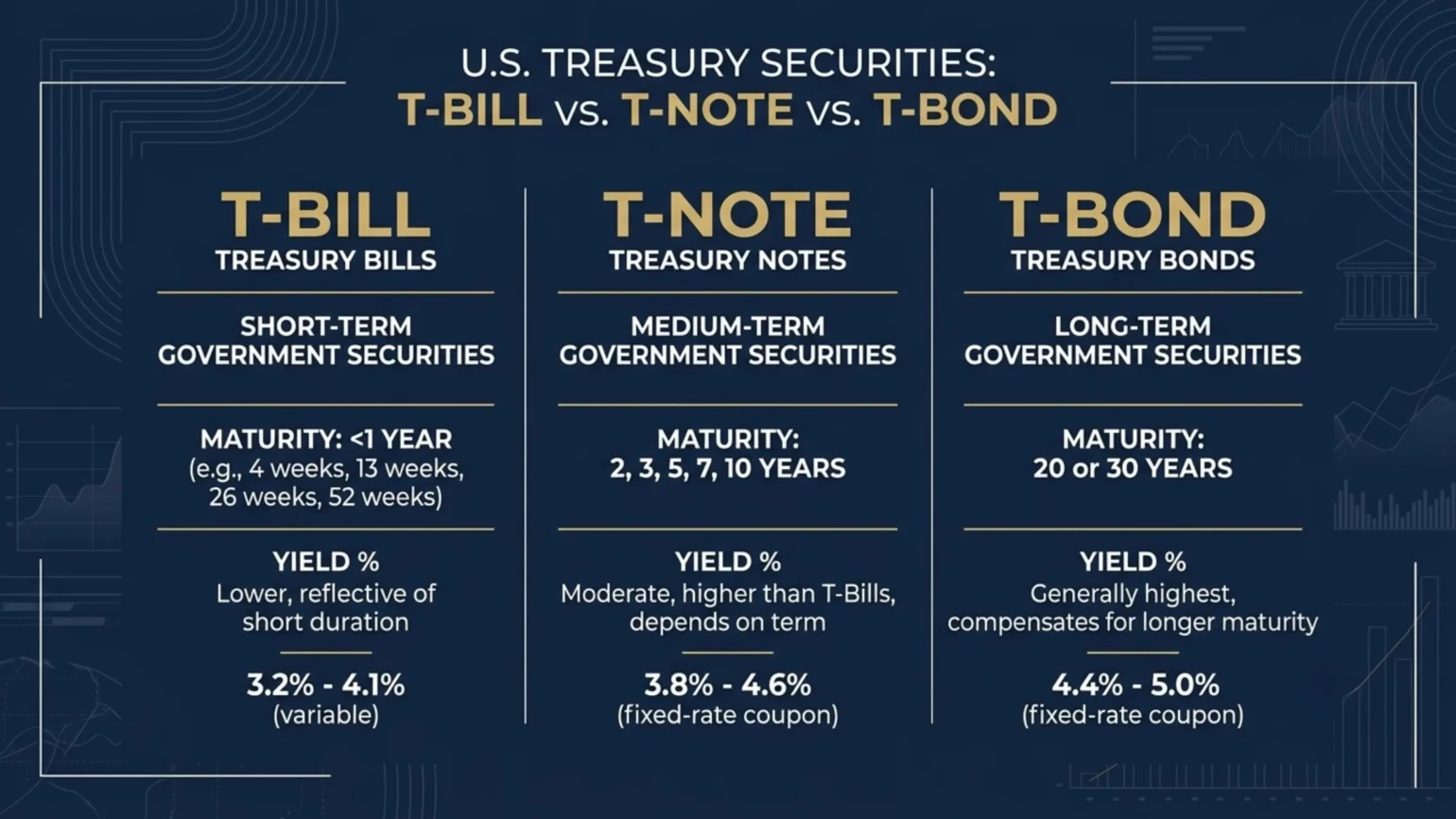
Treasury bills are short-term government securities with maturities of one year or less. The Treasury auctions bills on a regular weekly and monthly cycle that has remained consistent for decades, giving investors a predictable reinvestment schedule.
The 4-week and 8-week bills are auctioned every Tuesday. Announcements are typically released the previous Thursday. These ultra-short bills settle two business days after the auction date, meaning a Tuesday auction settles on Thursday of the same week. The 13-week (3-month) and 26-week (6-month) bills are auctioned every Monday.
The 52-week (1-year) bill is auctioned every four weeks, typically on a Tuesday. The CMB (cash management bill) is issued irregularly as needed by the Treasury to manage near-term cash flow needs, with maturities as short as a few days.
Bills do not pay interest in the traditional coupon sense. They are issued at a discount to their face value, and investors receive the full face value at maturity.
The difference between the purchase price and the face value constitutes the investment return. For example, a 52-week bill purchased at $980 per $1,000 face value returns $1,000 at maturity, providing a $20 return on a $980 investment over one year.
The Treasury auction schedule publishes the discount rate and the equivalent yield on an investment basis after each auction closes. The Treasury bill maturity yield guide covers yield calculation, reinvestment mechanics, and how to compare bill yields to bank savings rates.
For investors managing short-term cash through the 2026 rate environment, 4-week and 13-week bills provide maximum liquidity with no credit risk. These instruments settle into TreasuryDirect accounts automatically and can be rolled at each auction with a standing reinvestment instruction.
The how to buy Treasury bills guide walks through the TreasuryDirect account setup, the noncompetitive bid process, and the automatic reinvestment option for bill ladder strategies.
Treasury Note Auction Schedule
Treasury notes are medium-term government securities with maturities of 2, 3, 5, 7, and 10 years. Unlike bills, notes pay a fixed coupon interest rate every six months throughout the life of the security in addition to returning face value at maturity. The coupon rate is set at the auction and reflects the market yield at the time of issuance.
The auction schedule for notes follows a monthly pattern. The 2-year note is auctioned near the end of each month, with the announcement typically released in the third week of the month. The 3-year note is auctioned in the second week of each month. The 5-year note is auctioned alongside the 2-year note near the end of the month.
The 7-year note is auctioned one week after the 2-year and 5-year notes, completing the monthly end-of-month auction cycle. The 10-year note has a more complex schedule: it is auctioned as a new issue in February, May, August, and November, and reopened in the other eight months of the year.
A reopening is not a new security. When the Treasury reopens an existing note, it issues additional amounts of a note that was originally auctioned in a prior month, with the same CUSIP, the same coupon rate, and the same maturity date.
Investors bid on the reopened note at current market yields, which means the price they pay may be above or below par depending on whether market yields have risen or fallen since the original issuance. Reopenings are standard practice and allow the Treasury to build larger outstanding issue sizes for each security, which improves liquidity in the secondary market.
The 10-year Treasury yield explainer covers why the 10-year note’s auction results are the single most watched data point in global fixed income markets. For 2026 specifically, 10-year note auctions have been closely monitored given the fiscal backdrop of elevated debt levels and the question of whether Congress’s budget trajectory under the One Big Beautiful Budget Act signed in mid-2026 would require the Treasury to expand its issuance calendar.
Larger auction sizes can push yields higher by requiring the market to absorb greater supply, which tightens financial conditions independently of any Federal Reserve action. The debt ceiling 41 trillion strategy article covers the Treasury’s issuance planning under elevated debt constraint conditions.
Treasury Bond Auction Schedule
Treasury bonds are long-term securities with maturities of 20 and 30 years. They are the longest instruments in the Treasury’s issuance calendar and carry the highest duration risk, meaning their prices fluctuate more dramatically with changes in interest rates than bills or notes.
The 20-year bond is auctioned as a new issue in February and August, with reopenings in the other months on a cycle that mirrors the 10-year note structure. The 30-year bond is auctioned as a new issue in February, May, August, and November, with reopenings in the eight remaining months. Both the 20-year and 30-year bonds pay semiannual coupon interest and return face value at maturity.
Long-dated Treasury bonds are primarily purchased by pension funds, insurance companies, and foreign central banks that have long-duration liability structures requiring matching long-duration assets.
Individual investors occasionally hold 30-year bonds in retirement accounts for their higher coupon yields, though the price volatility over a 30-year holding period is substantial if the investor needs to sell before maturity.
The bond market yield shifts 2026 article documents how long-end Treasury yields have moved in response to fiscal policy developments and Federal Reserve balance sheet normalization during the current year.
The Treasury’s 20-year bond was reintroduced in May 2020 after a 34-year hiatus, adding a new maturity point to the yield curve and providing the Treasury with an additional financing tool between the 10-year note and the 30-year bond.
In 2026, the 20-year bond has become increasingly important as the Treasury manages its financing needs across a wide maturity spectrum to avoid concentrating too much refinancing risk in short-term bills. The Treasury bill note bond guide provides a side-by-side comparison of all three security categories across duration, yield characteristics, and investor suitability.
How the Bidding Process Works
Every Treasury auction uses the same competitive auction format, with a special provision for noncompetitive bids that gives individual investors a guaranteed allocation at the market-clearing yield. Understanding both bid types is essential before participating.
A noncompetitive bid is a commitment to purchase up to $10 million of a specific security at whatever yield the auction clears. The investor specifies the dollar amount they want to purchase but does not specify a yield.
After the auction closes, the Treasury determines the stop-out yield, which is the highest yield accepted in the competitive bidding, and all noncompetitive bidders receive that same yield automatically. This guarantees a full allocation and eliminates the risk of being shut out. TreasuryDirect is the primary platform for noncompetitive bids by individual investors.
A competitive bid requires the investor to specify both the dollar amount and the yield they are willing to accept. If the investor’s bid yield is at or below the stop-out yield, the bid is accepted at the stop-out yield, not the investor’s bid yield.
This is a uniform-price auction, sometimes called a Dutch auction, which means all successful bidders pay the same price regardless of where they individually bid.
If the investor’s bid yield is above the stop-out yield, the bid is rejected entirely. Competitive bids are submitted primarily by primary dealers, large banks, and institutional investors through a system connected directly to the Federal Reserve.
The detailed mechanics of how primary dealers interact with the Federal Reserve to support Treasury auctions is covered in the federal payments and settlement guide.
Results for each auction are published on the Treasury’s website within minutes of the close. The results include the stop-out yield, the bid-to-cover ratio (which measures total bids submitted relative to the amount offered and serves as a demand indicator), the allocation percentages for competitive versus noncompetitive bids, and the allotment to primary dealers.
A high bid-to-cover ratio signals strong demand and is generally associated with a lower clearing yield relative to market expectations. A low ratio suggests weak demand and can push yields higher. Markets watch these ratios closely because they indicate foreign investor appetite for U.S. debt, particularly at the longer end of the curve.
Settlement Mechanics and Timing
Understanding when your Treasury purchase actually settles is important for managing cash flow and account timing. Settlement is the moment when the Treasury delivers the security to your account and debits your account for the purchase price.
Treasury bills settle on T plus 2, meaning two Federal Reserve business days after the auction date. If you win a bill auction on Tuesday, the settlement and debit from your TreasuryDirect account occurs on Thursday.
Treasury notes and bonds also settle on T plus 2 for most auctions, with some new issue notes settling on the 15th of the month or the last day of the month depending on the coupon structure.
Reopened securities generally settle on the 15th or last day of the month corresponding to the original issue’s coupon payment dates to maintain consistent semiannual payment timing across outstanding issues.
The daily Treasury statement explained article covers how the Treasury tracks its cash position relative to planned settlements and how the daily statement reflects incoming auction proceeds.
Auction proceeds from large note and bond sales can temporarily boost the Treasury General Account balance held at the Federal Reserve Bank of New York, which in turn affects reserve conditions in the banking system and has feedback effects on overnight borrowing rates that the Fed monitors closely.
TIPS, or Treasury Inflation-Protected Securities, follow the same basic auction structure as nominal Treasury notes but with a different auction calendar. TIPS are issued at 5-year, 10-year, and 30-year maturities.
The principal value of TIPS adjusts with the Consumer Price Index, so the coupon payments also adjust upward with inflation. For investors concerned about purchasing power erosion in a sustained inflation environment, TIPS auctions provide access to inflation-linked government debt without credit risk.
The TIPS Treasury securities guide covers the indexation mechanics, auction calendar, and how real yields on TIPS compare to nominal Treasury yields as an inflation expectation indicator.
When does the Treasury announce upcoming auctions?
The Bureau of the Fiscal Service releases a weekly financing schedule each Thursday afternoon after 3:00 PM Eastern that announces auctions for the following week. For bills, the announcement typically covers Monday through Thursday auctions for the week ahead. For notes and bonds, announcements are released according to the monthly cycle described above. All announcements are publicly posted at the TreasuryDirect website and the Bureau of the Fiscal Service’s website under the Debt Management section. The official source for current auction announcements is the Bureau of the Fiscal Service auction announcements page.
What is the minimum purchase amount for Treasury securities?
The minimum purchase through TreasuryDirect is $100 for bills, notes, bonds, and TIPS. Purchases must be made in $100 increments above the minimum. There is no minimum holding period, though selling before maturity requires using the secondary market through a broker rather than TreasuryDirect directly, as TreasuryDirect does not support secondary market sales. Investors who want to sell before maturity must first transfer the security to a brokerage account.
Do Treasury auction results affect savings account rates?
Not directly. Savings account rates are set by commercial banks based on their competitive positioning, funding needs, and the federal funds rate environment. However, Treasury bill yields create a competitive alternative for cash deposits. When 4-week Treasury bill yields are meaningfully higher than high-yield savings account rates, rational depositors shift cash to T-bills. Banks that lose deposit funding must then raise rates to compete. This market mechanism creates indirect pressure for savings rates to track short-term Treasury yields, though with a lag and significant variation across institution types.
What is the bid-to-cover ratio and why does it matter?
The bid-to-cover ratio is total competitive bids received divided by the amount the Treasury offered. A ratio of 2.5 means investors submitted bids for 2.5 times the available supply. Historical averages vary by security: 10-year note auctions typically see ratios between 2.3 and 2.8. A ratio well below the historical average for that security is interpreted as weak demand, which can push yields higher as the Treasury must accept bids at a higher yield to clear the auction. The Treasury general account balance article explains how auction demand levels connect to Treasury cash management decisions.
Edge Cases and Escalation
Several circumstances can disrupt the normal Treasury auction schedule. When a Federal Reserve holiday falls on an auction date, the auction is moved to the next business day, and settlement dates shift accordingly. The Treasury publishes an adjusted calendar for holiday weeks in advance through the Bureau of the Fiscal Service’s website.
In periods of debt ceiling constraint, the Treasury may reduce auction sizes or defer certain auctions to preserve cash under the borrowing limit. This occurred most recently during the 2023 debt ceiling standoff when the Treasury deployed extraordinary measures to avoid breaching the statutory ceiling. The Treasury extraordinary measures article covers the tools available to the Treasury and how their use affects the auction calendar and market liquidity.
If your TreasuryDirect purchase did not settle on the expected date, contact TreasuryDirect directly at 1-844-284-2676. Settlement failures are rare but can occur if your linked bank account had insufficient funds on the settlement date.
If your bank account is debited but the security does not appear in your TreasuryDirect account within two Federal Reserve business days of the settlement date, the official process for resolving settlement discrepancies is documented at the TreasuryDirect help and guidance page.
How the Treasury’s payment system interfaces with the broader federal money movement infrastructure connects directly to the U.S. money movement system, which traces the complete path of Treasury auction proceeds from investor accounts through the Federal Reserve into the Treasury General Account.
What You Should Do Now
- Bookmark the Bureau of the Fiscal Service’s debt management calendar and check it each Thursday after 3:00 PM Eastern to see the following week’s auction announcements for bills, notes, and bonds.
- Open a TreasuryDirect account if you do not already have one. The account setup requires your Social Security number, bank routing and account numbers, and an email address. The process typically takes less than 20 minutes.
- Identify the maturity length that fits your timeline. For cash management within six months, 4-week or 13-week bills provide maximum flexibility. For medium-term fixed income, 2-year or 5-year notes lock in current yields without taking on duration risk. For inflation hedging, TIPS at 5-year or 10-year maturities provide principal protection against CPI increases.
- Check the Treasury auction schedule for the current week to identify upcoming bill auctions. Most individual investors benefit from starting with a noncompetitive bid on a 4-week or 13-week bill to understand the mechanics before committing to longer maturities.
- Monitor the bid-to-cover ratio for 10-year note auctions specifically. That ratio is the most reliable indicator of foreign and institutional demand for U.S. government debt and carries significant implications for mortgage rates, the Treasury yield curve 2026 environment, and the overall cost of government borrowing.
- Track how the Treasury auction schedule interacts with Federal Reserve balance sheet policy. When the Fed is reducing its Treasury holdings through quantitative tightening, private investors must absorb a larger share of each auction. Higher supply absorption requirements tend to push auction clearing yields higher, which affects savings yields, mortgage rates, and the broader rate environment directly connected to the federal reserve interest rate environment.










One thought on “Treasury Auction Schedule 2026: A Complete Guide to Bills, Notes, and Bonds @import url("https://fonts.googleapis.com/css2?family=Poppins:wght@400;500;600&family=Source+Sans+3:wght@400;500;600;700&display=swap"); /* ========================================= NORMAL BYLINE ========================================= */ .izo-clean-byline { display: flex; align-items: center; justify-content: space-between; width: 100%; max-width: 620px; gap: 16px; margin-top: 4px; margin-bottom: 16px; font-family: "Poppins", Arial, sans-serif; } .izo-clean-byline-content { display: flex; flex-direction: column; justify-content: center; align-items: flex-start; min-width: 0; gap: 4px; line-height: 1.12; transform: translateY(-4px); font-family: "Poppins", Arial, sans-serif; } .izo-clean-author-wrap { position: relative; display: inline-block; width: fit-content; line-height: 1.12; margin: 0; padding: 0; outline: none; } .izo-by-label { font-family: "Poppins", Arial, sans-serif; font-size: 14px; font-weight: 400; color: #111; line-height: 1.12; margin-right: 3px; } .izo-clean-author-name { position: relative; display: inline-block; font-family: "Poppins", Arial, sans-serif; font-size: 14px; font-weight: 600; color: #111; cursor: pointer; line-height: 1.12; padding: 0; margin: 0; text-decoration-line: underline; text-decoration-color: #111; text-decoration-thickness: 1px; text-underline-offset: 1px; } .izo-clean-author-name::after { display: none; } .izo-clean-meta { font-family: "Poppins", Arial, sans-serif; font-size: 11px; font-weight: 400; color: #555; line-height: 1.12; margin: 0; padding: 0; } /* ========================================= RIGHT ACTIONS GOOGLE + SHARE ========================================= */ .izo-byline-actions { display: flex; align-items: center; justify-content: flex-end; gap: 7px; flex: 0 0 auto; position: relative; top: 6px; } /* ========================================= GOOGLE SOURCE BADGE ========================================= */ .izo-google-source-badge { display: inline-flex; align-items: center; justify-content: center; width: 34px; height: 34px; min-width: 34px; flex: 0 0 34px; padding: 6px; margin: 0; box-sizing: border-box; background: #ffffff !important; border: 1px solid rgba(85,85,85,0.30) !important; border-radius: 6px; box-shadow: none !important; text-decoration: none !important; overflow: hidden; transition: border-color 0.18s ease, background-color 0.18s ease; } .izo-google-source-badge img { display: block; width: 100%; height: 100%; max-width: 100%; object-fit: contain; object-position: center; margin: 0; padding: 0; border: 0 !important; border-radius: 0 !important; background: transparent !important; box-shadow: none !important; } .izo-google-source-badge:hover { background: #ffffff !important; border-color: rgba(85,85,85,0.45) !important; box-shadow: none !important; transform: none !important; } .izo-google-source-badge:focus { background: #ffffff !important; outline: 1px solid rgba(85,85,85,0.45); outline-offset: 2px; box-shadow: none !important; } /* ========================================= SHARE BUTTON ========================================= */ .izo-share-button { display: inline-flex; align-items: center; justify-content: center; width: 34px; height: 34px; min-width: 34px; flex: 0 0 34px; padding: 7px; margin: 0; box-sizing: border-box; background: #ffffff !important; border: 1px solid rgba(85,85,85,0.30) !important; border-radius: 6px; box-shadow: none !important; color: #333333 !important; cursor: pointer; text-decoration: none !important; overflow: hidden; appearance: none; -webkit-appearance: none; transition: border-color 0.18s ease, color 0.18s ease, background-color 0.18s ease; } .izo-share-button svg { display: block; width: 18px; height: 18px; fill: none; stroke: currentColor; stroke-width: 1.8; stroke-linecap: round; stroke-linejoin: round; margin: 0; padding: 0; } .izo-share-button:hover { background: #ffffff !important; border-color: rgba(85,85,85,0.45) !important; color: #111111 !important; box-shadow: none !important; transform: none !important; } .izo-share-button:focus { background: #ffffff !important; outline: 1px solid rgba(85,85,85,0.45); outline-offset: 2px; box-shadow: none !important; } /* ========================================= AUTHOR DETAILS CARD ========================================= */ .izo-clean-author-tooltip { position: absolute; top: calc(100% + 10px); left: 0; width: 440px; max-width: calc(100vw - 40px); background: #fff; color: #333; border: 1px solid #e5e5e5; border-radius: 8px; padding: 16px; font-family: "Source Sans 3", Arial, sans-serif; font-size: 13px; font-weight: 400 !important; line-height: 1.55; box-shadow: 0 8px 24px rgba(0,0,0,0.10); opacity: 0; visibility: hidden; transform: translateY(5px); transition: opacity 0.2s ease, transform 0.2s ease, visibility 0.2s ease; z-index: 9999; pointer-events: none; } /* ========================================= IMAGE + BIO ========================================= */ .izo-tooltip-main { display: flex; align-items: flex-start; gap: 14px; width: 100%; } .izo-tooltip-image { width: 96px; height: 96px; flex: 0 0 96px; object-fit: cover; object-position: center; display: block; border-radius: 6px; margin: 0; padding: 0; } .izo-tooltip-bio { flex: 1 1 auto; min-width: 0; font-family: "Source Sans 3", Arial, sans-serif; font-size: 13px; font-weight: 400; line-height: 1.55; color: #333; margin: 0; padding: 0; } .izo-clean-author-tooltip strong { font-family: "Source Sans 3", Arial, sans-serif; font-weight: 400 !important; } /* ========================================= DESKTOP HOVER ========================================= */ .izo-clean-author-wrap:hover .izo-clean-author-tooltip { opacity: 1; visibility: visible; transform: translateY(0); pointer-events: auto; } /* ========================================= KEYBOARD / MOBILE TAP ========================================= */ .izo-clean-author-wrap:focus .izo-clean-author-tooltip, .izo-clean-author-wrap:focus-within .izo-clean-author-tooltip { opacity: 1; visibility: visible; transform: translateY(0); pointer-events: auto; } /* ========================================= POPUP FOOTER SOCIALS | READ PROFILE ========================================= */ .izo-tooltip-footer { display: flex; align-items: center; gap: 14px; margin-top: 16px; width: 100%; } .izo-tooltip-socials { display: flex; align-items: center; gap: 14px; margin: 0; padding: 0; } .izo-tooltip-socials a { display: inline-flex; align-items: center; justify-content: center; width: 24px; height: 24px; color: #222; text-decoration: none; border: none; transition: opacity 0.2s ease, transform 0.2s ease; } .izo-tooltip-socials a:hover { opacity: 0.72; transform: translateY(-1px); } .izo-tooltip-socials svg { width: 21px; height: 21px; fill: currentColor; display: block; } /* Grey separator */ .izo-tooltip-separator { display: inline-flex; align-items: center; justify-content: center; color: #b5b5b5; font-family: "Source Sans 3", Arial, sans-serif; font-size: 20px; font-weight: 400; line-height: 1; margin: 0 1px; } /* Read profile */ .izo-clean-author-tooltip .izo-profile-link { display: inline-block; font-family: "Source Sans 3", Arial, sans-serif; font-size: 13px; font-weight: 600; color: #1a73e8; text-decoration: none; border-bottom: 1px solid #1a73e8; line-height: 1.25; white-space: nowrap; } /* ========================================= MOBILE ========================================= */ @media (max-width: 650px) { .izo-clean-byline { display: flex; flex-direction: row; align-items: center; justify-content: space-between; width: 100%; max-width: 100%; gap: 7px; margin-top: 3px; margin-bottom: 14px; flex-wrap: nowrap; } .izo-clean-byline-content { display: flex; flex-direction: column; flex: 1 1 auto; min-width: 0; max-width: calc(100% - 68px); gap: 3px; line-height: 1.12; transform: translateY(-4px); } .izo-clean-author-wrap { line-height: 1.12; margin: 0; padding: 0; max-width: 100%; white-space: nowrap; } .izo-by-label { font-size: 12px; line-height: 1.12; margin-right: 3px; } .izo-clean-author-name { font-size: 12px; font-weight: 600; line-height: 1.12; padding: 0; margin: 0; text-underline-offset: 1px; white-space: nowrap; } .izo-clean-meta { font-size: 9.5px; line-height: 1.12; margin: 0; padding: 0; color: #555; white-space: nowrap; } /* ========================================= GOOGLE + SHARE MOBILE STAY ON SAME ROW ========================================= */ .izo-byline-actions { display: flex; flex-direction: row; align-items: center; justify-content: flex-end; gap: 5px; flex: 0 0 auto; white-space: nowrap; position: relative; top: 5px; } /* GOOGLE MOBILE */ .izo-google-source-badge { width: 28px; height: 28px; min-width: 28px; flex: 0 0 28px; padding: 5px; border-radius: 5px; background: #ffffff !important; border: 1px solid rgba(85,85,85,0.30) !important; box-shadow: none !important; margin: 0; } .izo-google-source-badge img { width: 100%; height: 100%; } /* SHARE MOBILE */ .izo-share-button { width: 28px; height: 28px; min-width: 28px; flex: 0 0 28px; padding: 6px; border-radius: 5px; background: #ffffff !important; border: 1px solid rgba(85,85,85,0.30) !important; box-shadow: none !important; margin: 0; } .izo-share-button svg { width: 15px; height: 15px; stroke-width: 1.8; } /* ========================================= MOBILE AUTHOR CARD ========================================= */ .izo-clean-author-tooltip { width: min(340px, calc(100vw - 32px)); max-width: calc(100vw - 32px); padding: 14px; left: 0; font-size: 12.5px; line-height: 1.5; } .izo-tooltip-main { gap: 11px; align-items: flex-start; } .izo-tooltip-image { width: 82px; height: 82px; flex: 0 0 82px; border-radius: 5px; } .izo-tooltip-bio { font-size: 12.5px; line-height: 1.5; } /* Mobile footer */ .izo-tooltip-footer { gap: 11px; margin-top: 14px; flex-wrap: nowrap; } .izo-tooltip-socials { gap: 12px; } .izo-tooltip-socials a { width: 22px; height: 22px; } .izo-tooltip-socials svg { width: 20px; height: 20px; } .izo-tooltip-separator { font-size: 18px; margin: 0; } .izo-clean-author-tooltip .izo-profile-link { font-size: 12.5px; line-height: 1.2; } }
ByAdarsha Dhakal

Adarsha Dhakal is the Founder and Editor of Investozora, an independent U.S. financial news publication he launched in August 2025. He covers IRS tax refunds, Social Security benefit payments, federal payment systems, Federal Reserve policy, and U.S. Treasury operations, explaining how government financial decisions affect the daily lives of American households. All reporting is sourced directly from official government records including IRS.gov, SSA.gov, FederalReserve.gov, and fiscal.treasury.gov.
|
Read full profile →
Published Jun 27, 2026 · 7:43 AM ET · Updated 2 months ago

”