

The Bureau of Economic Analysis has confirmed that revised Personal Consumption Expenditures price data, reflecting new methodology in three categories, will be published September 30, 2026, alongside the annual national accounts update. No revised figure has been finalized yet.
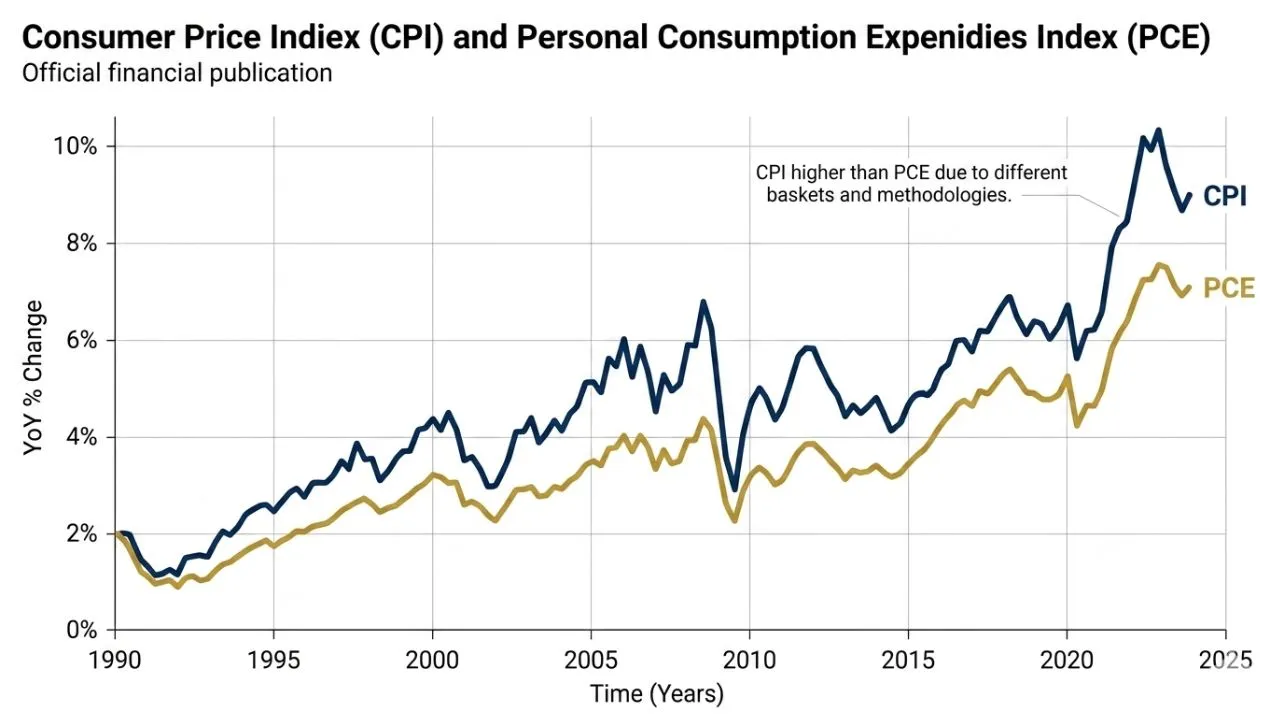
The Fed inflation math overhaul is not a rumor or a political maneuver. It is a real, already-announced change to how the government calculates one of the most important numbers in the American economy: the core Personal Consumption Expenditures price index, or core PCE, the inflation measure the Federal Reserve uses to judge whether it is meeting its 2 percent target.
Starting September 30, 2026, the Bureau of Economic Analysis will change the way it prices three specific categories of consumer spending, and multiple Wall Street banks expect the revision to shave a couple of tenths of a percentage point off recent readings.
If you have a mortgage, a savings account, or a retirement plan that depends on where the Fed thinks inflation stands, this matters to you, because Fed policy decisions are built on this exact number.
What is actually changing
The Bureau of Economic Analysis, a division of the Commerce Department, previewed the coming update in its Survey of Current Business in June 2026. The agency will improve how it calculates prices for three categories inside the PCE index: portfolio management and investment advice services, computer software and accessories, and legal services.
For portfolio management and investment advice, the current method has effectively tied price growth to stock market performance, because it uses a producer price index built around asset values. When stock portfolios rise in value, the fees advisors charge rise in dollar terms too, even if the advisor is not doing anything different.
The BEA will now measure the quantity of portfolio management services using Bureau of Labor Statistics employment data from that industry, then divide total spending by that quantity to estimate price change instead.
Because employment in the sector grows much more slowly than asset values do, this shift is expected to produce a lower measured price increase for the same underlying service.
For computer software and accessories, the agency has relied on a composite index that blends very different products together. The BEA methodology preview describes moving to a new composite built from more specific Consumer Price Index and Producer Price Index components, including separate pricing for game software and for hosting and information services.
For legal services, the current index has leaned on unpublished Bureau of Labor Statistics values that the BEA itself has described as erratic and inconsistent with other data. The fix replaces that input with a bespoke composite drawn from detailed producer price data for legal services actually consumed by households.
None of these three changes was announced in isolation. All three arrive together, in the same annual update, and all three will be applied retroactively back to 2021, meaning even historical inflation figures will be restated once the new data lands.
Why the timing raises questions
The technical case for each change is genuinely defensible. Federal Reserve research itself flagged distortions in these categories, and outside economists across the political spectrum generally agree the current inputs were flawed.
A Fed research note found that computer software and accessories pricing had produced contribution swings described as more than nine standard deviations above historical norms in a five-month stretch, which is a genuinely unusual statistical signal that something in the input data was broken.
What has drawn scrutiny is the moment this correction arrives. It comes as the Fed has run above its inflation target for roughly five years, as new Fed leadership under Chair Kevin Warsh has pushed for a broader review of how the central bank communicates and forecasts, and as the independence of federal statistical agencies has already been a subject of public debate this year. Investozora’s Fed independence coverage has tracked those separate but related tensions in detail.
Analysts at multiple banks have also pointed out, on the record, that the three revised categories happen to be among the largest positive contributors to core inflation over the past year. Portfolio management has been the second-largest contributor and computer software the fourth-largest, according to bank research cited in coverage of the announcement.
No category that has been pulling core inflation lower is being revised in this update. That asymmetry is a fact worth noting plainly, even though it does not by itself prove the changes were chosen for that reason; the BEA’s own technical justification predates the current political moment and mirrors adjustments other national statistical agencies, including the UK’s Office for National Statistics, have made when better data sources became available.
How much the numbers could move
Bank economists have estimated the magnitude ahead of the actual release. Analysts at one major bank projected that May 2026 core PCE, originally reported at 3.4 percent year-over-year, could be revised down toward 3.2 percent once the new methodology is applied.
A separate bank’s economists put the revised figure closer to 3.3 percent after rounding. Both estimates describe a change in the range of one to two tenths of a percentage point, concentrated mostly in the portfolio management adjustment.
That may sound small, but a couple of tenths matters enormously to a central bank trying to close what officials have called the last mile back to a 2 percent target.
It changes the visible gap between where inflation sits and where the Fed says it wants it, without any actual change in the prices households paid. This is a case where the number moves, but the underlying reality of grocery bills, rent, and gas prices does not move with it.
What this means for Fed policy
This section is Investozora’s own analysis, separate from the verified facts above. A modest downward revision to core PCE does not, by itself, guarantee a rate cut at the next Federal Open Market Committee meeting; a couple of tenths is not usually decisive on its own.
But it does shift the psychological and political backdrop for the Fed’s rate decisions this fall. If the September 30 release lands closer to 3.2 percent than to 3.4 percent, officials who have been arguing for patience gain a data point that makes the current stance look slightly less restrictive than it did before, while officials still worried about inflation can point out that the underlying spending patterns households actually experienced have not changed at all, only the yardstick measuring them.
Under Chair Warsh, the Fed has already signaled openness to reviewing how it communicates forecasts and uncertainty, a process Investozora covered in its explainer on how the Fed controls interest rates.
A cleaner PCE measurement, arriving in the middle of that broader review, is likely to become part of the conversation about how much weight markets should place on any single inflation print going forward.
What you should do now
Households should treat the September 30 revision as a measurement correction, not as evidence that prices are suddenly falling. Your actual cost of living, tracked through your own bills, is the number that matters for your budget, not the abstract methodology behind a government statistic.
If you hold savings tied to Fed policy expectations, such as a high-yield account or a CD, it is worth watching the actual September 30 release rather than reacting to bank estimates published beforehand, since the final BEA figures could differ from analyst projections in either direction.
Anyone with adjustable-rate debt tied to the federal funds rate should also watch the following Federal Open Market Committee statement closely, since officials will likely address the revision directly in their public remarks, given how closely tracked the Fed’s inflation math overhaul has already become.
For the deeper mechanics of how this figure feeds into the broader U.S. payment and monetary system, see Investozora’s money movement, which connects Fed policy, Treasury liquidity, and everyday deposit timing into one reference framework.
Readers following the related Treasury currency story can also see how a separate but overlapping legal debate is unfolding in our companion piece on the Treasury dollar redesign.