
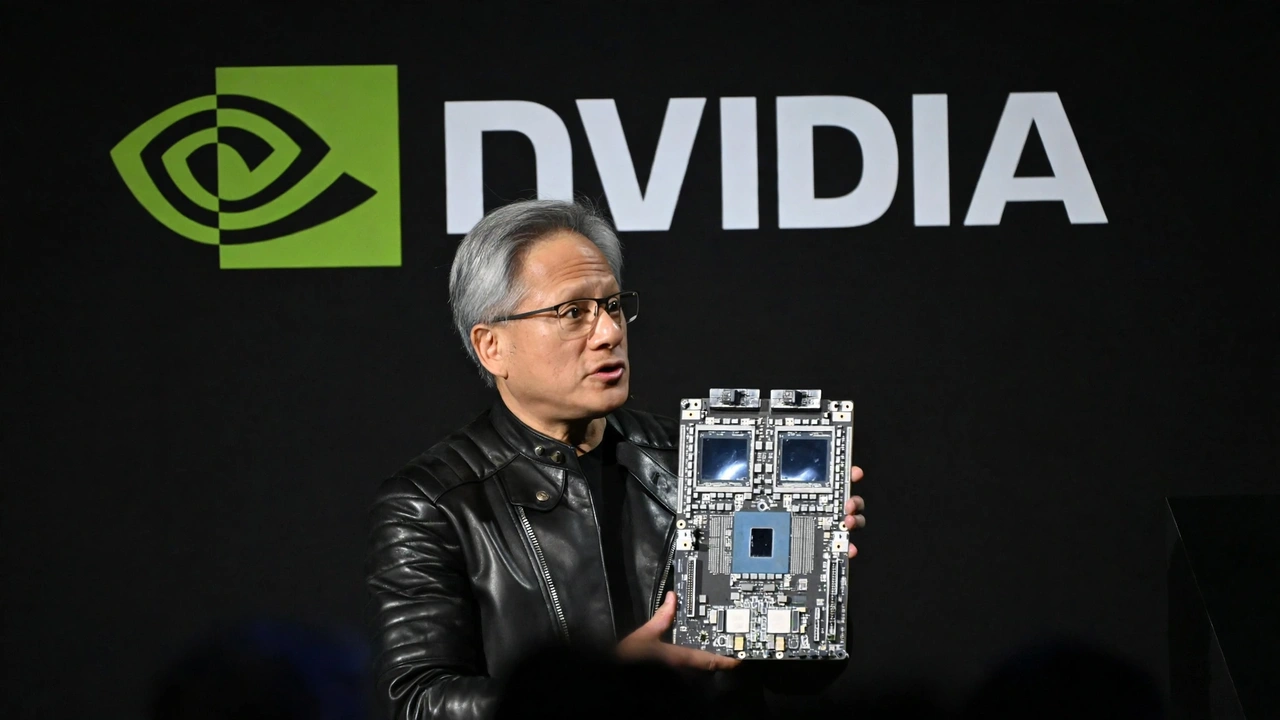
Nvidia shares fell 4.3% on Thursday, November 12, as the resignation of longtime CEO Jensen Huang intensified uncertainty surrounding the artificial intelligence chipmaker. Yet rival Advanced Micro Devices (AMD) surged 5.9%, revealing a striking divide in how Wall Street valued two companies competing in the same rapidly expanding AI market.
Nvidia closed at $166.19, down from $173.73 a day earlier, while AMD finished at $585.30, compared with $552.90 on Wednesday. My calculation puts the difference between their daily stock returns at 10.2 percentage points, suggesting investors were distinguishing Nvidia’s leadership crisis from the broader demand for artificial intelligence infrastructure rather than abandoning the entire semiconductor industry.
Why Nvidia Stock Fell
The immediate shock came from Nvidia’s leadership transition, confirmed in a regulatory filing submitted to the Securities and Exchange Commission on November 12. The filing establishes that Nvidia’s board accepted Huang’s resignation as president, chief executive officer and director on November 11, effective immediately.
The board appointed Chief Financial Officer Colette Kress as interim CEO while beginning a search for a permanent successor. Harvey C. Jones, a director since 1993, became the company’s first board chair, introducing a new leadership structure at a business that Huang had directed for more than three decades.
The departure followed an escalating controversy involving Huang’s personal relationships and reports raising national-security questions. Huang acknowledged infidelity in a November 8 message to employees, while Nvidia’s board separately announced an independent investigation following reports that he may have been targeted by a foreign intelligence effort.
Importantly, Nvidia’s board said on November 8 that it had no reason to believe national-security information or company secrets had been compromised. The investigation was not presented as a finding of espionage or wrongdoing, and the subsequent SEC filing confirmed the management changes without establishing the allegations reported in the media.
For shareholders, that distinction matters because a confirmed leadership change can create immediate uncertainty even when related allegations remain unresolved. Investors must now evaluate whether the company can maintain its execution, customer relationships and technological direction without the executive most closely associated with its rise.
The crisis also arrives after substantial volatility in technology shares, including an earlier AI stock selloff that demonstrated how quickly sentiment toward semiconductor companies can reverse. Nvidia had already been under pressure before Thursday’s announcement, making it difficult to attribute every dollar of its broader decline to the leadership controversy alone.
Nvidia Recovered From a Much Larger Drop
Nvidia opened Thursday at approximately $151.01, compared with Wednesday’s $173.73 closing price, representing an opening decline of roughly 13.1%. Its eventual closing price of $166.19 narrowed that loss to 4.34%, meaning the stock recovered approximately 8.7 percentage points relative to the previous day’s closing level.
That calculation is based on the difference between the opening and closing prices divided by Wednesday’s close, rather than on the percentage gain from Thursday’s opening price. It reveals an important part of the trading session: investors initially reacted much more negatively than the final closing figure alone suggests.
The recovery does not establish that shareholders had dismissed the underlying concerns. It instead indicates that buying interest emerged during the session, even as the company faced questions about succession, governance and the future of its leadership.
The volatility fits a broader pattern seen during the recent market selloff, when changes in expectations surrounding interest rates, technology valuations and AI spending produced unusually large market movements. Those pressures provide an alternative explanation for some of Nvidia’s recent weakness, separate from the controversy involving Huang.
Why AMD Stock Surged 5.9%
AMD’s contrasting performance is significant because the company competes with Nvidia in AI accelerators and data-center computing. Its shares advanced 5.86% on November 12, while Broadcom gained approximately 5.5%, indicating that investors were not applying the same negative judgment to every major semiconductor company.
AMD entered the session with substantial operating momentum already documented in its financial results. According to its SEC-filed earnings, the company generated $13.38 billion in third-quarter revenue, an increase of 45% from the comparable period in 2025.
Its Data Center segment produced $8.55 billion in revenue, up 97% from $4.34 billion a year earlier. These figures establish that AMD was already experiencing exceptionally strong demand for its computing products before the latest uncertainty surrounding Nvidia.
That growth provides an important foundation for interpreting Thursday’s rally, although it does not establish the precise reason investors bought AMD shares that day. The company’s recent revenue growth and earlier market rally show that its investment case was developing independently of Huang’s departure.
My reading is that AMD’s advance reflected at least two plausible considerations: its demonstrated business expansion and the possibility that some investors perceived greater competitive opportunity as Nvidia faced leadership uncertainty. The second explanation remains a market interpretation, not evidence that customers immediately transferred orders from Nvidia to AMD.
Large AI infrastructure projects involve hardware specifications, software compatibility, deployment schedules and long-term customer commitments. A leadership crisis at one supplier does not automatically establish that another supplier will receive its business, and neither company’s latest financial disclosures quantify any such transfer resulting from Huang’s resignation.
What the 10.2-Point Gap Reveals
The difference between Nvidia’s 4.34% decline and AMD’s 5.86% gain was 10.20 percentage points. I calculated that spread using the two companies’ November 12 regular-session closing returns, rather than combining after-hours quotations or comparing their dollar share prices.
That distinction is essential because AMD’s higher share price does not mean it has a larger market valuation, greater earnings power or a stronger competitive position. Percentage returns allow the two stocks’ daily performances to be compared without treating their different share prices as economically equivalent.
The broader semiconductor index declined approximately 0.5%, while the Nasdaq Composite fell 0.39% and the S&P 500 lost 0.35%. Those movements suggest Thursday was neither a straightforward sector-wide collapse nor an uncomplicated rally for AI companies.
Instead, the session showed pronounced differences between individual semiconductor stocks against a modestly weaker broader market. It fits a wider debate about Wall Street rotation, although one trading session cannot establish that a lasting shift in investment preferences has occurred.
Nvidia’s Business Remains Much Larger
One counterargument to the market’s negative reaction is that Nvidia’s underlying business remains extraordinarily substantial. Its latest available quarterly SEC filing reported $96.2 billion in revenue for the quarter ended July 26, 2026, including approximately $89.0 billion from Data Center products.
Based on those figures, Data Center accounted for roughly 93% of Nvidia’s quarterly revenue, compared with about 64% of AMD’s revenue in its quarter ended September 26. These are independently calculated revenue proportions, not estimates of AI-chip market share, and the differing reporting periods and segment definitions prevent a direct like-for-like comparison.
The figures nevertheless illustrate why the two businesses face different financial exposures. Nvidia depends heavily on a vast data-center computing business, whereas AMD’s revenue is distributed across data-center products, personal computing, gaming and embedded applications.
That exposure creates both opportunity and risk as large technology companies expand investment in artificial intelligence. Existing AI spending commitments and the wider cash-flow debate demonstrate why investors are increasingly focused on whether infrastructure expenditure can generate sustainable commercial returns.
Nvidia has also acknowledged important competitive and regulatory risks in its SEC filings. Its July-quarter report warned that export controls can disadvantage its products in restricted markets, create compliance burdens and potentially benefit competing semiconductor suppliers.
Those disclosed risks existed before Huang resigned, and they should not be confused with proof that the current controversy has produced an export-control violation. They do, however, explain why governance, national-security scrutiny and the ability to serve international customers are financially consequential questions for Nvidia.
What Happens Next for Nvidia and AMD?
The most immediate scheduled test for Nvidia comes on Tuesday, November 17, when the company is expected to announce its third-quarter fiscal 2027 results. Its SEC-filed announcement confirms that the earnings release and conference call remain scheduled despite the leadership change.
The results will give investors updated information about revenue growth, profitability, product demand and management’s expectations. They may also provide an opportunity for Kress to explain how Nvidia intends to maintain customer confidence, execute its technology roadmap and manage the transition to a permanent CEO.
A separate question concerns Nvidia’s independent investigation and any findings subsequently disclosed by the board or relevant authorities. Until those findings are available, the extent of any national-security implications remains unresolved, and allegations should not be presented as established conclusions.
For AMD, the next meaningful evidence will concern whether its rapid data-center expansion translates into sustained revenue, earnings and customer relationships. The company’s third-quarter results support a strong existing growth trend, but Thursday’s stock gain alone cannot establish that Nvidia’s difficulties have permanently altered the competitive balance.
There are also broader conditions that could weaken the interpretation that investors are simply moving from Nvidia into its rivals. Higher Treasury yields, more restrictive monetary policy, concerns about AI infrastructure profitability or disappointing sector earnings could place pressure on both companies regardless of their individual leadership situations.
The current uncertainty therefore requires more than watching two stock-price charts. It calls for comparing actual financial disclosures, new customer and product announcements, regulatory developments and the market’s response to information that emerges after Thursday’s unusually volatile session.
What Investors Should Understand
For investors holding Nvidia directly, the confirmed issue is a major leadership transition occurring alongside an unresolved investigation. For those holding diversified U.S. stock funds, Nvidia’s size means its performance can also influence broader index returns, although the actual effect depends on the fund’s holdings and portfolio weights.
AMD’s rally offers a different signal: investors still appeared willing to pay more for some companies exposed to AI computing demand. But strong operating results and a single favorable trading session do not guarantee future gains, just as Nvidia’s decline does not establish permanent damage to its underlying business.
The central finding is that Nvidia and AMD moved 10.2 percentage points apart during the same trading session, even as broader semiconductor shares weakened only modestly. Nvidia’s leadership crisis is confirmed, AMD’s existing growth is documented, and the possibility of a lasting competitive shift remains an open question that future disclosures not Thursday’s stock prices alone, will have to answer.